


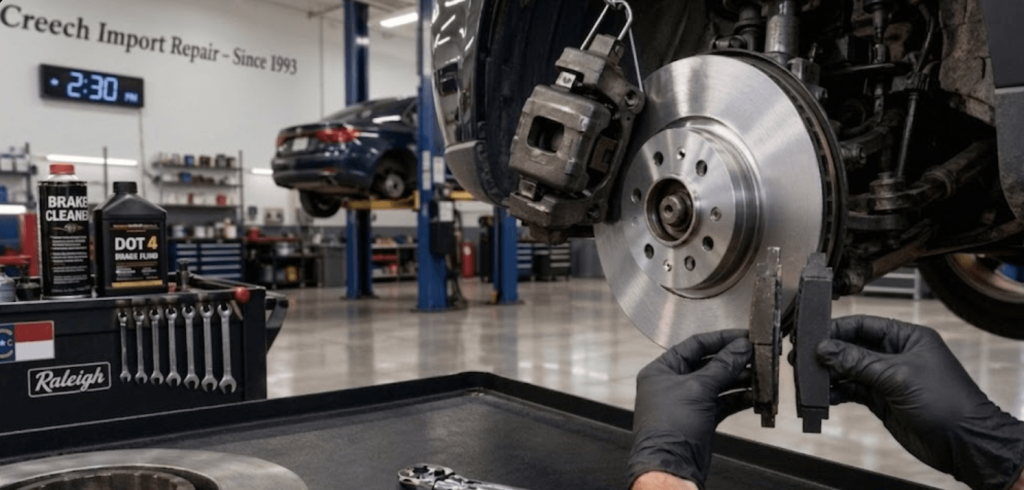
Your safety on the road starts with reliable brakes. At Creech Import Repair, we’ve been helping Raleigh drivers stop with confidence since 1993. This guide walks you through everything you need to know about brake repair—from warning signs and diagnostic steps to timing, pricing, and what to expect when you visit our shop on St. Albans Drive.
Why Brake Repair Matters for Raleigh Drivers
Brakes are your vehicle’s most critical safety system. Worn pads, warped rotors, or leaking brake fluid can increase stopping distance and put you, your passengers, and others at risk. In the Triangle area, stop‑and‑go traffic on I‑40, US‑70, and local streets means your brakes work harder than on rural roads. Regular brake service isn’t just about avoiding a costly repair—it’s about maintaining control during sudden stops, wet‑weather driving, and emergency maneuvers.
What Causes Brake Problems?
Understanding the root causes helps you recognize early symptoms and act before a minor issue becomes a safety hazard.
Common Cause | What Happens | Typical Symptoms |
Worn brake pads | Friction material wears down to < 3 mm | Squealing or grinding noise, longer pedal travel |
Warped rotors | Excessive heat or uneven wear distorts the rotor surface | Pulsation in the brake pedal or steering wheel when braking |
Sticking caliper | Caliper piston fails to retract, causing constant drag | Vehicle pulls to one side, overheated wheel, burnt smell |
Brake fluid leak | Loss of hydraulic pressure from damaged lines or seals | Soft or spongy pedal, low fluid warning light, visible fluid under car |
Contaminated fluid | Moisture or debris lowers boiling point, causing brake fade | Reduced stopping power after repeated hard stops, especially on hills |
These issues develop gradually, which is why many drivers don’t notice a change until the problem is severe. Regular inspections catch wear before it compromises safety.
How We Diagnose Brake Issues
At Creech Import, our ASE‑certified technicians follow a systematic process to pinpoint the exact problem—no guesswork, no unnecessary upsells.
- Road test – We listen for noises, feel for pedal pulsation, and check for pulling.
- Visual inspection – Wheels are removed to measure pad thickness, inspect rotor condition, and look for leaks or damaged hardware.
- Measurement – Using a micrometer, we check rotor thickness and runout against manufacturer specifications.
- Hydraulic test – We assess pedal feel and check for air or contamination in the brake lines.
- Digital scan (if applicable) – For vehicles with electronic brake‑distribution or ABS, we retrieve any stored codes to guide further testing.
Our approach aligns with industry best practices: we diagnose first, then recommend only the repairs needed to restore safe performance.creechimport
When to Schedule Brake Service
Don’t wait for a grinding noise or a warning light. Proactive maintenance saves money and keeps you safe.
Mileage / Time | Recommended Action |
Every 12,000 miles or annually | Visual brake inspection (pads, rotors, fluid) |
Every 25,000 miles | Pad replacement (depends on driving habits) |
Every 50,000 miles | Rotor inspection; resurface or replace if warped or below spec thickness |
Every 2 years | Brake fluid flush (to remove moisture and maintain boiling point) |
Immediately | Any squeal, grind, pedal pulsation, pulling, or warning light |
If you drive mostly in city traffic, tow frequently, or navigate the hilly terrain around Wake Forest and Knightdale, consider shorter intervals. Our service advisors will tailor a schedule to your vehicle and driving style during your visit.creechimport
What to Expect During Your Brake Repair Visit
When you bring your car to Creech Import, here’s the step‑by‑step experience:
- Friendly check‑in – Our service advisor greets you, confirms your concerns, and explains the inspection process.
- Comprehensive brake evaluation – Performed at no charge if you proceed with repairs (free diagnostics policy).
- Transparent estimate – We provide a detailed breakdown of parts, labor, and any additional services (e.g., fluid flush). No hidden fees.
- Repair execution – ASE‑certified technicians install OEM‑quality or equivalent parts, torque to factory specs, and bed‑in new pads for optimal performance.
- Final test drive – We verify pedal feel, stopping distance, and absence of noise before returning your keys.
- Review & warranty – We walk you through the work performed, show you old parts if desired, and remind you of our 36‑month/36,000‑mile warranty on parts and labor.yelp
Throughout, we communicate in plain language—no jargon, no pressure.
How Much Does Brake Repair Cost in Raleigh?
Pricing varies based on vehicle make, brake system type, and the extent of wear. Below are typical ranges for common services at our shop (parts + labor):
Service | Typical Price Range* |
Front brake pad replacement | $150 – $300 |
Front & rear pad replacement | $250 – $500 |
Rotor resurfacing (per axle) | $80 – $150 |
Rotor replacement (per axle) | $180 – $350 |
Caliper replacement (per side) | $200 – $450 |
Brake fluid flush | $90 – $130 |
Complete brake overhaul (pads + rotors + fluid) | $400 – $800+ |
*Prices include OEM‑grade or equivalent parts and are subject to change based on vehicle specifics. We always provide a written estimate before any work begins.
Factors that affect cost:
- Vehicle weight & performance – Heavier trucks or high‑performance models use larger, more expensive components.
- Extent of damage – If rotors are scored beyond resurfacing limits, replacement is required.
- Parts choice – We offer OEM, premium aftermarket, and budget‑friendly options; we explain the trade‑offs so you can decide.
Our goal is honest pricing that reflects the actual work needed—no surprises when you pick up your car.creechimport
Maintenance Tips to Extend Brake Life
While eventual wear is inevitable, these habits help you get the most miles out of your brakes:
- Anticipate stops – Release the accelerator early and coast to reduce reliance on the brakes.
- Avoid “riding” the brake – Keep your foot off the pedal when cruising; use engine braking on downhill stretches.
- Reduce unnecessary weight – Remove roof racks, cargo carriers, or heavy items when not needed.
- Use quality fuel – Clean combustion reduces brake‑dust buildup on wheels (aesthetic benefit).
- Schedule regular inspections – Catch thin pads or uneven wear before they damage rotors.
Pairing these habits with our routine maintenance keeps your braking system reliable and your repair costs lower over time.creechimport
Is It Safe to Drive with Brake Issues?
Driving with known brake problems increases the risk of accidents, especially in emergency situations. Here’s a quick safety checklist:
- Squeal or light grind – Often indicates worn pads; still safe for short distances but schedule service soon.
- Loud grinding – Metal‑on‑metal contact; stop driving and have the vehicle towed to avoid rotor damage.
- Pedal goes to the floor – Possible fluid leak or master‑cylinder failure; do not drive.
- Vehicle pulls when braking – Could be a sticking caliper or uneven wear; have it inspected promptly.
- ABS warning light – Indicates electronic fault; brakes may still work but have reduced anti‑lock capability.
If you’re ever in doubt, call us at (919) 872‑1999 for a quick assessment. We’d rather see you for a precautionary check than respond to an avoidable crash.creechimport
Service Area
We proudly serve drivers across Raleigh and the surrounding Triangle communities:
- Raleigh – Downtown, North Raleigh, East Raleigh, West Raleigh, South Raleigh
- Cary – Downtown, Weston, Preston, Harrison
- Apex – Historic Apex, Friendship, Olive Chapel
- Wake Forest – Downtown, Heritage, Renaissance
- Knightdale – Downtown, Hodge Road, Simmons
- Garner, Fuquay‑Varina, Holly Springs, Morrisville
Our shop is conveniently located at 1818 St. Albans Dr #106, Raleigh, NC 27609—just minutes from I‑440, US‑1, and Capital Boulevard. Mention “brake repair Raleigh NC” when you call, and we’ll get you scheduled fast.facebook
Trust & Social Proof
Our reputation is built on decades of honest work and genuine customer care. Here’s what real clients are saying:
- “Honest, reliable since 1993—best customer experience I’ve ever had at an auto shop.” – Yelp review★★★★★facebook
- “They treat customers with kindness and respect—exactly what you want when your car’s in the shop.” – Facebook comment★★★★★facebook
- “Five‑star across platforms—no surprises, fair pricing, and they really listen.” – CARFAX review★★★★★carfax
These testimonials reflect our core philosophy: customer‑oriented since 1993.creechimport
Contact Us Today
Ready to ensure your brakes are road‑ready? Take one of these simple steps today:
- Call us now at (919) 872‑1999 for a free brake inspection or to schedule service.
- Visit our website and click “Schedule Appointment” to pick a time that works for you.
- Stop by our shop at 1818 St. Albans Dr #106 for a quick courtesy check—no appointment needed for basic inspections.
Ask about our loaner car program (available with major repairs) and complimentary NC state inspection when you schedule brake service.
Your brakes are your first line of defense against accidents. At Creech Import Repair, we combine three decades of family‑owned expertise, ASE‑certified technicians, and a genuine commitment to honest, customer‑first service. Whether you’re hearing a faint squeal, planning a road trip to the coast, or simply want peace of mind on your daily commute, we’re here to help you stop safely and confidently.
Frequently Asked Questions About Brake Repair
Q: Do you service Hyundai Sonata brake systems?
A: Yes. Our ASE‑certified technicians have extensive experience with Hyundai braking systems, including pad replacement, rotor service, and fluid flushes.
Q: How much is a standard brake pad replacement at Creech Import?
A: Front axle pad replacement typically ranges from $150 to $300, depending on the vehicle model and pad type selected. We provide a written estimate before any work.
Q: Do you offer loaner cars if my brake repair takes more than a day?
A: For major brake jobs (e.g., rotor and caliper replacement), we offer complimentary loaner vehicles subject to availability. Ask your service advisor when you schedule.
Q: What NC inspection services do you provide alongside brake work?
A: We perform full North Carolina State Inspections—safety, emissions, and lights—so you can satisfy your annual requirement while you’re here.
Q: Are your diagnostics free if I decide to proceed with repairs?
A: Yes. Our brake inspection is free of charge when you authorize the recommended repairs.
Q: Do you use OEM or quality aftermarket parts?
A: We install OEM‑spec or equivalent high‑quality aftermarket parts, backed by our 36‑month/36,000‑mile warranty on parts and labor.
Q: How long does a typical brake repair take?
A: Most pad‑and‑rotor jobs are completed within 2–4 hours. Complex jobs involving calipers or hydraulic work may take longer; we’ll give you an accurate time estimate upfront.
Q: How long does a typical brake repair take?
A: Most pad‑and‑rotor jobs are completed within 2–4 hours. Complex jobs involving calipers or hydraulic work may take longer; we’ll give you an accurate time estimate upfront.
Q: Is it safe to drive with a squealing brake?
A: A light squeal often indicates worn pads but is usually safe for short distances. Schedule service soon to prevent rotor damage. Loud grinding means stop driving and call for a tow.
Q: Is it safe to drive with a squealing brake?
A: A light squeal often indicates worn pads but is usually safe for short distances. Schedule service soon to prevent rotor damage. Loud grinding means stop driving and call for a tow.
Q: How can I schedule a brake inspection?
A: Call (919) 872‑1999, use the online booking form on our website, or stop by our shop at 1818 St. Albans Dr #106.