


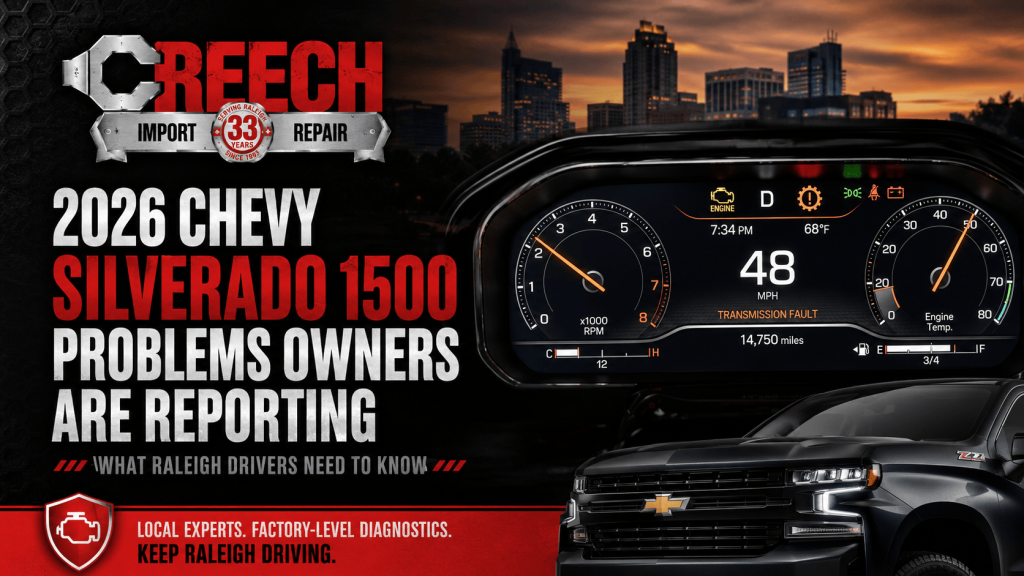
. If you own a 2026 Silverado or are considering one, understanding these common problems can save you from unexpected breakdowns and costly repairs. At Creech Import, we have been serving Raleigh GM owners since 1993, and we’re seeing these issues firsthand. This guide covers the most reported Silverado 1500 problems in 2026, what they mean for you, and how to address them before they leave you stranded on I-440.
Step 1: Transmission Glitches – The Most Common 2026 Silverado Problem
According to owner reports and industry analysis, transmission issues are the most frequent Silverado 1500 problem in 2026. Many 2026 Silverado owners face sudden transmission glitches, including uncommanded shifting, stalling, and even sudden braking behavior.
Common Transmission Symptoms in 2026 Silverado
-
Uncommanded shifting – truck shifts gears on its own
-
Stalling – engine stops while driving
-
Sudden braking – vehicle brakes unexpectedly
-
Harsh or delayed shifts – banging between gears
-
Check engine light – with transmission-related codes
What to Do
If you experience any of these Silverado 1500 problems in 2026, document everything – including the date, time, speed, and weather conditions. Treat it like a forensic record. Then call Creech Import at 919-872-1999 for a professional diagnostic scan
Step 2: "Do Not Drive" Recall – Wheel Lock-Up Risk
In June 2026, GM issued a urgent “Do Not Drive” warning for certain 2026 Chevrolet Silverado models. The issue involves a missing oil pickup tube inside the transfer case that can cause bearings to fail, leading to sudden wheel lock‑up at highway speeds.
What This Means for Raleigh Drivers
-
Affected vehicles: Some 2026 Silverado 1500 models
-
Risk: Wheels can lock while driving – extreme danger
-
Action: Check your VIN with a GM dealer immediately
-
Fix: Free repair at dealership – but independent shops like Creech Import can inspect and verify
According to NHTSA records, this recall affects a specific production batch. If your 2026 Silverado was manufactured in early 2026, you should verify your VIN immediately.
Step 3: Electronic Shifter Software Glitch
Another serious Silverado 1500 problem in 2026 involves a software vulnerability in the shift‑by‑wire system. One owner reported that at just 450 miles, the system slammed the brakes and dropped the moving truck into Park.
Symptoms
-
Unintended braking – truck brakes without driver input
-
Transmission shifts into Park or Neutral – while moving
-
Warning lights – on dashboard
Solution
GM has released software updates for this issue. However, if your truck exhibits these symptoms, have it inspected immediately. Creech Import uses factory‑level diagnostic tools to identify and address these Silverado 1500 problems in 2026.
Step 4: V8 Lifter Collapse – A Persistent GM Issue
One of America’s best‑selling trucks is suffering from a massive problem Chevy just can’t seem to cure: V8 lifter collapse. The cylinder deactivation system (Dynamic Fuel Management) relies on locking pins that are prone to sticking, resulting in violent misfires, bent pushrods, and chewed‑up cylinder heads.
Warning Signs of Lifter Failure
-
Ticking or knocking noise – from the engine valley
-
Misfire codes – P0300 or cylinder‑specific codes
-
Loss of power – especially under acceleration
-
Check engine light – illuminated
This problem affects not just 2026 models but also earlier Silverado and Sierra trucks. If you hear ticking from your 5.3L or 6.2L V8, don’t wait – bring it to Creech Import for diagnosis.
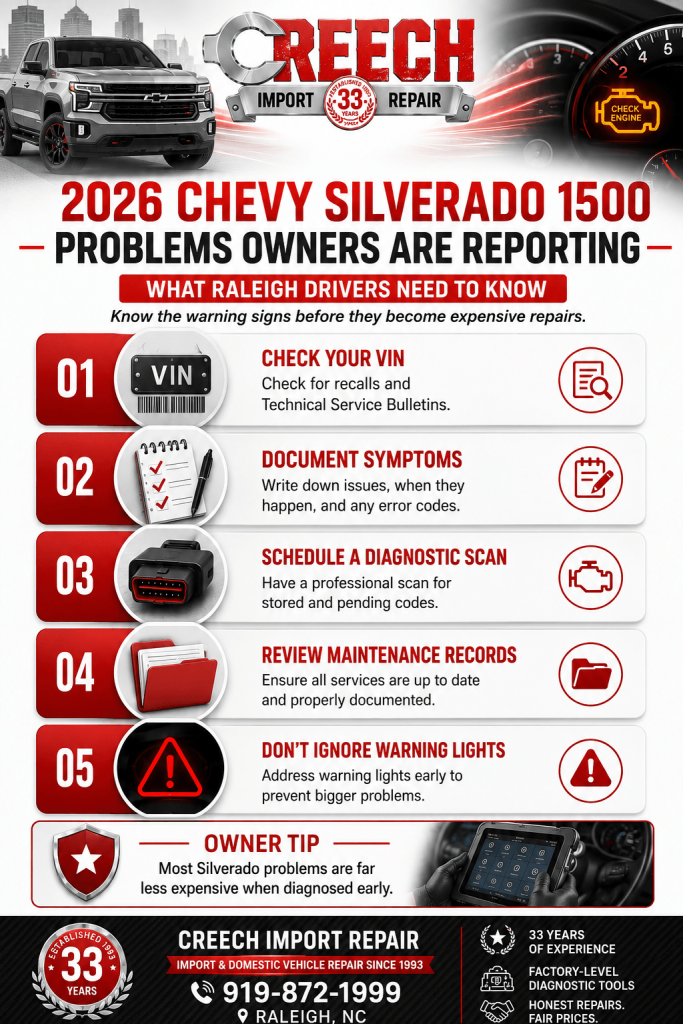
Step 5: What Raleigh Owners Should Do – A Checklist
If you own a 2026 Silverado 1500, follow this checklist to stay ahead of Silverado 1500 problems in 2026:
Check your VIN – visit NHTSA’s recall website or call a GM dealer
Document any unusual behavior – shifting, braking, warning lights
Schedule a diagnostic scan – Creech Import offers GM‑enhanced scanning
Keep maintenance records – oil changes, fluid flushes, inspections
Don’t ignore warning lights – they’re telling you something
[INSERT INFOGRAPHIC #1 HERE]
Alt text: Checklist infographic for 2026 Silverado 1500 owners to identify common problems
Title: 2026 Silverado 1500 Problems – Owner Checklist
Caption: Use this checklist to identify potential issues early and avoid costly repairs.
Description: A vertical checklist infographic with icons: VIN verification (magnifying glass), symptom documentation (notepad), diagnostic scan (diagnostic plug), maintenance records (folder), warning lights (warning triangle). No people, no shop background.
The Mechanical Breakdown: Why Dynamic Fuel Management (DFM) Destroys V8 Lifters
To understand why the 5.3L and 6.2L EcoTec3 V8 engines in the 2026 Silverado suffer from premature lifter failure, we have to look past simple bad luck and look directly at the complex engineering of GM’s Dynamic Fuel Management (DFM) system. Unlike older Displacement on Demand systems that deactivated the same fixed cylinders every time, DFM is a highly sophisticated system that can run in 17 different cylinder patterns. It constantly calculates how many cylinders are needed to maintain speed, shifting firing orders down to just two cylinders when coasting down Capital Boulevard or sitting in stop-and-go traffic on I-440.
This constant switching is controlled by a network of oil control solenoids located in the engine valley, which send high-pressure engine oil to special switching lifters. These DFM lifters feature an internal locking pin mechanism. When a cylinder needs to be deactivated, oil pressure pushes the locking pin inward, allowing the outer portion of the lifter to collapse over the camshaft lobe without moving the pushrod or opening the valves.
The engineering failure occurs because these locking pins operate on incredibly tight tolerances. Over time, even minor oil aeration, thermal breakdown, or microscopic carbon deposits can cause the locking pins to jam or fail to engage completely. When a pin becomes partially stuck or delayed while the camshaft is spinning at high RPMs, the lifter experiences a violent mechanical shock. This causes the internal components to bend pushrods, fracture the lifter housing, and score the camshaft lobes.
Because Raleigh driving demands a brutal mix of idle idling in downtown traffic followed by immediate high-load acceleration onto the highway, the DFM solenoids are forced to cycle aggressively. At Creech Import, we emphasize that preventing this catastrophic valve train failure relies heavily on maintaining perfect oil pressure and cleanliness. Skipping oil changes or using the wrong fluid viscosity degrades the hydraulic efficiency of the DFM system, directly accelerating the path toward a costly engine teardown.
CAN-Bus Data Chaos: Inside the Shift-by-Wire Electronic Glitch
The terrifying symptom of a moving 2026 Silverado suddenly slamming its own brakes or attempting to drop into Park while driving at highway speeds is rooted deep within the truck’s digital architecture. Modern GM trucks use a completely digital shift-by-wire system, meaning there is no physical cable linking your center console shifter to the actual transmission housing. Instead, your gear selection is translated into digital data packets and sent across the vehicle’s Controller Area Network (CAN-Bus) multiplexing system.
The transmission control module (TCM), body control module (BCM), and electronic brake control module (EBCM) must maintain constant, split-second communication to verify that the vehicle’s speed matches the intended gear commands. The software glitch in early 2026 models involves a data packet collision or timing delay within this high-speed CAN-Bus network. If a voltage drop occurs—even for a microsecond—or if a sensor provides conflicting data regarding wheel speed versus engine output, the safety software can panic.
When the network experiences a communication drop, the vehicle’s onboard safety diagnostics can misinterpret the data interruption as a total mechanical emergency or a runaway vehicle scenario. As a default failsafe strategy, the system commands the electronic parking pawl to engage or signals the automated braking system to lock up the wheels to prevent what it perceives as an uncontrolled roll.
At Creech Import, our diagnostic approach involves pulling historical communication codes (U-codes) that standard scanner tools often miss. Resolving these intermittent electrical anomalies requires factory-level programming tools to flash the updated GM software patches, stabilize system voltages, and clean critical ground connections that are easily corroded by North Carolina’s high summer humidity.
Thermal Runaway: The Physics Behind the Transfer Case Bearing Failures
The urgent “Do Not Drive” warning issued for the 2026 Silverado highlights a critical mechanical oversight inside the four-wheel-drive transfer case. The transfer case is responsible for splitting engine power between the front and rear axles, utilizing a series of heavy-duty chain drives, planetary gear sets, and precision roller bearings that spin at thousands of revolutions per minute. Because of the intense friction and load generated inside this aluminum housing, a constant spray of specialized fluid is mandatory to cool and lubricate the moving parts.
The specific recall involves a missing oil pickup tube during assembly. Without this pickup tube, the internal mechanical oil pump cannot draw fluid from the bottom reservoir to distribute it across the upper mainshaft bearings. When you take your Silverado down the highway, these unlubricated bearings quickly enter a state of severe boundary friction. Without a constant film of oil to carry away heat, the steel rollers experience rapid thermal expansion.
As the temperature spikes inside the bearing race, the metal expands beyond its clearance limits. The rollers weld themselves to the shaft housing in a fraction of a second, causing a catastrophic mechanical lock-up. When the transfer case locks up at 70 mph, it binds the entire drivetrain, forcing the rear wheels to drag and slide across the asphalt.
This is an incredibly dangerous scenario on busy commuter routes like I-540. If you drive a 2026 Silverado, verifying your VIN status is non-negotiable. Even if your truck currently shifts smoothly, driving without that internal oil pickup tube is a ticking clock that will inevitably end in mechanical failure.
Step 6: GM Recall – Headlight and Turn Signal Failures
Some 2024-2026 Silverado 1500 and Sierra 1500 trucks have experienced intermittent headlight, DRL, parking lamp, and turn signal failures. This is a safety hazard, especially when driving at night on Raleigh’s poorly lit roads.
Symptoms
Intermittent headlight failure – lights go out while driving
DRL not working – daytime running lamps inoperative
Turn signal issues – flashing rapidly or not working
Flickering lights – all exterior lights
What to Do
If you experience any lighting issues, have the electrical system inspected. This could be a faulty body control module (BCM) or wiring issue.
Step 7: What Raleigh 2026 Silverado Owners Should Do – A Comprehensive Checklist
If you own a 2026 Silverado 1500, follow this checklist to stay ahead of Silverado 1500 problems in 2026:
Check your VIN – visit NHTSA’s recall website or call a GM dealer for active recalls
Document any unusual behavior – shifting, braking, warning lights, noises – keep a log
Schedule a diagnostic scan – Creech Import offers GM‑enhanced scanning for all Silverado models
Keep maintenance records – oil changes, fluid flushes, inspections (digital photos recommended)
Don’t ignore warning lights – they’re telling you something important
Listen for unusual noises – ticking, knocking, or whining sounds
Check fluid levels regularly – engine oil, transmission fluid, coolant
Inspect for leaks – oil, transmission fluid, coolant
Test all lights – headlights, turn signals, brake lights, DRLs
Monitor fuel economy – sudden drops indicate problems
FAQs
What is the most common 2026 Silverado 1500 problem?
Transmission glitches, including uncommanded shifting, stalling, and sudden braking, are the most reported issues
Is there a recall on the 2026 Silverado?
Yes – GM issued a “Do Not Drive” recall for some 2026 Silverado models due to a wheel lock‑up risk from a missing oil tube in the transfer case
How do I know if my 2026 Silverado is affected by the recall?
Check your VIN on the NHTSA website or call a GM dealer. Creech Import can also verify your VIN for recalls.
What causes the V8 lifter collapse in 2026 Silverado?
The Dynamic Fuel Management system uses locking pins that can stick, causing lifter failure, misfires, and engine damage
Can Creech Import fix 2026 Silverado transmission problems?
Yes – we have factory‑level diagnostic tools and experience with GM’s latest transmissions.
What should I do if my 2026 Silverado shifts into Park while driving?
This is a serious safety issue. Pull over safely, have the truck towed, and do not drive it until it’s inspected
Does the warranty cover 2026 Silverado problems?
Many issues are covered under GM’s factory warranty (3/36 bumper‑to‑bumper, 5/60 powertrain). However, dealership delays are common – Creech Import can help document and diagnose.
How much does it cost to fix lifter failure on a 2026 Silverado?
Lifter replacement can cost $2,500-$4,500 depending on damage. If the camshaft is also damaged, costs increase significantly.
Can I drive my 2026 Silverado with the check engine light on?
If the light is flashing, stop driving immediately. If steady, schedule a diagnostic as soon as possible.
Does Creech Import offer a warranty on repairs for 2026 Silverado?
Yes – all repairs include a written warranty on parts and labor.
Sources
Why Choose Creech Import Repair for Your Vehicle?
Silverado 1500 problems in 2026 require a shop that understands GM’s latest technology – and the unique challenges of modern trucks. At Creech Import, we have been serving Raleigh GM owners since 1993. We use factory‑level diagnostic tools, stay current with GM technical service bulletins, and never recommend unnecessary repairs. Whether your Silverado has a transmission glitch, a software issue, or a lifter problem, we can diagnose and repair it – often faster and more affordably than the dealership. We also offer free second opinions on dealership diagnoses, so you can be confident in your repair decisions.
📞 Schedule Your Service Appointment Today
Don’t wait until a small problem becomes a major repair. Whether you need routine maintenance, diagnostics, or major repairs, the team at Creech Import Repair is ready to help.
📍 Address: 1818 St. Albans Dr #106, Raleigh, NC 27609
📞 Phone: 919-872-1999
🌐 Schedule Online: https://www.creechimport.com/chevrolet-silverado-1500-repair-services
About the Author: The ASE‑certified team at Creech Import Repair has been serving Raleigh drivers since 1993. We specialize in both domestic and import vehicles, with extensive experience in Chevrolet Silverado 1500 repair and maintenance.
Last updated: July 2026. Repair costs are estimates and may vary. Always obtain a written estimate before authorizing repairs.