


CREECH IMPORT REPAIR • RALEIGH, NORTH CAROLINA
If the gas pump keeps shutting off before your tank is full, the interruption can come from the station nozzle, how fuel enters the filler, or a restriction in the vehicle’s fuel-tank ventilation system. The click tells you that the nozzle sensed a shutoff condition; it does not tell you which part needs replacing.
The useful distinction is between a full tank and a tank that repeatedly refuses fuel when you know it is low. A single troublesome pump can behave differently from a problem that follows the vehicle to several stations. Observe that pattern without trying to defeat the nozzle’s safety mechanism. Stop adding fuel after the normal full-tank shutoff.
Gas Pump Keeps Shutting Off: Quick Answer
Repeated early shutoff can involve the nozzle, filler neck, fuel flow, or the EVAP system’s vapor-vent path. If it happens at multiple pumps with a low tank, arrange diagnosis. Do not top off, force repeated trigger clicks, invert the nozzle, or insert objects into the filler. Fuel spilling, visible leakage, or a strong persistent gasoline odor requires stopping the refueling attempt and addressing the hazard.
Why the Gas Pump Keeps Shutting Off Early
A dispensing nozzle is designed to stop fuel delivery automatically. Fuel reaching its sensing area, splashback, or conditions at the filler opening can trigger that stop before the vehicle’s tank has accepted the expected amount. It is a protective response rather than a message from the car’s fuel gauge. A vehicle fault and a station-side dispensing issue can therefore produce a similar interruption.
As liquid fuel enters a tank, displaced air and fuel vapor need an appropriate path out. Modern vehicles manage fuel vapors through an evaporative-emissions system rather than simply venting them into the atmosphere. Restrictions in the relevant refueling vent path can interfere with smooth filling. The exact components and routing differ across vehicles, so an explanation that names one universal “vent valve” is incomplete.
A normal click near the end of a fill is different from repeated clicks after only a small amount enters a substantially empty tank. The gauge is useful context, although it is not a precise measurement of the space available. Note the amount dispensed and the approximate starting gauge position. Those two observations are more informative than the number of times someone pulled the trigger.
Follow your vehicle’s refueling instructions, including nozzle insertion and capless-filler requirements. Ford’s owner guidance, for example, addresses proper nozzle placement and stopping at automatic shutoff. Instructions from one model should not become a universal procedure for every fuel filler. When correct use still leads to recurring early shutoff, the next step is diagnosis rather than increasingly creative nozzle manipulation.
Gas Pump Keeps Shutting Off: Station or Vehicle?
Think back over recent fills before deciding the tank needs repair. Did the problem occur at one dispenser only? Has the same vehicle filled normally elsewhere without unusual technique? Was this a one-time interruption or a pattern that has become progressively worse? Record what has already happened; you do not need to visit a series of stations just to collect more evidence.
One troublesome dispenser leaves room for a station-side explanation. A worn or unusually sensitive nozzle, dispensing behavior, or the interaction between that nozzle and the filler can matter. Ask the station attendant about a malfunctioning pump when appropriate. If fuel is spilling or the nozzle is not behaving safely, discontinue use instead of treating it as an experiment.
A pattern at multiple stations makes a vehicle-side restriction more relevant. That still does not prove the charcoal canister has failed. Filler geometry, damaged plumbing, vent controls, contamination, or another obstruction may need inspection. The diagnostic question becomes which part of the filling and vapor path is preventing normal fuel entry under the conditions you reported.
It is also worth separating two complaints: “the pump clicks off” and “the tank takes less fuel than I expected.” Trip mileage, gauge behavior, fuel economy, and the true starting fuel level can alter expectations. A shop needs the actual recurring fill difficulty rather than an assumed tank capacity discrepancy. Avoid running the vehicle extremely low as a way to settle that question.
Compare the Symptom Patterns
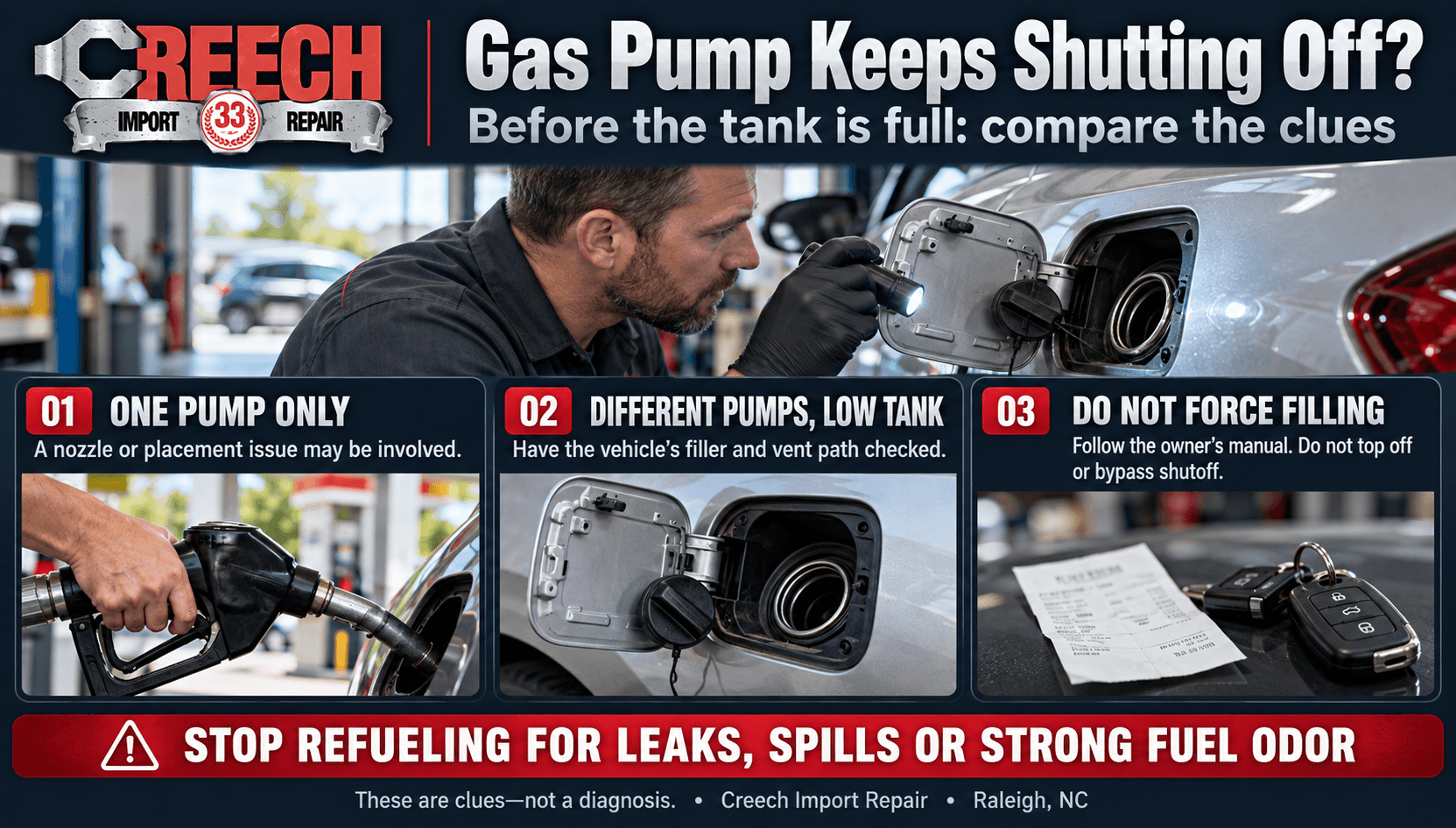
Use these clues to describe the complaint, not to select a replacement part. The patterns can overlap, and vehicle-specific inspection is needed to establish the cause.
| Observed pattern | What deserves checking | What it does not prove |
|---|---|---|
| One dispenser clicks repeatedly; other ordinary fills have been normal. | The nozzle or its interaction with the filler deserves consideration. | It does not establish a failed vehicle canister or justify topping off. |
| Several stations produce early shutoff with a known low tank. | The filler and relevant refueling ventilation path need vehicle-specific investigation. | It does not identify which hose, valve, filter, or connection failed. |
| The tank accepts roughly the expected amount before one final click. | That pattern may be normal full-tank shutoff rather than fill refusal. | The click is not a request to add more fuel beyond shutoff. |
| A check-engine light appears alongside the difficult filling complaint. | Exact codes can guide circuit, flow, or leak checks as appropriate. | A code description alone is not a replacement-part diagnosis. |
| A strong gasoline odor or visible fuel accompanies the interruption. | Stop the attempt and address the fuel hazard before further operation. | Improved fuel acceptance would not automatically rule out a separate leak. |
| The complaint began after work near filler or vapor-system plumbing. | Repair records and inspection of affected routing can provide useful leads. | Timing alone does not prove an installation error or assign responsibility. |
Does Early Nozzle Shutoff Mean the Car’s Fuel Pump Is Failing?
The phrase “gas pump keeps shutting off” can refer to two very different pieces of equipment. The dispenser at the station supplies fuel through its nozzle into the tank. The vehicle’s fuel pump supplies the engine according to the vehicle’s fuel-system design. A nozzle that clicks during refueling is not reporting the operating condition of the pump that supplies the engine.
That distinction matters when discussing a repair. Difficulty adding fuel calls for attention to the dispensing interaction, filler route, and relevant tank-venting conditions. Poor starting, loss of power, or an engine that stops can require a different investigation. The symptoms may coexist, but coexistence does not establish that replacing the vehicle’s fuel pump will correct premature nozzle shutoff.
Avoid booking a “fuel pump replacement” when the observation is that the station nozzle repeatedly clicks off. Describe the action and timing instead: the tank is low, fuel enters briefly, and the dispenser stops before a normal fill is possible. This tells the shop what needs to be diagnosed without selecting a part or confusing refueling with engine fuel delivery.
Likewise, a smooth-running engine does not prove the refueling path is unrestricted. The vehicle can start and drive normally while accepting fuel poorly. That is why a filling complaint remains worth investigating even without reduced engine performance. The diagnostic plan should follow the reported behavior rather than use normal driving as a blanket test of every fuel-system function.
If starting or drivability symptoms are also present, list them separately and provide their sequence. Did they begin before difficult filling, immediately after a fill, or at unrelated times? Those details help the technician decide whether a common system is relevant or two concerns need separate tests. They also prevent an estimate from presenting one part as an unsupported solution to every complaint.
Fuel Filler, Vent Path, and EVAP Clues
The filler neck connects the exterior fill point with the tank. A damaged section, inappropriate modification, foreign material, or a restriction can disturb the fuel’s path. A capless opening has its own mechanisms and handling requirements. None should be probed with a screwdriver, improvised funnel, or wire to see whether something opens farther.
The evaporative-emissions system captures and manages vapor. Depending on the design, refueling behavior can involve the canister, vent valve, filters, hoses, and tank connections. Debris, restricted passages, damaged lines, or a control fault are possibilities a technician may investigate. Some failures affect filling directly; others primarily affect emissions monitoring or engine operation. Similar terminology does not make them the same failure.
A check-engine light can provide additional information, but it does not select a replacement part on its own. A stored evaporative-system code may describe a circuit, leak, flow condition, or monitoring result. The technician should interpret the exact code alongside the refueling complaint, vehicle configuration, and supporting tests. Replacing an entire canister system because the pump clicked repeatedly skips that work.
Gasoline odor after refueling is a separate safety clue. A small external spill, a sealing issue, or a leak can have different implications. Persistent strong odor or visible fuel warrants prompt attention, particularly around ignition sources. Do not dismiss it as a normal consequence of difficult filling. This guide focuses on premature nozzle shutoff; odor diagnosis requires its own inspection path.
Purge Control and Refueling Venting Are Different Questions
EVAP is a broad system name, not a diagnosis. It includes functions that store fuel vapor, manage vapor flow, and monitor particular conditions. The relevant layout differs by engine and model. A component described online as a purge valve should not automatically be confused with every valve or passage involved in filling the tank.
During refueling, displaced air and vapor must move through the intended route while liquid fuel enters. During appropriate engine operation, a purge function manages vapor delivery toward the engine on applicable systems. These functions are related through the broader vapor-management design, but the test for one does not necessarily establish the condition of the other.
That is why a hard-start-after-refueling complaint and a nozzle-shutoff complaint should each be described accurately. A technician may find a shared issue, or may need to follow different branches of the diagnostic procedure. A general statement that “EVAP is bad” does not explain which function failed or what evidence supports the repair.
When a valve is suspected, ask whether the shop checked the relevant electrical command and actual function. A component making an audible click is not equivalent to confirming suitable flow through the passage. Similarly, an intact-looking hose may require further evaluation if the complaint points toward restriction. The procedure should match the vehicle and the question being investigated.
The practical goal is not to memorize every vapor-system part. It is to understand what the proposed test answers. Does it investigate refueling flow, a leak, a circuit, or another operating condition? A clear answer helps you judge why the next step is appropriate and why a part mentioned in an unrelated starting-problem article may not belong in this repair.
Capless Fillers and Nozzle Placement: Use the Correct Manual
A conventional fuel cap and a capless filler have different handling details. Some capless systems use internal closures that open with the appropriate dispensing nozzle. An emergency fuel-addition funnel, when supplied or specified, serves a particular purpose described by the manufacturer. It is not an invitation to use arbitrary tools or funnels to make the opening accept fuel differently.
The nozzle’s insertion and position can affect flow. Ford’s owner guidance illustrates how incorrect positioning can cause a premature stop, but the instructions must be matched to the actual model. Do not assume an illustration’s lettered position, angle, or placement applies to another vehicle. Read the procedure in your own manual and avoid a universal online rule such as rotating every nozzle upside down.
If the correct ordinary procedure still produces repeated early shutoff, stop escalating the technique. Pushing harder, partially defeating a closure, or inserting an object can damage the filler and create a new fault. The fact that a workaround allows some fuel to enter does not establish that the vehicle is functioning as designed.
Mention damage around the fill opening, unusual resistance during normal insertion, or recent filler-area work when arranging inspection. Do not photograph internal parts by holding a closure open with a tool. A picture of the accessible exterior and an accurate description are enough to start the conversation. The shop can determine what further access is appropriate.
After any repair, return to the manufacturer’s normal refueling procedure. Verification should not depend on a special angle, repeated trigger clicks, or a bypass that was never intended for ordinary use. Keep the instructions and repair findings together so a returning complaint can be described against the correct baseline rather than against a workaround.
What to Record Without Forcing Another Fill
Write down the starting gauge position, approximate amount the tank accepted, station or pump involved, and whether the problem has happened elsewhere. Note whether it began suddenly, followed repairs, or became worse over several fills. A photo of the receipt preserves the amount dispensed without requiring another attempt to reproduce the problem.
Tell the shop whether the car has a conventional fuel cap or a capless filler. Mention a check-engine light and any recent fuel-system, body, or underbody work. If you have diagnostic codes from an earlier scan, bring the exact numbers and any written report. A paraphrase such as “something about emissions” loses distinctions that can change the diagnostic route.
Also describe what happens immediately after refueling. Hard starting or rough operation after a fill may be relevant to the broader evaporative system, although it is not proof that a purge valve caused the filling interruption. Fuel odors and leaks deserve separate emphasis. Multiple symptoms can share a cause, or the vehicle may have more than one problem.
Do not try to improve the record by topping off, rocking the car, repeatedly restarting it, or disconnecting emissions equipment. The shop can reproduce conditions using an appropriate procedure. Your role is to provide a reliable description and avoid creating an additional fuel or vapor hazard. Keeping the original behavior intact is usually more useful than introducing a temporary workaround.
How a Shop Can Investigate Early Nozzle Shutoff
Diagnosis begins by verifying the complaint and the applicable fuel-system design. The technician may inspect the filler area, accessible hoses, connectors, and signs of physical damage. A careful visual examination can reveal a kinked or disconnected line that no dashboard warning could identify. Recent repair history can narrow the areas worth inspecting first.
If the check-engine light is present, scanning relevant systems can supply codes and operating information. Some vehicles permit control tests for evaporative-system valves; others require different procedures. A commanded valve response, electrical circuit check, or flow test should be judged against the vehicle’s service information. Hearing a click is not necessarily confirmation that a passage is open or flowing adequately.
Depending on the findings, further work may involve checking vent-path restriction, component operation, or vapor-system integrity with approved equipment. A smoke test can assist certain leak investigations, but a generic leak test does not automatically establish why fuel will not enter normally. The test needs to address the complaint, not simply generate a pass or fail result unrelated to filling.
The useful repair explanation connects evidence to the proposed part or procedure. Ask what restriction, failure, or damage was found and how it will be corrected. After repair, verification should address the original refueling difficulty and any related codes or odors. An emissions light going out by itself is weaker evidence than confirming that the underlying fault and reported filling behavior have been resolved.
Safety Decisions and Common Workarounds to Avoid
Stop the refueling attempt if liquid fuel spills, leaks are visible, or a strong gasoline odor persists. Move away from ignition sources and follow the station’s safety instructions. Do not restart the vehicle while trying to understand an active spill near it. Station staff can help address dispensing hazards; a vehicle leak needs the appropriate professional response.
Do not treat repeated topping off as a solution. Once the tank reaches its normal automatic shutoff, additional fuel can create problems with fuel expansion and vapor-management components. A slow, tedious fill is not evidence that the vehicle needs every remaining drop squeezed into the neck. The safe objective is normal filling within the manufacturer’s instructions.
Do not remove vent hoses, drill a filler opening, bypass capless components, or disconnect the canister to improve fill speed. These changes can create fuel-vapor hazards and emissions faults while hiding the original restriction. Avoid online procedures that assume every vehicle has the same removable component in the same location. Safe access and system testing are vehicle-specific.
Whether the car can be driven depends on the accompanying conditions. Difficulty filling alone is different from visible fuel leakage, severe odor, stalling, or another warning. Do not use a general blog description as clearance for a vehicle with an active hazard. Tell Creech’s Service Team about the complete symptom set and ask how to arrange an inspection without worsening the situation.
Specific Patterns That Change the Inspection
A low tank repeatedly refuses fuel
An illustrative pattern is a gauge well below full, a small amount dispensed, and several early shutoffs during ordinary correct refueling. That differs from a nozzle clicking once near the expected end of a fill. The useful evidence is the starting level and amount accepted, not a count of how many times the trigger was forced.
The limitation is that the gauge does not measure free tank space precisely. A technician still needs to evaluate the fuel path and applicable ventilation arrangement. Do not turn this example into a capacity test by running the car nearly empty or deliberately overfilling it.
The symptom follows a repair
If fill difficulty began after underbody, body, or fuel-system work, describe the sequence and bring the invoice. A displaced hose, damaged connection, or changed component can be a lead. There may also be a coincidental fault, so the repair date alone should not decide who is responsible or which part failed.
A useful inspection compares the affected area with the correct routing and connection requirements. The repair explanation should identify a physical or functional finding. A bill that merely says “EVAP problem” is less informative than a description of the restriction or operating failure that was demonstrated.
Filling difficulty with no warning light
A recurring filling complaint remains valid without a dashboard warning. Emissions monitoring evaluates defined conditions and does not necessarily report every restriction that a driver can notice during refueling. Tell the shop about the behavior directly rather than waiting until a light appears.
The absence of a code also means a scan cannot be the entire diagnosis. Filler condition, plumbing, and refueling vent operation may need investigation. Ask how the planned checks address fuel acceptance. That question keeps the inspection focused on the actual complaint instead of declaring the system healthy because the scan reported nothing relevant.
Questions to Ask About a Refueling Repair
There is a practical difference between verifying a filling complaint and trying to force enough fuel into the tank to satisfy an expectation. Ask the shop how it will assess the filler and refueling vent path safely, and what evidence identifies the restricted or malfunctioning part. The amount accepted and starting gauge position are context; neither is a universal tank-capacity measurement.
If a repair is proposed for an evaporative-system component, ask whether the finding explains premature nozzle shutoff specifically. An emissions code can justify further investigation without establishing the cause of difficult filling. A leak-related repair and a flow restriction may require different tests. The report should connect the proposed work to the actual complaint rather than rely only on an EVAP label.
Discuss any gasoline odor separately. A repair that improves fuel acceptance does not automatically establish that a persistent smell is resolved. Spills, sealing, vapor escape, and liquid leakage each need consideration as appropriate. If both complaints exist, the estimate should state whether one fault explains them or whether additional inspection is needed. Active leakage or strong persistent odor changes the safety response.
For follow-up, use ordinary refueling instructions and retain a simple note of the next fill. Do not create a capacity challenge by running the tank very low or squeezing fuel beyond automatic shutoff. If early clicking returns, the station, starting level, amount accepted, and any warning information help compare the new behavior with the original complaint. Keep the repair record so a further inspection begins with evidence rather than another speculative canister replacement.
Repair Scope, Follow-Up, and a Raleigh Appointment
The repair may be modest when a localized damaged line or connection is responsible, or more involved when access to a tank-mounted component is needed. Parts, labor, and testing depend on the actual design and failure. A universal price for “the gas pump problem” would conceal those differences, so request an estimate based on inspection findings.
Ask whether the estimate covers diagnosis, the specific repair, and verification. A code-related repair may also need confirmation that the associated monitoring conditions are satisfied. If the complaint is intermittent, the shop may need details about when it occurs or a safe way to reproduce it. That is a reason to improve the symptom record rather than authorizing a list of speculative parts.
After repair, keep a brief note of the next normal refueling event: station, approximate starting fuel level, amount accepted, and whether premature shutoff returned. Follow ordinary refueling instructions and stop at full-tank shutoff. If the problem recurs, provide those details promptly. Do not attempt a new workaround that could obscure the repair’s actual result.
For drivers in Raleigh, Creech Import Repair offers a shop-based setting for discussing recurring fuel-filling difficulty and associated warning lights. Tell the Service Team your make, model, and year so it can confirm the appropriate service fit. State clearly that the pump repeatedly shuts off while the tank is still low, and whether the behavior follows the car across stations. An accurate booking description helps distinguish this visit from a fuel-odor complaint or a routine check-engine-light inquiry.
Frequently Asked Questions
Why does the gas pump click off when my tank is nearly empty?
The nozzle may be responding to splashback or another sensing condition, or the vehicle may have difficulty venting displaced air and vapor as fuel enters. An empty-looking gauge does not identify the fault. Repeated behavior at different stations supports inspecting the filler and refueling vent path rather than simply replacing the nozzle or canister.
Does this always mean the charcoal canister is bad?
No. The canister is one possible part of the relevant vapor system, but a damaged hose, vent control, filler restriction, or station-side issue can also matter. Diagnosis should show what is restricted or malfunctioning. An evaporative-system code can help guide testing, but it does not by itself authorize a canister replacement.
Can I keep squeezing the trigger until the tank fills?
Do not repeatedly override shutoff or continue beyond the normal full-tank click. Follow the vehicle’s refueling instructions. If a low tank repeatedly refuses fuel, stop treating the nozzle as something to defeat and arrange inspection. Fuel spills, visible leakage, or persistent strong odor require stopping the attempt and addressing safety immediately.
Can a capless fuel filler cause trouble?
A capless filler can be involved if its mechanisms, seals, or fuel path are damaged or obstructed. It also has specific nozzle and emergency-funnel instructions. Do not insert random objects or a generic funnel to force it open. Use the owner’s manual and have recurring difficulty evaluated with the correct vehicle-specific procedures.
Will a check-engine light always appear?
No. Some refueling restrictions may occur without a stored warning, while other problems trigger an evaporative-system code. The presence or absence of a light does not settle the cause. Report the filling behavior itself, and supply exact codes if available. The technician can then connect the warning information with the physical symptom.
Is this the same problem as a gasoline smell after filling?
The complaints can be related, but they ask different diagnostic questions. Premature shutoff concerns fuel entry and venting; gasoline odor raises questions about spills, sealing, vapor escape, and leaks. If both occur, report both. A strong persistent smell or visible fuel should receive prompt safety attention rather than being treated as routine difficult filling.
Can I clean the vent myself?
The vent route, filters, valve locations, and safe testing methods vary by vehicle. Blowing compressed air into a random line or poking the filler can damage components or create a hazard. A shop should identify the restriction first and use an approved procedure. A recurring fill complaint is not a reason to dismantle emissions equipment blindly.
What should I tell Creech when booking?
Describe a low tank that repeatedly triggers early pump shutoff, the amount usually accepted, and whether it occurs at more than one station. Mention warning lights, fuel odors, leaks, and recent repairs. This information helps the Service Team plan a shop inspection in Raleigh and distinguish the complaint from an unrelated fuel-gauge or starting problem.
Arrange an Inspection at Creech Import Repair
Explain the symptoms and ask about an inspection at our Raleigh repair shop. Call 919-872-1999 or request an appointment online. The shop is at 1818 St. Albans Dr #106, Raleigh, NC 27609. Hours are Monday–Friday, 7:30 am–5:30 pm. Online requests become confirmed appointments only after the Service Team verifies them.
For related service information, see check-engine-light diagnosis. If the vehicle cannot be operated safely, arrange appropriate transportation rather than driving it to the shop.
Technical References
Manufacturer information applies to the vehicles or components described in each source. Diagnosis, pressure values, repair procedures, and safety instructions must be matched to the vehicle being inspected.
Find Creech Import Service articles useful?
Add this site to your Preferred Sources in Google Search.