


Creech Import Repair | Raleigh, North Carolina
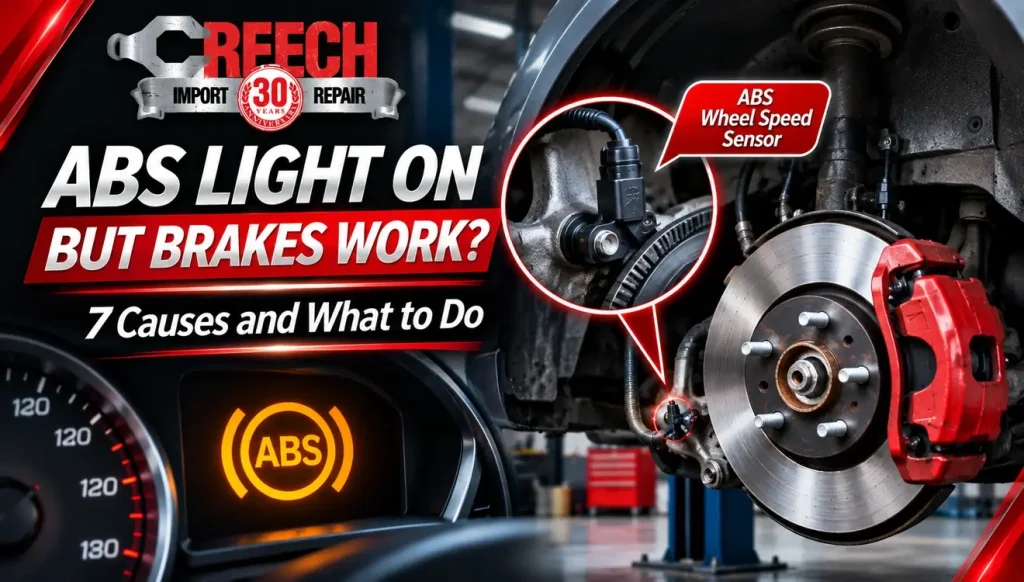
ABS Light On but Brakes Work? 7 Causes and What to Do
Your dashboard suddenly shows an amber ABS warning light. You press the brake pedal and the car seems to stop normally. No grinding, no unusual pedal movement, and no obvious sign that the brakes have failed. So why is the warning still there?
The situation described by the search phrase "ABS light on but brakes work" is possible because a vehicle's anti-lock braking system performs functions beyond ordinary brake-pedal operation. On many vehicles, conventional braking may remain available even when the anti-lock system detects a malfunction.
However, normal-feeling brakes during gentle stops do not prove that the vehicle will behave normally during an emergency stop. The anti-lock system may be disabled, and other functions such as traction control or electronic stability control may also be affected.
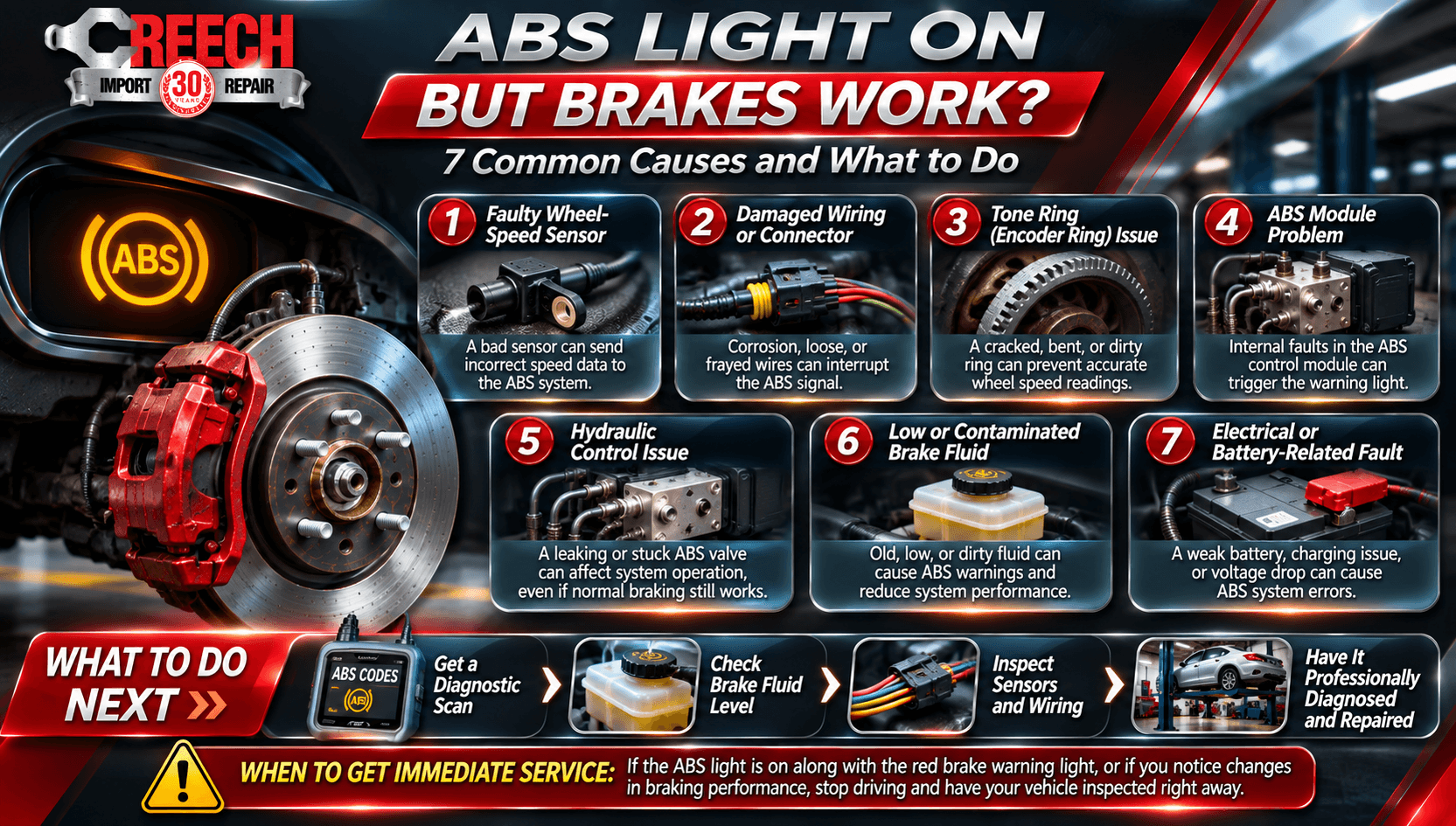
Potential causes include a failed wheel-speed sensor, damaged wiring, tone-ring or wheel-bearing encoder faults, electronic control problems, hydraulic modulator issues, brake-system conditions, or electrical power-supply faults.
This guide explains seven possible causes, the difference between amber ABS and red brake warnings, when driving is unsafe, what a mechanic checks, and which repairs may be appropriate.
The objective is to help you understand the warning without assuming that every ABS light requires an expensive module replacement or that a normal brake pedal means the problem can be ignored.
Quick Answer
ABS Light On but Brakes Work: What Does It Mean?
When the ABS light stays on but the brakes still work, the vehicle may have detected a fault in its anti-lock braking system while conventional braking remains available. Possible causes include wheel-speed sensors, sensor wiring, tone rings or magnetic encoders, ABS control electronics, hydraulic components, power-supply problems, or certain brake-system conditions.
On many vehicles, the amber ABS warning means anti-lock assistance may be limited or unavailable. Hard braking on wet or slippery roads could produce wheel lockup and reduce steering control. If a red brake warning also appears, the brake pedal feels abnormal, or stopping performance changes, stop safely and arrange urgent professional assistance or towing.
Why Can the ABS Light Stay On While the Brakes Still Work?
ABS stands for Anti-lock Braking System. Its purpose is to help prevent wheel lockup during certain hard-braking conditions so the driver can maintain more control over steering.
A vehicle's conventional braking system uses friction and hydraulic force, or another manufacturer-specific braking arrangement, to slow the wheels. ABS adds electronic monitoring and controlled brake-pressure modulation when needed.
When the ABS control system detects a fault, it may turn off or restrict anti-lock operation. Conventional brakes can remain functional in certain failure modes, but this depends on the vehicle and the actual defect.
Honda's published owner information, for example, explains that some vehicles retain normal conventional braking while ABS is unavailable. That does not mean every vehicle with an illuminated ABS light is safe to drive.
What Does ABS Actually Do During Hard Braking?
During a hard stop, a wheel can stop rotating while the car continues moving. This is called wheel lockup. A locked wheel may have reduced ability to provide directional control, especially on slippery pavement.
ABS uses wheel-speed information to help recognize this condition. On many designs, a hydraulic modulator adjusts brake pressure rapidly to reduce prolonged wheel lockup.
The driver may feel brake-pedal pulsation or hear a mechanical sound during normal ABS activation. Those sensations do not necessarily indicate a fault.
ABS does not guarantee the shortest stopping distance on every surface. Tire condition, road friction, speed, and driving behavior still strongly affect braking performance.
Does the ABS Light Mean My Brake Pads or Rotors Are Bad?
Not automatically. Brake pads and rotors provide the friction that slows the car. The amber ABS warning generally concerns the monitoring or control of anti-lock braking functions.
A worn brake pad or damaged rotor may require repair, but replacing those components is not the universal solution for an ABS warning.
A mechanic should identify whether the detected problem involves wheel-speed data, electronic controls, hydraulic operation, or another system.
Can ABS and Electronic Stability Control Fail Together?
Yes. Many modern vehicles share sensor information between ABS, traction control, and electronic stability control.
If a signal becomes unavailable or unreliable, the vehicle may display multiple warnings. For example, a wheel-speed fault can affect systems that depend on accurate wheel-rotation information.
However, two illuminated warning lights do not necessarily mean two separate components failed. A common electrical or communication fault may affect several systems simultaneously.
Amber ABS Warning
Conventional braking may remain available, but anti-lock function can be limited or disabled. Prompt diagnosis is appropriate.
ABS and Stability Warning
Related electronic vehicle-control functions may also be unavailable. Interpret the warning combination using the owner's manual.
ABS and Red Brake Warning
A more serious brake-system condition is possible. Stop safely and obtain urgent professional guidance.
7 Possible Causes of an ABS Light When the Brakes Still Work
The seven categories below are possible areas of failure, not a statistically verified ranking of the most common causes. They can overlap, and their importance differs by vehicle design.
Faulty Wheel-Speed Sensor
Wheel-speed sensors provide information about wheel rotation. The ABS controller uses that data to identify when a wheel may be approaching lockup and whether anti-lock intervention is needed.
Sensor designs vary. Some use magnetic or electronic sensing methods, while the rotating reference may be a toothed ring or a magnetic encoder integrated into another component.
A failed sensor may produce an incorrect signal, intermittent readings, or no signal at all. The control module may then illuminate the ABS warning.
In certain vehicles, the light appears immediately at startup. In others, it may come on only after the car begins moving because the system performs additional checks using live wheel-speed data.
A diagnostic code referencing one wheel does not automatically prove that the sensor itself needs replacement. A damaged connector, defective encoder, or broken wiring can cause similar symptoms.
Possible clues: A warning after movement begins, intermittent ABS operation, or wheel-specific diagnostic information.
Typical diagnosis: Review live wheel-speed data, test the appropriate sensor circuit, and inspect connected wheel-end components using manufacturer procedures.
Damaged ABS Wiring or Connectors
Wheel-speed sensor wiring is exposed to vibration, steering and suspension movement, moisture, road debris, and changing temperatures.
Wiring insulation can become damaged, connectors can corrode, and terminals may loosen. These defects can interrupt the signal reaching the ABS control unit.
Some wiring faults are intermittent. The warning may appear over bumps, during steering movement, or after the vehicle reaches a particular temperature.
A recent brake, wheel-bearing, or suspension repair can also be useful diagnostic history. However, the timing alone does not prove the earlier work caused the problem.
Improper repairs can introduce additional faults, especially when connector seals or wire routing are not restored correctly.
Possible clues: Intermittent illumination, visible harness damage, corroded connections, or circuit-related diagnostic codes.
Typical diagnosis: Inspect wiring and connectors, verify power or signal integrity, and test relevant circuits according to manufacturer instructions.
Damaged ABS Tone Ring or Wheel-Bearing Encoder
A wheel-speed sensor needs a reliable rotating reference to measure wheel movement.
Some vehicles use toothed tone rings mounted near the wheel hub or axle. Others use magnetic encoder rings integrated into wheel-bearing assemblies.
A damaged, corroded, cracked, contaminated, or incorrectly positioned reference can produce unreliable wheel-speed signals.
Depending on the design, a worn wheel bearing or an incorrectly installed replacement part can also affect signal quality.
A tone ring may be visible on some vehicles, but a magnetic encoder may be hidden inside a sealed bearing assembly.
The fact that one car has a toothed ring near a brake rotor does not mean every vehicle uses the same arrangement.
Possible clues: A wheel-specific signal fault, abnormal wheel-speed readings, or warning-light activation after hub or bearing work.
Typical diagnosis: Identify the exact sensor architecture and inspect the corresponding encoder, ring, hub, or bearing components.
ABS Control Module or Electronic Control Fault
The ABS control module evaluates sensor data, monitors system operation, and commands the hydraulic system during anti-lock braking.
Depending on the design, faults involving internal electronics, software, communication circuits, or module power supply can trigger a warning.
However, a scan-tool message saying the ABS module cannot communicate does not necessarily mean the module has failed.
A power interruption, damaged fuse, poor ground connection, wiring fault, or network communication issue may prevent a functioning module from responding.
Replacing a control unit can be expensive. Some vehicles require programming, calibration, or additional procedures after installation.
That makes it important to evaluate external causes before authorizing module replacement.
Possible clues: Persistent control faults, communication errors, or multiple related electronic warnings.
Typical diagnosis: Verify power, ground, communication, circuit integrity, and manufacturer-specific control-module operation.
ABS Hydraulic Modulator, Pump, or Valve Problems
Many ABS systems use a hydraulic control assembly to adjust brake pressure when anti-lock intervention is needed.
This assembly may contain solenoid valves, a pump motor, and other hydraulic or electronic components.
If the pump, valves, wiring, or hydraulic controls malfunction, the system may set fault codes and disable ABS operation.
Some failures affect anti-lock intervention while ordinary braking remains available. Other faults can affect broader brake-system functions, especially on vehicles with integrated electronic brake controls.
These differences matter because conventional ABS arrangements and modern integrated brake systems do not always fail in the same way.
Hydraulic brake service may require specialized equipment, electronic bleeding procedures, and other manufacturer-defined steps.
Possible clues: Pump or valve codes, system self-test failures, or abnormal electronic brake-control behavior.
Typical diagnosis: Check module commands, electrical circuits, supported component tests, and relevant hydraulic conditions.
Low Brake Fluid or Related Brake-System Conditions
Brake fluid transfers hydraulic pressure and is essential to many conventional braking systems.
Some vehicles monitor fluid level and display warnings if the fluid drops below a specified threshold or another hydraulic condition is detected.
Low brake fluid can result from pad wear, a leak, or other system conditions. A mechanic must identify the cause rather than merely adding fluid.
It is important to distinguish the amber ABS warning from the red brake-system indicator.
On many vehicles, low brake fluid is more directly associated with the red brake warning than with an isolated amber ABS light.
Old or contaminated fluid also does not automatically explain every ABS warning. A fluid service may be appropriate for vehicle-specific maintenance or repair reasons, but it cannot fix broken electronic components.
Possible clues: Low fluid level, a red brake warning, visible leaks, unusual pedal travel, or related brake-system messages.
Typical diagnosis: Inspect the fluid level, hydraulic condition, possible leaks, and applicable warning-system information.
Battery, Charging-System, Fuse, or Ground Fault
The ABS control system requires a reliable electrical supply.
Low voltage, unstable power, an open fuse circuit, a damaged ground connection, or certain charging-system faults can interfere with electronic module operation.
Some vehicles may illuminate several warning indicators when voltage or communication conditions become abnormal.
However, an ABS warning does not automatically mean the battery or alternator needs replacement.
The correct diagnosis depends on electrical measurements and the complete warning pattern.
Replacing a battery without inspecting relevant circuits may fail to address the underlying issue.
Possible clues: Multiple dashboard warnings, unusual electrical behavior, low-voltage codes, or recent starting and charging problems.
Typical diagnosis: Evaluate battery condition, charging output, relevant fuses, grounds, and control-module communication.
Amber ABS Warning vs. Red Brake Light: What's the Difference?
The warning-light color and combination can help indicate how urgently the vehicle needs attention.
However, manufacturers use different electronic brake-control architectures, so the owner's manual is the authoritative guide for the exact warning displayed by your car.
| Warning | What It May Indicate | What to Do |
|---|---|---|
| Amber ABS light alone | Detected anti-lock system malfunction; conventional braking may remain functional | Follow the owner's manual and arrange prompt diagnosis |
| ABS and stability-control lights | Shared sensor, control, or electrical fault affecting multiple functions | Seek prompt diagnosis and avoid assuming stability assistance works normally |
| Red brake warning after releasing parking brake | Potential brake-fluid, hydraulic, electronic, or other serious braking concern | Stop safely and seek urgent assistance |
| ABS and red brake warning together | Possible broader brake-control problem, including electronic brake-force distribution on some vehicles | Stop safely and arrange urgent inspection or towing |
| Soft pedal, fluid leak, or poor braking | Possible hydraulic failure or other safety-critical condition | Do not continue driving |
| ABS lamp briefly illuminates at startup | May be a normal self-check on some vehicles | Consult the owner's manual; investigate persistent or abnormal illumination |
What if Both ABS and Traction-Control Lights Come On?
ABS and traction-control systems commonly use shared wheel-speed data.
A single defective sensor circuit or another control fault may therefore trigger more than one warning. The additional light does not necessarily indicate another independent failure.
The correct approach is to inspect relevant fault codes and live system information rather than replace parts based on dashboard symbols alone.
Can ABS Failure Affect Electronic Brake-Force Distribution?
Potentially. Some vehicles integrate electronic brake-force distribution with ABS and other braking functions.
A fault involving the broader system may reduce functions beyond anti-lock intervention.
Certain manufacturer owner manuals specifically warn about combined ABS and red brake indicators. Do not assume conventional braking is fully functional if multiple serious warnings appear.
When Should You Stop Driving With an ABS or Brake Warning?
Stop safely and arrange urgent assistance if any of these conditions occurs:
- The red brake warning remains on after the parking brake is released.
- The amber ABS and red brake warnings appear together.
- The brake pedal becomes unusually soft, spongy, hard, or sinks excessively.
- Stopping performance noticeably worsens.
- Brake fluid is leaking or the hydraulic system appears damaged.
- The vehicle brakes unpredictably or pulls severely during braking.
- A dashboard message instructs you to stop driving.
Do not perform hard-stop tests to see whether the ABS system still works. If the brakes feel abnormal or the warning indicates a more serious system problem, stop in a safe location and arrange towing or professional recovery.
Is It Safe to Drive if the ABS Light Is On but the Brakes Work?
An isolated amber ABS warning may mean conventional braking is still available. However, anti-lock assistance may be disabled, reducing the vehicle's ability to prevent wheel lockup during sudden braking.
The risk can be more serious on wet, slippery, or low-traction surfaces.
Whether limited travel is appropriate depends on the exact vehicle, accompanying warnings, weather, traffic, and actual brake performance.
Avoid assuming the car is safe for ordinary use merely because it stops during a gentle test. Follow the manufacturer's instructions and seek prompt diagnosis.
Will My Brakes Stop Working if the ABS Light Is On?
Not necessarily. Some ABS malfunctions leave conventional braking operational.
However, an integrated electronic or hydraulic brake-system fault may affect more functions than ABS alone.
The warning indicator cannot confirm the overall condition of the braking system. If the brake pedal feels abnormal or stopping performance changes, do not continue driving.
Can You Drive Until Your Next Scheduled Service?
Waiting for unrelated scheduled maintenance is not the preferred response to a safety-related warning.
Some ABS faults may remain isolated, while others can affect associated electronic driving functions.
Schedule an appropriate diagnostic appointment promptly and arrange towing when normal braking cannot be assured.
What Should You Do When the ABS Light Comes On?
Find a Safe Location
Reduce speed smoothly, avoid abrupt maneuvers, and stop somewhere safe if necessary. Pay attention to how the vehicle responds during ordinary braking without deliberately testing emergency stopping.
Check for Additional Warnings
Identify whether the red brake indicator, traction-control warning, charging-system light, or another serious message is illuminated.
Observe Brake-Pedal Behavior
A pedal that sinks, feels unusually soft, or produces reduced stopping performance warrants immediate attention. Do not continue driving if braking is uncertain.
Document the Circumstances
Note whether the light appeared at startup, after driving a short distance, after recent wheel service, or alongside other electronic symptoms.
Check Only Safe, Accessible Information
Follow the owner's manual for brake-fluid checks where appropriate. Do not open brake lines, probe ABS connectors, or work near unsupported wheels.
Arrange Professional Diagnosis
Provide the service advisor with the vehicle's year, make, model, warning-light combination, and any changes in brake operation.
Should You Disconnect the Battery to Reset the ABS Light?
Disconnecting the battery does not repair a faulty sensor, damaged wiring, hydraulic defect, or control-module problem.
The warning may return when the system detects the fault again. Clearing diagnostic information can also make intermittent problems harder to investigate.
A proper repair identifies the actual cause and verifies normal system operation afterward.
Can a Basic OBD-II Scanner Diagnose ABS Problems?
Not every code reader can access ABS information.
Basic OBD-II scanners may focus on engine and emissions-related data. Enhanced diagnostic equipment is often needed to retrieve ABS fault codes, live wheel-speed information, and manufacturer-specific brake-control data.
Even with an appropriate scanner, a code is evidence to investigate rather than proof that a particular part has failed.
How Does a Mechanic Diagnose an ABS Light That Stays On?
The goal is to establish which part of the system is malfunctioning before replacement parts are recommended.
Confirm the Warning and Brake Condition
The technician reviews the warning-light combination, brake-pedal condition, leaks, symptoms, and relevant repair history.
Scan ABS and Related Modules
Appropriate equipment retrieves fault codes and may provide wheel-speed data, voltage information, and other electronic brake-control parameters.
Compare Wheel-Speed Signals
Where safe and appropriate, technicians compare wheel-speed information under controlled conditions to identify implausible or missing signals.
Inspect Sensor Circuits and Wheel-End Components
Applicable sensors, wiring, connectors, tone rings, encoders, hub assemblies, and wheel bearings are evaluated.
Investigate Electronic and Hydraulic Controls
When indicated, technicians check power, grounds, communication, pump or valve operation, and relevant manufacturer diagnostic procedures.
Explain the Findings and Repair Options
The shop should identify which test results support the diagnosis and whether any related parts or programming procedures are required.
Verify the Repair
After the authorized repair, appropriate checks confirm that the fault has been addressed and warning behavior is normal.
Does an ABS Trouble Code Tell You Which Part to Replace?
Not necessarily. A wheel-specific fault may involve the sensor, wiring, encoder, or another issue affecting that signal.
A module communication fault may involve module power, grounds, wiring, or network connections instead of an internal module defect.
A code should guide systematic testing before parts are ordered.
Can the ABS Warning Be Intermittent?
Yes. Some faults appear only under certain electrical, temperature, movement, or road conditions.
Intermittent operation does not mean the problem has repaired itself.
Tell the shop exactly when the warning appears and whether it disappears after restarting the car.
ABS Warning Patterns and What They May Suggest
| What Happens | Possible Diagnostic Direction | Important Limitation |
|---|---|---|
| ABS light comes on at startup | Power, module self-check, stored faults, electrical or hydraulic controls | Brief illumination during startup may be normal on some vehicles. |
| ABS light comes on after moving | Wheel-speed signal, sensor circuit, encoder, or movement-dependent check | A movement-related warning does not prove sensor failure. |
| ABS light appears intermittently | Wiring, connector, supply voltage, or intermittent component fault | The problem can still affect safety-related functions. |
| ABS and traction-control lights appear together | Shared wheel-speed data or electronic controls | One underlying fault may affect multiple systems. |
| ABS light after wheel-bearing replacement | Sensor routing, encoder, compatibility, installation, or connection | Timing is a clue, not proof that the repair caused the warning. |
| ABS warning and multiple electronic warnings | Power supply, charging, module communication, or multiple faults | Electrical tests are needed to establish the cause. |
| ABS and red brake warning together | Potential broader brake-system problem | Stop safely and seek urgent guidance. |
Why Does My ABS Light Come On After Driving a Few Feet?
Some ABS systems check wheel-speed signal consistency after the vehicle begins moving.
An abnormal reading may cause a warning after movement starts rather than during the initial ignition self-check.
This pattern can justify testing wheel-speed sensors, encoders, and circuits, but it does not identify a failed part by itself.
Why Does the ABS Light Turn Off After Restarting?
An intermittent electrical or signal fault may not be detected during every ignition cycle.
The warning disappearing does not guarantee that the system is operating properly.
Preserve the symptoms and any available diagnostic information for the repair shop.
How Much Does It Cost to Fix an ABS Light?
There is no accurate universal cost because an ABS warning can result from several different mechanical, electrical, and hydraulic faults.
A damaged connector may require a very different repair from replacing an integrated hydraulic control unit.
Vehicle year, make, model, system configuration, parts availability, programming, and diagnostic labor all influence the estimate.
| Confirmed Problem | Possible Repair | What Affects the Cost |
|---|---|---|
| Wheel-speed sensor fault | Repair or replace the confirmed failed sensor | Component location, integration, and testing |
| Damaged wiring or connector | Repair the verified damaged circuit | Harness access, corrosion, and sealing |
| Tone ring or bearing encoder fault | Repair or replace the relevant ring, hub, or bearing assembly | Whether components are separately serviceable |
| ABS control module fault | Repair external faults or replace confirmed defective assembly | Programming, calibration, and availability |
| Hydraulic modulator fault | Repair or replace affected ABS hydraulic components | System architecture and specialized procedures |
| Low brake fluid or leak | Correct the cause of fluid loss or hydraulic malfunction | Leak location and other affected components |
| Power or ground fault | Repair verified charging, wiring, fuse, or ground issue | Scope of electrical problems and diagnostics |
Can an ABS Sensor Be Replaced Without Replacing the ABS Module?
Yes, in many vehicles the wheel-speed sensors and ABS control module are separate components.
A confirmed sensor fault may be repaired without replacing the module. However, certain encoder components are integrated into wheel bearings or hub assemblies.
The exact repair depends on the design and test findings.
Does a Replacement ABS Module Need Programming?
Some electronic brake-control modules require manufacturer-specific configuration, programming, calibration, or other procedures after replacement.
Others use different installation processes.
A qualified shop should follow the service instructions for the exact vehicle.
Will Changing Brake Fluid Turn Off the ABS Light?
A brake-fluid service is not a guaranteed ABS repair.
Correcting a confirmed hydraulic or fluid-related problem may be necessary, but fluid replacement cannot repair a broken sensor, damaged encoder, or failed electronic control unit.
Identify the cause before approving service as a solution to the warning.
Does ABS Diagnosis Differ for Honda, Toyota, Lexus, Subaru, and Other Vehicles?
ABS operating principles are similar across many vehicles, but the underlying systems are not identical.
Honda and Acura
Honda and Acura vehicles may integrate ABS with Vehicle Stability Assist or other electronic brake functions.
Manufacturer owner information can distinguish an isolated ABS warning from combined indicators requiring a different response.
A sensor or module should not be replaced solely because an amber ABS light is illuminated.
Toyota and Lexus
Toyota and Lexus vehicles include conventional, electronically controlled, and hybrid-specific braking designs.
Certain hybrid systems coordinate regenerative and friction braking, so warning combinations and servicing requirements may differ from conventional hydraulic systems.
Always follow the manufacturer's vehicle-specific diagnostic procedures.
Nissan and Infiniti
Nissan and Infiniti models may use different sensor, encoder, module, and stability-control arrangements.
Enhanced diagnostic information helps distinguish wheel-end signal faults from electrical or hydraulic control problems.
Subaru
Subaru models can integrate ABS and stability systems with vehicle-specific drivetrain and wheel-speed information.
A warning should be investigated using the exact model's brake-control design and service instructions.
Hyundai and Kia
Different Hyundai and Kia models use distinct ABS and electronic stability-control components.
Diagnosis may include wheel-speed signals, wiring, module communication, power supply, and hydraulic operation.
Domestic Vehicles
Creech Import Repair also services supported domestic vehicles alongside its primary Asian import focus.
Contact the shop with the exact year, make, and model to confirm the appropriate service.
Common Mistakes to Avoid When the ABS Light Is On
Assuming the Car Is Safe Because It Stops Normally
Gentle braking does not demonstrate that anti-lock protection works during emergency stops.
Replacing Wheel-Speed Sensors Without Testing
Wiring, tone rings, wheel-bearing encoders, and other conditions may create similar signals.
Ignoring an Additional Red Brake Warning
The combined warning may indicate a more serious braking problem than an isolated amber ABS light.
Disconnecting the Battery to Clear the Fault
A reset does not repair damaged components and may erase useful diagnostic information.
Working on Brake Hydraulics Without Proper Procedures
Modern electronic brake systems can require specialized bleeding and service methods. Incorrect procedures can affect safety.
Replacing Expensive Modules Based Only on Codes
A module-related code may be caused by external wiring, power, or communication problems.
ABS Light On in Raleigh, NC? Schedule a Brake-System Diagnosis.
If your amber ABS light remains on while the brakes still seem to function, professional diagnosis can help establish whether the problem involves a wheel-speed signal, wiring, electronic control, hydraulic system, or another fault.
Creech Import Repair provides brake inspections, ABS-related diagnostics, and automotive repair services in Raleigh, North Carolina.
The shop specializes in Asian vehicles and also services supported domestic cars, SUVs, and light trucks.
When contacting the team, describe the year, make, model, warning-light combination, and any recent brake or wheel service.
Mention immediately if the red brake warning is illuminated or if stopping performance or pedal feel has changed.
Creech Import Repair
1818 St. Albans Dr #106
Raleigh, NC 27609
Phone: 919-872-1999
Hours: Monday-Friday, 7:30 AM-5:30 PM
Learn more about Creech's brake repair and ABS-related diagnostic services.
Appointment requests require confirmation from the service team. If braking performance is abnormal or a serious brake warning is present, arrange towing or roadside assistance instead of driving to the shop.
Frequently Asked Questions About ABS Lights and Braking
1. Why is my ABS light on if my brakes still work?
An ABS warning can appear while conventional braking remains functional because the anti-lock braking system monitors and controls specific functions beyond ordinary brake-pedal operation. Possible causes include a wheel-speed sensor fault, damaged wiring, an encoder or tone-ring problem, an ABS control module fault, hydraulic-control issues, or electrical power-supply problems. Some vehicles retain normal conventional braking but lose anti-lock assistance when the amber indicator stays on. A technician should check the vehicle's exact warnings and perform ABS diagnostics before recommending repairs.
2. Is it safe to drive with the ABS light on but normal brakes?
A car with an isolated amber ABS warning may still have conventional braking, but anti-lock protection or related stability functions may be unavailable. That can affect vehicle control during sudden braking, especially on slippery roads. The brake pedal feeling normal does not prove the system is fully safe. Check the owner's manual and arrange prompt diagnosis. If a red brake warning appears, the pedal feels abnormal, braking performance changes, or another serious warning occurs, stop safely and arrange urgent assistance or towing.
3. Will my brakes stop working if the ABS light is on?
Not necessarily. Some manufacturer instructions explain that conventional brakes may continue working when the anti-lock function is disabled. However, a broader hydraulic, electronic, or integrated brake-system malfunction could affect more than ABS. The warning light alone cannot confirm complete braking safety. Avoid assuming the vehicle will handle emergency braking normally. If the pedal feels soft, stopping performance worsens, fluid is leaking, or a red brake-system indicator is on, stop driving and arrange professional inspection.
4. Can a bad wheel-speed sensor cause the ABS light to come on?
Yes. A defective wheel-speed sensor can produce missing or inaccurate wheel-rotation data, causing the ABS control system to set a warning. However, a wheel-specific fault code may also result from damaged wiring, corroded connectors, a faulty tone ring, or a magnetic wheel-bearing encoder problem. Replacing the sensor without testing the related components may not resolve the warning. A technician should inspect the signal path and follow manufacturer diagnostic procedures before identifying the failed part.
5. Why are my ABS and traction-control lights on together?
ABS and traction or stability-control systems often share wheel-speed information and other electronic inputs. A fault affecting a shared sensor, circuit, control module, or power supply can cause more than one warning light to appear. This does not necessarily mean multiple parts have failed, nor does it prove that a single wheel-speed sensor is defective. A technician should scan the relevant modules, compare available data, and evaluate the vehicle's system design to establish the underlying cause.
6. What if both the ABS light and red brake warning light are on?
Illumination of both indicators may signal a more serious brake-system or electronic brake-control problem, depending on the vehicle. Some manufacturer documentation warns that electronic brake-force distribution or other braking functions may be affected. Safely stop, confirm the parking brake is released, and follow the owner's manual. Do not assume conventional braking remains fully available. If the warnings persist or braking performance is uncertain, arrange immediate professional advice and towing instead of continuing to drive.
7. Can low brake fluid cause an ABS warning light?
Low brake fluid can be associated with brake-system warnings, and some electronically controlled systems may display additional alerts. However, low fluid is not a universal explanation for an isolated amber ABS light. It more commonly activates a brake-system warning on many vehicle designs. Low fluid may indicate worn pads, a hydraulic leak, or another condition requiring inspection. Do not simply refill the reservoir repeatedly. A technician should determine why the fluid is low and whether the brakes remain safe.
8. Can I reset the ABS light by disconnecting the battery?
Disconnecting the battery is not a dependable ABS repair. A warning may disappear temporarily after an electrical reset, but the underlying sensor, wiring, hydraulic, module, or power-supply fault may remain. Clearing stored diagnostic information can also make intermittent problems harder to investigate. Some modern vehicles require additional procedures after battery disconnection. The appropriate approach is to retrieve the relevant ABS fault data, confirm the cause, perform the necessary repair, and verify that the system operates correctly.
9. How much does it cost to fix an ABS light?
ABS repair costs depend on the confirmed defect, vehicle design, parts availability, and diagnostic labor. Repairing a damaged connector can differ substantially from replacing a wheel-speed sensor, wheel-bearing encoder assembly, ABS module, or hydraulic modulator. Some control units also require programming or calibration after replacement. Because an ABS light is a symptom rather than a diagnosis, a universal repair price would be misleading. Request a written estimate based on actual testing and the vehicle's specific repair requirements.
10. Where can I get an ABS warning light diagnosed in Raleigh, NC?
Creech Import Repair provides automotive diagnostics and brake-related repair services at 1818 St. Albans Dr #106 in Raleigh, North Carolina. Call 919-872-1999 and provide your vehicle's year, make, model, and the exact warning-light combination. Mention whether the brakes feel normal, whether the warning appears while driving, and any recent brake or wheel service. If the vehicle has a red brake warning, abnormal pedal behavior, or reduced stopping performance, arrange urgent assistance or towing rather than driving to the shop.

Automotive Technical Review
Reviewed by Creech Import Staff
Creech Import Staff represents the automotive service team at Creech Import Repair in Raleigh, North Carolina.
The shop provides brake-system diagnostics, maintenance, and automotive repair for supported import and domestic vehicles.
Learn more about Creech Import Repair's service experience, automotive technicians, and commitment to explaining repair findings clearly.
About Creech Import RepairTechnical Sources and Evidence Limits
This article is general educational guidance. An ABS warning is a symptom, not a confirmed component failure. The exact meaning of dashboard warnings and the appropriate repair procedure depend on the specific vehicle.
- American Honda Motor Co. 2026 Honda CR-V Owner Information: Warning Indicators. Manufacturer-specific information about ABS warnings and conventional braking.
- American Honda Motor Co. 2026 Honda Accord Hybrid Owner Information. Additional manufacturer information about ABS and vehicle-control considerations.
- National Highway Traffic Safety Administration. Official Vehicle Safety Recall Lookup. Search for applicable recalls using the vehicle identification number.
- Creech Import Repair. Brake Repair in Raleigh, NC. Information about conventional brakes, ABS diagnosis, hydraulic components, and the shop's inspection process.
- Creech Import Repair. Brake Repair Raleigh NC: Expert Service Since 1993. Related general brake maintenance and repair guidance.
- Creech Import Repair. Complete Auto Repair Services. Information about the shop's supported automotive services.
- Creech Import Repair. Contact and Appointment Information. Raleigh shop location, telephone number, and appointment details.
Find Creech Import Service articles useful?
Add this site to your Preferred Sources in Google Search.