


Battery light on while driving? Look for a safe place to stop. The symbol often points to a charging-system problem, which means the car may be relying on the electricity already stored in its battery. An alternator is one possible cause, but a broken drive belt, a poor connection, or a charging-control fault can produce a similar warning. What you do in the next few minutes matters more than guessing which part failed.
Quick Answer: What Should You Do?
When the battery warning light appears while the engine is running, move toward a safe stopping place and check for other warnings, especially a rising temperature gauge. Keep headlights and wipers on if you need them for visibility. Once safely stopped, ask for repair guidance or a tow. If the vehicle overheats, loses power, or its steering behavior changes, do not continue driving. A new battery alone may not fix the charging problem.
Raleigh drivers may see this warning during a short neighborhood trip or while moving with traffic on I-440, I-540, or Capital Boulevard. There is no dependable number of miles a vehicle can travel after the lamp appears. Battery condition, electrical loads, vehicle design, and the underlying failure all change the outcome. This guide explains the immediate steps, the likely systems, and how a technician can find the actual cause without replacing parts by guesswork.
What Does the Battery Light Mean While You Are Driving?
The battery-shaped dashboard lamp is commonly a charging-system warning. The battery supplies the energy needed to start many vehicles and supports electrical equipment. With the engine running, the charging system normally provides electrical power and replenishes the battery. If the system cannot perform as intended, the vehicle may continue operating briefly on stored battery energy and later stall or fail to restart.
The name of the lamp can be misleading. It does not identify the battery as the failed part. The alternator, belt drive, battery connections, grounds, wiring, fuses, or vehicle charging controls may all need consideration. Toyota describes its charging-system warning as an indication of a charging-system malfunction; the exact display and recommended response still depend on the vehicle’s year and model. Check your owner’s manual for the symbol or message you actually see.
Many dashboard lamps light briefly when the ignition is first switched on as part of a normal check. A lamp that stays on after startup, appears partway through a trip, or repeatedly flickers while the engine runs deserves attention. Note the time and conditions when it appeared. Did the headlights dim? Was there a belt squeal, a burning smell, a temperature warning, or unusually heavy steering? Those observations can help distinguish a charging fault from its look-alikes.
What to Do Immediately When the Battery Light Comes On
- Stay focused on control. Scan traffic, signal, and move toward a safe pull-off or exit. Do not stop in a live lane merely to inspect the dashboard.
- Check other warnings. A rising temperature gauge, steam, a strong burning smell, or a sudden steering change makes the situation more urgent. On some vehicles, a damaged accessory belt can affect more than charging.
- Reduce nonessential electrical loads. You can turn off entertainment and other optional accessories. Keep headlights, wipers, defogging, and other equipment operating whenever road conditions require them for safety.
- Stop safely and assess. Once parked away from traffic, note whether the warning remains on and whether the engine temperature is normal. Do not put hands near a running belt or open a hot cooling-system cap.
- Arrange help. A tow is the prudent choice if the warning stays on, other systems behave abnormally, or the shop is not immediately reachable by a safe route. Tell the repair team exactly what happened.
AAA advises drivers who see a battery or charging warning to pull over safely and seek help rather than ignore it. That guidance fits the uncertainty: a driver cannot tell how much usable battery charge remains by looking at the warning lamp. The vehicle may seem normal for a while and then lose electrical functions. A successful restart or a lamp that briefly turns off does not prove the problem has resolved.
Stop and Request a Tow If These Appear
An overheating warning or steam; engine stalling or severe power loss; a missing or damaged belt; sudden steering-assist changes; electrical features failing; or a strong burning smell. Stop as soon as you can do so safely and explain all of the symptoms when requesting assistance.
Why Can a Charging Fault Also Cause Overheating?
On some vehicles, a single accessory drive belt operates the alternator and other components. Depending on the engine design, a failed belt may also stop a mechanically driven water pump or change steering assistance. That means a battery warning and a rising temperature gauge can be connected. Other vehicles use different belt routing, electric pumps, or electric power steering, so do not assume every warning combination has one universal explanation.
If the temperature gauge climbs or the dashboard reports overheating, stop safely and switch off the engine. Continuing to drive an overheated engine can cause major damage. Do not remove a pressurized radiator or coolant-reservoir cap while it is hot. If a belt is visibly off its pulleys, do not attempt an improvised roadside repair near moving engine parts. Request a tow and have the belt drive and cooling system inspected.
A loss of steering assist can also change how much effort it takes to turn the wheel. Maintain control and give yourself time and space to stop. Avoid treating a steering change as proof of a particular alternator or water-pump failure. Report exactly what changed so the shop can inspect the relevant vehicle systems.
How Far Can You Drive With the Battery Light On?
There is no safe universal time or mileage estimate. Remaining battery capacity, the electrical demand of the engine and safety equipment, whether the charging system has failed completely, and the condition of the wiring all matter. A car might continue running for a short period, but a driver cannot reliably predict when it will stall. Traffic, darkness, rain, and limited shoulder space increase the consequence of an unexpected shutdown.
The sensible goal is to reach a safe stopping place, not to stretch the battery to your destination. Do not switch off necessary lights at night to conserve charge. If the warning goes away temporarily, schedule a charging-system inspection; an intermittent connection or belt slip may return without notice. If you are already safely parked and the warning remains on, ask for transport guidance before attempting to drive to Creech Import Repair.
Be cautious with the common advice to leave the engine running after you reach safety. It may not restart once shut off, but running a vehicle with an overheating or belt problem can create a more serious hazard. Follow the vehicle’s warning instructions and the specific circumstances. A roadside service professional or repair shop can help decide the next safe step.
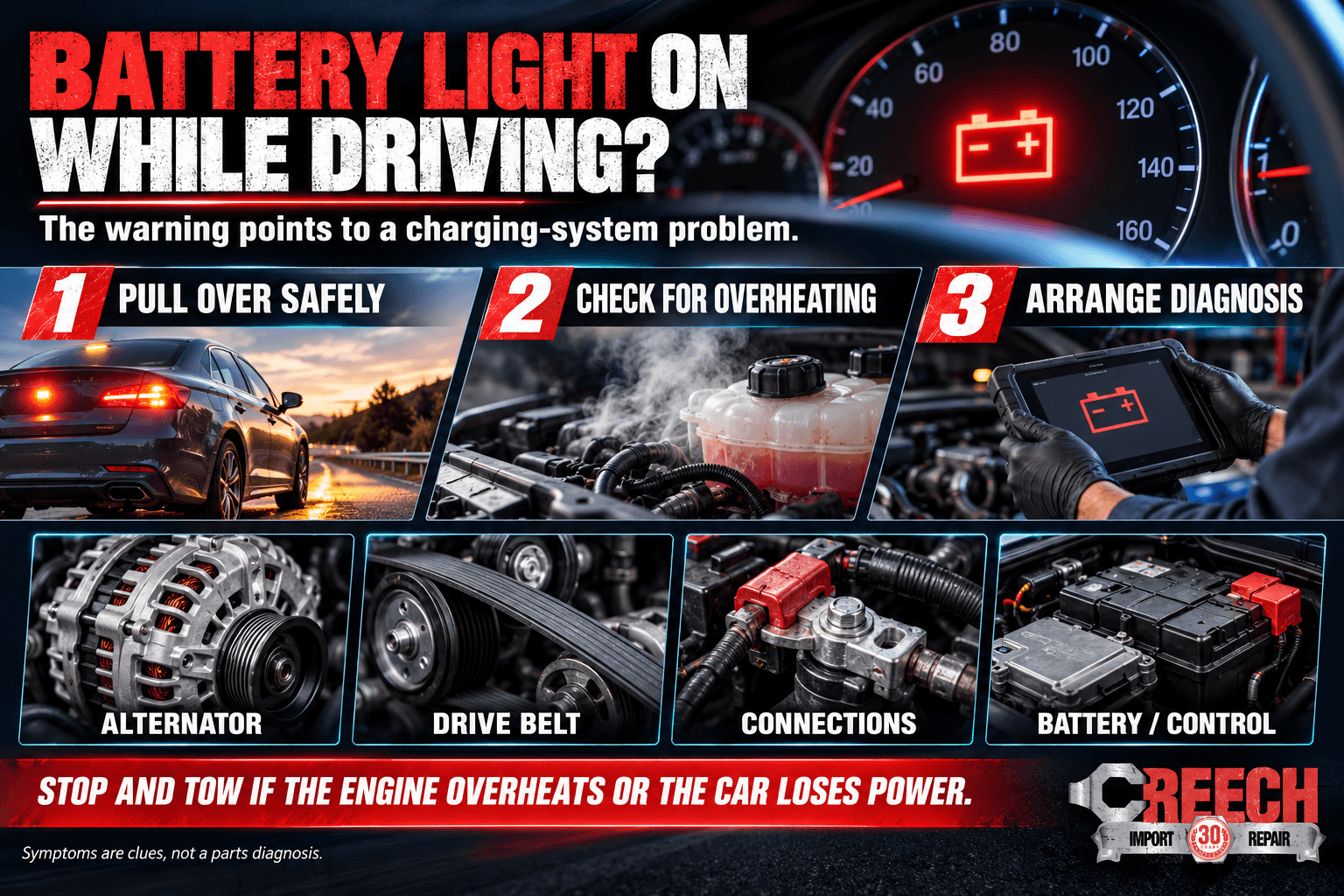
What Causes the Battery Warning Light to Come On?
A warning lamp identifies a system that needs investigation. It does not identify a single repair. These are common diagnostic directions and the evidence a technician should look for.
1. Alternator Output or Regulation
The alternator generates electricity while many conventional vehicles run. If it cannot supply the needed output, the battery may gradually discharge. Internal alternator faults, regulator behavior, or vehicle-controlled charging can be involved. Modern vehicles may vary charging output with operating conditions, so one voltage reading taken without context is not enough to condemn the alternator. A technician compares measured behavior with the correct service information and checks the rest of the circuit.
2. Drive Belt, Tensioner, or Pulley Trouble
A worn, loose, wet, slipping, or broken drive belt may prevent an alternator from turning correctly. A failing tensioner or pulley can create similar results. Squealing, a sudden loss of charging, or a warning that appears alongside overheating may raise suspicion, but the belt route and affected accessories differ by vehicle. Visual inspection and the appropriate belt-drive checks are necessary. Do not reach toward a running belt to see whether it feels tight.
3. Battery Terminals, Grounds, and Cables
Electrical power needs a reliable path. Corrosion, loose terminals, damaged cables, or a poor engine ground can interrupt charging or create intermittent warnings. A connection problem may appear after vibration, bumps, rain, or recent battery work. A battery can look clean while resistance exists elsewhere in the circuit. The technician can inspect the connections and test for excessive voltage loss under the conditions that reproduce the complaint.
4. Battery Condition
A weak or damaged battery may not accept or hold charge as it should. It can also be the result of an unresolved charging-system fault. Deep discharge and repeated jump-starts complicate battery testing, so a shop may need to charge the battery before evaluating its health. A new battery might temporarily start the vehicle while the underlying charging failure continues. The correct repair may involve the charging fault, the battery, or both, depending on the evidence.
5. Wiring, Fuse, Sensor, or Charging Control
Some vehicles use sensors and control modules to command charging behavior. A damaged wire, poor connection, relevant fuse or fusible link, sensor fault, or control problem may affect output or trigger a warning. Diagnostic trouble codes and live data can guide testing, but a code is not an instruction to replace the component named in its description. The shop should inspect the relevant circuit and verify power, ground, and commands for that vehicle.
What Do Different Warning Patterns Suggest?
| Pattern you notice | Possible direction | What to report or check |
|---|---|---|
| Lamp stays on and lights dim | Charging output or electrical connection | When dimming began; battery and circuit test |
| Lamp comes on with a squeal | Belt, tensioner, or pulley | Noise, belt condition, and temperature gauge |
| Lamp flickers on bumps or turns | Intermittent connection or belt behavior | Location and conditions when it flickers |
| Lamp and overheating warning | Possible shared belt or separate cooling fault | Stop safely; request a tow and full inspection |
| New battery, warning still on | Charging or circuit issue still present | Battery installation and charging-system tests |
These patterns are clues, not diagnoses. One symptom can have several causes. A shop should confirm the source before replacing a battery, alternator, or belt.
Battery Light Versus a Dead Battery: Why the Difference Matters
A battery light while the engine runs asks whether the charging system is supplying and managing power correctly. A car that will not start asks a broader question about starting power, connections, the starter, vehicle authorization, or the engine itself. The same charging problem can eventually cause a no-start, but the diagnostic starting point depends on when the symptom happens.
If your engine does not start but the lights still work, read Creech’s existing guide to a car that will not start when the lights work. It explains why lit dashboard lamps do not prove the battery can deliver the current needed to crank an engine. If the car starts but repeatedly loses charge while parked, the question may instead be battery health, incomplete charging, or a key-off electrical draw. Keep those situations separate when describing the vehicle to the service advisor.
A check engine light is also a different warning. Some electrical faults can affect several modules and set codes, but a battery icon does not automatically mean an engine-emissions problem. Likewise, an oil-pressure or coolant-temperature warning needs its own urgent response. If several warnings appear together, tell the shop their order and whether the vehicle lost power.
How Does a Repair Shop Diagnose the Actual Fault?
A careful diagnostic process begins with your account of the event: whether the warning appeared at startup or mid-drive, whether it flickers, what the temperature gauge did, and whether there was belt noise or a recent battery replacement. A technician then considers the vehicle’s exact year, make, model, engine, and charging design. This matters because the correct test procedure can differ even among vehicles from the same manufacturer.
The physical inspection may cover battery terminals, cable and ground connections, belt condition and routing, tensioner operation, and obvious wiring damage. Battery state of charge and health may need evaluation; a discharged battery can distort other test results. The technician can measure charging behavior under relevant operating conditions, review available diagnostic information, and test voltage loss across suspect circuits. If an intermittent complaint cannot be reproduced immediately, a documented test plan is better than guessing.
After the fault is repaired, the charging system and battery should be rechecked, and the warning should remain off during appropriate verification. Ask the shop which test established the failure and whether the battery suffered a deep discharge that requires charging or replacement. Creech Import Repair lists battery, alternator, wiring, and electrical-system service among its Raleigh offerings.
What Should You Avoid Doing?
- Do not replace the battery solely because the dashboard icon looks like one. Test the charging system and connections.
- Do not disconnect a battery cable with the engine running. That old shortcut is unsafe for modern vehicle electronics.
- Do not rely on a fixed remaining-driving-time estimate. Your vehicle’s condition and power demand are unknown.
- Do not turn off required lights or wipers to conserve power. Visibility and immediate road safety come first.
- Do not ignore a warning that goes out by itself. Intermittent charging problems still deserve inspection.
- Do not open a hot coolant cap or handle moving belts roadside. A charging warning may occur with other mechanical problems.
Can You Prevent a Charging Warning?
Not every failure is preventable, but routine inspections can find some developing problems. Have damaged or noisy drive belts, loose terminals, obvious corrosion, and starting difficulties examined before a trip. Follow the manufacturer’s maintenance guidance for the battery and belt system fitted to your vehicle. A battery test can help assess condition, but a passing battery test today does not guarantee a belt, connection, or alternator will never fail.
Pay attention to the sequence of early symptoms: slower cranking, flickering lights, unusual belt noise, repeated jump-starts, or accessories behaving erratically. These observations are valuable when reported together. Avoid assuming every dim lamp means a bad alternator; electrical loads, connections, and batteries must be checked in context. If you recently had a battery installed, tell the technician, because connection and battery-type details may matter.
Battery-Light Diagnosis in Raleigh, NC
Creech Import Repair is at 1818 St. Albans Dr #106, Raleigh, NC 27609. The shop lists automotive electrical diagnostics and services vehicles across the makes shown on its website. If the battery light appeared during a drive, call 919-872-1999 and explain whether the vehicle is already safely stopped, whether the warning stays on, and whether overheating or a steering change occurred. The team can discuss the appropriate next step for bringing the vehicle in. You can also request an appointment online; the request is not confirmed until a member of the service team verifies it.
Ask for a complete charging-system assessment rather than a particular replacement part. A clear explanation should connect the test results to the repair, explain the condition of the battery after the event, and include a verification step. The goal is to address the cause of the warning and help you avoid another unexpected stop.
Frequently Asked Questions
Does the battery light mean my battery is bad?
Not necessarily. A battery icon appearing while the engine runs usually signals that the charging system needs attention. The alternator, belt, wiring, terminals, grounds, controls, or battery may be involved. A weak battery can also result from a charging failure. A technician should evaluate the full system before deciding whether the battery, another component, or more than one part needs service.
Can I drive if the battery light is on but the car runs normally?
A car can feel normal while using stored battery energy. There is no reliable way to predict how long it will continue running, and it may stall or lose electrical functions. Move toward a safe place to stop, keep necessary safety equipment on, and request repair guidance. If the car overheats or handling changes, stop safely and arrange a tow.
Why did the light come on after I installed a new battery?
A new battery does not fix a charging fault. The alternator, belt, cable connections, grounds, or controls may still be causing the warning. Installation details and the specified battery type can also matter on some vehicles. Have the battery installation and charging system tested rather than assuming the new battery is defective or continuing to drive until it goes flat.
Why does my battery light flicker while driving?
An intermittent electrical connection, belt slip, or charging-control behavior may cause a light to flicker, among other possibilities. Note whether it happens over bumps, in rain, at idle, or with accessories on. A warning that goes out is still worth investigating because the underlying condition may return. A technician can test the circumstances and inspect the relevant circuits and belt drive.
What if the battery light and temperature warning appear together?
Stop in a safe place as soon as possible, switch off the engine, and arrange a tow. Depending on vehicle design, a failed accessory belt can affect both charging and engine cooling, though separate faults are possible. Overheating can damage the engine. Do not remove a hot cooling-system cap or try to touch the belt while components are moving.
Will turning off the AC help when the battery light comes on?
Switching off nonessential electrical accessories may reduce demand while you reach a safe stopping place. It is a short-term response, not a repair or a promise of extra driving time. Keep headlights, wipers, defogging, and other equipment in use whenever conditions require them. Arrange inspection because the warning may indicate a fault that can leave the vehicle stranded.
Is an alternator always the cause of a charging-system warning?
No. The alternator is one possible cause, but a loose or broken belt, corroded or damaged connections, weak battery, fuse, wiring, sensor, or control fault can produce similar symptoms. Vehicle-specific testing should establish whether charging output is wrong and why. Replacing the alternator solely because the lamp is on can waste money and leave the actual problem unresolved.
Can a battery light come on because of a broken serpentine belt?
Yes, on a vehicle whose belt drives the alternator, a broken or slipping belt can interrupt charging. Depending on the engine design, the same belt may also affect cooling or steering assistance. A squeal, rising temperature, or change in steering effort makes the situation especially urgent. Stop safely, shut the engine off if it overheats, and ask for professional help.
Should I jump-start the car after the battery light makes it stall?
A jump-start may get the engine running temporarily, but it does not repair a failed charging system and may not provide a safe journey. Repeated attempts can leave you stranded again, especially if a belt or overheating problem is involved. Follow your owner’s manual for any jump-start procedure and ask roadside assistance or a repair shop about towing and diagnosis.
Can Creech Import Repair diagnose a battery light in Raleigh?
Creech Import Repair lists electrical-system services that include battery, alternator, wiring, and related concerns. Call the Raleigh shop at 919-872-1999 with your vehicle’s year, make, and model and describe any temperature, steering, or drivability changes. Ask about safe transport if the warning remains on or the vehicle has already stalled. Online appointment requests require confirmation from the service team.
Sources and Further Reading
- Toyota Owners: Dashboard Symbols and Warning Lights — manufacturer guidance on the charging-system warning.
- AAA: What Is Wrong if the Battery or Charging-System Light Comes On? — general charging-warning causes and response.
- AAA: Signs Your Alternator May Need to Be Replaced — alternator symptoms and safe next steps.
- Creech Import Repair: Electrical System Service — local service scope.
About Creech Import Repair
Creech Import Repair is a Raleigh auto repair shop established in 1993. Its website lists ASE-certified technicians and automotive electrical-system services. For a battery or charging warning, describe the exact dashboard message and how the vehicle behaved so the team can advise on the next step. This article offers general education; the vehicle’s owner manual and an inspection determine the right response and repair for a specific car.
Find Creech Import Service articles useful?
Add this site to your Preferred Sources in Google Search.