


CREECH IMPORT REPAIR • RALEIGH, NORTH CAROLINA
A brake pedal should give you confidence at a stop. A new change in its travel deserves attention.
If your brake pedal sinks at a stop, the important question is whether it moves briefly as assistance activates or continues dropping while you hold steady pressure. Those experiences can have different explanations. A continuing descent, unusually low pedal, or change in stopping ability calls for professional assessment before you keep driving.
It is tempting to blame the master cylinder immediately, especially when there is no puddle under the car. However, pedal feel alone cannot identify the failed part. The useful next step is to describe the pattern accurately, recognize signs that require towing, and have the hydraulic and related systems checked using information for your vehicle.
Quick Answer: Why a Brake Pedal Sinks at a Stop
A brake pedal that keeps sinking at a stop may indicate fluid escaping from the hydraulic system or pressure bypassing internally, including a possible master-cylinder fault. Other conditions can produce a low or spongy pedal. If the pedal reaches the floor, stopping power decreases, or brake fluid visibly leaks, stop safely and arrange towing. Testing must confirm the cause.
In This Guide
What Does It Mean When a Brake Pedal Sinks at a Stop?
When a brake pedal sinks at a stop, your foot stays on the brake, but the pedal continues traveling farther down. That differs from a pedal that starts lower than usual and then holds its position. Both deserve attention when they are new or abnormal, but the distinction helps the technician choose the right diagnostic path.
In a conventional hydraulic system, the master cylinder converts pedal input into fluid pressure. That pressure operates the brakes at the wheels. Brake assistance reduces the effort needed from your leg. These functions work together, but a problem with assistance is not automatically the same as a loss of hydraulic pressure.
If your brake pedal sinks at a stop, be specific about the setting. Did the movement happen as the vehicle first started, after you had already stopped, or while an automatic brake-hold feature was active? Was the vehicle fully powered on? Had the brakes recently been serviced? These details make your description more useful without requiring you to perform a test.
Can a small initial pedal movement be normal?
Yes, some vehicles have a small, expected movement when assistance or a powered braking system activates. For example, the 2023 Honda Accord Hybrid owner’s manual describes a slight pedal sink when the power mode is switched on. That is a model-specific operating note, not permission to ignore continued pedal descent.
When a brake pedal sinks at a stop, there is no universal distance or number of seconds that makes an unfamiliar movement safe across every vehicle. Conventional vacuum-assisted brakes, electrically assisted systems, and hybrid braking arrangements can behave differently. Compare the observation with the correct owner’s manual and your vehicle’s established behavior, then seek professional guidance if it has changed.
When Should You Stop Driving and Arrange a Tow?
Do not continue driving with abnormal pedal travel or unreliable stopping. If a brake pedal sinks at a stop and reaches the floor, or braking force decreases, fluid visibly leaks, or the vehicle will not remain securely stopped, stop safely and request assistance. A short distance to home or the repair shop does not establish that the trip is safe.
If the vehicle is already parked, leave it parked instead of taking a drive to reproduce the symptom. If you are in traffic, concentrate on reaching a safe stopping place and follow the emergency guidance in your owner’s manual. Do not look at your phone or try to photograph the pedal while operating the vehicle.
Arrange towing rather than another test drive when:
- The pedal goes unusually low or reaches the floor.
- The vehicle takes more effort or distance to stop.
- Fluid leakage accompanies a change in braking.
- A brake warning appears together with abnormal pedal behavior.
- You cannot be confident the vehicle will stop and remain stopped.
Once safely stopped, explain the braking problem when requesting roadside assistance. Tell the operator if the vehicle is on a slope, cannot be secured normally, or has special towing requirements. Do not leave an unsecured vehicle unattended. If its position creates an immediate danger, contact emergency services and follow their instructions.
A brake pedal that briefly feels better after repeated presses still needs diagnosis. That improvement does not demonstrate that the underlying condition has disappeared. Likewise, the absence of a dashboard warning does not prove the hydraulic system is sound. Your observed loss of normal pedal behavior matters even when the instrument panel looks ordinary.
How Do Sinking, Soft, Low, and Hard Brake Pedals Differ?
When you report that a brake pedal sinks at a stop, distinguish continued descent from other pedal sensations to prevent a misunderstanding at the service desk. They are clues rather than diagnoses. You do not need to force your experience into one category: tell the technician if the pedal feels both soft and unusually low, or if its behavior changes from one stop to another.
| Pedal pattern | What the driver notices | Why the distinction matters |
|---|---|---|
| Sinking | The pedal continues descending under steady pressure. | Pressure retention and system operation need assessment. |
| Soft or spongy | The pedal feels springy or less resistant than usual. | Air or another hydraulic concern may be involved. |
| Low | More travel occurs before the brakes respond. | Clearance, adjustment, hydraulics, and repair history may matter. |
| Hard | Unusually high leg effort is needed. | Assistance or mechanical concerns require a different evaluation. |
| Brief initial movement | A small change occurs as the system activates. | Check the model’s operating guidance. Do not assume continued sinking is normal. |
Also distinguish a steady descent from a rapid pulse. Pedal pulsation during an actual anti-lock braking event is a different observation from a pedal slowly dropping while the car is stationary. If you are uncertain which occurred, describe the road conditions, whether the vehicle was moving, and any warning message instead of guessing the component.
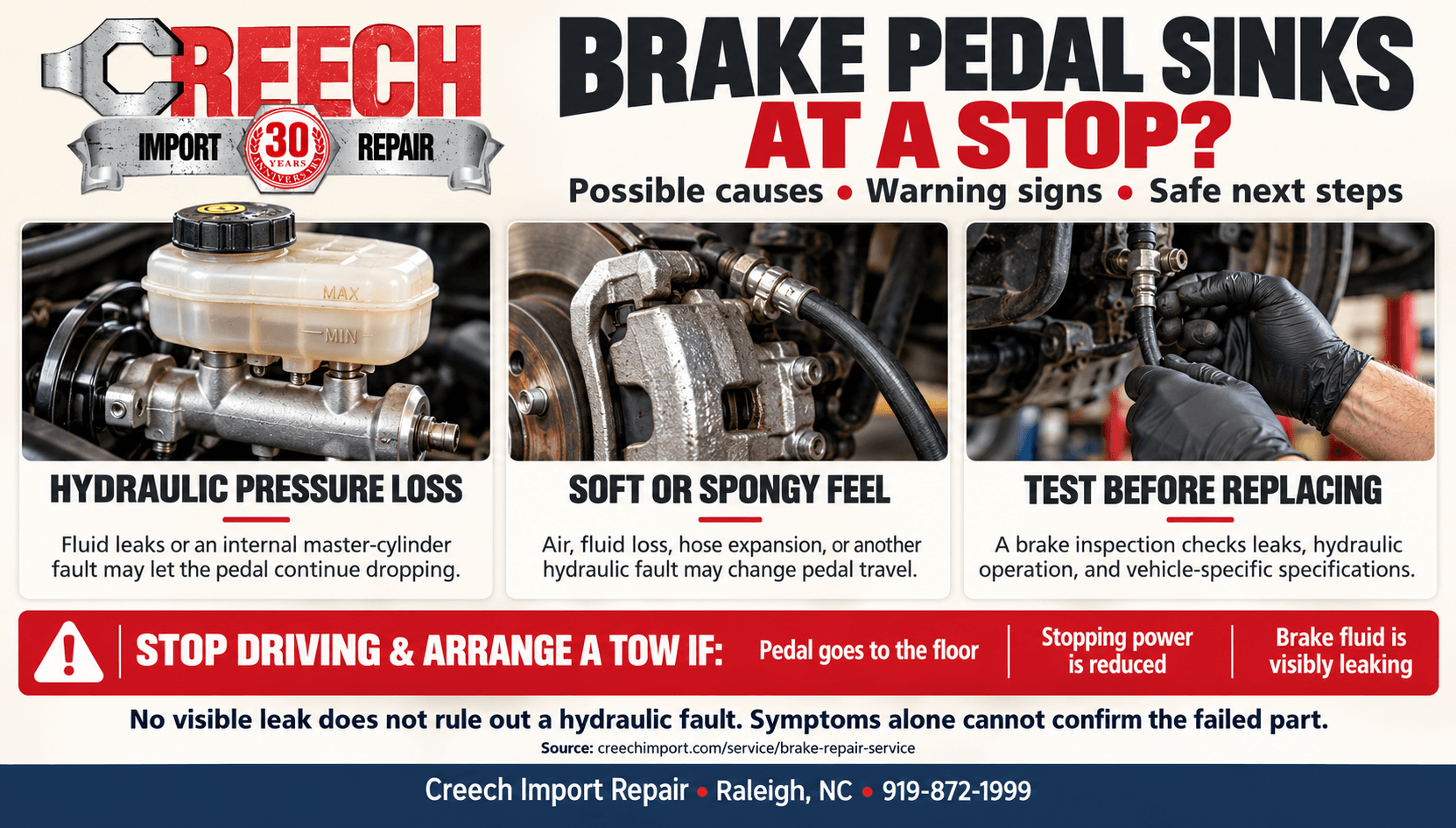
A visual guide to possible hydraulic problems, professional testing, and urgent warning signs.
What Can Cause the Brake Pedal to Keep Dropping?
When a brake pedal sinks at a stop, diagnostic possibilities include external leakage, an internal hydraulic fault, and other conditions that change pedal travel. A useful inspection separates the exact complaint from similar symptoms. It also checks whether more than one issue is present. For example, replacing worn friction material does not automatically address a separate pressure-retention problem.
1. Brake fluid escaping from the system
An external leak means fluid is leaving the hydraulic circuit. Potential inspection areas include lines, hoses, connections, calipers, wheel cylinders on applicable vehicles, and the master cylinder. The amount visible on the ground does not reliably show the full problem: fluid may collect on components or in locations that are difficult to see without proper access.
Tell the shop about any fresh wet area, but do not crawl beneath an unsupported vehicle or touch fluid to identify it. A photograph taken from a safe position can help document what you noticed. The technician still needs to establish the source and determine whether it is brake fluid rather than another vehicle fluid.
2. Internal master-cylinder bypass
The master cylinder must generate and retain pressure as the brakes are applied. If an internal sealing problem allows fluid to bypass where it should be contained, the pedal may continue moving without an obvious external puddle. That makes internal bypass a possibility worth investigating, but it is not a diagnosis that can be confirmed by feel alone.
The practical question for a repair estimate is: what evidence isolated the problem to this component? A recommendation should account for the rest of the system and the vehicle’s design. Replacing a master cylinder merely because an online symptom list mentions it can leave the original complaint unresolved if another fault was responsible.
3. Air or another cause of excessive hydraulic travel
Air is compressible, so air in a brake circuit can absorb pedal movement that should help apply the brakes. The result often feels soft or spongy. This is related to, but not necessarily identical to, a pedal that slowly loses its position. Hydraulic service history is especially useful when the complaint began after a circuit was opened.
Bleeding is a procedure for removing air; it does not repair every source of pressure loss. If a leak or other fault remains, simply bleeding the system may not provide a lasting correction. The technician must determine why the abnormal condition exists and follow the appropriate procedure for that braking system.
4. Hose, wheel-brake, or adjustment concerns
Other components can affect how much pedal movement is required. A damaged hose, excessive clearance, or an adjustment concern on an applicable brake design can complicate the complaint. These possibilities are reasons for inspecting the whole relevant circuit, rather than assuming that every low pedal originates in the same place.
Ask whether the concern involves pressure escaping, movement being used to take up clearance, or an assistance problem. You do not need to make that distinction yourself. It is a useful way to understand the shop’s explanation and why its proposed repair addresses the symptom you reported.
5. ABS hydraulic or electronically controlled braking faults
Depending on the vehicle, the anti-lock braking system and related controls include hydraulic valves, a pump, sensors, and electronic functions. A fault in this system may require testing beyond a basic visual inspection. However, an ABS warning does not automatically identify a defective hydraulic unit, and an unusual pedal does not automatically prove an ABS fault.
HELLA’s technical overview of ABS and ESP control units explains the interaction of electronic control and hydraulic components. For an individual vehicle, diagnostic codes, measurements, service information, and functional checks must be interpreted together before an expensive component is condemned.
Can the Pedal Sink When There Is No Leak or Warning Light?
Yes. A brake pedal sinks at a stop without a visible puddle in some cases; no puddle does not rule out an internal hydraulic problem or a leak hidden from ordinary view. Similarly, warning lights monitor particular conditions; they are not a complete pass-or-fail assessment of every brake component. A changing pedal should be evaluated on its own merits, not dismissed because the dashboard has remained quiet.
A reservoir that appears full also cannot verify pressure retention. Fluid quantity and the system’s ability to hold pressure are different questions. Avoid using a fluid top-up as a diagnostic experiment or treating it as permission to drive. If fluid is low, the reason matters, and the correct fluid specification must come from the vehicle manufacturer.
An intermittent complaint still deserves a clear record. Note when it happened and when it did not, without repeatedly operating the vehicle to investigate. An issue that disappears before the appointment may require additional diagnostic planning. Tell the shop about the most concerning episode, not only how the pedal felt the last time you touched it.
What If the Pedal Changed After Brake Work?
If your brake pedal sinks at a stop after service, or feels very low or spongy, report the change promptly. Do not assume that a hydraulic pedal problem is a normal part of bedding in new pads. Contact the shop, explain exactly what changed, and discuss safe transport before returning the vehicle if normal braking is uncertain.
Provide the repair invoice if possible. Replacing pads, opening a hydraulic line, installing a caliper, servicing a master cylinder, and working on an ABS hydraulic unit involve different diagnostic questions. The timing of the symptom is valuable evidence, but it does not establish that one particular procedure was performed incorrectly.
Useful follow-up questions include whether the hydraulic system was opened, which components were replaced, and how operation was verified before the vehicle was released. On some designs, service procedures require additional equipment or electronically commanded steps. Generic bleeding instructions from a different model may not apply, even when the two vehicles look similar.
How Should a Professional Brake Inspection Approach the Problem?
An inspection when a brake pedal sinks at a stop should establish what is abnormal, locate the responsible system or component, and explain how the findings support the repair. The exact order and procedures depend on the vehicle. A shop should not need you to perform a road test or disassemble anything at home to make your report worthwhile.
Confirm the operating conditions
The technician needs the year, make, model, and relevant equipment before comparing pedal behavior with service information. Whether the symptom occurs during startup, with brake hold, at a stationary stop, or after heating up helps define the concern. Clear notes can be more useful than describing the pedal simply as “bad.”
Inspect and test the relevant components
Evaluation may involve the reservoir, accessible hydraulic components, hoses, lines, wheel brakes, and assistance system, followed by further testing as indicated. The objective is to distinguish among competing explanations. HELLA’s workshop brake-check guidance also illustrates why brake complaints require examination of relevant components rather than a symptom-based parts swap.
Use electronic information where appropriate
If the vehicle has related warning messages or an electronically controlled system, scan information may guide further checks. Ask what a code indicates and what confirmed the proposed failure. A stored code can identify a circuit or operating concern without proving that replacing the named component is the correct remedy.
Verify the original complaint after repair
Completion should address the symptom that brought the vehicle in, not merely the installation of a new part. Ask how the shop checked for leakage, appropriate pedal behavior, and correct system operation after the work. Verification should follow the vehicle’s procedures and occur only under conditions the technician has determined are safe.
What Should You Tell the Shop Before the Appointment?
If your brake pedal sinks at a stop, report the observations you already have. You do not need to collect every item on a checklist before contacting the shop, and you should not delay assistance to investigate a braking concern. Start with whether the vehicle can stop normally, where it is located, and whether it needs towing.
- Vehicle: year, make, model, and whether it is a hybrid or has brake-hold features.
- Pedal behavior: continued sinking, softness, excessive travel, unusually high effort, or a combination.
- Timing: startup, a stationary stop, after recent service, or after the vehicle has been driven.
- Stopping: any change in effort, distance, or ability to remain stopped.
- Other clues: warning messages, visible wet areas, unusual sounds, or odors.
- History: recent brake repairs, fluid service, and any previous diagnosis of the same symptom.
A concise description could be: “The pedal kept moving lower while I was stopped with steady pressure. This started after yesterday’s drive. I have parked the vehicle and need advice about towing it in.” Use only details that actually happened; there is no need to guess whether the master cylinder, a caliper, or the ABS unit is responsible.
What Should a Written Repair Estimate Explain?
A useful estimate connects the confirmed finding with the proposed work. The price depends on the actual fault, the vehicle, parts availability, and required procedures. A single online cost range for a “sinking pedal repair” can be misleading because that phrase describes a symptom rather than a specific repair.
Ask which component failed, what testing supports that conclusion, and whether any additional work is essential to complete the repair correctly. Separate the immediate braking concern from unrelated maintenance recommendations. If fluid service or another part is included, request a plain-language explanation of its role in correcting or verifying the fault.
Also ask what is included in the diagnostic charge, whether further authorization is needed if additional faults are found, and what warranty terms apply to the proposed work. Before collecting the vehicle, make sure you understand what was repaired and what to do if the original pedal behavior returns.
Where Can Raleigh Drivers Get Help With a Sinking Brake Pedal?
If your brake pedal sinks at a stop, Creech Import Repair offers brake inspection and repair in Raleigh. Contact the team with your vehicle information and a description of the pedal concern. If stopping is abnormal, arrange towing rather than driving to the appointment. Online appointment requests require confirmation from the service team.
The purpose of contacting the shop first is practical: establish how the vehicle will arrive, explain any securing or unloading concern, and give the team the information needed to prepare for diagnosis. Do not treat a booking confirmation as a determination that the vehicle is safe to drive. That requires an assessment of the actual braking condition.
Get the Cause Checked Before Replacing Parts
Creech Import Repair
1818 St. Albans Dr #106, Raleigh, NC 27609
Monday–Friday, 7:30 a.m.–5:30 p.m.
Frequently Asked Questions
What should I do if my brake pedal sinks at a stop?
If a brake pedal sinks at a stop under steady pressure, the hydraulic system may not be retaining pressure normally. External fluid loss or an internal fault, including possible master-cylinder bypass, may be involved. The exact behavior must be checked against the vehicle’s design. If travel or stopping has become abnormal, leave the vehicle parked and arrange professional assessment rather than repeating the symptom on a drive.
Can a master cylinder leak internally without leaving a puddle?
Yes. Internal bypass can allow fluid to move past a sealing surface inside the master cylinder without escaping onto the ground. However, no puddle does not prove that the master cylinder is responsible. A hidden external leak or another system concern may also require investigation. The repair recommendation should be based on diagnostic findings that isolate the fault, not simply the absence of visible fluid.
Is a small pedal drop when starting the vehicle normal?
A small initial movement can be normal on some vehicles as brake assistance or powered braking activates. If a brake pedal sinks at a stop continuously, that is a different pattern. The correct owner’s manual is the reference for your model. That limited movement is different from a pedal that continues descending or reaches an unusually low position. A new change, associated warning, or loss of normal stopping should be assessed rather than assumed to be ordinary startup behavior.
Can air in the brake lines cause a low pedal?
Air can compress when you apply the pedal, contributing to softness or additional travel. This possibility is especially relevant when hydraulic service or fluid loss preceded the change. However, air is not the explanation for every sinking pedal, and bleeding does not fix a continuing leak or failed component. A technician should determine the cause and use the correct bleeding procedure for that vehicle.
Why did my brake pedal change after brake service?
The answer depends on what work was performed and how the pedal changed. Hydraulic work raises different questions from a friction-material replacement, and model-specific procedures may be needed. Report the concern to the shop promptly and provide the invoice. Do not dismiss a sinking or excessively low pedal as normal pad bedding, and discuss towing if you cannot rely on normal braking.
Does pumping the pedal make the vehicle safe to drive?
No. A temporarily firmer pedal after repeated presses does not confirm that the braking system has recovered or that the next stop will be normal. It is a symptom to report, not a repair or a safety test. If pedal travel or stopping is abnormal, do not set out on a drive because the pedal briefly feels better. Arrange professional assistance.
Can an ABS hydraulic fault cause a sinking pedal?
An ABS hydraulic concern can be part of the diagnostic picture on some vehicles, but pedal feel alone cannot identify it. Codes and warning lights must also be interpreted with testing and service information. Replacing an ABS hydraulic unit without confirming its role can miss another cause. Ask the shop what findings distinguish an ABS-related fault from a master-cylinder, line, hose, or wheel-brake concern.
What information should I give the shop before arranging a tow?
Provide the year, make, model, current location, and the most serious braking symptom you experienced. Mention any warning lights, visible leakage, recent repairs, and difficulty keeping the vehicle secured. Tell the towing operator about hybrid, electric, all-wheel-drive, or other relevant vehicle details so the correct handling procedure can be checked. You do not need to identify the failed component before requesting help.
Sources and Vehicle-Specific Guidance
This guide explains symptom patterns and questions to discuss with a repair professional. It does not establish a diagnosis or a universal acceptable pedal-travel limit. The correct owner’s manual and manufacturer service information govern vehicle-specific procedures.
- Creech Import Repair: brake services, warning signs, and inspection information
- Honda: 2023 Accord Hybrid owner’s manual, turning on the power
- HELLA Tech World: checking the brakes
- HELLA Tech World: ABS and ESP control units
- Ferodo: brake efficiency and hydraulic-fluid performance
About Creech Import Repair
Creech Import Repair is a Raleigh automotive repair business serving drivers since 1993. Its brake services include inspection and diagnosis of friction, hydraulic, and related components. Learn more about the shop’s brake repair services or contact the service team with your vehicle details.
Find Creech Import Service articles useful?
Add this site to your Preferred Sources in Google Search.