


Car Overheating Raleigh NC? Common Causes and When to Schedule Cooling System Repair
If you are searching for car overheating Raleigh NC, you are probably dealing with a temperature gauge that is climbing, coolant that keeps disappearing, steam from under the hood, or an engine that runs hot in traffic. These symptoms should not be ignored because an overheating engine can lead to serious damage if the vehicle is driven too long.
Raleigh NC drivers often deal with the problem during hot weather, stop-and-go traffic, long commutes, or heavy truck and SUV use. If your temperature gauge is rising, coolant keeps disappearing, steam comes from under the hood, or your engine runs hot at idle, your vehicle may need professional cooling system repair.
An overheating engine should never be ignored. Your vehicle’s cooling system is designed to manage engine temperature by circulating coolant through the engine, radiator, thermostat, water pump, hoses, heater core, coolant reservoir, and cooling fans. When one part fails, the engine can overheat quickly.
Creech Import Repair provides cooling system repair in Raleigh, NC for many import and domestic cars, trucks, SUVs, crossovers, and hybrids. Our ASE-certified technicians inspect the full system, identify the cause, and explain the right repair before work begins.
If your car, truck, or SUV is overheating in Raleigh traffic, call 919-872-1999 or schedule service online.
Why an Overheating Engine Is Serious
Your engine creates heat every time it runs. The cooling system keeps that heat under control so the engine can operate safely. If the temperature rises too high, internal engine parts can expand, warp, leak, or fail.
Driving while the engine is overheating can lead to:
- Damaged head gaskets
- Warped cylinder heads
- Radiator damage
- Water pump failure
- Hose failure
- Internal engine damage
- Breakdown or towing
- More expensive repairs
A vehicle may seem to run normally again after cooling down, but that does not mean the problem is gone. If the system is low on coolant, leaking, restricted, or not circulating properly, the overheating can return.
That is why Creech Import Repair recommends scheduling a diagnostic inspection as soon as you notice the temperature gauge rising, coolant leaking, or steam coming from under the hood.
Common Questions Raleigh Drivers Ask About Overheating
- Why does my car overheat only when idling?
- Why does my temperature gauge rise when the AC is on?
- Why does my coolant keep disappearing?
- Can I drive if my car overheated once?
- Why does my car cool down when I start driving?
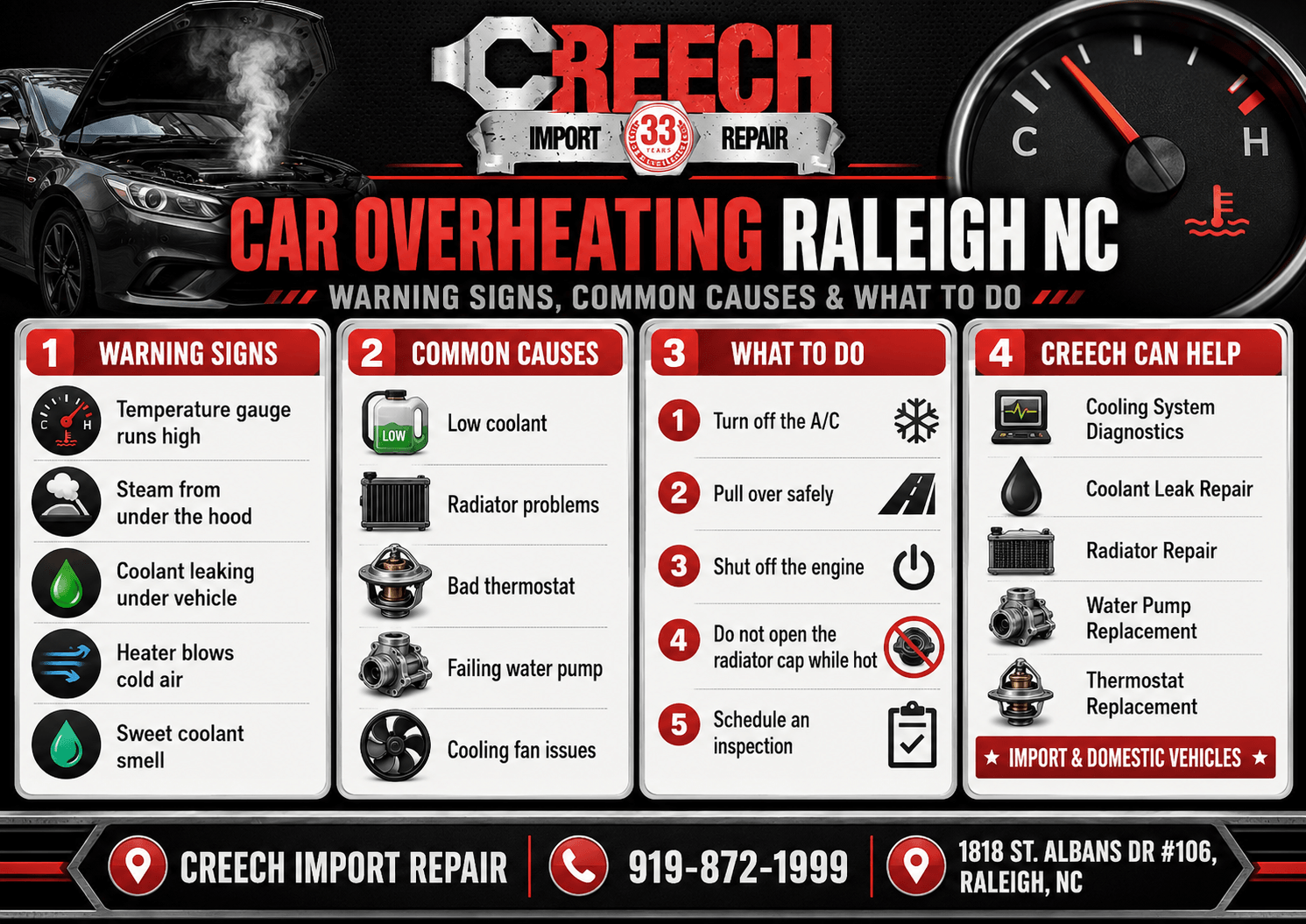
Common Signs Your Car Is Overheating
Some overheating symptoms are obvious. Others are easier to miss until the problem becomes more serious.
The Temperature Gauge Is Higher Than Normal
A rising temperature gauge is one of the clearest signs of a cooling system problem. If the needle moves higher than usual or approaches the red zone, the engine is running hotter than it should.
This may be caused by low coolant, a coolant leak, stuck thermostat, failing water pump, clogged radiator, bad cooling fan, weak radiator cap, air trapped in the system, or an internal engine issue.
Steam Comes From Under the Hood
Steam is a warning sign that coolant may be boiling or escaping from the system. If you see steam, pull over safely and turn off the engine.
Do not open the radiator cap or coolant reservoir while the engine is hot. Hot coolant can be pressurized and dangerous.
Coolant Is Leaking Under the Vehicle
Coolant may appear green, orange, pink, yellow, or blue depending on the vehicle. If you see fluid under the front of your car, truck, or SUV, the system may have a leak.
Common leak points include the radiator, radiator cap, upper and lower hoses, water pump, thermostat housing, coolant reservoir, heater hoses, heater core, clamps, fittings, or engine gaskets.
The Heater Blows Cold Air
A heater that blows cold air can point to a cooling system issue. Your heater uses hot coolant to warm the cabin. If the coolant level is low, the heater core is restricted, the thermostat is not working correctly, or air is trapped in the system, the heater may not work properly.
This symptom is easy to overlook during warm weather, but it can be an early warning sign.
The Coolant Level Keeps Dropping
Coolant should not need constant topping off. If you keep adding coolant, there is likely a leak or pressure issue somewhere in the system.
A small leak can become a major overheating problem during Raleigh summer driving.
The Engine Overheats While Idling
If your vehicle overheats at stoplights, in school pickup lines, or in traffic but cools down when driving, the issue may involve the cooling fan, radiator airflow, thermostat, water pump, temperature sensor, or electrical control circuit.
This is especially common in Raleigh stop-and-go traffic on I-440, I-540, Capital Boulevard, Glenwood Avenue, Wake Forest Road, and Six Forks Road.
Why Cars Overheat in Raleigh Traffic
Raleigh Triangle driving conditions can make cooling system problems show up faster. A weak cooling system may seem fine on mild days, then fail when summer heat, traffic, and long idle times increase engine load.
Overheating problems often become more noticeable during:
- Stop-and-go traffic on I-440 and I-540
- Long waits on Capital Boulevard, Glenwood Avenue, Wake Forest Road, and Six Forks Road
- Afternoon summer driving
- Towing or hauling
- Heavy SUV and truck use
- Long commutes across Wake County
- Parking in direct sun
- Work trucks idling for long periods
- Road trips from Raleigh to the coast or mountains
If your vehicle only overheats in traffic, the system still needs attention. A cooling system should be able to manage engine temperature during normal Raleigh driving conditions.
Common Causes of Car Overheating
Overheating can come from several different parts of the cooling system. Accurate diagnosis matters because the same symptom can have more than one cause.
Low Coolant
Low coolant is one of the most common causes of overheating. If there is not enough coolant in the system, heat cannot move away from the engine properly.
Low coolant is usually caused by a leak, improper filling, evaporation from a pressure issue, or an internal engine problem. The cause should be identified before simply adding more coolant.
Coolant Leak
A coolant leak can happen at several points in the system. Some leaks leave a visible puddle. Others only appear when the system is hot and under pressure.
A coolant leak may come from:
- Radiator
- Radiator cap
- Upper radiator hose
- Lower radiator hose
- Heater hoses
- Water pump
- Thermostat housing
- Coolant reservoir
- Hose clamps
- Heater core
- Intake gaskets
- Engine gaskets
- Cooling system fittings
Creech Import Repair can pressure test the system, inspect the components, and locate the source of the leak.
Radiator Problems
The radiator helps release heat from the coolant. If the radiator is clogged, leaking, damaged, corroded, or restricted, the engine may run hot.
Radiator problems may cause overheating in traffic, coolant loss, visible leaks, rusty coolant, or temperature fluctuation.
Bad Thermostat
The thermostat controls coolant flow based on engine temperature. If it sticks closed, coolant may not circulate properly, and the engine can overheat. If it sticks open, the engine may take too long to warm up or operate below its intended temperature range.
Thermostat problems can also cause the temperature gauge to fluctuate.
Water Pump Failure
The water pump circulates coolant through the engine and radiator. If it fails, coolant may not move properly through the system.
Signs of water pump trouble may include overheating, coolant leaks, whining or grinding noises, steam, temperature spikes, or poor coolant circulation.
Cooling Fan Problems
Cooling fans help move air through the radiator when the vehicle is stopped or moving slowly. If the fan does not operate correctly, the vehicle may overheat at idle or in traffic.
A cooling fan issue may involve the fan motor, relay, fuse, wiring, temperature sensor, control module, or another electrical concern. Creech Import Repair can also inspect related electrical system repair issues when fan operation is part of the problem.
Radiator Hose Failure
Radiator hoses carry coolant between the engine and radiator. Over time, hoses can become soft, swollen, cracked, brittle, or loose.
A failed hose can cause sudden coolant loss and fast overheating.
Weak Radiator Cap or Pressure Issue
The radiator cap helps maintain the correct pressure in the cooling system. If the cap is weak or not sealing properly, coolant can boil at a lower temperature or escape from the system.
A pressure issue may also cause coolant to push into the reservoir or leak from weak points.
Air Trapped in the Cooling System
Air pockets can prevent coolant from circulating correctly. This may happen after a repair, coolant loss, improper filling, or certain system faults.
Air trapped in the system can cause overheating, poor heat, gurgling sounds, or temperature fluctuations.
Heater Core Problems
The heater core helps warm the cabin using hot coolant. If it leaks or becomes restricted, you may notice poor heat, coolant smell inside the vehicle, foggy windows, wet carpet, or coolant loss.
Internal Engine Problems
In some cases, overheating may be related to internal engine concerns. These issues require careful diagnosis because symptoms can overlap with normal cooling system failures.
If the vehicle overheats repeatedly, loses coolant with no visible leak, or shows signs of contamination, the system should be inspected before more damage occurs.
What to Do if Your Car Starts Overheating
If your temperature gauge rises or steam appears under the hood, take action quickly.
- Turn off the AC.
- Turn on the heater if it is safe and tolerable. This may help pull heat away from the engine temporarily.
- Pull over as soon as it is safe.
- Turn off the engine.
- Do not open the radiator cap or coolant reservoir while the engine is hot.
- Wait for the engine to cool.
- Call for help if the vehicle continues to overheat, leaks coolant, or shows steam.
Do not keep driving an overheating vehicle unless you must move it for safety. Even a short drive with a severely overheated engine can cause serious damage.
Is Overheating Related to Auto AC Problems?
Cooling system repair and auto AC repair are different services, but some symptoms can overlap.
Your cooling system protects the engine from overheating. Your AC system keeps the cabin cool.
If the engine temperature gauge is high, coolant is leaking, or steam is coming from under the hood, the issue likely involves the engine cooling system. If the cabin vents blow warm air but the engine temperature is normal, the issue may involve the AC system.
However, some vehicles may show both symptoms at the same time. For example, if a cooling fan is not operating correctly, the AC may blow warm air in traffic and the engine may also run hotter than normal.
If your cabin AC is not cooling, visit our auto AC repair in Raleigh, NC page. If your engine is overheating or losing coolant, schedule cooling system repair.
Overheating in Import and Domestic Vehicles
Creech Import Repair services many import and domestic cars, trucks, SUVs, crossovers, and hybrids. Cooling system problems can affect any vehicle, but certain driving patterns make them more common.
Daily commuters may notice overheating in traffic. Family SUVs may run hot during summer trips. Work trucks may overheat while idling or hauling. Domestic trucks and SUVs may show problems during towing or heavy use.
Toyota and Honda Overheating Problems
Creech Import Repair provides cooling system diagnostics for many Toyota and Honda models, including Toyota Camry, Corolla, RAV4, Highlander, Tacoma, Tundra, 4Runner, Prius, Sienna, Honda Accord, Civic, CR-V, Pilot, Passport, Odyssey, and Ridgeline.
For related service information, visit our Toyota repair and Honda repair pages.
Subaru, Nissan, Hyundai, Kia, Lexus, Acura, and Infiniti Overheating Problems
We also service cooling systems on many Subaru, Nissan, Hyundai, Kia, Lexus, Acura, Infiniti, and other import vehicles.
If your Subaru Outback, Nissan Rogue, Hyundai Santa Fe, Kia Telluride, Lexus RX, Acura MDX, or Infiniti QX60 is overheating, leaking coolant, or showing temperature warnings, our technicians can inspect the system and recommend the right repair.
For related service information, visit our Subaru repair, Nissan repair, Hyundai repair, Kia repair, Lexus repair, Acura repair, and all makes we service pages.
Chevrolet, GMC, Ford, Ram, Dodge, Jeep, Buick, Cadillac, Chrysler, and Lincoln Overheating Problems
Creech Import Repair now provides domestic auto repair for many domestic cars, trucks, and SUVs.
We can help with overheating, coolant leaks, radiator concerns, water pump issues, thermostat problems, cooling fan failures, and related temperature problems on vehicles such as Chevrolet Silverado, Tahoe, Suburban, Equinox, Traverse, GMC Sierra, Yukon, Acadia, Terrain, Ford F-150, Explorer, Escape, Expedition, Ram trucks, Jeep Grand Cherokee, Jeep Wrangler, Buick Enclave, Cadillac Escalade, Chrysler Pacifica, and related models.
For related domestic service information, visit our Chevrolet repair and GMC repair pages.
Truck and SUV Overheating in Raleigh
Trucks and SUVs often place extra demand on the cooling system. Larger engines, heavier curb weight, towing, hauling, long idle times, and summer traffic can make cooling problems show up faster.
Schedule a cooling system inspection if your truck or SUV:
- Overheats while towing
- Runs hot in traffic
- Leaks coolant after parking
- Shows a temperature warning light
- Has weak cabin heat
- Smells like coolant
- Loses coolant between services
- Has a noisy water pump
- Has a cracked or swollen radiator hose
Creech Import Repair services many import and domestic trucks and SUVs, including Toyota Tacoma, Toyota Tundra, Nissan Frontier, Chevrolet Silverado, GMC Sierra, Ford F-150, Ram trucks, Chevrolet Tahoe, GMC Yukon, Toyota 4Runner, Honda Pilot, Subaru Ascent, Jeep Grand Cherokee, and related vehicles.
How Creech Import Repair Diagnoses Overheating
Creech Import Repair uses a diagnostic-first process to identify the cause of overheating. We do not guess at the repair.
1. Review the Symptoms
We ask when the issue happens. Does the engine overheat at idle? Does it run hot on the highway? Is coolant disappearing? Is there steam, odor, or a visible leak?
2. Inspect Coolant Level and Condition
We check coolant level and condition when the engine is safe to inspect. Low, rusty, oily, sludgy, or contaminated coolant can point to different problems.
3. Inspect Visible Components
We inspect hoses, clamps, radiator, coolant reservoir, water pump area, belts, fans, fittings, and signs of dried or active coolant leakage.
4. Pressure Test the Cooling System
A pressure test can help reveal leaks that may not appear when the system is cold or not under pressure.
5. Test Fan Operation
We check whether the cooling fan operates properly, especially if the vehicle overheats at idle or in traffic.
6. Evaluate Thermostat and Water Pump Operation
If the symptoms point to circulation problems, we inspect whether coolant appears to be moving properly and whether the thermostat is opening as expected.
7. Check Related Electrical and Engine Data
Some overheating issues involve sensors, wiring, fan controls, or check engine light data. If needed, we inspect related systems to avoid missing the root cause.
8. Explain the Repair
After diagnosis, we explain what failed, why it matters, and what repair is recommended. You receive a clear estimate before work begins.
When to Schedule Cooling System Repair
Schedule cooling system repair if your vehicle shows any of these symptoms:
- Temperature gauge runs high
- Steam comes from under the hood
- Coolant leaks under the vehicle
- Coolant level keeps dropping
- Heater blows cold air
- Sweet coolant smell after driving
- Engine overheats at idle
- Engine overheats in traffic
- Check engine light appears with temperature concerns
- Radiator hose looks swollen, cracked, or soft
- Vehicle overheats while towing or hauling
If your engine is overheating, do not wait for the problem to become a breakdown.
Why Choose Creech Import Repair?
Creech Import Repair has served Raleigh drivers since 1993. Our ASE-certified technicians provide honest diagnostics, clear communication, and professional service for many import and domestic vehicles.
Drivers choose Creech Import Repair because we offer:
- Cooling system diagnostics
- Overheating diagnosis
- Coolant leak detection
- Radiator repair and replacement
- Water pump replacement
- Thermostat replacement
- Hose and clamp inspection
- Cooling fan diagnosis
- Heater core diagnosis
- Pressure testing
- Check engine light diagnostics
- Electrical system repair
- Oil change service
- Tune-up and maintenance
- NC State Inspection
If your vehicle is overheating or leaking coolant, Creech Import Repair can inspect the system and recommend the right repair.
Cooling System Repair Near Raleigh, NC
Creech Import Repair is located at 1818 St. Albans Dr #106, Raleigh, NC 27609. Our shop is convenient for drivers from North Raleigh, Midtown Raleigh, Wake Forest, Knightdale, Cary, Morrisville, Garner, Rolesville, and surrounding Wake County communities.
If your car, truck, or SUV is overheating, leaking coolant, losing coolant, or running hot in Raleigh traffic, schedule service today.
Call 919-872-1999 or schedule your appointment online.
Frequently Asked Questions About Car Overheating in Raleigh, NC
Why is my car overheating in Raleigh traffic?
Your car may be overheating in Raleigh traffic because of low coolant, a coolant leak, bad cooling fan, failing water pump, stuck thermostat, clogged radiator, weak radiator cap, air trapped in the system, or an electrical control issue. Stop-and-go traffic and summer heat can make an existing cooling system problem worse.
Is it safe to drive when my car is overheating?
No. Driving with an overheating engine can cause serious damage. Pull over safely, turn off the engine, and let it cool. Do not open the radiator cap or coolant reservoir while the engine is hot.
Why does my coolant level keep dropping?
Coolant loss usually means there is a leak or pressure issue. The leak may come from the radiator, hose, water pump, thermostat housing, heater core, coolant reservoir, radiator cap, or engine gasket. The system should be inspected and pressure tested.
Why does my car only overheat while idling?
If your vehicle overheats while idling but cools down while driving, the issue may involve the cooling fan, radiator airflow, fan relay, temperature sensor, wiring, thermostat, or coolant circulation.
Can a bad thermostat make my car overheat?
Yes. A thermostat that sticks closed can prevent coolant from circulating properly, causing the engine to overheat. A thermostat that sticks open may cause the engine to warm up slowly or operate below its intended temperature range.
What are signs of a bad water pump?
Signs of a bad water pump may include overheating, coolant leaks, whining or grinding noises, steam, temperature spikes, or poor coolant circulation. Because the water pump moves coolant through the system, it should be inspected quickly if failure is suspected.
Can the AC make my engine overheat?
Running the AC can add load to the engine and cooling fans. If the cooling system is already weak, or if a fan or electrical control is failing, the engine may run hotter when the AC is on. The cooling system should be diagnosed to find the cause.
Is overheating the same as an AC problem?
No. Overheating usually involves the engine cooling system. An AC problem usually affects cabin comfort. If the temperature gauge is high or coolant is leaking, schedule cooling system repair. If the cabin vents blow warm air, schedule auto AC repair.
Do you repair overheating problems on domestic vehicles?
Yes. Creech Import Repair services many import and domestic vehicles, including Chevrolet, GMC, Ford, Ram, Jeep, Buick, Cadillac, Chrysler, Lincoln, Toyota, Honda, Subaru, Nissan, Hyundai, Kia, Lexus, Acura, and related models.
How do I schedule overheating diagnostics in Raleigh?
Call Creech Import Repair at 919-872-1999 or schedule an appointment online. The shop is located at 1818 St. Albans Dr #106 in Raleigh, NC.