


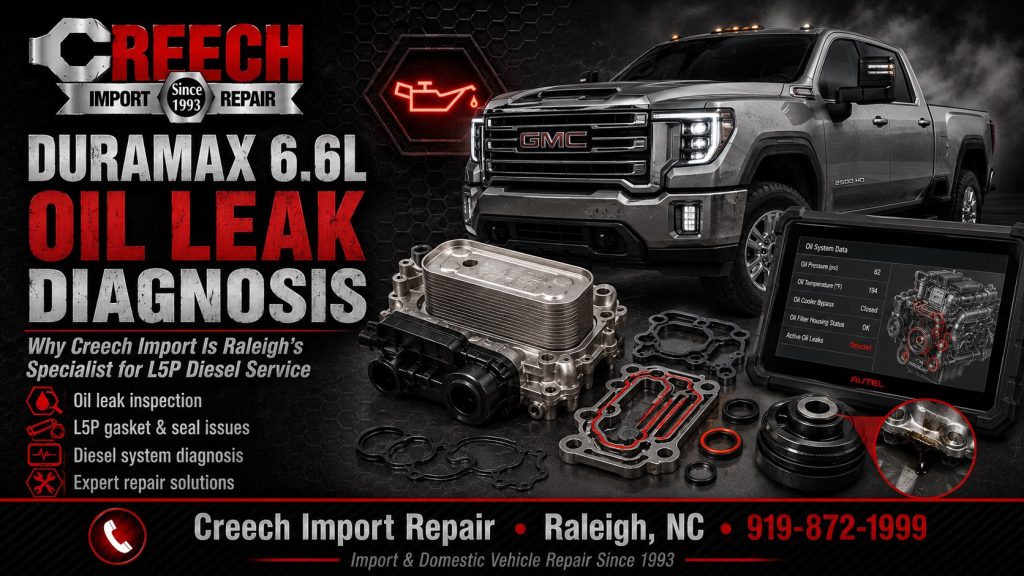
Duramax 6.6L oil leaks are a known concern for owners of 2024-2026 Silverado 2500HD/3500HD and Sierra 2500HD/3500HD trucks equipped with the 6.6L Duramax diesel engine (RPO L5P). These oil leaks can occur from the engine oil cooler seal, oil pan gasket, rear main seal, or other locations, and if left unaddressed, they can lead to low oil pressure, engine wear, and potentially catastrophic failure. At Creech Import, we have been diagnosing and repairing Duramax diesel engines since their introduction in 2001, and we understand exactly how the L5P engine is built, what causes oil leaks, and how to identify problems early. This comprehensive guide explains the most common Duramax 6.6L oil leak sources, what symptoms to watch for, how proper diagnosis can save you from unnecessary repairs, and why Creech Import is Raleigh’s trusted choice for diesel engine diagnosis and repair.
Understanding the L5P Duramax Engine – A Technical Overview
The L5P is GM’s 6.6L Duramax V8 diesel engine, introduced in 2017 and used in 2024-2026 Silverado HD and Sierra HD trucks. It produces substantial torque and horsepower, making it a favorite among heavy haulers, contractors, and RV owners in Raleigh. However, like any complex diesel engine, the L5P has its share of potential issues, including oil leaks that can develop over time or suddenly appear.
Key Specifications of the L5P Engine
-
Displacement: 6.6 liters (403 cubic inches)
-
Configuration: V8, 90-degree
-
Fuel system: Common rail direct injection
-
Turbocharger: Variable geometry (VGT)
-
Emissions controls: DEF (Diesel Exhaust Fluid), DPF (Diesel Particulate Filter), EGR (Exhaust Gas Recirculation)
-
Power output: 445-470 horsepower (depending on application)
-
Torque output: 910-975 lb-ft (depending on application)
The L5P Lubrication System – How Oil Flows
The L5P’s lubrication system is complex, with oil flowing through multiple paths to lubricate and cool engine components:
-
Oil pump – draws oil from the oil pan and pressurizes the system
-
Oil cooler – a heat exchanger that cools engine oil using engine coolant
-
Oil filter – removes contaminants from the oil
-
Oil galleries – internal passages that distribute oil to bearings, lifters, and other components
-
Turbocharger oil supply – feeds oil to the turbocharger for lubrication and cooling
-
Oil return – oil returns to the oil pan after circulating through the engine
When any seal or gasket in this system fails, oil can leak out, leading to low oil pressure and potential engine damage.
Common Duramax 6.6L Oil Leak Sources – Detailed Breakdown
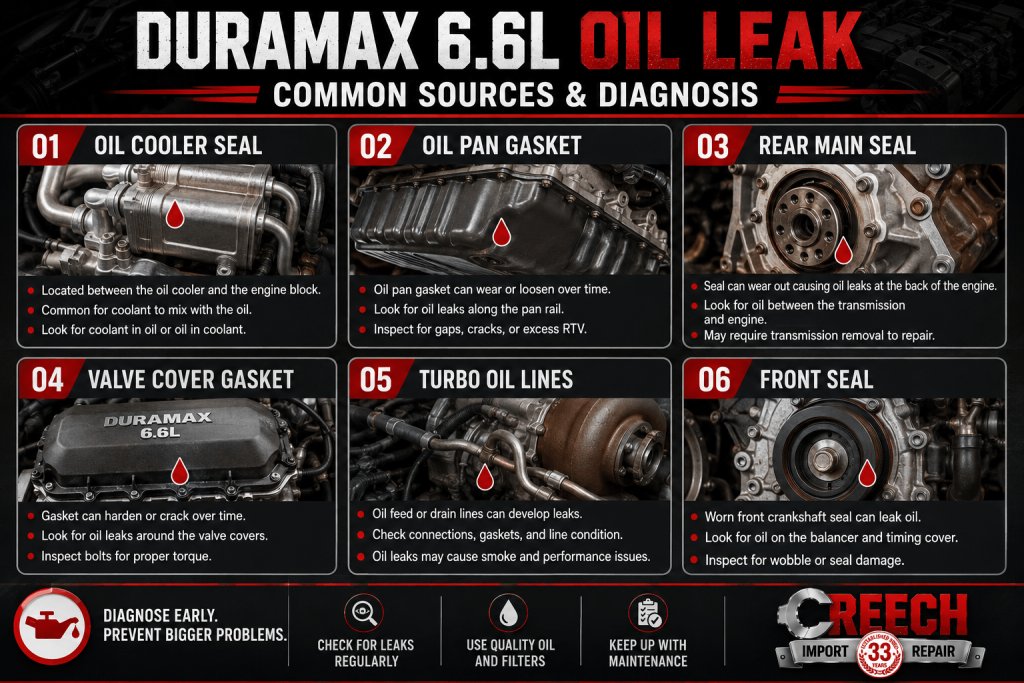
1. Engine Oil Cooler Seal Leak – The Most Common L5P Oil Leak
Some 2024-2026 Silverado 2500HD/3500HD and Sierra 2500HD/3500HD trucks equipped with the 6.6L Duramax diesel engine may have an engine oil leak from the oil cooler seal. This is one of the most common oil leak sources on the L5P engine and can appear on relatively low-mileage trucks.
Symptoms:
-
Oil spots under the vehicle – often near the front of the engine
-
Low oil level between changes – requiring frequent top-ups
-
Burning oil smell – from oil dripping onto hot engine components
-
Oil residue on the engine block or crossmember
-
Visible oil dripping from the oil cooler area
Root Causes:
-
Seal degradation from heat and age – the seal material can harden and lose its sealing ability
-
Improper seal installation – if the oil cooler has been serviced previously
-
Cooler housing warping – from overheating or over-tightening
-
Coolant contamination – coolant in the oil can damage seals
Why This Is a Serious Issue:
The oil cooler seal leak can be difficult to diagnose because the oil can spread across the engine, making it appear that the leak is coming from elsewhere. If left unaddressed, a small leak can become a large leak, causing low oil pressure and potential engine damage. Additionally, oil dripping onto the hot exhaust components can create a fire risk.
2. Oil Pan Gasket Leak
The oil pan gasket can develop leaks over time, especially on high-mileage engines or engines that have been subjected to extreme temperatures. This is a more straightforward leak to diagnose because it’s visible on the bottom of the engine.
Symptoms:
-
Oil drips from the bottom of the engine
-
Oil residue on the oil pan and surrounding components
-
Oil spots under the vehicle after parking
Root Causes:
-
Gasket degradation – from heat and age
-
Over-tightened or under-tightened oil pan bolts
-
Oil pan damage from road debris – rocks or curbs can dent the oil pan
-
Crankcase pressure issues – from a clogged PCV system
Repair Considerations:
Replacing the oil pan gasket requires draining the oil, removing the oil pan, cleaning the sealing surfaces, and installing a new gasket. The oil pan bolts must be torqued to the correct specification to prevent future leaks.
3. Rear Main Seal Leak – The Most Expensive L5P Oil Leak
The rear main seal is located at the back of the crankshaft, where it connects to the transmission. This is a more serious leak because it requires transmission removal to repair. A rear main seal leak can be mistaken for a transmission fluid leak, so proper diagnosis is essential.
Symptoms:
-
Oil dripping from the bellhousing area – where the engine meets the transmission
-
Oil between the engine and transmission – visible from underneath
-
Low oil level – from oil escaping through the seal
-
Clutch or torque converter issues – in severe cases, oil can contaminate the clutch or torque converter
Root Causes:
-
Seal wear from age and mileage – the seal can harden and lose its sealing ability
-
Crankshaft end play – excessive movement can cause the seal to wear
-
Improper installation – if the seal was not installed correctly
-
High crankcase pressure – from a clogged PCV system
Why This Is a Serious Issue:
The rear main seal is one of the most expensive oil leaks to repair because it requires removing the transmission. The transmission must be supported, disconnected from the engine, and lowered to access the seal. This is a labor-intensive job.
4. Valve Cover Gasket Leak
Valve cover gaskets can leak, allowing oil to drip onto the exhaust manifolds and create a burning smell. This is a relatively common leak on higher-mileage Duramax engines.
Symptoms:
-
Burning oil smell from the engine bay – especially after driving
-
Oil residue on the valve covers and exhaust manifolds
-
Oil dripping onto the exhaust – can cause smoke
Root Causes:
-
Gasket degradation from heat – the gasket can harden and lose its sealing ability
-
Over-tightened or under-tightened valve cover bolts
-
PCV system issues – excessive crankcase pressure can force oil past the gasket
5. Turbocharger Oil Line Leaks
The turbocharger has oil supply and return lines that can develop leaks over time. These lines are subject to high heat and can degrade.
Symptoms:
-
Oil dripping from the turbo area – visible on the exhaust manifold or heat shield
-
Burning oil smell from the exhaust
-
White smoke from the exhaust – if oil enters the exhaust system
Root Causes:
-
Line degradation from heat – rubber or metal lines can crack or corrode
-
Loose fittings – from vibration
-
Gasket failure – at the turbocharger mounting points
6. Front Crankshaft Seal Leak
The front crankshaft seal is located behind the harmonic balancer. A leak here can be difficult to spot because the seal is behind the balancer and other components.
Symptoms:
-
Oil dripping from the front of the engine – near the harmonic balancer
-
Oil on the serpentine belt – can cause belt squealing
Root Causes:
-
Seal wear from age and mileage
-
Harmonic balancer issues – wobbling can cause the seal to wear
Why Duramax 6.6L Oil Leaks Are Often Misdiagnosed
Duramax 6.6L oil leaks are frequently misdiagnosed because:
Multiple Leak Sources Can Appear Simultaneously
An oil leak from one source can spread oil across multiple areas, making it difficult to identify the actual source. Oil can drip from one component and blow onto another, creating a misleading appearance.
Leaks Can Be Intermittent
Some leaks only occur under certain conditions, such as when the engine is hot, under load, or at operating temperature, making them hard to reproduce during inspection. A leak that only appears on a hot engine may not show itself during a cold inspection.
Diesel Engines Are Complex
Duramax engines have many components that can leak, including the oil cooler, turbocharger, and various seals. Without proper diagnostic equipment and expertise, it is easy to misidentify the source. A visual inspection alone may not be sufficient.
Oil Spreading
Oil can spread across the engine, making it appear that the leak is coming from a different location than the actual source. For example, an oil cooler seal leak can spread oil across the front of the engine, making it look like a front seal leak.
How Creech Import Diagnoses Duramax 6.6L Oil Leaks
At Creech Import, we use a systematic diagnostic process to identify Duramax 6.6L oil leaks:
1. Visual Inspection
We perform a thorough visual inspection of the engine, looking for oil residue, wet spots, and drips. We use a bright light and mirror to inspect hard-to-see areas. We inspect the oil cooler, oil pan, rear main seal, front seal, valve covers, and turbocharger oil lines.
2. UV Dye Test – The Most Accurate Method
We add UV dye to the engine oil and run the engine to operating temperature. Using a UV light, we can trace the dye to the exact source of the leak. This is the most accurate method for identifying oil leaks, especially when the source is not obvious.
3. Oil Level and Condition Check
We check the oil level and inspect the oil for contamination, which can indicate internal issues. Low oil level can indicate a leak, while contaminated oil can indicate internal problems.
4. Component-Specific Inspection
We inspect specific components like the oil cooler, oil pan, rear main seal, and turbocharger oil lines for signs of leakage. This includes checking fittings, gaskets, and seals.
5. Crankcase Pressure Test
We test crankcase pressure to identify potential PCV system issues that can cause oil leaks. High crankcase pressure can force oil past seals.
6. Documentation
We document our findings with photographs, helping you understand exactly what was found and why we recommend specific repairs.
Noticing oil spots under your Duramax? Don’t let a small oil leak become a major engine problem. Call Creech Import at 919-872-1999 for a professional Duramax oil leak diagnosis. Visit us at 1818 St. Albans Dr #106, Raleigh, NC 27609 or book online at https://www.creechimport.com/contact.
FAQs
What causes Duramax 6.6L oil leaks?
Common causes include engine oil cooler seal failure, oil pan gasket leaks, rear main seal wear, valve cover gasket leaks, and turbocharger oil line leaks.
What are the symptoms of a Duramax oil leak?
Symptoms include oil spots under the vehicle, low oil level, burning oil smell, and oil pressure warning lights.
How does Creech Import diagnose Duramax oil leaks?
We use visual inspection, UV dye testing, pressure testing, and component inspection to identify the exact source of the leak.
Is an oil leak on a Duramax a serious problem?
Yes – if left unaddressed, an oil leak can lead to low oil pressure, engine wear, and potentially catastrophic failure.
Can I drive with a Duramax oil leak?
If the leak is minor and you monitor oil levels, you may be able to drive for a short time. However, any oil leak should be diagnosed and repaired as soon as possible.
What is the engine oil cooler seal on a Duramax?
The engine oil cooler seal is a seal that prevents oil from leaking from the oil cooler. It is a common leak point on L5P engines.
What is the rear main seal on a Duramax?
The rear main seal is located at the back of the crankshaft, where it connects to the transmission. It is one of the most expensive oil leaks to repair.
Does Creech Import offer a warranty on Duramax oil leak repairs?
Yes – all repairs include a written warranty on parts and labor.
How can I prevent Duramax oil leaks?
Regular maintenance, including oil changes with high-quality diesel oil and periodic inspections, can help prevent oil leaks.
What is the difference between an oil leak and oil consumption?
An oil leak is visible oil escaping from the engine. Oil consumption is oil being burned inside the engine, which may not be visible as a leak.
Can a clogged PCV system cause oil leaks?
Yes – a clogged PCV system can increase crankcase pressure, forcing oil past seals and causing leaks.
How much does it cost to fix a Duramax oil leak?
Repair costs vary depending on the source of the leak. Creech Import provides written estimates before any work begins.
Does the Duramax warranty cover oil leaks?
Oil leaks may be covered under warranty if the vehicle is within the warranty period and the leak is due to a manufacturing defect.
What is the most common Duramax oil leak source?
The engine oil cooler seal is the most common oil leak source on L5P Duramax engines.
How long does Duramax oil leak repair take?
Repair time varies depending on the source of the leak. Simple repairs take 1-2 days; more complex repairs (like rear main seal) take 3-5 days.
Sources
Why Choose Creech Import Repair for Your Vehicle?
Serving Raleigh since 1993 – Family‑owned, deeply rooted in the community.
✓ ASE‑Certified Technicians – Trained on domestic and import vehicles.
✓ Both domestic and import expertise – One trusted shop for mixed garages.
✓ Transparent pricing & electronic approvals – No surprises, no unnecessary work.
✓ Professional‑grade diagnostic equipment – Advanced scanners and live data analysis.
✓ High‑quality parts & long‑lasting repairs – We don’t cut corners.
📞 Schedule Your Service Appointment Today
Don’t wait until a small problem becomes a major repair. Whether you need routine maintenance, diagnostics, or major repairs, the team at Creech Import Repair is ready to help.
📍 Address: 1818 St. Albans Dr #106, Raleigh, NC 27609
📞 Phone: 919-872-1999
🌐 Schedule Online: https://www.creechimport.com/chevrolet-silverado-1500-repair-services
About the Author: The ASE‑certified team at Creech Import Repair has been serving Raleigh drivers since 1993. We specialize in both domestic and import vehicles, with extensive experience in Chevrolet Silverado 1500 repair and maintenance.
Last updated: May 2026. Repair costs are estimates and may vary. Always obtain a written estimate before authorizing repairs.
Find Creech Import Service articles useful?
Add this site to your Preferred Sources in Google Search.