


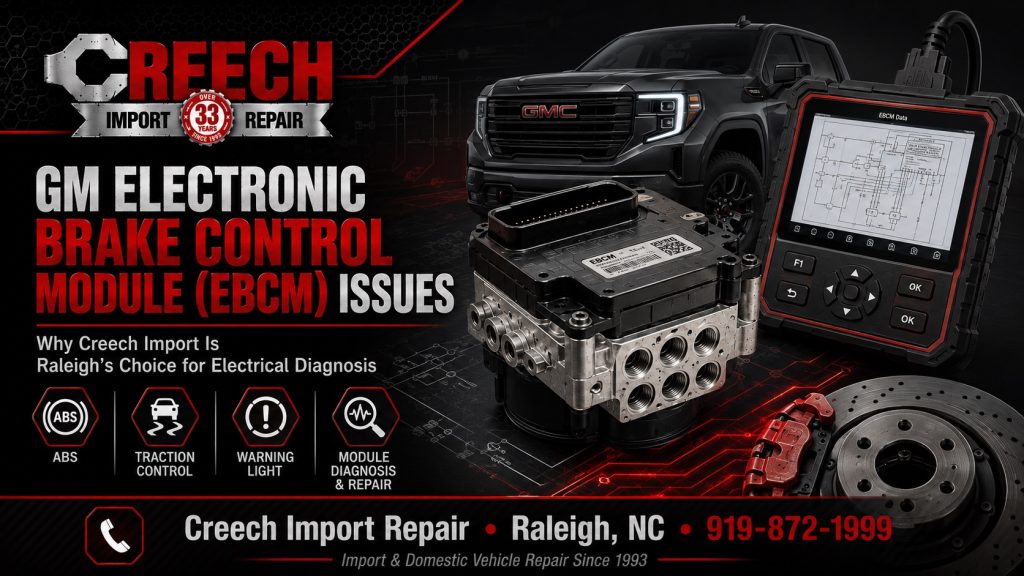
The electronic brake control module (EBCM) is a critical safety component in modern GM vehicles, including the 2026 Chevrolet Silverado EV and GMC Sierra EV. When the EBCM software malfunctions, the electronic stability control (ESC) warning light may fail to illuminate, leaving drivers unaware of a potential stability control issue. GM has issued recalls for certain 2026 Silverado EV and Sierra EV vehicles to address this EBCM software problem, but EBCM issues can affect a wide range of GM vehicles across multiple model years. At Creech Import, we have been diagnosing and repairing GM electrical systems since 1993, and we understand exactly how the EBCM works, what can go wrong, and how to identify problems early. This comprehensive guide explains the EBCM, common issues, the 2026 EV recall, and why Creech Import is Raleigh’s trusted choice for GM electrical diagnosis.
Understanding the EBCM – What It Does and Why It Matters
The Electronic Brake Control Module – The Brain of Your Brake System
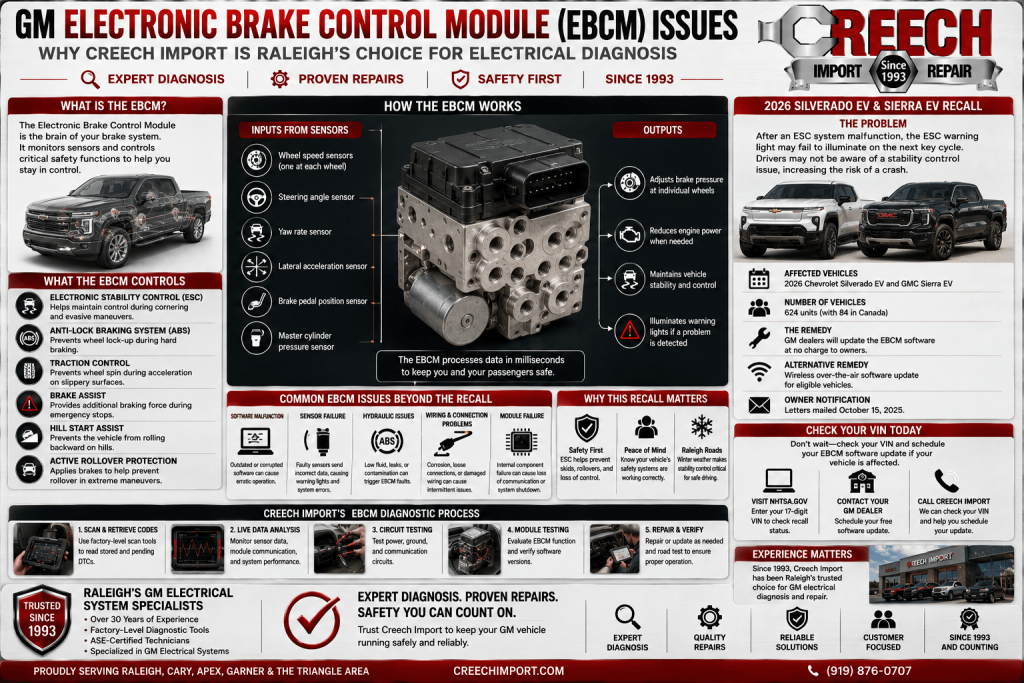
The EBCM is the electronic brain of the vehicle’s brake control system. It is a small computer that receives input from multiple sensors and makes split-second decisions to help you maintain control of your vehicle. The EBCM is typically located under the hood, near the master cylinder, or in the passenger compartment.
Critical Safety Functions Managed by the EBCM
Electronic Stability Control (ESC) – helps maintain vehicle control during cornering and evasive maneuvers by applying individual brakes and reducing engine power
Anti-lock Braking System (ABS) – prevents wheel lock-up during hard braking, allowing you to steer while braking
Traction Control – prevents wheel spin during acceleration on slippery surfaces
Brake Assist – provides additional braking force during emergency stops
Hill Start Assist – prevents the vehicle from rolling backward on hills
Active Rollover Protection – applies brakes to prevent rollover in extreme maneuvers
How the EBCM Works – The Technical Details
The EBCM receives input from multiple sensors:
Wheel speed sensors – one at each wheel, measuring rotational speed
Steering angle sensor – measures how much the steering wheel is turned
Yaw rate sensor – measures the vehicle’s rotation around its vertical axis
Lateral acceleration sensor – measures sideways forces on the vehicle
Brake pedal position sensor – measures how hard the brake pedal is pressed
Master cylinder pressure sensor – measures hydraulic pressure in the brake system
The EBCM processes this data and applies braking to individual wheels as needed to maintain vehicle stability and control. When the EBCM detects a problem, it illuminates the ESC or ABS warning light to alert the driver.
The 2026 Silverado EV and Sierra EV EBCM Recall – What Owners Need to Know
The Problem – ESC Warning Light Failure
In June 2025, GM’s supplier notified GM that the released EBCM software was not functioning as intended during internal testing for future model year vehicles. GM subsequently issued a recall for certain 2026 Chevrolet Silverado EV and GMC Sierra EV vehicles.
After experiencing an electronic stability control (ESC) system malfunction, the ESC malfunction warning light may not illuminate on the next key cycle. This means that drivers may not be aware of a stability control issue, potentially increasing the risk of a crash. The ESC warning light is the driver’s primary indication that the stability control system is not functioning properly. If the light does not illuminate when there is a problem, the driver may not know that the vehicle’s stability control is compromised.
The Recall Details
Affected vehicles: 2026 Chevrolet Silverado EV and GMC Sierra EV
Number of vehicles: 624 units (with 84 vehicles registered in Canada)
The remedy: GM dealers will update the EBCM software at no charge to owners
Alternative remedy: Owners can receive a wireless over-the-air software update to eligible vehicles
Notification: Owner notification letters were mailed October 15, 2025
Why This Recall Matters for Raleigh EV Owners
Raleigh experiences winter weather, including ice and snow, that can make stability control particularly important. A functioning ESC system can help prevent skids and loss of control on icy roads. Knowing that your vehicle’s safety systems are functioning correctly provides peace of mind, especially for families and those who drive in challenging conditions. For EV owners, this recall is particularly important because the high torque of electric motors can make stability control even more critical during acceleration.
Common EBCM Issues Across GM Vehicles – Beyond the EV Recall
While the 2026 Silverado EV and Sierra EV recall is specific to those models, EBCM issues can affect a wide range of GM vehicles:
1. Software Malfunctions – The Most Common EBCM Issue
EBCM software can malfunction, causing the ESC warning light to fail to illuminate or causing the system to behave erratically. This can happen due to:
Software bugs – programming errors in the EBCM software
Corrupted data – from voltage spikes or battery issues
Incomplete updates – from dealer programming
2. Sensor Failures – When the Inputs Are Wrong
The EBCM relies on sensors to provide data about the vehicle’s motion. If a sensor fails, the EBCM may not be able to properly control stability or braking.
Wheel speed sensor failure – can cause ABS and traction control issues
Steering angle sensor failure – can cause ESC issues
Yaw rate sensor failure – can cause stability control issues
3. Wiring and Connector Issues – The Physical Problems
Corrosion, damage, or loose connections can cause communication issues between the EBCM and its sensors or other modules. Common issues include:
Corrosion – from water intrusion or road salt (common in winter)
Wire chafing – wires rubbing against metal edges
Loose connections – from vibration over time
4. Module Failure – When the EBCM Itself Fails
Like any electronic component, the EBCM can fail internally, requiring replacement. This can happen due to:
Internal component failure – transistors, capacitors, or processors
Water intrusion – from leaks or flooding
Voltage spikes – from jump-starting or alternator issues
5. Communication Issues – When the EBCM Can’t Talk to Other Modules
The EBCM communicates with other modules over the vehicle’s network (GMLAN). If communication is lost, the EBCM may not receive the data it needs. This can happen due to:
Network issues – CAN bus problems
Module failures – other modules not communicating
Wiring issues – damaged network wiring
Symptoms of EBCM Issues – What to Watch For
Recognizing the symptoms of EBCM issues can help you address problems before they affect vehicle safety:
ESC or ABS Warning Light
The most obvious sign of an EBCM issue is the illumination of the ESC or ABS warning light. However, in the case of the 2026 EV recall, the light may not illuminate even when there is a problem – which is exactly why the recall was issued.
Loss of Stability Control
You may notice that the vehicle feels less stable during cornering or evasive maneuvers, or that the traction control system is not functioning. The vehicle may feel “loose” or unpredictable.
Brake Pedal Behavior
The brake pedal may feel different, such as pulsating (typical of ABS activation) or being harder to press than usual.
Check Engine Light
EBCM issues can trigger the check engine light, especially if the module is not communicating with other systems.
Unusual ABS Activation
The ABS may activate when it shouldn’t – such as under normal braking on dry pavement.
Traction Control Issues
The traction control system may not activate when it should, or it may activate when it shouldn’t.
Why EBCM Issues Are Often Misdiagnosed
EBCM issues are frequently misdiagnosed because:
Multiple Systems Are Involved
The EBCM works with the ABS, traction control, and engine management systems. A problem in one system can cause symptoms in another, making diagnosis complex. For example, a wheel speed sensor failure can cause both ABS and traction control issues.
Intermittent Symptoms – The Hardest to Diagnose
EBCM issues can be intermittent, making them difficult to reproduce during diagnosis. The EBCM may only fail under certain conditions, such as when the vehicle is at a certain speed or temperature.
Software vs. Hardware – The Diagnostic Challenge
Some EBCM issues are software-related and can be fixed with an update, while others require hardware replacement. Without proper diagnostic equipment, it is easy to misidentify the cause.
Dealerships May Not Have the Right Tools
Some dealerships may not have the right diagnostic tools or may not have technicians trained in EBCM diagnosis. At Creech Import, we use factory-level diagnostic software and have technicians with extensive electrical system experience.
How Creech Import Diagnoses EBCM Issues
At Creech Import, we use a systematic diagnostic process to identify EBCM issues:
1. Comprehensive Scan with GM-Enhanced Software
We use factory-level diagnostic tools to read codes from all brake-related modules – not just generic OBD-II codes. GM-specific codes provide detailed information about which circuits or components are affected.
2. Live Data Analysis
We monitor brake system parameters in real time, including:
Wheel speed sensor data – whether sensors are providing correct readings
Steering angle sensor data – whether the sensor is calibrated correctly
Yaw rate sensor data – whether the vehicle’s motion is being measured correctly
Brake pedal position – whether the pedal is being read correctly
3. Module Communication Test
We test communication between the EBCM and other modules to ensure the vehicle’s network is functioning correctly.
4. Sensor Testing
We test individual sensors to ensure they are providing correct readings. This includes checking resistance, voltage, and signal patterns.
5. Wiring and Connector Inspection
We inspect wiring and connectors for damage, corrosion, or loose connections.
6. Software Version Check
We check the EBCM software version to determine if it is affected by the recall or if an update is available.
Is your ESC or ABS warning light on? Don’t ignore a potential brake control system issue. Call Creech Import at 919-872-1999 for a professional electrical diagnostic. Visit us at 1818 St. Albans Dr #106, Raleigh, NC 27609 or book online at https://www.creechimport.com/contact.
FAQs
What is the EBCM?
The EBCM (Electronic Brake Control Module) is the computer that manages the vehicle’s electronic stability control, anti-lock braking, and traction control systems.
What is the 2026 Silverado EV and Sierra EV EBCM recall?
GM recalled certain 2026 Silverado EV and Sierra EV vehicles because the ESC malfunction warning light may not illuminate after an ESC system malfunction.
What are the symptoms of EBCM issues?
Symptoms include ESC or ABS warning lights, loss of stability control, unusual brake pedal behavior, and check engine lights.
How does Creech Import diagnose EBCM issues?
We use factory-level diagnostic tools, live data analysis, module communication testing, sensor testing, and visual inspection to accurately identify the problem.
Can an EBCM issue be fixed with a software update?
Some EBCM issues are software-related and can be fixed with an update. Others require hardware replacement.
Does the EBCM recall apply to all 2026 Silverado EV and Sierra EV vehicles?
The recall covers 624 units of the Chevy Silverado EV, with 84 vehicles registered in Canada also included. Check your VIN to see if your vehicle is affected.
How can I check if my vehicle is affected by the EBCM recall?
Check your VIN on the NHTSA website or contact a GM dealer.
Does Creech Import offer a warranty on EBCM repairs?
Yes – all repairs include a written warranty on parts and labor.
Can a bad battery cause EBCM issues?
Yes – low battery voltage can cause module malfunctions and communication issues. Always check the battery first.
What should I do if my ESC warning light is on?
Have the vehicle diagnosed by a qualified technician as soon as possible. Do not ignore the warning light.
Does the EBCM control ABS?
Yes – the EBCM is the primary controller for the anti-lock braking system (ABS).
What is the difference between ESC and ABS?
ABS prevents wheel lock-up during braking. ESC prevents skidding and loss of control during cornering and evasive maneuvers.
Can I drive with a faulty EBCM?
If your ESC or ABS warning light is on, you should have the vehicle diagnosed as soon as possible. The vehicle may still be safe to drive, but the safety systems may not function.
Does Creech Import work on EV EBCM systems?
Yes – we have experience with EBCM systems on both gasoline and electric GM vehicles.
What is the over-the-air update for the EBCM recall?
GM can perform a wireless software update to eligible vehicles, allowing owners to receive the fix without visiting a dealer.
Sources
Why Choose Creech Import Repair for Your Vehicle?
Serving Raleigh since 1993 – Family‑owned, deeply rooted in the community.
✓ ASE‑Certified Technicians – Trained on domestic and import vehicles.
✓ Both domestic and import expertise – One trusted shop for mixed garages.
✓ Transparent pricing & electronic approvals – No surprises, no unnecessary work.
✓ Professional‑grade diagnostic equipment – Advanced scanners and live data analysis.
✓ High‑quality parts & long‑lasting repairs – We don’t cut corners.
📞 Schedule Your Service Appointment Today
Don’t wait until a small problem becomes a major repair. Whether you need routine maintenance, diagnostics, or major repairs, the team at Creech Import Repair is ready to help.
EBCM issues require more than a scan tool and a guess. They require deep knowledge of GM’s electronic architecture, access to factory-level diagnostic software, and the discipline to diagnose before replacing parts. At Creech Import, we have been serving Raleigh drivers since 1993. Our ASE-certified technicians use professional scan tools, live data, and factory-level procedures to diagnose electrical problems accurately. We never recommend unnecessary repairs, and we stand behind our work with a written warranty. From EBCM software updates to sensor replacement, we keep Raleigh’s GM vehicles safe and reliable.
📍 Address: 1818 St. Albans Dr #106, Raleigh, NC 27609
📞 Phone: 919-872-1999
🌐 Schedule Online: https://www.creechimport.com/contact
About the Author: The ASE-certified team at Creech Import Repair has been serving Raleigh drivers since 1993. We specialize in GM electrical diagnosis and repair, with extensive experience in brake control systems and electronic modules. We have helped hundreds of GM owners identify and resolve EBCM issues.
Last updated: August 2026.
Find Creech Import Service articles useful?
Add this site to your Preferred Sources in Google Search.