


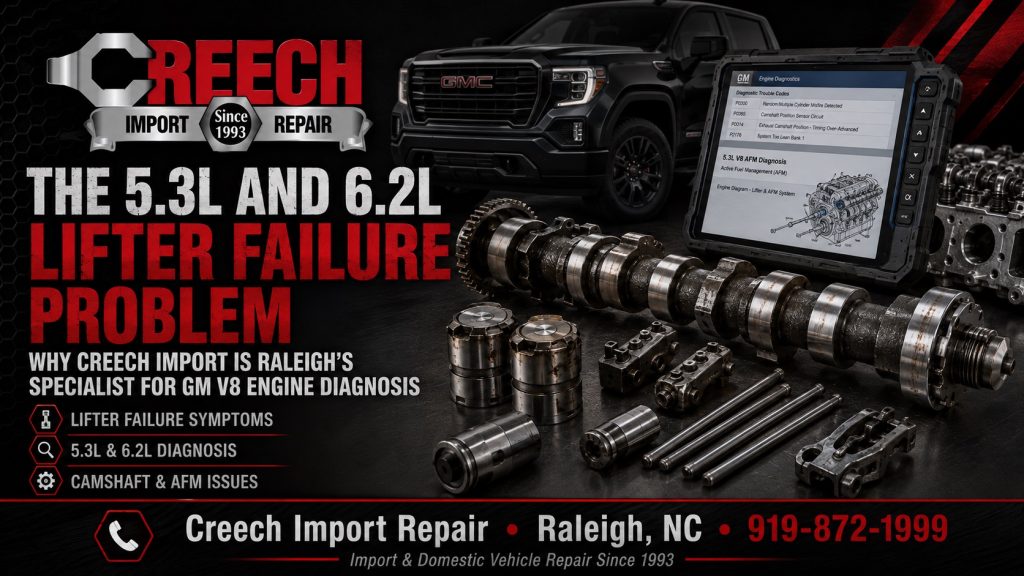
GM lifter failure is one of the most significant engine problems affecting 5.3L and 6.2L V8 engines in Chevrolet Silverado and GMC Sierra trucks from 2019 through 2026. The Active Fuel Management (AFM) and Dynamic Fuel Management (DFM) systems, designed to improve fuel economy, have proven to be a mechanical vulnerability that can cause catastrophic engine failure, leaving owners stranded on Raleigh highways like I-440 or I-540. At Creech Import, we have been diagnosing and repairing GM V8 engines since 1993, and we understand exactly how AFM and DFM systems fail, what symptoms to watch for, and how to identify problems early before they cause extensive damage. This comprehensive guide explains the lifter failure problem, why it happens, how to recognize the warning signs, what GM’s technical service bulletins say, and why Creech Import is Raleigh’s trusted choice for GM V8 engine diagnosis and repair.
Understanding AFM and DFM – How They Work and Why They Fail
Active Fuel Management (AFM) – The Original System
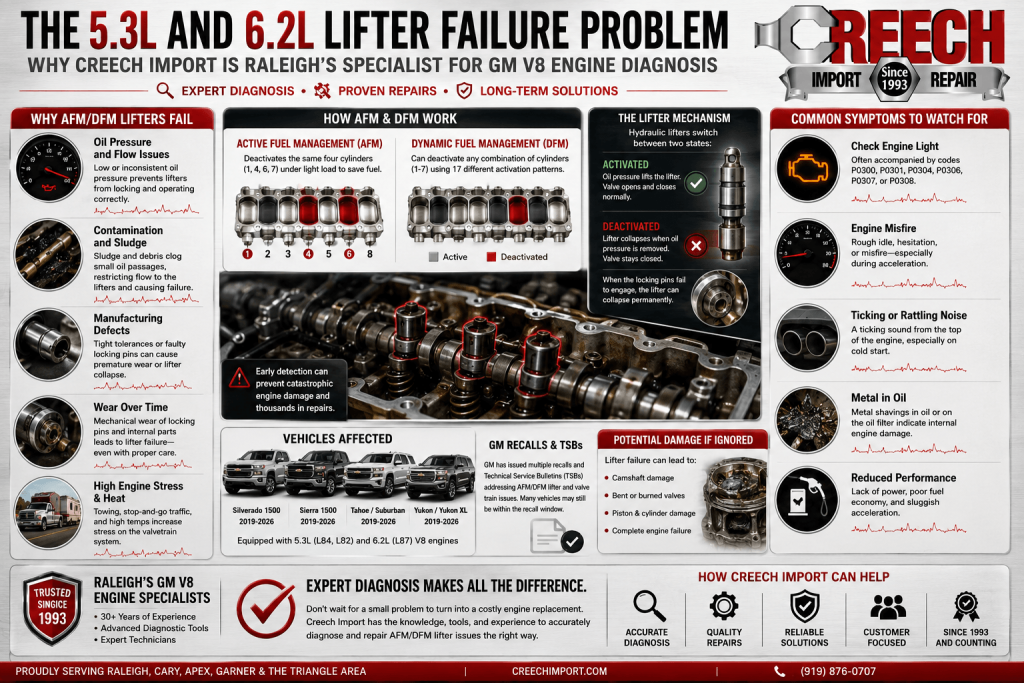
Active Fuel Management is GM’s cylinder deactivation technology, introduced in the mid-2000s and used extensively in 5.3L and 6.0L V8 engines. AFM shuts down four of the eight cylinders under light load conditions to save fuel – typically cylinders 1, 4, 6, and 7. When the engine needs more power, the deactivated cylinders are reactivated. This is accomplished through specialized hydraulic lifters that can collapse or “deactivate” when oil pressure is removed.
Dynamic Fuel Management (DFM) – The Advanced System
DFM is GM’s more advanced version of cylinder deactivation, introduced in 2019 on the 5.3L L84 and 6.2L L87 V8 engines. Unlike AFM, which deactivates the same four cylinders every time, DFM can deactivate any combination of cylinders, from one to seven, depending on engine load and operating conditions. DFM uses 17 distinct cylinder activation patterns to optimize fuel economy. While this provides better fuel efficiency, it also places more stress on the valvetrain components, potentially increasing the risk of failure.
The Lifter Mechanism – How It Works and What Goes Wrong
Both AFM and DFM rely on specialized hydraulic lifters that can switch between two states:
-
Activated – the lifter pumps up and the valve opens and closes normally
-
Deactivated – the lifter collapses, and the valve remains closed
These lifters contain locking pins that engage and disengage to switch between states. When the locking pins fail to engage properly, the lifter can collapse permanently, causing a misfire and potentially damaging the camshaft. The failure mechanism is often related to oil pressure, contamination, or manufacturing defects.
Why the 2026 Models Are Not Immune
A common misconception is that the 2026 model year Silverado and Sierra are immune to lifter failure. This is not the case. GM’s V8 engine, which is used in these vehicles, has been on the market for years, and the lifter failure problem has persisted across multiple model years. GM has had issues with V8 engine lifter failure for years, and the company hasn’t been able to fully fix them, even in 2026 models.
Why AFM and DFM Lifters Fail – The Technical Details
The lifter failure problem is not caused by owner neglect or lack of maintenance – it stems from fundamental design and manufacturing flaws in the engine itself. Legal experts have contended that General Motors failed to disclose that these vehicles have defective AFM and/or DFM valvetrain systems. Key factors contributing to lifter failure include:
Oil Pressure and Flow Issues
The AFM and DFM lifters rely on consistent oil pressure to activate and deactivate properly. When oil pressure drops – due to low oil level, dirty oil, or a failing oil pump – the lifters may not receive enough pressure to engage the locking pins. This is particularly common when oil change intervals are extended beyond GM’s recommendations.
Contamination and Sludge
The small oil passages that control the lifters can become clogged with sludge or debris, preventing the lifters from receiving the oil pressure they need. This is why using high-quality oil and changing it regularly is critical for AFM and DFM engines.
Manufacturing Defects
Some lifters have been manufactured with tolerances that are too tight or too loose, causing premature wear or failure. The locking pins can stick or fail to engage, leading to collapse. In some cases, the lifter bore itself can be out of specification, causing the lifter to bind.
Wear Over Time
Even with proper maintenance, the lifters experience mechanical wear over time. The locking pins and the bores they slide in can wear, leading to inconsistent operation and eventual failure. High-mileage engines are particularly susceptible.
Oil Viscosity and Quality
Using the wrong oil viscosity or oil that does not meet GM’s Dexos specifications can accelerate lifter wear. GM recommends specific viscosity grades (typically 0W-20 for 5.3L and 6.2L engines) and only Dexos-approved oils.
Symptoms of Lifter Failure – What to Listen For
Recognizing the symptoms of lifter failure early can prevent extensive engine damage. Here are the most common signs reported by Silverado and Sierra owners:
Ticking or Knocking Noise
A ticking or knocking noise from the engine, especially at idle or cold start, is often the first sign of lifter failure. The noise is caused by the collapsed lifter allowing the pushrod to move excessively, creating metal-on-metal contact. If you hear a persistent tick, don’t dismiss it as “normal” – it could be the early warning of lifter collapse.
Misfire and Rough Idle
When a lifter fails, the affected cylinder cannot open and close its valves properly, causing a misfire. The engine may idle roughly, shake, or hesitate. The check engine light may flash, indicating a severe misfire.
Loss of Power
A lifter failure can cause a significant loss of power, especially under acceleration. The engine may feel sluggish or unresponsive. If your Silverado or Sierra feels down on power, lifter failure could be the cause.
Check Engine Light
The engine control module will detect the misfire and illuminate the check engine light. Common codes include:
-
P0300 – Random misfire
-
P0301-P0308 – Cylinder-specific misfire codes (e.g., P0304 indicates cylinder 4)
-
P0011/P0014 – Camshaft position timing codes
Excessive Oil Consumption
Some owners report excessive oil consumption before lifter failure occurs. This can be a warning sign that the engine is experiencing internal wear. If you need to add oil between changes, have the engine inspected.
Catastrophic Failure
If lifter failure is not addressed promptly, the collapsed lifter can damage the camshaft lobe, sending metal debris through the engine and leading to catastrophic failure. This can result in the need for a full engine replacement.
How Creech Import Diagnoses Lifter Failure
At Creech Import, we use a systematic diagnostic process to identify lifter failure and distinguish it from other engine problems:
1. Comprehensive Scan with GM-Enhanced Software
We use factory-level diagnostic tools to read codes from all engine-related modules. GM-specific codes can indicate which cylinder is affected and whether the problem is mechanical or electronic.
2. Live Data Analysis
We monitor engine parameters in real time, including:
-
Misfire counters – which cylinders are misfiring and how often
-
Fuel trims – whether the engine is running lean or rich
-
Camshaft position – whether the camshaft is in the correct position relative to the crankshaft
3. Oil Pressure Testing
We test oil pressure at idle and under load to ensure the AFM/DFM system is receiving adequate pressure.
4. Cylinder Balance Test
We perform a cylinder balance test to identify which cylinder is not contributing power.
5. Leak-Down Test
We perform a cylinder leak-down test to determine whether the loss of compression is due to valve issues (lifter failure) or ring issues.
6. Visual Inspection
If indicated, we remove the valve cover to visually inspect the lifters, pushrods, and camshaft. This allows us to identify collapsed lifters, bent pushrods, or scored camshaft lobes.
Why Lifter Failure Is Often Misdiagnosed
Lifter failure is frequently misdiagnosed because its symptoms overlap with other engine problems:
Fuel Injector Noise
The ticking sound of a failing lifter can be mistaken for a noisy fuel injector. However, injector noise is usually consistent, while lifter noise often changes with engine temperature and load. Injector noise is typically higher-pitched and less metallic.
Exhaust Leak
A ticking noise from the engine bay can be mistaken for an exhaust leak. However, exhaust leaks usually have a distinct “puffing” sound and are not accompanied by misfire codes. An exhaust leak is more noticeable on cold starts and diminishes as the engine warms up.
Normal Engine Noise
Some dealers may dismiss early lifter noise as “normal” for an AFM or DFM engine. However, any new or worsening ticking noise should be investigated. If the noise disappears after a few seconds, it may be normal; if it persists, it’s a warning sign.
Spark Plug or Ignition Issues
A misfire can be caused by spark plugs, ignition coils, or fuel injectors. Without proper diagnosis, lifter failure may be overlooked until it causes more extensive damage. This is why a comprehensive diagnostic approach is essential.
The GM Lifter Failure Lawsuit – What Owners Need to Know
GM is currently facing multiple class-action lawsuits over lifter failure in Silverado, Sierra, Tahoe, Escalade, and other vehicles with 5.3L and 6.2L V8 engines. Plaintiffs contend that GM manufactured and sold vehicles with defective AFM and DFM lifters and valvetrain components that fail prematurely. The core allegations are that GM failed to disclose these defects and that the defects cause the vehicle to lose power while being driven, to hesitate, and for the engine to experience catastrophic internal failure.
Key Lawsuit Developments
-
Federal Judge Denies Motion to Split GM Lifter Lawsuit – A federal judge denied a motion to split the GM lifter lawsuit, keeping the Silverado and Sierra V8 class action intact. This means the lawsuit continues as a single, consolidated action.
-
Certification of Class Action – The lawsuit has been certified as a class action, representing potentially thousands of affected vehicle owners.
-
Potential Remedies – If the lawsuit succeeds, owners may be eligible for reimbursement, extended warranties, or other remedies.
What This Means for Owners
If you own a Silverado or Sierra with a 5.3L or 6.2L V8 engine, keep all service records and document any issues you experience. This documentation may be valuable if the lawsuit results in a settlement or if you pursue an individual claim.
How Creech Import Diagnoses Lifter Failure
At Creech Import, we use a systematic diagnostic process to identify lifter failure and distinguish it from other engine problems:
1. Comprehensive Scan with GM-Enhanced Software
We use factory-level diagnostic tools to read codes from all engine-related modules. GM-specific codes can indicate which cylinder is affected and whether the problem is mechanical or electronic.
2. Live Data Analysis
We monitor engine parameters in real time, including:
-
Misfire counters – which cylinders are misfiring and how often
-
Fuel trims – whether the engine is running lean or rich
-
Camshaft position – whether the camshaft is in the correct position relative to the crankshaft
-
Oil pressure – to ensure the AFM/DFM system is receiving adequate pressure
3. Oil Pressure Testing
We test oil pressure at idle and under load to ensure the AFM/DFM system is receiving adequate pressure. Low pressure can be a contributing factor to lifter failure.
4. Cylinder Balance Test
We perform a cylinder balance test to identify which cylinder is not contributing power. This helps pinpoint the affected cylinder.
5. Leak-Down Test
We perform a cylinder leak-down test to determine whether the loss of compression is due to valve issues (lifter failure) or ring issues. This test can reveal whether the valves are sealing properly.
6. Visual Inspection
If indicated, we remove the valve cover to visually inspect the lifters, pushrods, and camshaft. This allows us to identify collapsed lifters, bent pushrods, or scored camshaft lobes. Visual inspection is the definitive diagnostic step for lifter failure.
Hearing a ticking noise from your Silverado or Sierra’s V8 engine? Don’t wait for lifter failure to cause catastrophic engine damage. Call Creech Import at 919-872-1999 for a professional engine diagnostic. Visit us at 1818 St. Albans Dr #106, Raleigh, NC 27609 or book online at https://www.creechimport.com/contact.
FAQs
What is GM lifter failure?
GM lifter failure occurs when the AFM or DFM lifters in 5.3L and 6.2L V8 engines collapse, causing misfires, loss of power, and potential catastrophic engine damage.
Which vehicles are affected by lifter failure?
Affected vehicles include 2019-2026 Chevrolet Silverado and GMC Sierra 1500 with 5.3L L84 and 6.2L L87 V8 engines, as well as Tahoe, Suburban, Yukon, and Escalade models.
What are the symptoms of lifter failure?
Common symptoms include ticking or knocking noise, rough idle, loss of power, check engine light, and excessive oil consumption.
Is lifter failure caused by owner neglect?
No – lifter failure stems from fundamental design and manufacturing flaws in the AFM and DFM systems, not owner neglect.
Is there a lawsuit over GM lifter failure?
Yes – GM is facing multiple class-action lawsuits over lifter failure in Silverado, Sierra, and other vehicles with 5.3L and 6.2L V8 engines.
How does Creech Import diagnose lifter failure?
We use factory-level diagnostic tools, live data analysis, oil pressure testing, leak-down testing, and visual inspection to accurately identify the problem.
Can lifter failure be prevented?
Regular oil changes with Dexos-approved oil and early diagnosis of symptoms can help prevent lifter failure from causing extensive damage.
What happens if lifter failure is not addressed?
A collapsed lifter can damage the camshaft lobe and send metal debris through the engine, leading to catastrophic failure.
Does Creech Import offer a warranty on lifter repairs?
What is the difference between AFM and DFM?
What is the difference between AFM and DFM?
AFM deactivates the same four cylinders, while DFM can deactivate any combination of cylinders for more precise fuel economy optimization.
Are 2026 models affected by lifter failure?
Yes – GM’s V8 engine, which is used in these vehicles, has been on the market for years, and the lifter failure problem has persisted across multiple model years.
What is GM's technical service bulletin for lifter failure?
GM has issued multiple TSBs addressing lifter failure, including PIP6101A, which provides diagnostic procedures for lifter-related issues.
How much does lifter repair cost?
Repair costs can be significant, which is why early diagnosis is critical. Creech Import provides written estimates before any work begins.
Can I drive with lifter noise?
If you hear lifter noise, you should have the vehicle diagnosed as soon as possible. Continued driving can cause more extensive damage.
Does Creech Import work on all GM V8 engines?
Yes – we have experience with all GM V8 engines, including 5.3L, 6.0L, and 6.2L variants.
Sources
Why Choose Creech Import Repair for Your Vehicle?
Serving Raleigh since 1993 – Family‑owned, deeply rooted in the community.
✓ ASE‑Certified Technicians – Trained on domestic and import vehicles.
✓ Both domestic and import expertise – One trusted shop for mixed garages.
✓ Transparent pricing & electronic approvals – No surprises, no unnecessary work.
✓ Professional‑grade diagnostic equipment – Advanced scanners and live data analysis.
✓ High‑quality parts & long‑lasting repairs – We don’t cut corners.
📞 Schedule Your Service Appointment Today
Don’t wait until a small problem becomes a major repair. Whether you need routine maintenance, diagnostics, or major repairs, the team at Creech Import Repair is ready to help.
GM lifter failure requires more than a scan tool and a guess. It requires deep knowledge of GM’s AFM and DFM systems, access to factory-level diagnostic software, and the discipline to diagnose before replacing parts. At Creech Import, we have been serving Raleigh drivers since 1993. Our ASE-certified technicians use professional scan tools, live data, and factory-level procedures to diagnose engine problems accurately. We never recommend unnecessary repairs, and we stand behind our work with a written warranty.
📍 Address: 1818 St. Albans Dr #106, Raleigh, NC 27609
📞 Phone: 919-872-1999
🌐 Schedule Online: https://www.creechimport.com/contact
About the Author: The ASE-certified team at Creech Import Repair has been serving Raleigh drivers since 1993. We specialize in GM V8 engine diagnosis and repair, with extensive experience in AFM and DFM system diagnosis. We have helped hundreds of Silverado and Sierra owners identify lifter issues before they cause catastrophic engine damage.
Last updated: August 2026.
Find Creech Import Service articles useful?
Add this site to your Preferred Sources in Google Search.