


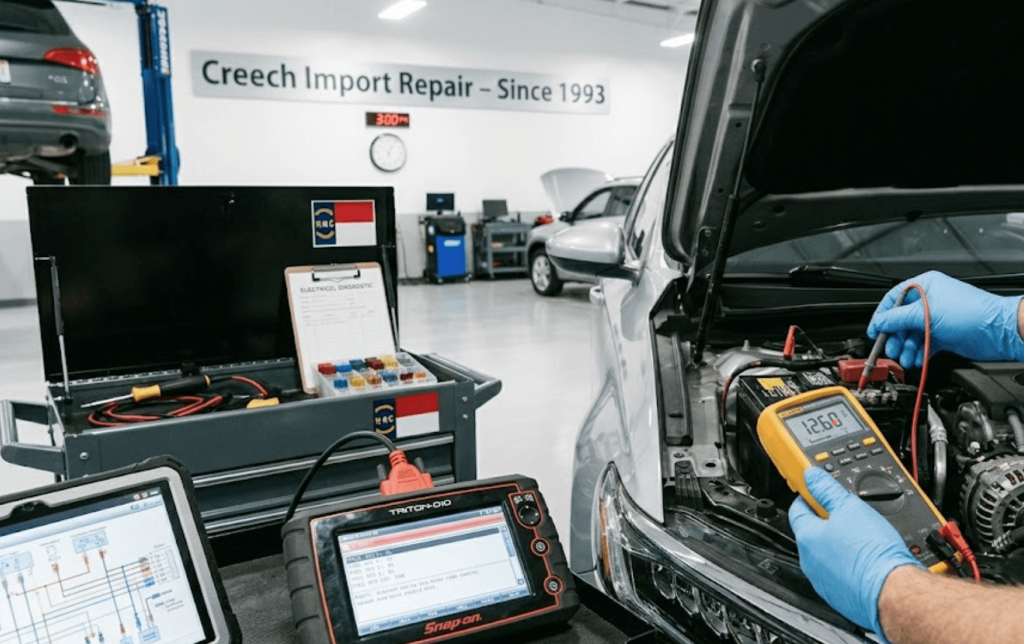
Your vehicle’s electrical system powers everything from the starter and lights to the engine‑management computer that keeps it running efficiently. When a warning light flickers or a component fails, you need a shop that can pinpoint the problem fast, explain it in plain language, and fix it right the first time. At Creech Import Repair, we’ve been delivering honest, ASE‑certified electrical diagnostics and repair to Raleigh drivers since 1993, with a customer‑first approach that means no surprises, free inspections, and loaner cars available for larger jobs.
Why Electrical Diagnostics Matter for Raleigh Drivers
Modern cars rely on a complex network of sensors, wiring, batteries, and computers. A minor glitch—like a corroded connector or a weak battery—can trigger the check‑engine light, cause hard starts, or leave you stranded in a Raleigh downpour. Ignoring electrical symptoms often leads to more expensive damage (e.g., a failing alternator can destroy a battery, or a short can fry expensive modules). Regular electrical checks keep your vehicle reliable, improve fuel economy, and help you avoid surprise breakdowns on I‑40, US‑70, or the Beltline. creechimport
“We treat every customer with kindness, respect, and honesty, and success will follow.” — Creech Import Repair Business Philosophy yelp
What Causes Electrical Problems?
Understanding the root helps you recognize early signs and act before a small issue becomes a costly repair.
Common Cause | What Happens | Typical Symptoms |
Weak or dead battery | Insufficient voltage to crank the engine | Slow crank, dim lights, clicking sound |
Failing alternator | Battery not recharged while driving | Battery warning light, dimming headlights, electrical accessories cutting out |
Corroded or loose wiring/connections | Intermittent power flow | Flickering lights, erratic gauge readings, sporadic accessory failure |
Blown fuses | Circuit protection trips when overloaded | Specific systems (radio, power windows, lights) stop working |
Faulty sensors (O₂, MAF, coolant temp, etc.) | Incorrect data sent to ECU | Check‑engine light, poor fuel economy, rough idle |
Starter motor wear | Engine fails to turn over | Grinding noise, no crank despite good battery |
ECU/PCM software glitch | Miscommunication between systems | Multiple warning lights, limp‑mode activation, unexplained drivability issues |
Electrical issues often start subtly—dim lights or occasional warning lights—so early diagnosis saves both money and frustration.creechimport
How We Diagnose Electrical Issues
At Creech Import, our ASE‑certified auto electricians follow a systematic, no‑guess process that leverages advanced scan tools and hands‑on testing.
- Customer interview – We listen to your symptoms (e.g., “car won’t start after rain,” “lights flicker when idling”).
- Visual inspection – Battery terminals, fuse box, wiring harnesses, and accessory connections are checked for corrosion, damage, or looseness.
- Battery & charging test – Using a conductance tester and alternator output tester, we measure cranking amps, reserve capacity, and charging voltage (should be 13.8‑14.7 V at idle).
- On‑board diagnostics scan – A professional scanner reads stored trouble codes (P‑codes, U‑codes, B‑codes) from the ECU, transmission, ABS, and airbag modules.
- Live data streaming – We monitor sensor readings (O₂, MAF, throttle position, coolant temp) in real time to spot out‑of‑range values.
- Circuit testing – With a multimeter and wiring diagrams, we check continuity, resistance, and voltage drops across suspect circuits (e.g., starter solenoid, fuel pump relay).
- Component isolation – If needed, we bench‑test items like the alternator, starter, or individual sensors off the vehicle.
- Repair recommendation – We explain the exact fault, show you the failed part (if desired), and provide a written estimate before any work begins. creechimport
Our process aligns with industry best practices: we diagnose first, then recommend only the repairs needed to restore reliable electrical function. creechimport
When Should You Schedule Electrical Diagnostics?
Don’t wait for a no‑start situation. Proactive checks catch wear before it leaves you stranded.
Mileage / Time | Recommended Action |
Every 12,000 miles or annually | Battery load test, alternator output check, visual wiring inspection |
Every 2 years | Full electrical system scan (including sensor live data) to catch aging components |
Immediately | Check‑engine light on (solid or flashing), dim/flickering lights, slow crank, electrical accessories cutting out, battery warning light |
Before long trips | Pre‑trip electrical health check (battery, alternator, lights, wipers) to ensure reliability on highways |
If you frequently drive short trips, use many electrical accessories (phone chargers, GPS, aftermarket lights), or operate in extreme heat or cold, consider shorter intervals. Our advisors tailor a schedule to your vehicle and driving habits during your visit.creechimport
What to Expect During Your Electrical Diagnostic Visit
When you bring your car to Creech Import, here’s the step‑by‑step experience:
- Friendly check‑in – Our service advisor confirms your concerns, explains the diagnostic process, and offers a complimentary battery and charging test.
- Comprehensive electrical evaluation – Performed at no charge if you proceed with the recommended repairs (free diagnostics policy).
- Transparent estimate – We itemize labor, any needed parts (battery, alternator, wiring harness, sensors), and additional services (e.g., terminal cleaning). No hidden fees.
- Repair execution – ASE‑certified electricians replace faulty components, repair or seal wiring, clean corrosion, and torque all connections to factory specs.
- System verification – We re‑scan for codes, verify proper voltage outputs, and test all affected accessories (lights, wipers, power windows, radio).
- Review & warranty – We walk you through the work performed, show you old parts if desired, and remind you of our 36‑month/36,000‑mile warranty on parts and labor.yelp
Throughout, we speak plain language—no jargon, no pressure.
How Much Does Electrical Diagnostic & Repair Cost in Raleigh?
Pricing varies by vehicle make, the specific faulty component, and labor time. Below are typical ranges for common electrical services at our shop (parts + labor):
Service | Typical Price Range* |
Battery replacement | $120 – $220 |
Alternator replacement | $380 – $650 |
Starter motor replacement | $250 – $450 |
Wiring harness repair (per section) | $150 – $350 |
Sensor replacement (O₂, MAF, coolant temp, etc.) | $120 – $280 each |
Fuse block or relay replacement | $80 – $150 |
ECU/PCM reflash or replacement | $400 – $900+ |
Full electrical diagnostic (scan + live data) | $90 – $130 (free if you proceed with repairs) |
Battery & charging system test | $40 – $60 (free with service) |
*Prices include OEM‑spec or equivalent quality parts and are subject to change based on vehicle specifics. We always provide a written estimate before any work begins.creechimport
Factors that affect cost:
- Vehicle complexity – Luxury or European models often have more intricate wiring and pricier control modules.
- Extent of damage – If a short has damaged multiple connectors, labor increases.
- Parts choice – We offer OEM, high‑quality aftermarket, and budget‑friendly options; we explain trade‑offs so you can decide.
Our goal is honest pricing that reflects the actual work needed—no surprises when you pick up your car.yelp
Maintenance Tips to Extend Electrical Life
While eventual wear is inevitable, these habits help you get the most reliability between visits:
- Keep battery terminals clean – Corrosion increases resistance; clean with a battery‑terminal brush and apply dielectric grease.
- Turn off accessories before shutting off – Reduces load on the battery and alternator during startup.
- Check lights regularly – Dim or flickering bulbs often signal a wiring or charging issue before they fail completely.
- Avoid water intrusion – Ensure windshield cowl seals and hood seals are intact; water can cause corrosion in wiring harnesses.
- Schedule annual battery tests – A weak battery strains the alternator and can cause premature failure.
- Use quality fuel additives – Clean combustion reduces carbon buildup that can interfere with sensor readings.
Pairing these habits with our professional electrical service keeps your vehicle’s nervous system healthy and helps you avoid unexpected repair bills.epa
Is It Safe to Drive With Electrical Issues?
Some electrical faults are merely inconvenient; others can create genuine safety hazards. Use this quick guide:
- Dim interior lights – Usually safe for short trips, but have the charging system checked soon.
- Flickering headlights or taillights – Reduce night driving; could be a loose ground or failing alternator.
- Battery warning light on – Stop driving if the light comes on while driving; the battery may not be charging, risking a sudden stall.
- Check‑engine light flashing – Indicates a severe misfire or sensor fault; pull over safely and call for a tow to avoid catalytic‑converter damage.
- Electrical smoke or burning smell – Do not drive; disconnect the battery if safe and call for assistance.
If you’re ever uncertain, call us at (919) 872‑1999 for a quick assessment. We’d rather see you for a precautionary check than deal with a preventable breakdown.
Contact Us
Ready to ensure your car’s electrical system is reliable? Take one of these simple steps today:
- Call us now at (919) 872‑1999 for a free electrical inspection or to schedule service.
- Visit our website and click “Schedule Appointment” to pick a time that works for you.
- Stop by our shop at 1818 St. Albans Dr #106 for a quick courtesy check—no appointment needed for basic inspections.
Ask about our loaner car program (available with major repairs) and complimentary NC state inspection when you schedule electrical diagnostics.
To learn more about our full range of services, explore these pages:
- Auto Repair Services – Overview of everything we offer, from brakes to engine diagnostics.
- Electrical System Repair – Detailed look at our electrical‑diagnostic process.
- Check Engine Light Service – How we handle warning‑light diagnostics.
Contact Us – Directions, hours, and online booking.
Frequently Asked Questions
Q: Do you service Hyundai Sonata electrical systems?
A: Yes. Our ASE‑certified technicians have extensive experience with Hyundai electrical systems, including battery, alternator, starter, and sensor diagnostics and replacement.
Q: How much does a battery test cost at Creech Import?
A: A battery and charging system test is $40–$60, but it’s free of charge when you authorize any recommended repairs.
Q: Do you offer loaner cars if my electrical repair takes more than a day?
A: For major electrical jobs (e.g., alternator or wiring‑harness replacement), we offer complimentary loaner vehicles subject to availability. Ask your service advisor when you schedule.
Q: What NC inspection services do you provide alongside an electrical diagnostic?
A: We perform full North Carolina State Inspections—safety, emissions, and lights—so you can satisfy your annual requirement while you’re here.
Q: How often should I have my battery checked?
A: We recommend a battery load test every 12,000 miles or annually, or sooner if you notice slow cranking or dim lights.
Q: Is it safe to drive with the battery warning light on?
A: No. If the light illuminates while driving, the alternator may not be charging the battery; continued operation can leave you stranded. Pull over safely and call for assistance.
Q: Do you recycle old batteries and electronic components responsibly?
A: Absolutely. We partner with EPA‑licensed recyclers to ensure used batteries, wiring, and control modules are properly processed and kept out of the environment
Q: How can I schedule an electrical diagnostic?
A: Call (919) 872‑1999, use the online booking form on our website, or stop by our shop at 1818 St. Albans Dr #106.