


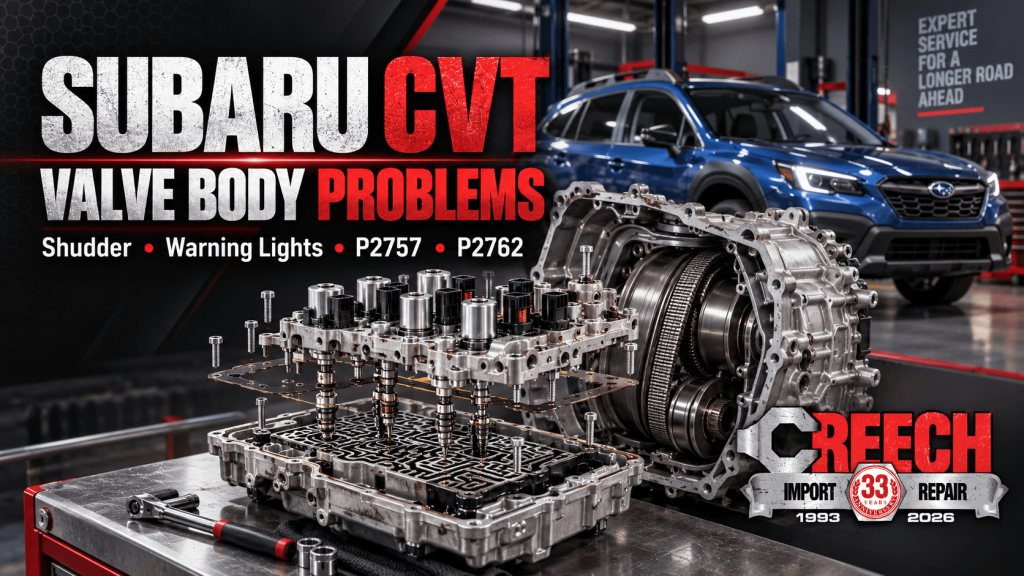
Quick answer: Subaru CVT valve body problems may cause shuddering during acceleration or deceleration, hesitation, abnormal movement, transmission warning lights, and diagnostic codes such as P2757 or P2762. Subaru’s revised Service Bulletin 16-156-25R addresses specific valve-body symptoms and diagnostic procedures for certain Impreza, Crosstrek, Forester, Legacy, and Outback models. A professional diagnosis is necessary because these symptoms do not automatically mean the valve body or entire CVT has failed.
Subaru CVT valve body problems should be investigated when an Impreza, Crosstrek, Forester, Legacy, or Outback begins shuddering, hesitating, displaying warning lights, or behaving differently during acceleration and deceleration. These symptoms may involve the CVT control valve body, but they can also be caused by fluid condition, electrical faults, torque-converter operation, engine performance, axles, mounts, or other drivetrain components.
Subaru issued and later revised a technical service bulletin addressing a CVT control valve body design change, specific diagnostic trouble codes, and shuddering in certain models. Subaru also issued a separate 2026 bulletin correcting diagnostic procedures for additional CVT-related codes in several newer Subaru vehicles.
This guide explains which models are listed in the bulletins, common symptoms, what the codes mean, how technicians separate valve-body problems from other faults, and when Raleigh-area Subaru owners should schedule diagnostic service.
Important: A Subaru technical service bulletin is not the same as a recall, warranty extension, or confirmation that every listed vehicle has a defective CVT. Applicability, warranty coverage, open campaigns, and current repair procedures should be verified using the vehicle identification number and Subaru’s latest service information.
What Are Subaru CVT Valve Body Problems?
A continuously variable transmission, or CVT, uses hydraulic pressure, electronic controls, pulleys, and a chain system to adjust the transmission ratio without the fixed gear changes associated with a traditional automatic transmission.
The control valve body directs pressurized transmission fluid through internal passages and electronically controlled solenoids. Those hydraulic commands help the CVT manage functions such as ratio control, clutch operation, and torque-converter lockup.
A mechanical, hydraulic, electrical, or control problem involving the valve body may affect how the transmission responds. Depending on the vehicle and underlying condition, a driver might experience:
- Shuddering while accelerating from a stop
- Shuddering while slowing to a stop
- Hesitation or delayed response
- Abnormal movement after releasing the brake
- Transmission or dashboard warning lights
- Stored CVT-related diagnostic trouble codes
- Inconsistent torque-converter lockup behavior
These symptoms require diagnosis. They do not, by themselves, establish that the valve body needs replacement.
What Does Subaru Service Bulletin 16-156-25R Address?
Subaru Service Bulletin 16-156-25R, revised May 13, 2026, announces a design change to the CVT control valve body. Subaru states that the updated valve body incorporates an enhanced valve sleeve intended to improve durability.
The bulletin addresses abnormal operation that may involve:
- P2757: Torque converter clutch pressure control solenoid control circuit performance or stuck-off condition
- P2762: Lock-up duty solenoid malfunction
- P06EF: Engine restart performance on applicable 2014–2016 Crosstrek Hybrid models
- Shuddering while accelerating from a stop
- Shuddering while decelerating to a stop
- No forward movement after releasing the brake from an EV stop on applicable Crosstrek Hybrid models
You can review the source information in Subaru Service Bulletin 16-156-25R published through NHTSA.
Which Subaru Models Are Listed in the Valve Body Bulletin?
Subaru’s revised valve body bulletin lists the following model and engine combinations:
| Subaru model | Model years listed | Bulletin qualification |
|---|---|---|
| Impreza | 2012–2023 | Models listed in the bulletin |
| Crosstrek | 2013–2019 | 2.0-liter models |
| Forester | 2014–2023 | 2.5-liter models, excluding Wilderness |
| Legacy | 2013–2019 | 2.5-liter models |
| Outback | 2013–2019 | 2.5-liter models |
| Crosstrek Hybrid | 2014–2016 | Additional hybrid-specific symptoms and P06EF procedure |
A vehicle appearing in this table is not automatically affected. The model, year, engine, transmission, VIN, symptoms, stored codes, service history, and test results must all be considered before applying the bulletin’s diagnostic direction.
Seven Possible Subaru CVT Valve Body Warning Signs
Subaru CVT valve body problems can produce symptoms that overlap with engine, axle, mount, tire, brake, and other drivetrain concerns. The following signs justify professional testing, but none confirms valve-body failure by itself.
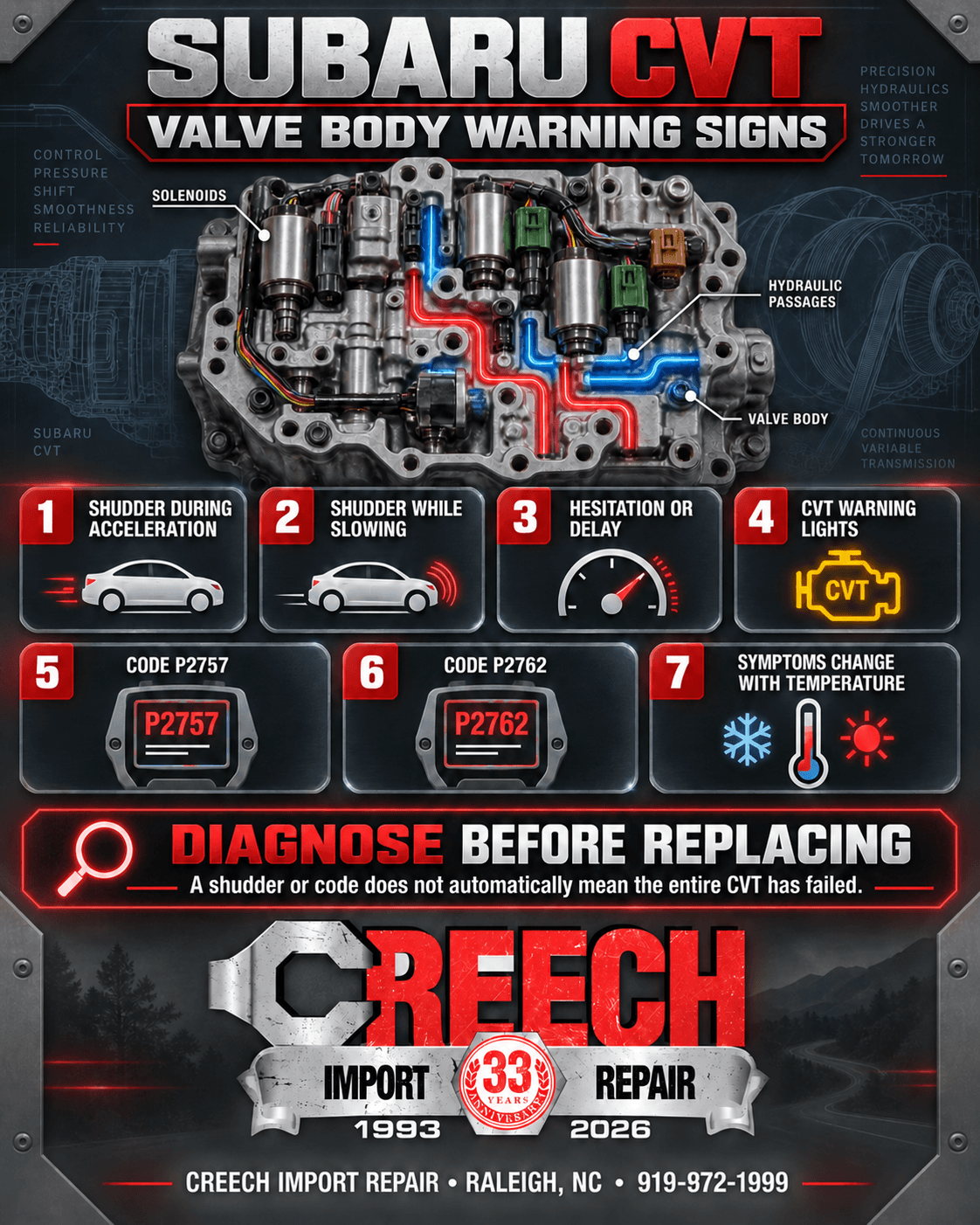
1. Shuddering During Acceleration
A vibration or shudder while accelerating from a stop is one of the symptoms identified in Subaru’s valve body bulletin. The sensation may feel like the vehicle is briefly driving across a rough surface.
Acceleration-related vibration can also come from an engine misfire, worn axle, damaged CV joint, engine or transmission mount, tire problem, or another drivetrain condition. The timing and operating conditions of the shudder are important diagnostic clues.
2. Shuddering While Slowing Down
Subaru’s bulletin also addresses shuddering while decelerating to a stop. A technician may need to evaluate torque-converter clutch release, valve-body operation, recorded transmission data, fluid temperature, and other drivetrain behavior.
A brake, wheel, suspension, engine, or axle problem can sometimes feel similar from the driver’s seat. The vehicle should be tested under repeatable conditions rather than diagnosed from a description alone.
3. Delayed or Hesitant Response
A Subaru that hesitates before moving, responds inconsistently to throttle input, or behaves abnormally after the brake is released may have a transmission-control concern. On applicable Crosstrek Hybrid models, Subaru’s bulletin specifically discusses abnormal behavior or no forward movement after releasing the brake from an EV stop.
Do not assume all hesitation is caused by the CVT. Engine performance, throttle control, fuel delivery, hybrid controls, braking systems, and other electronic inputs may affect how the vehicle responds.
4. Transmission or Dashboard Warning Lights
A transmission warning, AT Oil Temp light, check engine light, or multiple illuminated indicators may appear when a control module detects a fault. The vehicle’s modules should be scanned before codes are cleared or the battery is disconnected.
Stored codes, freeze-frame information, and live operating data can help determine whether the problem involves a solenoid circuit, pressure control, torque-converter behavior, wiring, fluid condition, or another system.
5. Diagnostic Code P2757
Subaru describes P2757 in the bulletin as a torque converter clutch pressure control solenoid control circuit performance or stuck-off condition. The presence of P2757 does not automatically authorize valve-body replacement. Subaru’s process requires technicians to follow the applicable diagnostic procedure and evaluate the results.
6. Diagnostic Code P2762
P2762 is associated in Subaru’s bulletin with a lock-up duty solenoid malfunction. Wiring, connections, electrical operation, hydraulic control, and other possible causes must be evaluated before condemning the valve body or transmission.
7. Symptoms That Change With CVT Temperature
A shudder or hesitation may be more noticeable when the CVT is cold, fully warmed, or transitioning between operating conditions. Subaru’s bulletin instructs technicians to compare recorded data at different CVT fluid temperatures when evaluating certain shudder complaints.
Drivers should tell the technician when the symptom occurs, including whether the vehicle was cold or warm, the approximate speed, whether the vehicle was accelerating or slowing, and which warning lights were visible.
Is Your Subaru Shuddering or Displaying a CVT Warning?
Creech Import Repair provides Subaru diagnostic and repair services in Raleigh. Have the problem tested before assuming the entire CVT needs replacement.
Does a Shudder Mean the Subaru CVT Is Failing?
No. Shuddering is a symptom, not a complete diagnosis. Subaru’s valve body bulletin shows why a methodical test process matters. A shudder can potentially involve valve-body or torque-converter operation, but it can also originate outside the CVT.
| When the symptom occurs | Possible areas to investigate | Why testing matters |
|---|---|---|
| Accelerating from a stop | CVT controls, engine performance, mounts, axles or CV joints | Several systems can produce a similar shudder |
| Slowing to a stop | Torque-converter release, valve-body operation, brakes or engine behavior | The location of the vibration may be misleading |
| Only at highway speed | Tire balance, wheel condition, bearings, axles or drivetrain | A speed-related vibration may not be a valve-body problem |
| Engine running roughly | Ignition, fuel, air, compression or engine controls | An engine misfire may feel like transmission shudder |
| Warning light with stored codes | Code-specific electrical, hydraulic and mechanical diagnosis | A code identifies a detected fault, not necessarily the failed part |
A complete CVT should not be replaced solely because a Subaru shudders. Likewise, fluid service should not be presented as a guaranteed cure for a mechanical or electrical fault. The correct repair depends on the diagnostic results.
How Are Subaru CVT Valve Body Problems Diagnosed?
A diagnostic process may include:
- Confirming the complaint: The technician reviews when the symptom occurs and attempts to reproduce it safely.
- Scanning relevant modules: Stored, pending, and history codes are retrieved before anything is cleared.
- Reviewing vehicle applicability: The model year, engine, transmission, VIN, and current service information are checked.
- Inspecting electrical components: Wiring, connectors, circuit integrity, grounds, and related components may require testing.
- Checking fluid condition and leaks: Fluid level, condition, contamination, and visible leakage may provide important evidence.
- Evaluating live data: A technician may monitor CVT temperature, engine speed, torque-converter speed, commanded operation, and related data during a controlled test drive.
- Separating CVT symptoms from other faults: Engine misfires, axles, mounts, tires, wheel bearings, brakes, and other systems may need inspection.
- Completing required relearn procedures: Certain repairs or diagnostic paths may require an applicable transmission or torque-converter relearn.
Subaru’s revised bulletin includes a procedure comparing lock-up duty behavior at different CVT fluid temperatures when diagnosing specified shudder complaints. This illustrates why a quick code scan alone is not equivalent to a complete diagnosis.
What Does Subaru’s 2026 CVT Diagnostic Bulletin Change?
Subaru Service Bulletin 18-241-26, dated May 19, 2026, corrects diagnostic procedures for certain CVT-related trouble codes. It applies to listed model years of the Legacy, Outback, Impreza, Crosstrek, Forester, Forester Wilderness, and Ascent.
The bulletin addresses diagnostic procedures for:
P0730 · P0746 · P0747 · P0841 · P0846 · P0867 · P1867 · P1894 · P2723
Subaru instructs technicians to use enhanced troubleshooting steps from the applicable 2025 service manual when diagnosing these codes in the listed vehicles. The purpose is to avoid misdiagnosis. The bulletin does not say that every one of these codes proves valve-body failure.
You can review Subaru Service Bulletin 18-241-26 through NHTSA.
Is the Subaru Valve Body Bulletin a Recall or Warranty Extension?
Service Bulletin 16-156-25R is a technical service bulletin. It is not, by itself, a safety recall or blanket warranty extension.
The bulletin states that a qualifying repair may be submitted when a vehicle remains within an applicable Basic New Car Limited Warranty, Powertrain Warranty, emissions warranty, or eligible Subaru Added Security plan. Actual coverage depends on the vehicle, mileage, time in service, warranty terms, diagnosis, and Subaru’s current requirements.
Before authorizing a potentially covered repair, owners should:
- Locate the vehicle’s 17-character VIN.
- Ask an authorized Subaru retailer to check for open recalls, campaigns, warranty extensions, or applicable coverage.
- Request a copy of the diagnostic findings and stored codes.
- Confirm what repair is covered and whether any owner cost applies.
- Avoid assuming that a technical service bulletin automatically provides free repairs.
Can You Drive With a Subaru CVT Warning or Shudder?
A mild, intermittent symptom may not create an immediate breakdown, but continued driving without diagnosis can allow some conditions to worsen. Stop driving and arrange assistance if the Subaru:
- Will not move normally in drive or reverse
- Loses propulsion or responds unpredictably
- Shudders or jerks severely
- Produces a burning odor or visible smoke
- Leaks a significant amount of fluid
- Displays an overheating transmission warning
- Enters a reduced-power or fail-safe mode
- Makes new grinding, banging, or other severe mechanical noises
If a warning light appears but the vehicle continues operating normally, schedule a diagnostic inspection promptly. Do not clear codes before the vehicle is inspected because stored information may help identify the problem.
Can Changing the CVT Fluid Fix a Valve Body Problem?
CVT fluid condition can affect lubrication, cooling, and hydraulic operation, but a fluid change is not a guaranteed repair for a failed solenoid, worn valve-body component, damaged circuit, or internal mechanical condition.
The wrong fluid, incorrect fluid level, contamination, or an inappropriate service procedure can also create problems. Subaru CVTs require the correct fluid specification and a service process appropriate for the exact vehicle and transmission.
Maintenance decisions should be based on the owner’s manual, vehicle usage, service history, fluid condition, and current Subaru guidance. A vehicle already exhibiting warning lights, shuddering, hesitation, or abnormal movement should be diagnosed before assuming routine fluid service will solve the complaint.
Subaru CVT Diagnosis in Raleigh, NC
Creech Import Repair has served Raleigh-area drivers since 1993. Our team provides Subaru repair and diagnostic service for Outback, Forester, Crosstrek, Impreza, Legacy, Ascent, and other Subaru models.
If your Subaru has a check engine light or another stored fault, learn more about Creech Import Repair’s check engine light diagnostic service. For broader vehicle concerns, visit our auto repair service page.
Our goal is to identify the cause of the symptom before recommending a repair. A Subaru that shudders does not automatically need a complete transmission, and a CVT-related code does not automatically prove which component failed.
Schedule Subaru CVT Diagnostic Service
If your Subaru is shuddering, hesitating, displaying transmission warnings, or storing CVT-related codes, schedule a professional diagnosis before the problem becomes more disruptive.
Location: 1818 St. Albans Dr #106, Raleigh, NC 27609
Frequently Asked Questions About Subaru CVT Valve Body Problems
What are the most common signs of a Subaru CVT valve body problem?
Possible signs include shuddering during acceleration or deceleration, hesitation, abnormal movement, transmission warning lights, and codes such as P2757 or P2762. These symptoms can have other causes, so proper testing is required before confirming valve-body failure.
Which Subaru models are listed in valve body bulletin 16-156-25R?
The bulletin lists specified 2012–2023 Impreza, 2013–2019 2.0-liter Crosstrek, 2014–2023 2.5-liter Forester excluding Wilderness, and 2013–2019 2.5-liter Legacy and Outback models. Hybrid-specific instructions apply to certain 2014–2016 Crosstrek Hybrid vehicles.
Does code P2762 mean the valve body must be replaced?
No. Subaru associates P2762 with a lock-up duty solenoid malfunction, but the applicable troubleshooting process must be completed. Wiring, electrical operation, hydraulic control, and other possible causes should be evaluated before parts are replaced.
Does code P2757 confirm a failed Subaru transmission?
No. P2757 is associated with torque converter clutch pressure-control performance or a stuck-off condition. The code does not independently prove that the complete CVT has failed or that the entire transmission requires replacement.
Is Subaru valve body bulletin 16-156-25R a recall?
No. It is a technical service bulletin describing a design change and diagnostic procedures. It does not automatically provide recall status or free repairs. Warranty coverage must be verified for the individual vehicle.
Can old CVT fluid cause a Subaru to shudder?
Fluid condition or level may affect CVT operation, but shuddering can also involve valve-body controls, torque-converter behavior, electrical faults, engine performance, axles, mounts, tires, or other components. Diagnosis should come before assuming fluid service is the solution.
Can I drive my Subaru if the AT Oil Temp light comes on?
An AT Oil Temp warning can indicate excessive CVT fluid temperature or another transmission-related condition. Follow the owner’s manual, stop safely when appropriate, and arrange professional assistance if the warning flashes, remains illuminated, or accompanies abnormal operation.
Can Creech Import diagnose Subaru CVT problems in Raleigh?
Yes. Creech Import Repair provides Subaru diagnostic and repair services in Raleigh. The team can evaluate warning lights, stored codes, shuddering, hesitation, fluid concerns, and other symptoms before recommending an appropriate repair.
 Schedule Your Service Appointment Today
Don’t wait until a small problem becomes a major repair. Whether you need routine maintenance, diagnostics, or major repairs, the team at Creech Import Repair is ready to help.
 Address: 1818 St. Albans Dr #106, Raleigh, NC 27609 Phone: 919-872-1999
 Schedule Online: https://www.creechimport.com/chevrolet-silverado-1500-repair-services
About the Author: The ASE-certified team at Creech Import Repair has been serving Raleigh drivers since 1993. We specialize in Subaru transmission diagnosis, repair, and replacement..
Source and accuracy note: Technical information in this article is based primarily on Subaru Service Bulletin 16-156-25R, revised May 13, 2026, and Subaru Service Bulletin 18-241-26, dated May 19, 2026. Service procedures, vehicle applicability, warranty coverage, and campaign information may change. Owners and technicians should verify current information using the VIN and Subaru’s latest service resources. This article is informational and does not replace professional diagnosis.