


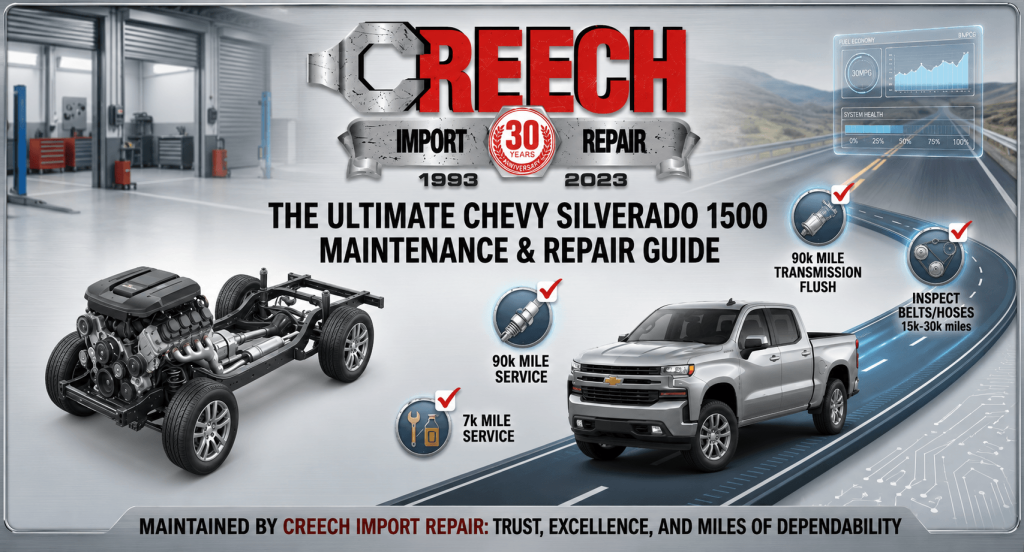
The Ultimate Chevy Silverado 1500 Maintenance & Repair Guide: Keeping Your Truck on the Road for 250,000+ Miles
By the ASE-Certified Team at Creech Import Repair | Updated: May 2026
The Chevrolet Silverado 1500 is more than just a pickup—for many Raleigh drivers, it’s a mobile workshop, a weekend adventure rig, a family hauler, and a daily driver rolled into one. Since its debut in 1999, the Silverado has become America’s second best‑selling vehicle, with over 12 million units sold. But even the toughest Chevy truck needs expert care, especially when it faces the unique demands of North Carolina roads, from the stop‑and‑go grind of I‑440 to the pothole‑riddled back roads of Wake County.
At Creech Import Repair, we’ve been keeping vehicles on the road since 1993. While “Import” is in our name, we have extensive experience servicing domestic vehicles, including the Chevrolet Silverado 1500. We combine decades of hands‑on experience with modern diagnostic equipment to provide repair and maintenance services that extend your truck’s life and save you money.
➡️ Schedule Your Silverado 1500 Service Appointment Today
In this comprehensive guide, we’ll cover everything Silverado 1500 owners need to know: common problems and their solutions, manufacturer‑recommended maintenance schedules, repair costs, model years to avoid, and how the Silverado stacks up against its rivals.
Most Common Chevrolet Silverado 1500 Problems
Transmission problems are the most widely reported issue for the Silverado 1500. Based on owner complaints and NHTSA data, symptoms include slipping gears, rough shifting, transmission shudder, and complete failure. Repair costs range from a 282 – 282 – 377 fluid change to a complete replacement costing up to $5,800.
The transmission problems vary by generation:
| Generation | Transmission | Common Issues |
|---|---|---|
| Pre‑2007 | 4L60E (4‑speed) | Harsh shifting, delayed engagement, gear slippage |
| 2007‑2014 | 6L80E (6‑speed) | Overheating under heavy loads, pressure control solenoid failures, delayed upshifts |
| 2015‑2019 | 8L90 (8‑speed) | Shuddering on light acceleration (20‑80 mph) due to torque converter clutch problems |
| 2020‑present | 10‑speed automatic | Generally more reliable, but occasional rough shifting and valve body issues |
Proactive maintenance is key. If your transmission fluid is dark, smells burnt, or contains metallic particles, have it inspected immediately.
Engine Problems: AFM/DFM Lifter Failure (5.3L & 6.2L V8)
The most notorious engine problem across 2007‑2023 Silverado 1500 models is lifter failure in the 5.3L and 6.2L V8 engines equipped with Active Fuel Management (AFM) or Dynamic Fuel Management (DFM). When a lifter collapses, you’ll hear a distinct ticking noise followed by a misfire and rough running. If ignored, a collapsed lifter can damage the camshaft, requiring thousands in repairs. This issue has become one of the most widely reported pain points for GM truck owners.
This guide is for general informational purposes and does not constitute a specific repair estimate or warranty of any particular outcome. Always have your vehicle diagnosed in person by a qualified technician.
AC & Cooling System Failures
North Carolina summers demand a reliable AC system. Common Silverado AC issues include weak airflow, intermittent cooling, or warm air at idle—often due to low refrigerant, a failing compressor, blend door problems, or electrical faults. An AC recharge typically costs 252 – 252 – 333.
Cooling system problems are also common, especially coolant leaks from water pumps, radiator cracks, or failed thermostats. A full coolant flush typically costs 624 – 624 – 815.
🔩 Suspension & Steering Wear
Raleigh’s potholes and rough roads take a toll on Silverado suspension components. Owners often report clunks over bumps, wandering steering, uneven tire wear, or a harsh ride—often caused by worn ball joints, tie rod ends, control arm bushings, or failing shocks/struts.
⚡ Electrical & Sensor Glitches
Modern Silverados rely on multiple computers and sensors. Common electrical issues include random warning lights, infotainment screen freezes, backup camera failures, and battery drain problems.
Chevrolet Silverado 1500 Maintenance Schedule (What the Dealer Won't Tell You)
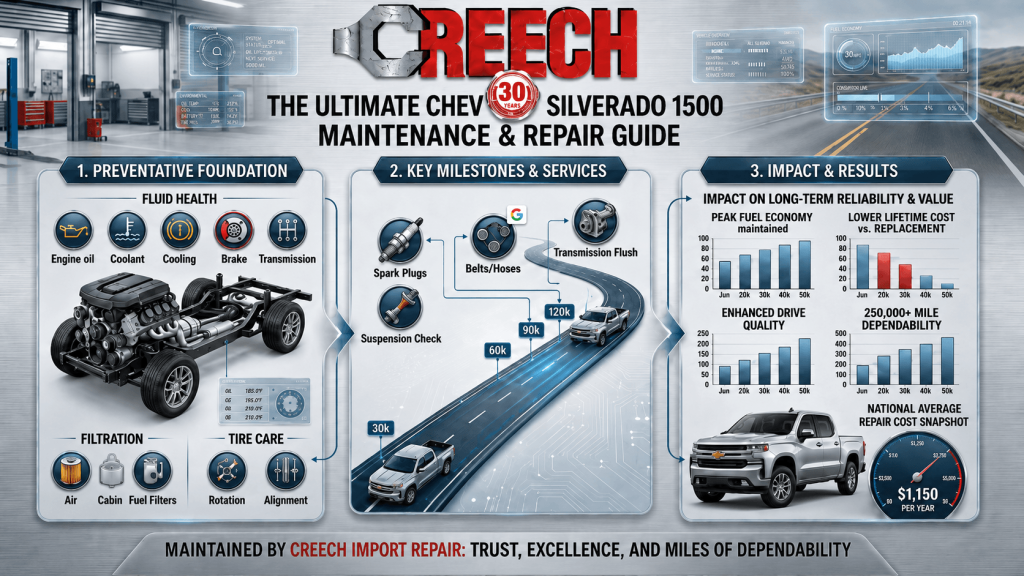
Following the manufacturer‑recommended maintenance schedule is the single most effective way to prevent major repairs and extend your truck’s life. Chevrolet recommends service intervals every 7,500 miles.
Maintenance by Mileage Interval
| Mileage | Services Required |
|---|---|
| 7,500 miles | Oil & filter change, tire rotation, brake inspection, fluid check, multi‑point inspection (Est. 245–245–358) |
| 15,000 miles | Oil change, tire rotation, replace cabin air filter, inspect fuel system, check suspension/steering components |
| 30,000 miles | Replace engine air filter, replace fuel filter, inspect exhaust system, test battery, clean terminals |
| 45,000 miles | Oil change, tire rotation, replace spark plugs, inspect transfer case fluid (4WD models), inspect evaporative control system |
| 60,000 miles | Inspect/replace drive belts and hoses, change automatic transmission fluid, inspect cooling system |
| 90,000 miles | Check battery voltage, inspect/replace oil cooler and heater hoses, replace timing belt (if equipped) |
Estimated 10‑Year Maintenance & Repair Costs
A Chevrolet Silverado 1500 will cost about **10,950formaintenanceandrepairsduringitsfirst10years∗∗—10,950formaintenanceandrepairsduringitsfirst10years∗∗—1,325 more than the industry average. There’s also a 30.98% chance of a major repair within 10 years.
Raleigh‑Specific Maintenance Tips
Summer (May–September): Check AC performance monthly; monitor coolant levels.
Winter (December–February): Test battery and charging system; check antifreeze protection.
Year‑round: Inspect brakes every 6 months (Raleigh traffic causes accelerated wear).
➡️ Schedule Your Scheduled Maintenance at Creech Import Repair
Best & Worst Chevrolet Silverado 1500 Model Years (What to Buy, What to Avoid)
If you’re buying used, knowing which model years to avoid can save you thousands in unexpected repairs.
⚠️ Silverado 1500 Years to Avoid
| Model Year | Why to Avoid |
|---|---|
| 2003‑2004 | Over 1,000 NHTSA complaints each—rough idling, stalling, electrical issues, power steering problems |
| 2005‑2007 | HVAC system failures, drivetrain problems, numerous recalls |
| 2011 | Transmission failures, engine problems, cooling issues, stalling, noisy engines |
| 2014 | Worst model year overall—transmission failures, engine problems, cooling issues, stalling, noisy engine |
| 2019‑2024 (6.2L V8) | Under federal investigation for engine bearing failures; 1,157 reports received |
Best Silverado 1500 Years to Buy
| Model Year | Why Recommended |
|---|---|
| 1998, 2000‑2002 | Reliable, durable, simple maintenance |
| 2008‑2010 | Fewer complaints than surrounding years |
| 2012 | Reliable and well‑built; minor brake complaints |
| 2020‑2021 | Very few NHTSA complaints; improved interior quality, ride comfort |
Silverado 1500 vs. Ford F‑150 vs. Ram 1500: Which Full‑Size Truck Is Most Reliable?
| Criteria | Chevrolet Silverado 1500 | Ford F‑150 | Ram 1500 |
|---|---|---|---|
| J.D. Power Reliability Score | 84–86/100 | 78–86/100 | 89/100 |
| Most Common Problems | AFM lifter failure, transmission shudder, electrical | Cam phaser issues, transmission, electrical | HEMI lifter tick, air suspension, manifold bolts |
| 10‑Year Maintenance Cost | $10,950 | Similar | Similar |
| Best For | Overall balance of power, comfort, and reliability | Towing capacity, resale value, technology | Ride quality, luxury interiors |
While the Ram 1500 scores highest in J.D. Power’s reliability ratings, the Chevrolet Silverado 1500 remains the most reliable full‑size truck currently on sale when factoring in dealership experience and long‑term durability.
Comprehensive Repair Cost Guide for Silverado 1500 Owners
Knowing typical repair costs helps you budget and recognize fair estimates.
| Service/Repair | Typical Cost Range (Parts & Labor) |
|---|---|
| Oil Change (synthetic) | 65–120 |
| Tire Rotation | 25–50 |
| Brake Pad Replacement | 200–500 |
| Full Brake Job (pads + rotors) | 1,200–2,200 |
| Transmission Fluid Change | 165–435 |
| Transmission Rebuild/Replace | 3,500–6,400 |
| AC Recharge | 252–333 |
| AC Compressor Replacement | 1,200–1,800 |
| Coolant Flush | 624–815 |
| Water Pump Replacement | 500–900 |
| AFM Lifter Repair (5.3L/6.2L) | 3,500–5,500 |
| Front Suspension Overhaul | 1,500–2,500 |
| Alternator Replacement | 400–700 |
| Starter Replacement | 350–600 |
Prices are national averages and vary based on model year, labor rates, and parts quality.
Proactive Maintenance Tips for Maximum Longevity (250,000+ Miles)
Use full‑synthetic oil. Change every 5,000–7,500 miles. The 5.3L and 6.2L V8 engines benefit from high‑quality synthetic oil to reduce AFM/DFM lifter failure risk.
Flush transmission fluid every 45,000–60,000 miles under normal conditions, or more frequently if you tow regularly.
Address check engine lights immediately. Silverados have complex computer systems—small sensor failures can trigger drivability issues and transmission shifting problems.
Inspect front suspension annually. Ball joints, tie rods, and control arms wear faster on Raleigh roads.
Test your battery twice a year. Silverados have high electrical demands; failing batteries can cause random warning lights.
Keep cooling system in top shape. The 5.3L and 6.2L V8 engines are sensitive to overheating—use proper Dex‑Cool coolant and replace every 5 years or 150,000 miles.
Consider an AFM/DFM disable device if you own a 2007–2023 5.3L or 6.2L Silverado. While not a guaranteed fix, many owners report reduced lifter failure risk.
Advanced Silverado 1500 Ownership: Engine Deep Dive & Financial Reality Check
To truly dominate Silverado 1500 repair content, you need more than a list of common problems. You need to understand which engine will actually last and whether an extended warranty makes financial sense. Here’s what most shops won’t tell you.
5.3L vs. 6.2L vs. 3.0L Duramax: Which Silverado Engine Truly Lasts?
The 5.3L V8 (L83, L84) is the most common Silverado engine, and with proper AFM prevention (disabler + 5,000‑mile synthetic oil changes), many exceed 250,000 miles. The 6.2L V8 (L86, L87) makes more power but shares the same AFM/DFM lifter design — and in 2019‑2024 models, it’s under federal investigation for engine bearing failures. Our shop has seen several 6.2L trucks need complete long‑block replacements before 60,000 miles.
The dark horse is the 3.0L Duramax inline‑6 diesel (LM2, LZ0). It avoids AFM lifters entirely, has no bearing investigation, and routinely achieves 25‑30 MPG highway. Maintenance costs are higher (DEF fluid, fuel filters every 15k miles, and the CP4 fuel pump risk), but we’ve yet to see a 3.0L Duramax with a catastrophic internal failure before 200,000 miles. For Raleigh owners who tow frequently or drive 25,000+ miles per year, the diesel is the long‑term reliability winner — despite the higher upfront cost.
Bottom line for used buyers: Prioritize a 5.3L with AFM disabled, a 3.0L Duramax with documented maintenance, or a 6.2L only if you have a warranty and accept the bearing risk.
Extended Warranty vs. Self‑Insure: The $10,950 Math
Earlier we noted that a Silverado 1500 costs about **10,950inmaintenanceandrepairsover10years∗∗,witha∗∗30.9810,950inmaintenanceandrepairsover10years∗∗,witha∗∗30.982,500‑$4,000 for 5‑7 years of coverage.
Run the numbers: If you put 3,000intoahigh‑yieldsavingsaccountinsteadofbuyingawarranty,after5yearsat43,000intoahigh‑yieldsavingsaccountinsteadofbuyingawarranty,after5yearsat43,650. The average major repair (transmission rebuild or AFM lifter job) runs 3,500‑3,500‑5,500. So self‑insuring covers one major repair. A second major repair would push you over.
Our advice for Raleigh Silverado owners:
Keep the truck beyond 100,000 miles? Buy a warranty that specifically covers the transmission and AFM components. Read the fine print — many exclude “collapsible lifters.”
Sell before 100,000 miles? Self‑insure. Put $50/month into a repair fund.
Own a 2019‑2024 6.2L V8? Get the warranty. The bearing failure risk is real, and a new engine costs 8,000‑8,000‑12,000.
No warranty covers neglected maintenance. Regardless of your choice, follow the 5,000‑mile oil change rule and flush your transmission every 45,000 miles. That’s the real secret to 250,000+ miles.
FAQ: Questions Most Silverado 1500 Owners Are Afraid to Ask
My 2015‑2019 Silverado has the dreaded 8L90 transmission shudder. I've already done the triple flush with Mobil 1 LV HP fluid. It helped for 5,000 miles but came back. What's the real fix?
You’re experiencing the known torque converter clutch (TCC) degradation issue. The triple flush (TSB 18‑NA‑355) is a temporary bandage. When shudder returns, the torque converter itself has internal wear. The permanent fix is replacing the torque converter with the updated GM part #24288678 (redesigned turbine hub and clutch material). Many owners also replace the transmission fluid thermostat with a lower‑temperature unit (e.g., SureCool or STL010) to keep fluid under 170°F. Expect 2,000–2,000–2,800 for converter + labor. Avoid aftermarket converters. Use only GM replacement parts.
I have a 2018 Silverado 1500 5.3L with 90,000 miles. Should I install an AFM disabler now, or is it too late?
Not too late, but proceed strategically. An AFM disabler (Range Technology, DiabloSport, or Pulsar LT) prevents the engine from switching to 4‑cylinder mode, which reduces the cycling of the collapsible lifters. However, if your lifters already have microscopic wear, disabling AFM won’t reverse it. Best practice: Perform an engine oil flush with BG EPR or Liqui Moly Engine Flush, switch to 5W‑30 full‑synthetic with high‑zinc (e.g., Amsoil, Red Line), then install the disabler. This combo has kept many 5.3Ls running past 200k miles without failure.
My check engine light is on with code P0420 (catalyst efficiency) on my 2014‑2018 Silverado. Is it always the catalytic converter, or could it be something else?
Don’t replace the catalytic converter yet. On Silverado’s, P0420 is often caused by exhaust manifold leaks, lazy upstream oxygen sensors, or even a minor vacuum leak. First, check for the infamous broken exhaust manifold bolts (common on 5.3L/6.2L). Second, monitor O2 sensor data with a scan tool—if Bank 1 Sensor 1 is slow to switch, replace both upstream sensors. Only after ruling out those should you replace the cat. A genuine GM cat is recommended. Aftermarket bolt‑on units(Walker, Magna Flow) are lower priced but may fail sooner.
My 2020‑2023 Silverado with the 10‑speed transmission sometimes slams into gear when cold. I hear that is "normal." Is that true?
Partial truth with a caveat. The Ford/GM 10R80/10L80 transmission has adaptive learning. Harsh 1‑2 or 2‑3 shifts when cold (below 40°F) is a known characteristic, but clunking, delayed engagement, or banging into reverse is not normal. Ask the dealer to check for TSB 22‑2345 (valve body calibration update) and verify fluid level using the proper procedure (fluid temp at 195‑205°F, vehicle level). Many owners find that a transmission tune (HP Tuners or Livernois) eliminates harsh shifts completely, though that may void warranty.
Is it safe to use a tuner or "pedal commander" on my daily‑driven Silverado 1500?
Safe if you choose wisely. Pedal commanders (only throttle response) are low‑risk but won’t improve power. Full tuners (DiabloSport, HP Tuners) can disable AFM/DFM, adjust shift firmness, and gain 15‑25 HP, but they increase powertrain stress. Risk areas: Excessively firm shifts can damage the transmission over time; raising torque converter lockup thresholds increases heat. For a daily driver, we recommend a conservative 87‑octane tune with AFM disabled and transmission shift pressure increased by no more than 10%. Always keep your stock tune file saved.
I live in Raleigh and tow a 7,000 lb boat 6‑8 times per year. My 2017 Silverado 5.3L overheats on long grades. New radiator, water pump, thermostat. Still overheating. What am I missing?
Classic Silverado 1500 towing overheat mystery. The likely culprit is insufficient transmission cooler and engine fan clutch. The factory auxiliary transmission cooler (if equipped) is marginal. Upgrade to the GM heavy‑duty cooler kit (#84352794) or an aftermarket stacked‑plate cooler (Derale or Tru‑Cool 40k GVW). Also, replace the engine fan clutch with the severe‑duty thermal fan clutch (Hayden 2799 or equivalent) . Finally, verify your radiator cap holds pressure (16 PSI). Many owners also add a secondary electric fan (Spal or Flex‑a‑lite) with a manual override switch for towing.
My 2007‑2013 Silverado has the "GM dash crack" and my instrument cluster gauges are freaking out (speedometer drops to zero, fuel gauge erratic). Is this a ground issue or a bad cluster?
Both are possible, but the 2007‑2013 generation is infamous for stepper motor failure on the instrument cluster. The speedometer, tachometer, and fuel gauge stepper motors develop dead spots. You have two options: send the cluster to a repair service (e.g., GM Gauge Repair, Module Experts) for ~150‑150‑200 with lifetime warranty, or replace the cluster yourself with a rebuilt unit. Ground issues on G201 and G203 (behind the driver’s side dash) can cause similar symptoms, so check those first with a multimeter.
What's the real‑world cost to replace all 4 shocks on a 2014‑2018 Silverado 1500 with the Z71 off‑road package (Rancho shocks)?
OEM Rancho shocks are low‑quality and often fail by 50k miles. To replace all four with quality aftermarket:
Budget (Monroe or Gabriel): 300‑300‑400 parts, 2‑3 hours labor → 600‑600‑800 total.
Mid‑level (Bilstein 5100 or Fox 2.0): 500‑500‑700 parts, same labor → 800‑800‑1,100 total.
Premium (King or Icon coilovers): 2,000‑2,000‑3,500 parts, 3‑4 hours labor → 2,500‑2,500‑4,500 total.
For Raleigh daily driving with occasional light off‑road, Bilstein 5100s are the best value—improved handling without harshness.
My 2019‑2022 Silverado Trail Boss has the "clunk in the front end" when turning at low speed. Dealers have replaced sway bar links, tie rods, and control arms. Still clunks. Can Creech Help?
This is the Silverado Trail Boss front suspension mystery clunk, often misdiagnosed. The real cause for many owners is either:
Upper control arm ball joint clearance – The ball joint nut can bottom out on the stud, leaving play. Fix: Add a washer under the nut or replace with aftermarket UCAs (Cognito, Kryptonite).
Strut mount bearing failure – The top hat bearing on the factory Rancho shocks fails internally without external visible damage. Fix: Replace strut top mounts with aftermarket heavy‑duty units (Supreme Suspensions or ReadyLift).
Body mount bushing compression – Apply silicone lubricant to all body mount bushings; if noise stops, replace with polyurethane mounts.
I'm the original owner of a 2004 Silverado 1500 with 220,000 miles. It runs fine but leaks a quart of oil every 1,000 miles. No smoke, no puddles. Engine replacement or keep driving?
Keep driving – that leak is almost certainly the rear main seal or oil pressure sensor. At 220k miles on a 5.3L LM7, rear main seal replacement costs 1,200‑1,200‑1,800 (transmission removal). Not worth it unless you’re doing a transmission rebuild. Instead, switch to high‑mileage 10W‑30 oil (Valvoline MaxLife) which has seal conditioners, and add Lucas Oil Stabilizer. Check oil every fuel fill‑up. Many LM7 engines run happily to 300k+ miles with a quart‑per‑1,000 mile consumption. Only replace the engine if you develop rod knock, low oil pressure (<10 psi hot idle), or excessive smoke.
Our Services at a Glance
Creech Import Repair has been serving Raleigh since 1993. We specialize in:
Learn more About Us or Contact Us for an appointment.
Why Choose Creech Import Repair for Your Silverado 1500
Serving Raleigh since 1993 – Family‑owned, deeply rooted in the community.
✓ ASE‑Certified Technicians – Trained on domestic and import vehicles.
✓ Both domestic and import expertise – One trusted shop for mixed garages.
✓ Transparent pricing & electronic approvals – No surprises, no unnecessary work.
✓ Professional‑grade diagnostic equipment – Advanced scanners and live data analysis.
✓ High‑quality parts & long‑lasting repairs – We don’t cut corners.
📞 Schedule Your Silverado 1500 Service Appointment Today
Don’t wait until a small problem becomes a major repair. Whether you need routine maintenance, diagnostics, or major repairs, the team at Creech Import Repair is ready to help.
📍 Address: 1818 St. Albans Dr #106, Raleigh, NC 27609
📞 Phone: 919-872-1999
🌐 Schedule Online: https://www.creechimport.com/chevrolet-silverado-1500-repair-services
About the Author: The ASE‑certified team at Creech Import Repair has been serving Raleigh drivers since 1993. We specialize in both domestic and import vehicles, with extensive experience in Chevrolet Silverado 1500 repair and maintenance.
Last updated: May 2026. Repair costs are estimates and may vary. Always obtain a written estimate before authorizing repairs.
Sources
NHTSA – Official government safety recalls and complaints data.
CarComplaints.com – Aggregated owner complaints with PainRank™ scoring.
J.D. Power – Industry‑standard reliability ratings.
RepairPal – Real‑world repair cost estimates.
GM‑TechLink – Official General Motors technical service bulletins.
AP News – Breaking news on NHTSA investigations and recalls.