


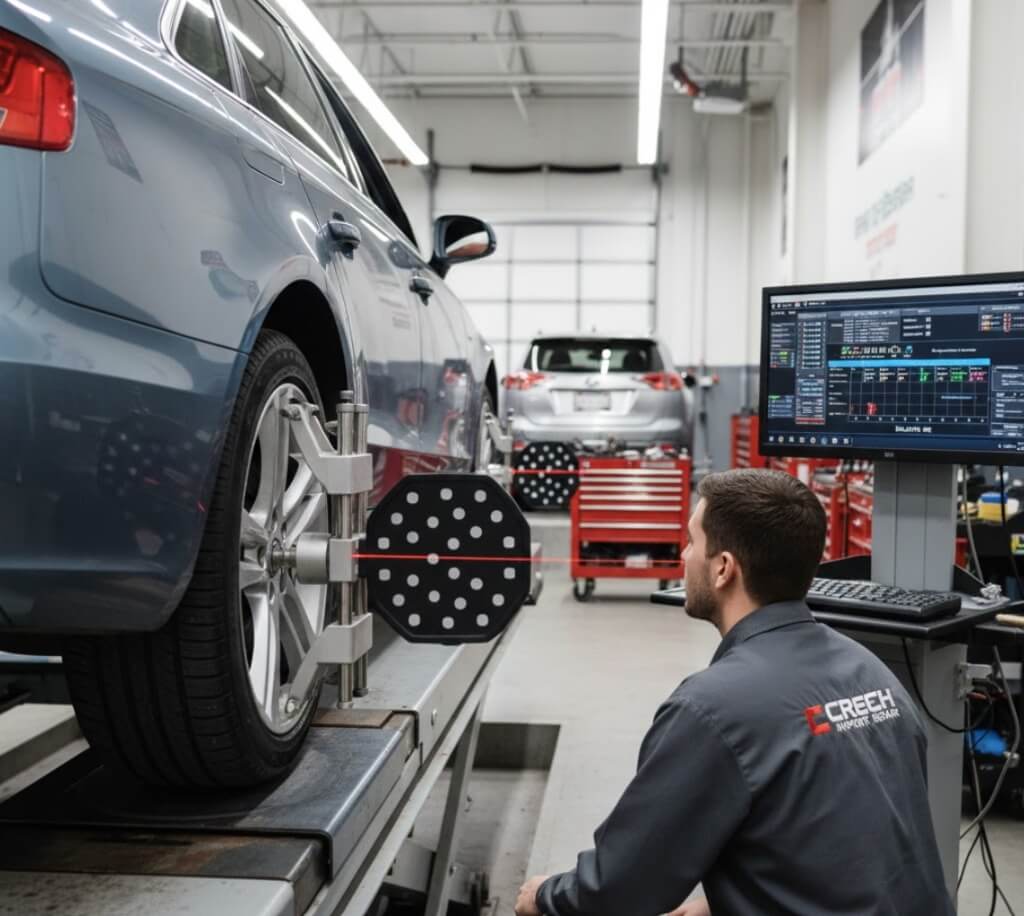
Ask any technician with years in the bay, and they’ll tell you: few services protect a vehicle’s long-term health the way a proper wheel alignment does. Tires last longer, steering feels consistent, braking improves, and fuel consumption stabilizes. If you drive an import in the Triangle — Subaru, Toyota, Lexus, Honda, Mazda, Nissan, VW, Audi, BMW, or Mercedes — alignment matters even more. These vehicles rely heavily on tight steering angles, advanced suspension geometry, and electric power steering calibration. A small drift in toe or camber can turn into rapid tire wear, shaky highway steering, or a steering wheel that won’t sit straight.
Creech Import Repair (1818 St. Albans Dr #106, Raleigh, NC) performs alignment in Raleigh, NC for Asian and European imports using precision alignment equipment, factory specifications, and suspension evaluation before adjustments — essential for modern cars with multi-link and MacPherson setups.
If your steering feels “off,” the wheel won’t center, or your tires are feathering or cupping, a professional alignment is the fix that restores confidence behind the wheel.
Why Alignment Matters More for Imports in Raleigh
Between Midtown traffic, I-440 expansion joints, Peace Street roadwork, and the heat-humidity cycle that affects suspension bushings in summer, Raleigh’s roads are hard on steering geometry.
Common local contributors to misalignment include:
- Potholes on Glenwood, Six Forks, Wake Forest Rd, and Atlantic Ave
- Parking lot curb strikes (especially around North Hills)
- Worn strut mounts from temperature swings
- Aging control arm bushings on Hondas, Subarus, Toyotas, and Mazdas
- Bent wheels from low-profile tires on Audis, BMWs, and Mercedes
Even a small impact can shift suspension angles. An alignment in Raleigh, NC isn’t just a tire service — it’s a suspension health check.
What Alignment Actually Corrects (Camber, Caster, Toe)
When a shop talks about “alignment,” they’re really correcting three angles:
Camber
How much the tire leans inward or outward when viewed from the front.
- Too much negative camber: inside tire wear
- Too much positive camber: outside tire wear
- Imports like BMW/VW/Audi run slight negative camber by design
Caster
How far forward or backward the steering axis tilts — affects stability and return-to-center.
- Subaru & Honda rely heavily on precise caster for straight-line tracking
- Uneven caster = pulling, even with perfect camber/toe
Toe
The most critical angle for tire life: whether the fronts point inward or outward.
- Even 1/16″ of incorrect toe can shred a tire in a few thousand miles.
- Toe drift is the #1 cause of rapid wear in Raleigh on imports.
Creech Import examines all three, plus thrust angle, which ensures the rear wheels track straight behind the vehicle — important on multi-link suspensions common in imports.
Why a “Quick Alignment” Isn’t Enough
Chain shops may “set the toe and go.” But imports require more.
Creech Import inspects:
- Tie rods (inner + outer)
- Control arm bushings
- Sway bar end-links
- Ball joints
- Strut mounts / upper bearings
- Thrust arm bushings (common BMW issue)
- Rear multi-link play (Mazda, Subaru, Lexus, Infiniti)
Without those checks, an alignment won’t hold.
If the underlying component is worn, a perfect alignment becomes imperfect within days.
Imports have tighter tolerances, so minor bushing deterioration affects the entire system. A certified import shop ensures geometry adjustments stay accurate after you leave.
Raleigh’s Weather = Faster Suspension Wear
Heat, humidity, and road salt from occasional winter storms can accelerate rubber aging. That includes:
- Control arm bushings
- CV boots (Subaru, Mazda)
- Strut bearings
- Rack and pinion boots
- Sway bar bushings
When these soften or crack, alignment angles shift under load, especially during:
- Highway lane changes
- Hard braking
- Speed bumps
- Tight turns in parking decks
This is why Creech Import checks bushing condition before performing alignment.
Signs You Need Alignment in Raleigh, NC
You may feel one or more of the symptoms:
- Steering wheel is off-center while driving straight
- Vehicle drifts left or right
- Vibrations at 50–70 mph
- Rapid inside or outside tire wear
- Tires feathering or cupping
- Steering feels “loose,” delayed, or twitchy
- Car feels unstable on I-440 ramps
- Squealing tires at low-speed turns
Or the signs may be subtle: rising fuel consumption, slight on-center play, or a quiet thump during turns.
Raleigh’s road conditions worsen these quickly, so an alignment check every 12 months or 10,000 miles is ideal — or more frequently for lowered vehicles, hybrids, or cars with oversized wheels.
Alignment Process at Creech Import (Step-by-Step)
A real alignment is more than four bolts and a printout. Here’s how Creech does it:
1. Road Test & Intake Interview
Technicians listen for pulling, vibration, clunks, or steering lag. They’ll ask:
- When does it pull?
- Does the wheel vibrate on highway or city?
- Recent tire replacements?
- Any recent suspension work?
2. Holistic Suspension Inspection
Before any adjustment, the team inspects:
- Joints, bushings, tie rods
- Struts, shocks, and mounts
- Wheel bearings
- Tire wear patterns
- Wheel runout (bent wheels)
A bent wheel on a VW Golf, for example, creates alignment symptoms without any alignment change.
3. Alignment Rack Setup
Using precision lasers and manufacturer specs, the vehicle is leveled, sensors attached, and baseline measurements taken.
4. Correction of Camber, Caster, Toe, Thrust Angle
Creech adjusts angles to OEM tolerances, not “close enough.” For imports, this is key — many European cars require sub-degree accuracy.
5. Recheck Under Load
Because bushings behave differently under compression, the team verifies readings after minor movement — essential for older Toyota, Lexus, and Subaru models.
6. Documentation & Tire Recommendations
You’ll get a full report with before/after specs and notes on:
- Tire pressure
- Tire rotation schedule
- Future bushing considerations
- Suspension wear trends
Alignment Helps Hybrids and EVs Even More
Toyota Prius, Accord Hybrid, Lexus hybrid SUVs, and many EVs require precise alignment for reasons beyond tire wear:
- Regenerative braking calibration
- Electric power steering load
- Low rolling-resistance tire compounds
- High torque at low speeds
Incorrect alignment can reduce EV range and increase hybrid inverter stress.
Creech Import is equipped and trained to align hybrid systems safely.
When Alignment Alone Won’t Solve the Issue
Some handling problems seem like alignment but originate elsewhere:
Tire Conicity
A manufacturing variation that makes the tire pull.
Uneven tire pressure
5 psi difference can cause drift.
Worn rear shocks
Creates instability at highway speeds.
Wheel bearing play
Masquerades as alignment issues.
Torque steer on FWD imports
Common on older Hondas, Acuras, Mazdas.
Creech Import’s diagnostic approach isolates true causes before performing adjustments.
Example Case Studies (Anonymized)
2017 Subaru Outback – Pulling Right
- Issue: Vehicle drifted right after hitting curb.
- Findings: Bent lower control arm, misaligned rear toe.
- Fix: Replace control arm, perform 4-wheel alignment.
- Result: Straight tracking and even tire wear.
2015 BMW 328i – Inside Tire Wear
- Issue: Tires worn through cords at 18k miles.
- Findings: Excessive negative camber due to worn thrust arm bushings.
- Fix: Replace arms, align to BMW specs.
- Result: Normal wear; improved braking stability.
2018 Honda CR-V – Steering Wheel Off-Center
- Issue: Steering wheel 10° left on straight road.
- Findings: Toe misalignment from pothole impact.
- Fix: Correct toe; recalibrate EPS.
- Result: Centered steering and smoother tracking.
Why Choose Creech Import for Alignment in Raleigh?
Here’s what sets them apart:
- Asian & European specialization:
- Full suspension inspection before adjustments
- Hybrid-safe procedures
- OEM specifications for all angles
- Road test + verification
- Local, family-owned credibility
- Convenient Midtown Raleigh location
- Same-day service for most alignments
- Schedule or ask questions anytime
Explore Creech Services
Preparing for Your Alignment Appointment
Bring or check:
- Tire pressures
- Any recent suspension work
- Notes on when pulling occurs
- Mileage since last alignment
- If tires were recently replaced
Don’t rotate tires the same day unless recommended — alignment readings are more accurate when tire wear patterns are untouched.
FAQs — Wheel Alignment in Raleigh, NC
Q1: How often should I get an alignment?
Every 12 months or 10,000 miles, or after hitting a pothole/curb.
Q2: Do I need an alignment after buying new tires?
Yes. New tires amplify misalignment and can wear prematurely.
Q3: Can alignment improve fuel economy?
Yes. Incorrect toe increases rolling resistance.
Q4: Why does my steering wheel sit crooked?
Toe or thrust angle misalignment, often from impact.
Q5: Does Creech Import align lowered cars?
In most cases yes — call to confirm vehicle details.
Q6: Will alignment fix vibration?
Only if vibration comes from geometry issues; otherwise it may be wheel balance or a bent wheel.
Q7: Do hybrids need special alignment?
Yes — due to regenerative braking and EPS calibration.
Q8: Do you check suspension before alignment?
Always. Worn parts cause alignment to “not hold.”
Sources
- NHTSA – Tire Safety & Alignment Effects
https://www.nhtsa.gov/equipment/tires - EPA – Fuel Economy & Rolling Resistance
https://www.epa.gov/greenvehicles/guide-fuel-efficient-vehicles - NCDOT Emissions & Inspection Program
https://www.ncdot.gov/dmv - SAE International – Alignment & Vehicle Dynamics Papers
https://www.sae.org
AAA Research – Road Impact on Tire Wear
https://newsroom.aaa.com