


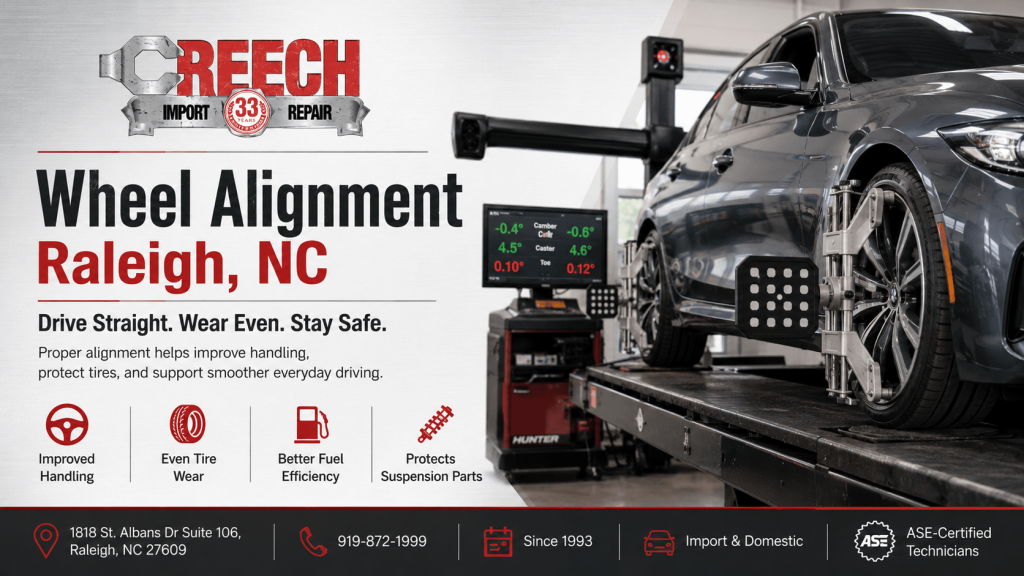
Wheel Alignment Raleigh NC: Signs, Cost, Process, and When to Schedule Service
Wheel alignment Raleigh NC drivers can trust starts with a simple question: does your vehicle track straight, steer smoothly, and protect your tires the way it should? If your car pulls to one side, the steering wheel sits crooked, the tires are wearing unevenly, or the vehicle feels less stable on I-440, I-540, Capital Boulevard, Six Forks Road, or daily Triangle commutes, it may be time for an alignment inspection.
Wheel alignment is not just about making the steering wheel look straight. Proper alignment affects tire wear, steering response, fuel efficiency, ride quality, braking stability, and long-term suspension health. A small alignment issue can quietly wear out tires, make the vehicle harder to control, and create extra stress on steering and suspension parts.
At Creech Import Repair, Raleigh drivers can schedule wheel alignment service at 1818 St. Albans Dr Suite 106, Raleigh, NC 27609. Creech Import Repair has served local drivers since 1993 with a customer-first approach built around honest diagnostics, ASE-certified technicians, clear communication, and no-surprise repair recommendations.
Whether you drive a Honda, Toyota, Subaru, Acura, Hyundai, Ford Bronco, Chevrolet, GMC, Jeep, Chrysler, or another daily driver, proper alignment helps your vehicle feel safer, smoother, and more predictable on the road.
What Is a Wheel Alignment?
Wheel alignment is the process of measuring and adjusting the angles of your vehicle’s wheels so they meet the manufacturer’s specifications. The goal is to help the tires contact the road correctly, reduce uneven wear, improve steering response, and keep the vehicle tracking straight.
An alignment does not usually involve adjusting the tires themselves. Instead, technicians adjust steering and suspension angles that control how the wheels sit and move. The most common alignment angles are camber, caster, and toe.
A wheel alignment may involve:
- Measuring current alignment angles
- Comparing measurements to manufacturer specifications
- Adjusting toe, camber, and caster where applicable
- Centering the steering wheel
- Inspecting tire wear patterns
- Checking steering and suspension components
- Reviewing tire pressure
- Road-testing the vehicle when appropriate
- Explaining any worn parts that may affect alignment
A proper alignment helps the vehicle drive the way it was designed to drive. If the alignment is out, the tires may scrub against the road instead of rolling evenly, which can shorten tire life and make the vehicle feel less stable.
Why Wheel Alignment Matters for Raleigh Drivers
Wheel alignment matters because Raleigh roads can be hard on tires, steering, and suspension. Potholes, curbs, construction zones, speed bumps, uneven pavement, and daily stop-and-go traffic can gradually move alignment angles out of specification.
Raleigh drivers often deal with:
- Potholes after heavy rain
- Construction zones
- Tight parking lots
- Curbs near shopping centers
- Highway ramps
- Stop-and-go commuting
- Rough neighborhood roads
- Long Triangle drives
- School pickup and family driving
- Weekend trips to the coast or mountains
When alignment is off, your vehicle may still run, but it may not drive correctly. Over time, misalignment can wear down tires, reduce steering precision, and make the car feel more tiring to drive.
Wheel alignment can help:
- Extend tire life
- Improve straight-line tracking
- Reduce steering pull
- Improve ride comfort
- Support better fuel efficiency
- Reduce uneven tread wear
- Protect steering and suspension parts
- Improve confidence on highways
- Help prepare for new tires
- Catch suspension concerns early
A wheel alignment Raleigh NC drivers schedule early can often prevent premature tire replacement and help keep daily driving smoother.
Signs You Need a Wheel Alignment in Raleigh NC
You may need a wheel alignment in Raleigh NC if your vehicle pulls to one side, the steering wheel sits off-center, the tires wear unevenly, the car feels unstable, the steering feels loose, or the vehicle recently hit a pothole, curb, or road debris.
Common alignment warning signs include:
- Vehicle pulls left or right
- Steering wheel is crooked when driving straight
- Uneven tire wear
- Tires squeal during normal turns
- Steering feels loose or wandering
- Vehicle feels unstable at highway speed
- Vibration after hitting a pothole
- New tires wearing too quickly
- One tire edge wearing faster than the other
- Vehicle drifts even on a level road
- Steering wheel does not return smoothly after a turn
- Handling feels different after suspension work
Not every symptom means alignment is the only problem. Pulling can also come from tire pressure, tire defects, brake drag, worn suspension, or road crown. That is why diagnosis matters before assuming a simple adjustment will fix every handling issue.
Wheel Alignment Symptoms vs. Possible Causes
Wheel alignment symptoms can overlap with tire, brake, steering, and suspension problems. A professional inspection helps determine whether the vehicle needs an alignment, tire rotation, tire replacement, suspension repair, steering repair, brake service, or another fix.
| Driver Symptom | Possible Cause | Why It Matters |
|---|---|---|
| Vehicle pulls to one side | Misalignment, tire pressure, tire issue, brake drag, road crown | Diagnosis prevents replacing the wrong part |
| Steering wheel is off-center | Toe misalignment, steering adjustment issue, previous impact | Alignment may correct steering position |
| Uneven tire wear | Misalignment, low tire pressure, worn suspension, lack of rotation | Tires may wear out early if ignored |
| Vibration at speed | Tire balance, tire damage, wheel issue, suspension wear | Not always an alignment-only problem |
| Loose steering | Worn steering or suspension parts, alignment issue | Safety-related components should be inspected |
| Tires squeal while turning | Alignment, tire wear, tire pressure, aggressive driving | Can signal poor tire contact |
| Car wanders on highway | Alignment, steering wear, tire issue, suspension concern | Can make highway driving stressful |
| New tires wearing fast | Misalignment or suspension issue | Alignment should be checked to protect new tires |
This table is a guide, not a diagnosis. A trusted Raleigh auto repair shop should inspect the vehicle and explain what is actually causing the symptom.
What Causes Bad Wheel Alignment?
Bad wheel alignment can be caused by potholes, curb impacts, worn steering parts, worn suspension components, accidents, improper previous repairs, uneven tire wear, or normal wear over time. Raleigh roads, construction areas, and daily commuting can make alignment issues more likely.
Common causes include:
- Hitting a pothole
- Bumping a curb
- Driving over road debris
- Minor collision damage
- Worn ball joints
- Worn tie rods
- Worn control arm bushings
- Struts or shocks wearing out
- Suspension repairs
- Steering repairs
- New tire installation
- Uneven tire pressure
- High-mileage wear
- Aggressive driving over rough roads
Sometimes a driver knows exactly what happened. The vehicle hit a pothole and immediately started pulling. Other times, alignment problems develop slowly. The steering wheel may drift a little more each month, or the tires may show uneven wear before the driver notices handling changes.
Camber, Caster, and Toe Explained
Camber, caster, and toe are the main alignment angles technicians measure. Camber affects how the tire leans inward or outward, caster affects steering stability and return, and toe affects whether tires point slightly inward or outward when viewed from above.
Camber
Camber is the inward or outward tilt of the wheel when viewed from the front of the vehicle. Too much negative or positive camber can cause tire edges to wear faster than the center.
Caster
Caster is the angle of the steering axis when viewed from the side. Proper caster helps the vehicle track straight and helps the steering wheel return after turning.
Toe
Toe describes whether the front of the tires points inward or outward when viewed from above. Toe problems can wear tires quickly because the tires may scrub against the pavement.
Small alignment angle changes can make a noticeable difference in tire wear and handling. That is why alignment should be measured with professional equipment, not guessed by sight.
Alignment vs. Tire Balancing
Wheel alignment adjusts steering and suspension angles, while tire balancing corrects weight distribution in the tire and wheel assembly. Alignment problems often cause pulling or uneven tire wear. Balance problems often cause vibration at certain speeds.
Many drivers use the terms alignment and balancing interchangeably, but they are different services.
| Service | What It Does | Common Symptoms |
|---|---|---|
| Wheel alignment | Adjusts wheel angles to manufacturer specifications | Pulling, crooked steering wheel, uneven tire wear |
| Tire balancing | Corrects weight imbalance in tire/wheel assembly | Vibration at certain speeds |
| Tire rotation | Moves tires to different positions to even out wear | Uneven wear prevention |
| Suspension inspection | Checks parts that support steering and ride control | Clunks, looseness, wandering, uneven wear |
A vehicle may need more than one of these services. For example, a car with vibration and uneven wear may need tire balancing, alignment, and a suspension inspection.
What Happens During a Wheel Alignment at Creech Import Repair?
A wheel alignment at Creech Import Repair includes checking tire condition, inspecting steering and suspension components, measuring alignment angles, adjusting the vehicle to specifications where possible, centering the steering wheel, and explaining any related concerns.
A typical alignment process may include:
- Driver concern review
The service team asks whether the vehicle pulls, vibrates, wears tires unevenly, or recently hit a pothole or curb.
Tire inspection
The technician looks for uneven wear, low tread, tire damage, or pressure issues that may affect handling.
Steering and suspension inspection
Worn parts can prevent a vehicle from holding alignment. Tie rods, ball joints, bushings, control arms, struts, and other components may be checked.
Alignment measurement
The vehicle is placed on alignment equipment that measures wheel angles against manufacturer specifications.
Adjustment when possible
The technician adjusts applicable alignment angles to bring the vehicle back into proper range.
Steering wheel centering
The steering wheel is centered so the vehicle tracks correctly while driving straight.
Final review
The shop explains the results, including any parts that may be worn or any repairs needed before alignment can hold properly.
This process supports Creech Import Repair’s customer-first philosophy: honest diagnostics, practical recommendations, and no surprises.
Why Steering and Suspension Inspection Comes First
A steering and suspension inspection matters because worn parts can make an alignment impossible to set correctly or impossible to hold. If a tie rod, control arm, ball joint, bushing, or strut is worn, the alignment may drift again even after adjustment.
That is why a good alignment visit should not be treated like a quick number adjustment. The technician should look for underlying issues that can affect alignment, tire wear, and handling.
Parts that may affect alignment include:
- Tie rods
- Ball joints
- Control arms
- Control arm bushings
- Struts
- Shocks
- Wheel bearings
- Steering rack components
- Sway bar links
- Subframe or mounting points
- Tires and wheels
If worn parts are found, Creech Import Repair can explain what needs attention now, what can be monitored, and what should be repaired before alignment is completed.
How Much Does Wheel Alignment Cost in Raleigh NC?
Wheel alignment cost in Raleigh NC depends on the vehicle, alignment type, suspension design, adjustment needs, whether parts are worn, and whether additional steering or suspension repairs are required. A professional inspection is the best way to get an accurate estimate.
Cost factors may include:
- Vehicle make and model
- Two-wheel vs. four-wheel alignment
- Suspension design
- Adjustment access
- Rust or seized components
- Tire condition
- Steering and suspension wear
- Whether the vehicle was recently in an impact
- Whether parts must be replaced first
- Whether the vehicle has aftermarket suspension
- Whether diagnostic time is needed
An alignment on a simple daily driver is different from an alignment after suspension damage, tire replacement, or off-road use. A trustworthy shop should explain what is included, what was measured, and whether additional repairs are needed before the vehicle can be aligned correctly.
How Long Does a Wheel Alignment Take?
A wheel alignment often takes about an hour when the vehicle is in good condition and no additional repairs are needed. The visit can take longer if worn steering or suspension parts are found, adjustments are difficult, tires are damaged, or diagnostic work is needed.
Typical timelines may look like this:
| Service Need | Typical Timeline |
|---|---|
| Standard alignment inspection | Often about an hour depending on schedule |
| Four-wheel alignment | Often similar, depending on vehicle design |
| Alignment with tire inspection | May take slightly longer |
| Alignment after pothole impact | May require deeper suspension inspection |
| Alignment with worn parts | Repair may be needed before alignment |
| Alignment after suspension repair | Depends on repair complexity |
| Alignment with vibration complaint | May also require tire balance or tire inspection |
Scheduling early helps avoid driving on misaligned tires long enough to cause premature wear.
Is It Safe to Drive With Bad Alignment?
It may be possible to drive with mild alignment symptoms, but bad alignment can reduce stability, wear tires quickly, and make the vehicle harder to control. If the car pulls strongly, the steering feels loose, tires are severely worn, or the vehicle feels unsafe, schedule service promptly.
Bad alignment becomes more concerning when it appears with:
- Strong pulling
- Steering looseness
- Severe tire wear
- Vibration
- Clunking noises
- Recent curb or pothole impact
- Steering wheel suddenly off-center
- Tire pressure warning
- Wet-road instability
- Brake pull
- Suspension noise
If your vehicle feels unpredictable or difficult to steer, do not wait. Ask the shop for guidance and schedule an inspection.
Wheel Alignment and Tire Life
Wheel alignment has a direct effect on tire life because misaligned wheels can scrub, drag, or load the tires unevenly. Even if the tire still has plenty of tread in the center, edge wear or feathering may make the tire unsafe or require early replacement.
Drivers should inspect tires for:
- Inner-edge wear
- Outer-edge wear
- Feathered tread
- Cupping
- One tire wearing faster than the others
- Shoulder wear
- Center wear from overinflation
- Edge wear from underinflation
- Cracks, bulges, or cuts
- Exposed cords
Tire wear patterns can help point toward alignment, tire pressure, rotation, suspension, or balancing concerns. If the tire wear is severe, alignment alone may not restore the tire. The underlying cause should be corrected before new tires are damaged.
Wheel Alignment After New Tires
A wheel alignment after new tires can help protect the investment by making sure the new tread contacts the road evenly. If the old tires wore unevenly, installing new tires without checking alignment may cause the same wear pattern to return.
It is smart to consider alignment when:
- You buy new tires
- Old tires show uneven wear
- The vehicle pulls
- The steering wheel is off-center
- You recently hit a pothole
- Suspension work was performed
- The vehicle has high mileage
- You want the best tire life possible
New tires can make a vehicle feel better, but they do not correct bad alignment by themselves. Alignment helps the new tires wear as evenly as possible.
Wheel Alignment for Honda, Toyota, Subaru, Acura, Hyundai, and Domestic Vehicles
Creech Import Repair works on many import and domestic vehicles, including Honda, Toyota, Subaru, Acura, Hyundai, Ford, Chevrolet, Jeep, GMC, Chrysler, and more. Alignment needs vary by suspension design, mileage, tire size, driving habits, and vehicle use.
A Honda Accord commuter, Toyota Camry daily driver, Subaru Outback family vehicle, Acura MDX, Hyundai Sonata, Ford Bronco, Chevrolet Tahoe, Jeep Wrangler, GMC truck, or Chrysler vehicle may all have different alignment specifications and adjustment needs.
Drivers can review related pages such as:
- Auto repair services
- Honda repair
- Toyota repair
- Acura repair
- Hyundai repair
- Domestic car repair
- Ford Bronco repair
Wheel Alignment and NC State Inspection
Wheel alignment itself is not the same as an NC state inspection, but tire condition, steering safety, and suspension concerns can affect vehicle safety. If uneven wear, steering problems, or damaged tires are present, the issue should be inspected before waiting for registration renewal time.
Alignment-related issues that may matter before inspection include:
- Severely worn tires
- Uneven tire wear
- Exposed cords
- Steering looseness
- Suspension damage
- Pulling or instability
- Tire pressure warning
- Damaged wheels
- Brake or steering concerns
Drivers can also review Creech Import Repair’s NC state inspection page if registration renewal is coming up.
How to Help Prevent Alignment Problems
You can help prevent alignment problems by avoiding potholes when safely possible, slowing down over rough roads, checking tire pressure, rotating tires on schedule, inspecting tire wear, and scheduling alignment checks after curb impacts or suspension repairs.
Alignment prevention tips include:
- Avoid potholes when safe to do so
- Slow down over speed bumps
- Do not ignore curb impacts
- Check tire pressure regularly
- Rotate tires as recommended
- Inspect tread wear monthly
- Schedule alignment after suspension repairs
- Schedule alignment after new tires when appropriate
- Ask about alignment if the steering wheel is off-center
- Have suspension noises inspected early
- Do not ignore pulling or wandering
Good tire and alignment habits help prevent small issues from turning into early tire replacement or steering problems.
Why Choose Creech Import Repair for Wheel Alignment in Raleigh?
Creech Import Repair is a family-owned Raleigh auto repair shop serving drivers since 1993. The shop is known for customer-first service, honest diagnostics, ASE-certified technicians, import and domestic repair experience, and clear communication that helps drivers avoid surprises.
Drivers choose Creech Import Repair because they want:
- A Raleigh shop serving customers since 1993
- ASE-certified technicians
- Honest diagnostics
- Clear communication
- Import and domestic repair experience
- Alignment and suspension service
- Honda, Toyota, Subaru, Acura, Hyundai, Ford, GM, Jeep, and Chrysler service knowledge
- Quality parts when repairs are needed
- Professional-grade equipment
- Help protecting tire life
- Repair recommendations without pressure
- Loaner cars available for larger jobs when available
- A customer-first experience
That matters because alignment problems are not always obvious. Creech Import Repair can inspect the full picture, explain what is happening, and help you make a practical decision.
Real-World Wheel Alignment Scenarios
The Raleigh commuter with a crooked steering wheel
A Raleigh commuter notices the steering wheel sits slightly left while driving straight. The car still feels drivable, but the tires are beginning to show uneven wear. An alignment check can confirm whether toe, camber, caster, or steering adjustments are needed.
The Cary family vehicle after hitting a pothole
A family vehicle from Cary hits a pothole hard enough to shake the cabin. A week later, the vehicle starts pulling right. The shop can inspect tires, wheels, suspension components, and alignment angles to determine whether adjustment or repair is needed.
The Wake Forest driver buying new tires
A Wake Forest driver replaces tires after uneven wear. Before putting miles on the new set, an alignment helps protect the investment and reduces the chance of the same wear pattern returning.
Service Area: Raleigh, Cary, Apex, Wake Forest, Knightdale, and the Triangle
Creech Import Repair serves drivers in Raleigh, NC and surrounding Triangle communities, including Cary, Apex, Wake Forest, Knightdale, Garner, Morrisville, North Raleigh, and nearby areas. Drivers can visit the shop at 1818 St. Albans Dr Suite 106, Raleigh, NC 27609 for wheel alignment, tire wear inspection, suspension diagnostics, maintenance, and auto repair.
Local drivers commonly search for:
- Wheel alignment Raleigh NC
- Alignment Raleigh NC
- Car pulling to one side Raleigh
- Crooked steering wheel repair Raleigh
- Uneven tire wear Raleigh
- Tire alignment Cary NC
- Wheel alignment near North Raleigh
- Suspension inspection Raleigh NC
- Auto repair shop Raleigh NC
- Import and domestic alignment Raleigh
For scheduling, drivers can use the contact page or visit Creech Import Repair’s auto repair services page.
Schedule Wheel Alignment in Raleigh NC
If your vehicle pulls to one side, the steering wheel sits crooked, the tires wear unevenly, or you recently hit a pothole or curb, schedule service before the issue damages your tires or makes daily driving more stressful.
Creech Import Repair provides wheel alignment service in Raleigh, NC with honest communication, ASE-certified technicians, and repair support if suspension or steering concerns are found.
Call Creech Import Repair at (919) 872-1999 or schedule service online.
- Schedule service through Contact Us
- View wheel alignment service
- Explore auto repair services
- Learn about domestic car repair
FAQs About Wheel Alignment Raleigh NC Drivers Ask
How do I know if I need a wheel alignment?
Common signs include pulling to one side, a crooked steering wheel, uneven tire wear, loose steering, squealing tires, wandering on the highway, or handling changes after hitting a pothole or curb. A professional inspection can confirm whether alignment is the issue.
How often should I get a wheel alignment?
Many drivers should have alignment checked about once a year, when buying new tires, after suspension work, or after hitting a pothole or curb. Your driving habits, roads, tire wear, and vehicle condition may change the timing.
Is wheel alignment the same as tire balancing?
No. Wheel alignment adjusts the angles of the wheels and suspension. Tire balancing corrects weight imbalance in the tire and wheel assembly. Alignment problems often cause pulling or uneven tire wear, while balance problems often cause vibration at certain speeds.
Can bad alignment ruin new tires?
Yes. If the vehicle is misaligned, new tires can begin wearing unevenly quickly. That is why alignment is often recommended when installing new tires, especially if the old tires showed uneven wear.
How long does a wheel alignment take?
A standard alignment often takes about an hour when the vehicle is in good condition and no repairs are needed. The visit may take longer if worn steering or suspension parts are found.
How much does wheel alignment cost in Raleigh NC?
Wheel alignment cost depends on the vehicle, alignment type, suspension design, adjustment access, tire condition, and whether worn parts must be repaired first. The shop can provide a clearer estimate after inspection.
Is it safe to drive with bad alignment?
Mild alignment symptoms may not be an immediate emergency, but strong pulling, severe tire wear, loose steering, vibration, or recent impact damage should be inspected promptly. Bad alignment can reduce tire life and make the vehicle harder to control.
Do you align Honda, Toyota, Subaru, Acura, Hyundai, and domestic vehicles?
Yes. Creech Import Repair works on many import and domestic vehicles, including Honda, Toyota, Subaru, Acura, Hyundai, Ford, Chevrolet, Jeep, GMC, Chrysler, and more.
Should I get an alignment before or after new tires?
If the old tires wore unevenly, alignment should be checked when new tires are installed or shortly afterward. Correcting alignment helps protect the new tires from premature wear.
Who should I call for wheel alignment Raleigh NC?
Drivers in Raleigh and the Triangle can call Creech Import Repair at (919) 872-1999 for wheel alignment, tire wear inspection, suspension diagnostics, and general auto repair.
Sources
- Creech Import Repair
- Creech Import Repair Wheel Alignment
- Creech Import Repair Auto Repair Services
- Creech Import Repair Contact Us
- Creech Import Repair Domestic Car Repair
- Creech Import Repair Honda Repair
- Creech Import Repair Toyota Repair
- Creech Import Repair Acura Repair
- Creech Import Repair Hyundai Repair
- Creech Import Repair Ford Bronco Repair
- AAA: Guide to Vehicle Wheel Alignment and Suspension
- AAA: Make Sense of Car Care — Tires and Wheels
- NHTSA Tire Safety
- NTSB Tire Safety Alert