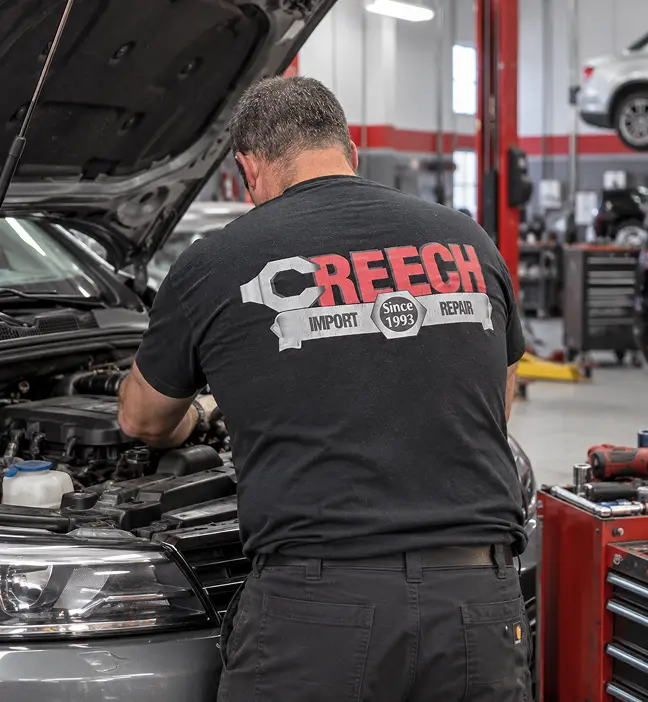
Independent Toyota service in Raleigh
Toyota Camry Repair in Raleigh, NC
An oil level that keeps dropping, a vibration on your commute, or an A/C system that struggles in summer deserves a clear explanation. Creech Import Repair provides Toyota Camry repair and maintenance in Raleigh, with attention to your vehicle’s model year, engine, mileage, and service history.
Our locally owned shop has served Raleigh since 1993. Whether you need routine maintenance or help diagnosing a new symptom, start by telling us what your Camry is doing and when it happens. That information helps focus the inspection and the conversation about your next steps.
1818 St. Albans Dr #106, Raleigh, NC 27609. Monday–Friday, 7:30 a.m.–5:30 p.m. Online appointment requests require confirmation from our service team.

Find the information you need
A Raleigh Repair Shop for Your Toyota Camry
Your Camry may be the car you depend on for work, school pickups, or trips across the Triangle. When something changes, the practical questions are usually the same: What is causing it? Is it safe to drive? What needs attention now, and what can be planned for later?
Creech Import Repair’s ASE-certified technicians work on Toyota vehicles as part of our Japanese-import service focus. Our Raleigh location gives Camry owners a local option for maintenance, inspections, and repair discussions without having to choose a shop solely on the basis of a dealership badge.
Visit our Toyota repair page for broader Toyota service information, or learn about Creech Import Repair before scheduling.
Toyota Camry Repair and Maintenance Services
A Camry service plan should account for its condition and equipment. A high-mileage gasoline model and a newer hybrid may need different inspections even when their owners describe a similar symptom.
Check-Engine Light and Driveability
Rough idle, hesitation, difficult starting, and reduced power can have several causes. Diagnostic trouble codes help identify the system involved, while testing determines what has actually failed.
Learn about our check-engine light diagnostic service .
Oil Leaks and Oil Consumption
Oil on the driveway and an oil level that drops between changes call for different investigations. External leaks, crankcase ventilation, and internal engine conditions should be considered before recommending a repair.
Bring any oil-change records and note how often you have added oil.
Brake and Suspension Service
Squealing, grinding, a pulling sensation, and vibration deserve an inspection. Brake wear, tire condition, steering components, and suspension play can affect how the car feels.
Explore brake repair and alignment service .
Air Conditioning and Engine Cooling
Cabin A/C and engine cooling are separate systems. Warm air from the vents calls for A/C diagnosis. Rising engine temperature, coolant loss, or steam calls for cooling-system attention.
See our automotive A/C repair and cooling-system repair services.
Battery and Electrical Diagnosis
A no-start condition, repeated battery discharge, or intermittent electrical problem needs testing. Battery condition, connections, charging performance, and unwanted electrical draw can all matter.
Read about electrical-system service .
Scheduled Maintenance
Oil service, tire rotation, filters, and inspections should follow the correct Toyota guide and your vehicle’s condition. Missing service history is a reason to establish a baseline, rather than assume every maintenance item is overdue.
View oil-change service and tire rotation .
Have a Camry Hybrid or a Specialized Service Request?
Tell us the model year and the work you need when you contact us. We will confirm whether your request falls within our service scope. High-voltage battery work, driver-assistance calibration, manufacturer software work, and recall repairs each require specific equipment, procedures, or authorization.
Common Camry Symptoms: What They Can Mean
A symptom is a starting point. The same noise or warning light can come from different causes, and a model-year problem list cannot diagnose your individual car.
| What you notice | What may need checking | Helpful information to bring |
|---|---|---|
| Oil level falls between oil changes | External leaks, service history, crankcase ventilation, and possible internal oil consumption | Mileage between top-ups, amount added, oil type, and recent service records |
| Shudder during light acceleration | Engine operation, transmission behavior, tires, and applicable vehicle-specific service information | Speed, throttle position, whether the car is warm, and whether the symptom is repeatable |
| Vibration when braking | Brake condition, rotor measurements, tires, and suspension or steering components | Whether the vibration is in the pedal, steering wheel, or seat, and the speed at which it occurs |
| A/C blows warm air | Refrigerant leaks, system pressures, compressor operation, airflow, and electrical controls | Whether cooling changes at idle, while driving, or between different vents |
| Rising engine temperature or coolant loss | Coolant leaks, pressure retention, circulation, cooling fans, and other cooling-system faults | When the temperature rises and any recent coolant additions |
| Battery goes flat repeatedly | Battery health, connections, charging performance, and possible electrical draw | Battery age, how long the car sits, recent accessories, and any previous testing |
When to Stop Driving and Arrange Help
Stop safely and arrange assistance for an oil-pressure warning, overheating, severe loss of braking, or a flashing check-engine light accompanied by rough running. Follow the warning instructions in your owner’s manual. Let an overheated engine cool, and do not open a hot cooling-system cap.
Oil Consumption on Certain 2AZ-Engine Camrys
Toyota’s historical ZE7 warranty enhancement addressed excessive oil consumption in certain 2007–2009 Camrys and 2007–2011 Camry Hybrids equipped with a 2AZ engine. This is a documented concern for a specific group of vehicles, rather than a description of every Camry.
For a car losing oil today, the starting point is to identify the engine, check for leaks, and establish the amount of oil used over a measured distance. The historical program does not establish current repair coverage. Ask Toyota to verify any coverage question using your VIN. Read Toyota’s ZE7 documentation hosted by NHTSA .
Torque-Converter Shudder on Certain 2012–2014 Camrys
Toyota documented intermittent torque-converter shudder in certain 2012–2014 Camrys with the U760E transmission. The described symptom can occur under light throttle at roughly 25–50 mph. A road test and vehicle-specific diagnosis are necessary because other faults can also cause vibration.
Toyota’s ZE5 document describes a historical warranty enhancement, not a blanket current recall or a promise of free repairs. Current eligibility must be checked with Toyota. Read Toyota’s ZE5 documentation hosted by NHTSA .
Why Your Camry’s Model Year and Engine Matter
Model year helps narrow the service information, but the engine, transmission, hybrid equipment, and maintenance history determine which recommendations apply. Share your VIN when requesting a vehicle-specific service plan.
Older Camrys Through 2006
With an older car, age and previous maintenance often matter as much as mileage. Inspecting leaks, cooling components, rubber parts, brakes, tires, and suspension condition helps establish what needs attention.
Timing-belt or timing-chain requirements must be matched to the engine. Avoid using one replacement interval for every four-cylinder and V6 Camry.
2007–2011 Camrys
Confirm whether the vehicle has a four-cylinder engine, V6, or hybrid powertrain. Oil-use concerns on applicable 2AZ-engine vehicles deserve a measured investigation, while leaks and other age-related issues require their own inspection.
2012–2017 Camrys
Describe driveability concerns carefully, especially whether a vibration occurs during acceleration, braking, or cruising. Certain 2012–2014 U760E-equipped vehicles have documented torque-converter service information; that concern should not be extended to the entire generation.
2018–2024 Camrys
Toyota identifies the 2024 Camry as part of the eighth generation. Gasoline, hybrid, and equipment differences affect the correct service information. Warning messages and driver-assistance concerns should be described specifically when requesting service.
2025 and Newer Camrys
The redesigned U.S. 2025 Camry introduced an exclusively hybrid lineup, and Toyota’s 2026 model continues the hybrid focus. Maintenance and diagnostic guidance should reflect that equipment.
Contact us with your model year and service request so we can confirm the appropriate appointment. Read Toyota’s 2025 Camry overview .
High-Mileage Camrys
A high odometer reading does not tell the whole story. Recent repairs, fluid condition, oil use, rust, and maintenance records help put a new recommendation in context.
If you are deciding how much to invest in an older Camry, ask which findings affect safety, reliability, or routine upkeep, and discuss the priorities before approving work.
Toyota Camry Maintenance: Use the Right Schedule
There is no single maintenance table that accurately covers every Camry. Start with the warranty and maintenance guide for your model year, then account for the engine, operating conditions, and completed services.
| Maintenance item | What determines the recommendation |
|---|---|
| Engine oil and filter | Model-year schedule, correct oil specification, elapsed time, mileage, and applicable special operating conditions |
| Engine and hybrid cooling systems | Correct coolant, circuit involved, initial versus subsequent replacement, and leak or contamination findings |
| Spark plugs | Engine-specific schedule, plug specification, and any diagnosed ignition problem |
| Timing belt or chain | Engine identification and Toyota’s applicable maintenance or diagnostic guidance |
| Transmission fluid | Transmission type, manufacturer guidance, operating conditions, and documented service history |
| Brake fluid and brake components | Applicable guidance, inspection findings, measured wear, and system condition |
| Filters, tires, and inspections | Model-year schedule, condition, usage, and previous replacement or service records |
A Manufacturer Example: The 2025 Camry
Toyota’s 2025 guide specifies oil and filter replacement at 10,000 miles or 12 months under the standard schedule. Applicable special operating conditions call for 5,000 miles or six months.
It lists initial engine-coolant replacement at 100,000 miles or 120 months, followed by 50,000 miles or 60 months. The inverter cooling circuit has a separate initial interval.
These examples apply to the 2025 guide and should not be copied onto an older Camry’s service plan. Use the mileage or time limit that comes first. View Toyota’s 2025 Camry Warranty & Maintenance Guide .
Bring your maintenance records if you have them. For the correct manual and schedule for another model year, use Toyota’s owner manuals and warranty resources .
Getting Ready for Your Camry Service Appointment
A useful appointment begins with a clear description of the problem. You do not need to diagnose it yourself. A few specific details can help a technician understand what to reproduce and test.
- Share the vehicle details. Provide the year, mileage, engine or hybrid designation, and VIN if available.
- Describe when the symptom happens. Note cold starts, highway speed, light acceleration, braking, idling, or hot weather.
- Bring the history. Include recent repairs, fluid additions, warning messages, and service records.
- Discuss diagnosis and authorization. Ask about diagnostic charges, the initial testing scope, and how additional testing or repairs will be approved.
- Review the findings. Ask what the testing established, what work is recommended, and which items deserve priority.
What a Diagnostic Investigation Can Include
Depending on the concern, diagnosis can involve a road test, visual inspection, scan data, electrical measurements, fluid checks, pressure testing, or mechanical measurements. A fault code can identify an affected system without proving that a particular part needs replacement.
Repair cost and completion time depend on the findings, parts availability, and work required. Contact us to discuss the initial appointment and estimate process. Bring any Toyota recall or warranty letter so the appropriate coverage route can also be considered.
Toyota Camry Repair FAQs
Why is my Toyota Camry using oil between changes?
A falling oil level can result from an external leak or internal oil consumption. The engine and model year matter. Certain 2AZ-engine Camrys were included in Toyota’s historical oil-consumption program, but your car still needs testing. Record how much oil is added and the distance between top-ups, and use the oil-level checking procedure in your owner’s manual.
Why does my Camry shudder during light acceleration?
The cause may involve engine operation, transmission behavior, or another source of vibration. Toyota documented a particular torque-converter concern on certain 2012–2014 Camrys with the U760E transmission. Share the speed and driving conditions when it happens so the concern can be evaluated.
Does my Camry have a timing belt or a timing chain?
Camrys have used different engine designs, so the answer depends on the engine and model year. Have the engine identified before scheduling a timing-belt replacement. A timing chain should not be assigned a routine belt-replacement interval. Follow the applicable Toyota guidance.
Can I drive my Camry with the check-engine light on?
Driving advice depends on the warning and symptoms. A flashing light with rough running calls for stopping safely and arranging assistance. A steady light still needs diagnosis. If the car is overheating, losing power, or behaving abnormally, follow the owner’s manual and seek help before continuing.
Why is my Camry’s A/C blowing warm air?
Possible causes include a refrigerant leak, compressor or control fault, electrical problem, or airflow issue. Adding refrigerant without identifying the cause can leave the problem unresolved. Tell us whether cooling changes at idle, while driving, or between vents.
How often should I change my Camry’s oil?
Follow the schedule for your model year and engine, including its time limit and special operating conditions. Older Camrys and newer hybrids can have different requirements. The maintenance section above provides a 2025 example; it should not replace your own vehicle’s guide.
Do you service Toyota Camry hybrids?
Contact Creech Import Repair with your Camry Hybrid’s year and the service you need. We will confirm the work that falls within our service scope. High-voltage battery repairs, specialized calibrations, and manufacturer campaigns require separate consideration.
How much does Toyota Camry repair cost?
The cost depends on the diagnosed fault, parts, labor, and any related work. A symptom alone does not establish the repair price. Ask about diagnostic charges and the estimate process when booking, and review the recommended work before authorizing repairs.
Should an older, high-mileage Camry be repaired?
Consider the car’s overall condition, safety needs, repair history, and the findings from an inspection. A repair estimate is more useful when it distinguishes urgent work from routine maintenance and optional improvements. Discuss those priorities in relation to your plans for the car.
Can an independent shop perform a Toyota recall repair?
Manufacturer recall remedies are generally handled through authorized Toyota dealerships. Check your VIN with Toyota or NHTSA to determine whether an open safety recall applies. A technical service bulletin or historical warranty enhancement does not automatically establish an open recall or current coverage.
How do I request a Camry service appointment in Raleigh?
Call 919-872-1999 or use our appointment request page . Include your Camry’s year, mileage, and the service or symptom you want addressed. Online requests become confirmed appointments after verification by our service team.
Schedule Toyota Camry Service in Raleigh
Tell us what has changed with your Camry, what maintenance is due, or what you would like checked. Creech Import Repair can help you start with the appropriate service appointment and a clearer understanding of the next steps.
Creech Import Repair1818 St. Albans Dr #106
Raleigh, NC 27609
919-872-1999
Shop hours: Monday–Friday, 7:30 a.m.–5:30 p.m.
Please wait for service-team confirmation of an online request. If you are concerned that the vehicle is unsafe to drive, call before bringing it to the shop.
Manufacturer and Safety References
Vehicle-specific information matters. These references support the model and maintenance information above. They do not establish your vehicle’s current condition or eligibility for coverage.
- Toyota: 2025 Camry Warranty & Maintenance Guide
- Toyota ZE7: historical 2AZ-engine oil-consumption program
- Toyota ZE5: historical U760E torque-converter shudder program
- Toyota: 2024 Camry model information
- Toyota: 2025 Camry hybrid redesign
- Toyota: 2026 Camry model information
- NHTSA: VIN-based safety recall lookup