


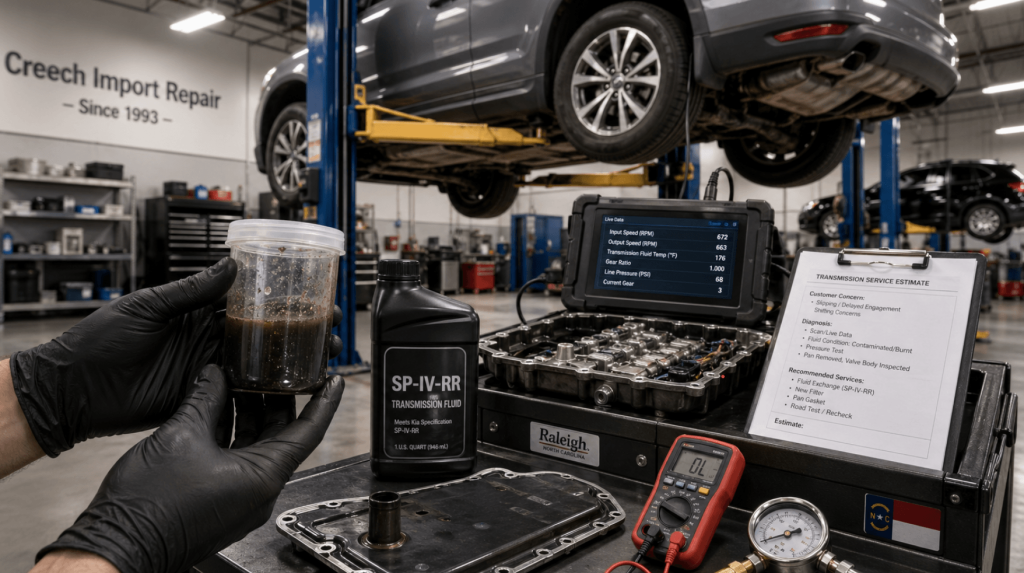
Your Kia Sorento is built for family adventures, daily commutes, and weekend getaways. When the transmission starts to slip, shudder, or refuse to shift, it can turn a reliable SUV into a source of stress—and a safety concern. At Creech Import Repair, we’ve been helping Raleigh drivers understand and fix transmission problems since 1993, using honest diagnostics, ASE‑certified technicians, and a customer‑first approach that means no surprise charges.
Why Transmission Problems Matter for Sorento Owners
The transmission is responsible for transferring engine power to the wheels at the right speed and torque. A failing transmission can cause reduced acceleration, unexpected loss of power, or even a complete inability to move—situations that are especially dangerous on Raleigh’s busy highways like I‑40, US‑70, or the Beltline. Early diagnosis not only saves money (a fluid service is far cheaper than a rebuild) but also helps you avoid being stranded in traffic or inclement weather. motorbiscuit
“We treat every customer with kindness, respect, and honesty, and success will follow.” — Creech Import Repair Business Philosophy yelp
What Causes Transmission Problems on a Kia Sorento?
Understanding the root helps you recognize early signs and act before a minor issue becomes a costly repair.
Common Cause | What It Happens | Typical Symptoms |
Low or dirty transmission fluid | Fluid loses lubricating and cooling properties; contaminants cause wear | Slipping gears, delayed engagement, whining noise |
Worn clutch plates or bands (in traditional automatics) | Friction material wears down, reducing ability to hold gear | Harsh shifts, shudder, slipping under load |
Faulty shift solenoids | Electrical valves that control fluid flow malfunction | Erratic shifting, stuck in gear, limp‑mode activation |
Torque converter issues | Lock‑up clutch wears or fluid flow restricted | Shudder at 30‑45 mph, poor fuel economy, overheating |
Software/TCM glitches | Transmission Control Module sends incorrect commands | Unexpected shifts, delayed response, false warning lights |
Cooling system failure | Transmission overheats due to clogged cooler or low fluid | Over‑temp warning, burnt smell, fluid discoloration |
Internal wear (gears, bearings) | High mileage or lack of maintenance leads to metal‑to‑metal contact | Grinding noises, metal shavings in fluid, eventual failure |
Multiple owner‑report sources cite transmission slips, delayed shifting, and limp‑mode activation as frequent complaints for the Sorento, especially in 2021‑2024 models.
How We Diagnose Transmission Issues
At Creech Import, our ASE‑certified technicians follow a systematic, no‑guess process that combines electronic scanning with hands‑on testing.
- Customer interview – We note when the problem occurs (cold start, after warming up, under load), any warning lights, and whether the vehicle enters limp mode.
- Visual & fluid check – Transmission fluid level, color, and smell are inspected; burnt or low fluid hints at internal wear or overheating.
- On‑board diagnostics scan – A professional scanner reads stored DTCs (P‑codes, U‑codes, B‑codes) from the Transmission Control Module (TCM) and related systems. nhtsa
- Live data streaming – We monitor sensor readings (input/output speed sensors, turbine speed, gear command, fluid temperature) to spot values out of range.
- Pressure test – Using a transmission pressure gauge, we check line pressure at idle and in each gear to ensure the pump and valves are functioning correctly.
- Road test – We replicate the customer’s described conditions (e.g., merging onto a highway, stop‑and‑go traffic) to observe shift quality, slip, or shudder.
- Component isolation – If needed, we remove the transmission pan to inspect for metal debris, clutch wear, or solenoid condition.
- Repair recommendation – We explain the exact fault, show you failed parts if desired, and provide a written estimate before any work begins. creechimport
Our method aligns with industry best practices: diagnose first, then recommend only the repairs needed to restore reliable shift quality.
When Should You Schedule a Transmission Diagnostic?
Don’t wait for a complete failure. Early checks keep repair costs lower and your Sorento safer on the road.
Mileage / Time | Recommended Action |
Every 30,000 miles or every 2 years | Transmission fluid level & condition check; visual inspection for leaks |
Every 60,000 miles | Fluid exchange (if recommended by your model’s maintenance schedule) and filter replacement (if equipped) |
Immediately | Slipping gears, delayed or harsh shifts, shudder at speed, transmission warning lamp, limp‑mode activation, or unusual noises (whining, grinding) |
Before long trips | Pre‑trip transmission health check (fluid, pressure, road test) to ensure reliable performance on highways |
Prior to NC state inspection | If the transmission causes the check‑engine light to illuminate, resolve it first to avoid an automatic emissions fail in counties that require testing |
If you frequently drive in Raleigh’s stop‑and‑go traffic, tow trailers, or operate in extreme heat, consider shorter intervals because heat accelerates fluid degradation.aaa
What to Expect During Your Transmission Visit
When you bring your Sorento to Creech Import, here’s the step‑by‑step experience:
- Friendly check‑in – Our advisor confirms your concerns, explains the diagnostic process, and offers a complimentary fluid level and condition check.
- Comprehensive transmission evaluation – Performed at no charge if you proceed with the recommended repairs (free diagnostics policy).
- Transparent estimate – We itemize labor, any needed parts (fluid, filter, solenoids, torque converter, etc.), and additional services (e.g., cooler flush). No hidden fees.
- Repair execution – ASE‑certified technicians replace faulty components, flush or replace fluid, clean the pan, and torque all fasteners to factory specs.
- System verification – We re‑scan for codes, verify proper pressure and shift quality, and conduct a road test to ensure the issue is resolved.
- Review & warranty – We walk you through the work performed, show you old parts if desired, and remind you of our 36‑month/36,000‑mile warranty on parts and labor.yelp
Throughout, we speak plain language—no jargon, no pressure.
How Much Does Transmission Diagnosis & Repair Cost in Raleigh?
Pricing varies by Sorento year, the specific faulty component, and labor time. Below are typical ranges for common transmission services at our shop (parts + labor):
Service | Typical Price Range* |
Transmission fluid drain & fill | $120 – $180 |
Transmission fluid flush (with filter change, if applicable) | $180 – $280 |
Shift solenoid replacement (per solenoid) | $150 – $300 |
Transmission pan gasket replacement | $200 – $350 |
Torque converter replacement | $800 – $1,400 |
Valve body repair or replacement | $900 – $1,600 |
Transmission rebuild | $2,200 – $3,800+ |
Full diagnostic (scan + live data + pressure test) | $90 – $130 (free if you proceed with repairs) |
Transmission cooler flush | $150 – $250 |
*Prices include OEM‑spec or equivalent quality fluid and parts and are subject to change based on vehicle specifics. We always provide a written estimate before any work begins.
Factors that affect cost:
- Model year & transmission type – Older Sorentos with traditional automatics may have different parts costs than newer models with dual‑clutch or continuously variable transmissions (though most Sorentos use a conventional automatic).
- Extent of damage – If metal contamination is found, a rebuild may be necessary versus a simple fluid service.
- Parts choice – We offer OEM, high‑quality aftermarket, and budget‑friendly options; we explain trade‑offs so you can decide.
Our goal is honest pricing that reflects the actual work needed—no surprises when you pick up your car. yelp
Maintenance Tips to Extend Transmission Life
While eventual wear is inevitable, these habits help you get the most miles between major transmission services:
- Follow the manufacturer’s fluid‑change interval – Many Sorentos recommend a fluid exchange every 60,000–100,000 miles; severe service (towing, frequent short trips) may require it sooner.
- Use the correct fluid type – Kia specifies SP‑IV‑RR or equivalent; using the wrong fluid can cause poor shift quality and accelerated wear.
- Avoid “riding” the brakes on downhill stretches – Excessive heat from braking can transfer to the transmission via the coolant system.
- Come to a complete stop before shifting between Drive and Reverse – Reduces shock to the drivetrain.
- Monitor for leaks – Check your driveway or garage for red‑brown fluid spots; a small leak can lead to low fluid and overheating if ignored.
- Schedule regular inspections – Have the fluid level and condition checked during every oil change or tire rotation.
Pairing these habits with our professional transmission service keeps your Sorento’s drivetrain smooth and helps you avoid unexpected repair bills.
Is It Safe to Drive With Transmission Problems?
Driving with a known transmission fault increases the risk of sudden loss of power, which can be hazardous in traffic. Use this quick guide:
- Mild slipping or delayed shift (only noticeable under hard acceleration) – Usually safe for a short trip to schedule service, but avoid heavy loads or high‑speed driving.
- Shudder or vibration at 30‑45 mph – Could be torque‑converter clutch wear; limit highway speeds and have it inspected soon.
- Transmission stuck in one gear or limp mode – Reduce speed and seek assistance; continued operation can cause overheating and further damage.
- Grinding noises or metal smell – Stop driving and have the vehicle towed; internal damage may be occurring.
- Transmission warning lamp illuminated – Treat as a serious fault; get diagnostics promptly.
If you’re ever uncertain, call us at (919) 872‑1999 for a quick assessment. We’d rather see you for a precautionary check than deal with a preventable breakdown.
Contact Us Today
Ready to ensure your Sorento shifts smoothly? Take one of these simple steps today:
- Call us now at (919) 872‑1999 for a free transmission inspection or to schedule service.
- Visit our website and click “Schedule Appointment” to pick a time that works for you.
- Stop by our shop at 1818 St. Albans Dr #106 for a courtesy check—no appointment needed for basic questions about your transmission.
Ask about our loaner car program (available with major repairs) and complimentary NC state inspection when you schedule transmission diagnostics.
Internal Links
To learn more about our full range of services, explore these pages:
- Auto Repair Services – Overview of everything we offer, from brakes to engine diagnostics.
- Kia Sorento Repair & Maintenance – Detailed look at Sorento‑specific maintenance and common issues.
- Contact Us – Directions, hours, and online booking.
Blog – Helpful articles on maintenance, diagnostics, and local service tips.
Frequently Asked Questions
Q: Do you service Kia Sorento transmission issues?
A: Yes. Our ASE‑certified technicians have extensive experience diagnosing and repairing transmission problems on all Sorento generations, from fluid services to solenoid replacements and rebuilds.
Q: How much does a transmission diagnostic cost at Creech Import?
A: A full OBD‑II scan with live data and pressure test is $90–$130, but it’s free of charge when you authorize any recommended repairs.
Q: Do you offer loaner cars if my Sorento repair takes more than a day?
A: For major transmission jobs (e.g., valve body replacement or rebuild), we offer complimentary loaner vehicles subject to availability. Ask your service advisor when you schedule.
Q: What NC inspection services do you provide alongside a transmission repair?
A: We perform full North Carolina State Inspections—safety, emissions, and lights—so you can satisfy your annual requirement while you’re here.
Q: Are your diagnostics free if I decide to proceed with repairs?
A: Yes. Our transmission inspection is free of charge when you authorize the recommended repairs.
Q: How often should I change the transmission fluid in my Kia Sorento?
A: Most Sorento models recommend a fluid exchange every 60,000–100,000 miles under normal conditions; severe service (towing, frequent short trips, extreme heat) may require it every 30,000–40,000 miles. Always consult your owner’s manual.
Q: Is it safe to drive with the transmission warning light on?
A: No. The warning light indicates the TCM has detected a fault that could lead to loss of power or further damage; have it inspected as soon as possible.
Q: Do you recycle used transmission fluid and parts responsibly?
A: Absolutely. We partner with EPA‑licensed recyclers to ensure used fluid, metal parts, and electronic components are properly processed and kept out of the environment.
Q: How can I schedule a transmission diagnostic for my Sorento?
A: Call (919) 872‑1999, use the online booking form on our website, or stop by our shop at 1818 St. Albans Dr #106.