


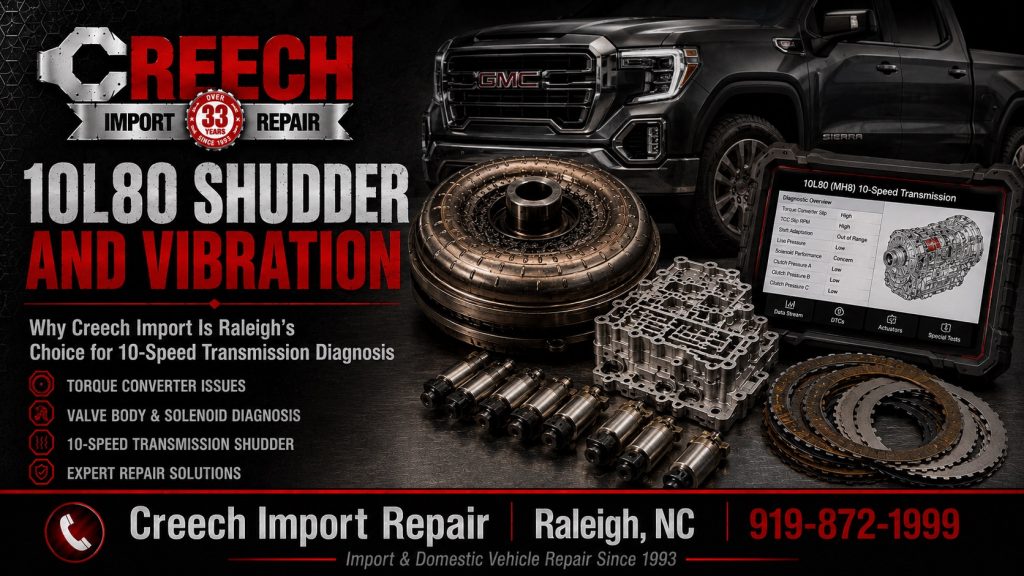
10L80 shudder and vibration is a common complaint among Chevrolet Silverado and GMC Sierra owners with the 10-speed automatic transmission. The shudder typically occurs at light throttle between 25-50 mph and feels like driving over rumble strips. While many owners assume this is a torque converter issue, the root cause can be more complex, including valve body problems, fluid contamination, or other factors. At Creech Import, we have been diagnosing and repairing GM transmissions since 1993, and we understand exactly what causes 10L80 shudder, how to identify the root cause, and how to restore smooth shifting. Our ASE-certified technicians use factory-level diagnostic tools and live data analysis to pinpoint transmission issues accurately. This comprehensive guide explains the 10L80 shudder problem, what symptoms to watch for, how GM’s technical service bulletins address the issue, and why Creech Import is Raleigh’s trusted choice for transmission diagnosis.
Understanding 10L80 Shudder
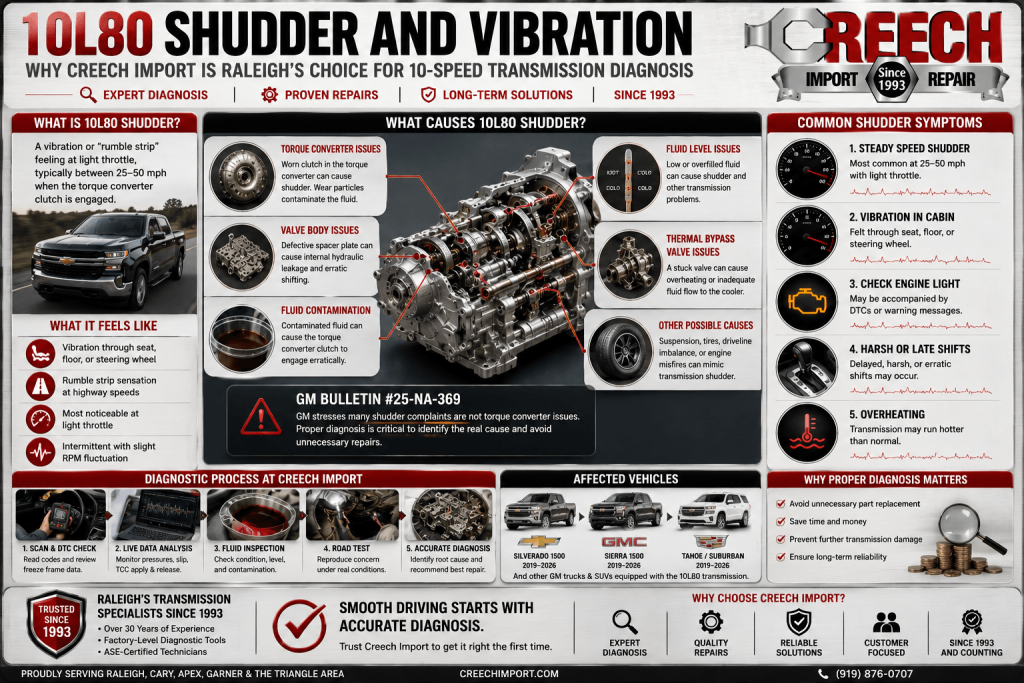
What Shudder Feels Like
10L80 shudder is typically described as:
-
Vibration – felt through the seat, floor, or steering wheel, often described as a “buzzing” or “humming” sensation
-
Rumble strip sensation – as if driving over rumble strips at highway speeds, typically between 25-50 mph
-
Light throttle occurrence – most noticeable at light throttle, when the torque converter clutch is engaged
-
Intermittent – may come and go depending on driving conditions, engine temperature, and load
-
RPM fluctuation – slight movement of the tachometer during shudder events
What Causes 10L80 Shudder
The root cause of 10L80 shudder can vary, and identifying the exact cause requires proper diagnostic procedures:
Torque Converter Issues
The torque converter clutch can wear prematurely, contaminating the transmission fluid with clutch material. This is the most common cause of shudder in 8-speed transmissions and can also affect 10-speed transmissions. When the torque converter clutch cannot engage smoothly, it produces the shudder sensation.
Valve Body Issues
A defective spacer plate can cause internal hydraulic leakage, leading to erratic shifting and shudder. The valve body may not be delivering the correct pressure to the torque converter clutch. This is a known issue on 10L80 and 10L90 transmissions, as confirmed by GM’s recall documentation.
Fluid Contamination
Contaminated fluid can cause the torque converter clutch to engage and disengage erratically, producing shudder. Fluid contamination can occur from:
-
Moisture absorption
-
Clutch material wear
-
Overheating
-
Normal degradation over time
Fluid Level Issues
Low or overfilled transmission fluid can cause shudder and other transmission problems. Low fluid can cause the torque converter to slip, while overfilled fluid can cause aeration and erratic operation.
Thermal Bypass Valve Issues
Some 10L80 transmissions have experienced issues with the thermal bypass valve, which controls fluid flow to the transmission cooler. A stuck valve can cause overheating or inadequate fluid flow.
Other Causes (GM Bulletin #25-NA-369)
GM Bulletin #25-NA-369 addresses vibration or shudder felt at steady speeds between 25 and 80 mph. GM stresses that many shudder complaints are not torque-converter issues. Other causes frequently produce the same sensation:
-
Ride height changes – from suspension modifications or wear
-
Excessive tongue weight – from towing
-
Tire or wheel issues – imbalance, wear, or damage
-
Driveline imbalance – from worn U-joints or driveshaft issues
-
Engine misfires – can produce similar sensations
Common 10L80 Shudder Symptoms
Common Symptoms of Transmission Shudder:
| Symptom | Details & Description |
|---|---|
| 1. Steady Speed Shudder | The most common symptom is a shudder or vibration that occurs at steady highway speeds, typically between 25-50 mph. The shudder is most noticeable under light throttle when the torque converter clutch is engaged. It may feel like driving over rumble strips or washboard roads. |
| 2. Light Throttle Shudder | The shudder is most pronounced under light throttle application. It may disappear when you accelerate harder or when you let off the throttle completely. This is a classic symptom of torque converter clutch issues. |
| 3. Vibration Through the Vehicle | The vibration may be felt through the seat, floor, or steering wheel. It can be mild and barely noticeable, or severe enough to be distracting and uncomfortable. |
| 4. Intermittent Nature |
The shudder may come and go depending on:
|
| 5. No Check Engine Light | Often, there is no check engine light or diagnostic trouble code associated with the shudder. This makes diagnosis more challenging, as the vehicle’s computer may not detect any problem. |
| 6. RPM Fluctuation | During shudder events, the tachometer may show slight fluctuations as the torque converter clutch slips and grabs. |
Why 10L80 Shudder Is Often Misdiagnosed
10L80 shudder is frequently misdiagnosed because:
Overlapping Symptoms
Shudder can be caused by torque converter issues, valve body problems, fluid contamination, or other factors. Without proper diagnosis, it is easy to misidentify the cause. A simple fluid flush may not resolve the issue if the valve body is defective.
Intermittent Symptoms
Shudder can be intermittent, making it difficult to reproduce during diagnosis. The issue may only occur when the vehicle is at operating temperature, or only under certain load conditions.
Lack of Warning
Shudder often occurs without any check engine light or other warning, so owners may not realize there is a problem until it worsens. This can lead to delayed diagnosis and more extensive damage.
Multiple Potential Causes
As noted in GM Bulletin #25-NA-369, many shudder complaints are not torque-converter issues. Tire issues, driveline imbalance, and other factors can produce the same sensation. Without a systematic diagnostic process, it is easy to replace the wrong component.
Dealership Practices
Some dealerships may perform a fluid flush as a “first step” without properly diagnosing the root cause. While this may temporarily mask the issue, it often returns if the underlying problem is not addressed.
GM's Technical Bulletins on 10L80 Shudder
Bulletin #25-NA-369 – Vibration or Shudder
GM Bulletin #25-NA-369 addresses vibration or shudder felt at steady speeds between 25 and 80 mph. The bulletin notes that many shudder complaints are not torque-converter issues. Other causes frequently produce the same sensation:
-
Ride height changes
-
Excessive tongue weight
-
Tire or wheel issues
-
Driveline imbalance
The bulletin instructs technicians to check these potential causes before performing transmission repairs.
Bulletin #25-NA-175 – 10L80 Torque Converter Shudder (Reference)
This bulletin (originally for 8L90, but referenced for 10L80) addresses torque converter shudder and provides diagnostic procedures for identifying the issue.
Bulletin #25-NA-188 – Transmission Fluid Flush Procedure
This bulletin provides the correct procedure for flushing the 10L80 transmission, including using the correct fluid and equipment.
How Creech Import Diagnoses 10L80 Shudder
At Creech Import, we use a systematic diagnostic process to identify the root cause of 10L80 shudder:
Step 1: Customer Interview
We ask detailed questions about the shudder:
-
When did you first notice the shudder?
-
At what speeds does it occur?
-
Does it happen under light throttle, heavy throttle, or both?
-
Is it worse when the vehicle is hot or cold?
-
Do you tow with the vehicle?
-
Have you had any recent transmission service?
Step 2: Comprehensive Scan with GM-Enhanced Software
We use factory-level diagnostic tools to read codes from all transmission-related modules. GM-specific codes provide detailed information about which circuits or components are affected.
Step 3: Live Data Analysis
We monitor transmission parameters in real time during a road test, including:
-
TCC slip speed – whether the torque converter clutch is slipping
-
Line pressure – whether the valve body is delivering correct pressure
-
Shift timing – whether shifts are occurring at the correct time
-
Solenoid response – whether solenoids are activating correctly
-
Transmission fluid temperature – whether the transmission is operating at the correct temperature
Step 4: Fluid Condition Inspection
We inspect the transmission fluid for:
-
Color – should be bright red; dark or brown indicates overheating or contamination
-
Smell – burnt odor indicates clutch or fluid degradation
-
Debris – metal particles or clutch material in the fluid or on the magnet
Step 5: Road Test
We road test the vehicle to reproduce the shudder and observe its characteristics. We note the speed, throttle position, and conditions under which the shudder occurs.
Step 6: Vehicle Inspection
We inspect the vehicle for other potential causes of shudder, including:
-
Tire condition – wear, pressure, and balance
-
Wheel balance – Road Force balancing if needed
-
Driveline inspection – U-joints, carrier bearings, driveshaft balance
-
Ride height – suspension modifications or wear
-
Tongue weight – if towing
Step 7: Valve Body Inspection
If indicated, we remove the valve body for visual inspection to check for spacer plate defects and valve bore wear. This is the most definitive way to identify valve body issues.
Repair Options for 10L80 Shudder
Based on our diagnosis, we recommend the appropriate repair:
| Repair Option | Details & Solution |
|---|---|
| Fluid Exchange with Updated Fluid | If fluid contamination is the cause and there is no debris, a complete fluid exchange with updated GM-approved fluid may resolve the issue. The correct fluid for the 10L80 is Mobil 1 Synthetic LV ATF or GM-approved equivalent. The exchange should include flushing the cooler and cooler lines. |
| Torque Converter Replacement | If the torque converter clutch has failed, replacement of the torque converter is necessary. The new converter should be the updated GM design. The cooler and cooler lines must be flushed to remove debris. |
| Valve Body Repair or Replacement |
If the valve body or spacer plate is defective, repair or replacement of the valve body is necessary. This may include:
|
| Transmission Rebuild | If internal damage has occurred (clutch wear, drum damage, etc.), a full rebuild may be necessary. A rebuilt transmission includes new clutches, seals, bushings, and any damaged components. |
| Thermal Bypass Valve Replacement | If the thermal bypass valve is stuck, replacing it can restore proper fluid flow to the cooler. |
Experiencing shudder or vibration in your Silverado or Sierra? Don’t let a transmission problem go undiagnosed. Call Creech Import at 919-872-1999 for a professional transmission diagnostic. Visit us at 1818 St. Albans Dr #106, Raleigh, NC 27609 or book online at https://www.creechimport.com/contact.
FAQs
What is 10L80 shudder?
10L80 shudder is a vibration that feels like driving over rumble strips, typically occurring at light throttle between 25-50 mph. It is caused by the torque converter clutch engaging and disengaging erratically.
What causes 10L80 shudder?
Causes can include torque converter issues, valve body problems, fluid contamination, tire issues, driveline imbalance, or other factors as noted in GM Bulletin #25-NA-369.
How does Creech Import diagnose 10L80 shudder?
We use factory-level diagnostic tools, live data analysis, fluid inspection, road testing, and vehicle inspection to identify the root cause.
s 10L80 shudder always a transmission problem?
No – as GM Bulletin #25-NA-369 notes, many shudder complaints are not torque-converter issues. Tire issues, driveline imbalance, and other factors can produce the same sensation.
What is GM Bulletin #25-NA-369?
GM Bulletin #25-NA-369 addresses vibration or shudder felt at steady speeds between 25 and 80 mph and instructs technicians to check non-transmission causes before performing transmission repairs.
Can a fluid flush fix 10L80 shudder?
If the shudder is caused by contaminated fluid, a fluid flush with updated GM-approved fluid may resolve the issue. However, if the valve body or torque converter is defective, a flush alone will not fix the problem.
Can a valve body issue cause 10L80 shudder?
Yes – a defective spacer plate can cause internal hydraulic leakage, leading to erratic torque converter clutch engagement and shudder.
Does Creech Import offer a warranty on transmission repairs?
Yes – all repairs include a written warranty on parts and labor.
How can I prevent 10L80 shudder?
Regular transmission fluid service and early diagnosis of symptoms can help prevent shudder from causing further damage. We recommend fluid changes every 45,000-60,000 miles.
What should I do if I experience 10L80 shudder?
Have the vehicle diagnosed by a qualified transmission specialist as soon as possible. Continued driving can cause further damage to the torque converter and other transmission components.
Sources
Why Choose Creech Import Repair for Your Vehicle?
Serving Raleigh since 1993 – Family‑owned, deeply rooted in the community.
✓ ASE‑Certified Technicians – Trained on domestic and import vehicles.
✓ Both domestic and import expertise – One trusted shop for mixed garages.
✓ Transparent pricing & electronic approvals – No surprises, no unnecessary work.
✓ Professional‑grade diagnostic equipment – Advanced scanners and live data analysis.
✓ High‑quality parts & long‑lasting repairs – We don’t cut corners.
📞 Schedule Your Service Appointment Today
Don’t wait until a small problem becomes a major repair. Whether you need routine maintenance, diagnostics, or major repairs, the team at Creech Import Repair is ready to help.
10L80 shudder requires more than a scan tool and a guess. It requires deep knowledge of GM’s 10-speed transmission architecture, access to factory-level diagnostic software, and the discipline to diagnose before replacing parts. At Creech Import, we have been serving Raleigh drivers since 1993. Our ASE-certified technicians use professional scan tools, live data, and factory-level procedures to diagnose transmission problems accurately. We never recommend unnecessary repairs, and we stand behind our work with a written warranty. From torque converter diagnosis to valve body replacement, we keep Raleigh’s Silverado and Sierra trucks shifting smoothly.
📍 Address: 1818 St. Albans Dr #106, Raleigh, NC 27609
📞 Phone: 919-872-1999
🌐 Schedule Online: https://www.creechimport.com/contact
About the Author: The ASE-certified team at Creech Import Repair has been serving Raleigh drivers since 1993. We specialize in GM transmission diagnosis and repair, with extensive experience in 10-speed, 8-speed, and 6-speed transmissions. We are fully equipped to service the latest GM models, including 2026 releases with modern transmission architectures.
Last updated: August 2026.
Find Creech Import Service articles useful?
Add this site to your Preferred Sources in Google Search.