


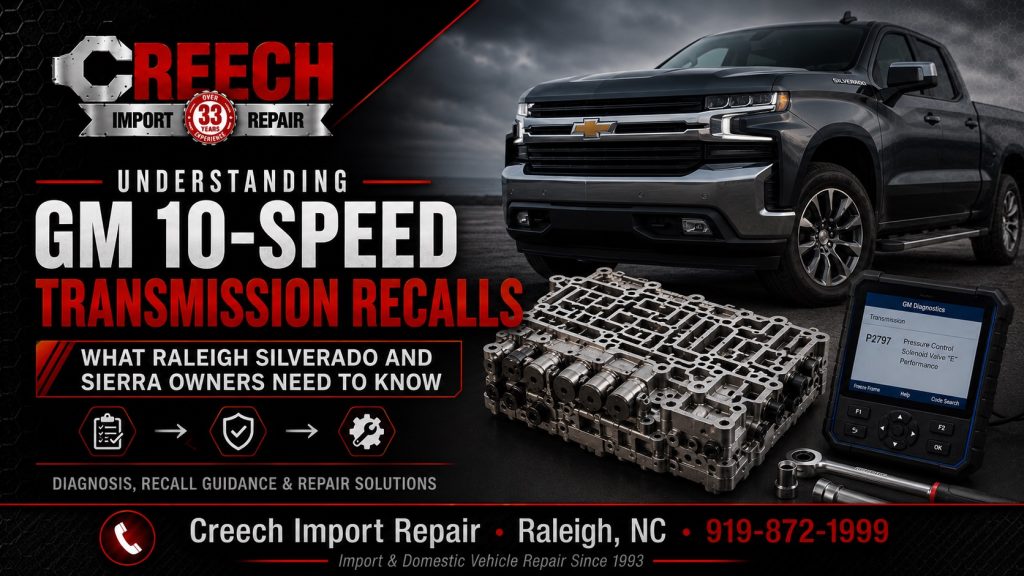
General Motors has issued multiple official safety recalls for certain trucks and full-size SUVs equipped with the 10-speed automatic transmission (10L80, 10L90, and related variants) due to valve body issues. These GM 10-speed transmission recalls affect Chevrolet Silverado 1500, 2500HD, and 3500HD models, as well as GMC Sierra 1500, 2500HD, and 3500HD models. The valve body malfunction can lock rear wheels at highway speed, creating a serious safety risk. At Creech Import, we have been diagnosing and repairing GM transmissions since 1993, and we understand exactly how the 10-speed transmission works, what the recall covers, and how to identify valve body issues early. This comprehensive guide explains the GM 10-speed transmission recall, what it means for owners, how to check if your vehicle is affected, what symptoms to watch for, and why Creech Import is Raleigh’s trusted choice for transmission diagnosis.
Understanding the 10-Speed Transmission Recall
What the Recall Covers
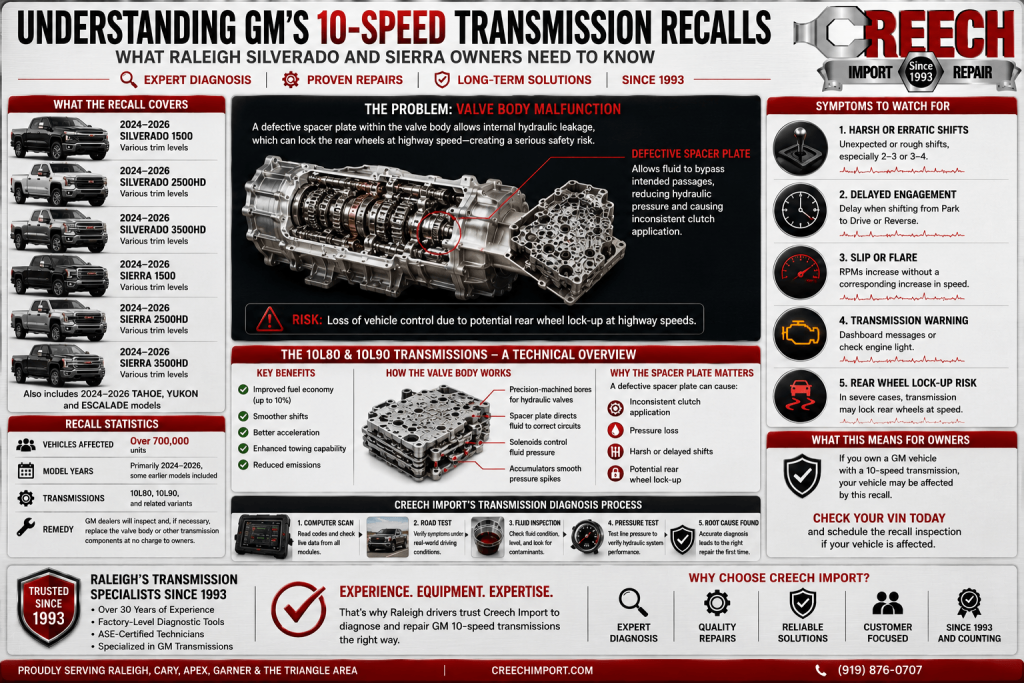
General Motors has issued multiple official safety recalls for certain trucks and full-size SUVs equipped with the 10-speed automatic transmission (10L80, 10L90, and related variants). Affected vehicles include:
2024-2026 Chevrolet Silverado 1500 – various trim levels
2024-2026 Chevrolet Silverado 2500HD – various trim levels
2024-2026 Chevrolet Silverado 3500HD – various trim levels
2024-2026 GMC Sierra 1500 – various trim levels
2024-2026 GMC Sierra 2500HD – various trim levels
2024-2026 GMC Sierra 3500HD – various trim levels
2024-2026 Chevrolet Tahoe – various trim levels
2024-2026 GMC Yukon – various trim levels
2024-2026 Cadillac Escalade – various trim levels
The Problem – Valve Body Malfunction
A valve body malfunction in the 10-speed automatic transmission can lock the rear wheels at highway speed. This is a serious safety issue that can cause loss of vehicle control and potentially lead to a crash. The problem stems from a defective spacer plate within the valve body that allows internal hydraulic leakage, causing inconsistent clutch application and potential lock-up.
The Recall Statistics
Vehicles affected: Over 700,000 units across multiple GM models
Model years: Primarily 2024-2026, with some earlier models included
Transmissions affected: 10L80, 10L90, and related variants
Remedy: GM dealers will inspect and, if necessary, replace the valve body or other transmission components at no charge to owners
What This Means for Owners
If you own a GM vehicle with a 10-speed transmission, your vehicle may be affected by this recall. You should check your VIN as soon as possible and schedule the recall inspection if your vehicle is affected.
The 10L80 and 10L90 Transmissions – A Technical Overview
What Makes the 10-Speed Transmission Unique
The GM 10-speed automatic transmission (10L80 and 10L90 variants) represents a significant advancement in transmission technology. Developed in partnership with Ford, the 10-speed transmission offers:
Improved fuel economy – up to 10% better than 6-speed transmissions
Smoother shifts – more gears mean less RPM drop between shifts
Better acceleration – optimized gear ratios for performance
Enhanced towing capability – lower first gear for improved launch when towing
Reduced emissions – more efficient operation
How the Valve Body Works
The valve body is the hydraulic control center of the transmission. It contains:
Precision-machined bores – where hydraulic valves slide back and forth
Spacer plate – contains precisely machined holes and passages that direct fluid flow
Solenoids – electronically controlled valves that direct fluid pressure
Accumulators – smooth out hydraulic pressure spikes
When the valve body functions correctly, shifts are smooth and the transmission responds instantly to driver inputs. When the valve body fails, the entire transmission’s performance is compromised.
Why the Spacer Plate Matters
The spacer plate is a critical component within the valve body. It contains precisely machined holes and passages that direct fluid flow to the correct clutch and band circuits. When the spacer plate is defective, fluid can bypass intended passages, reducing hydraulic pressure and causing:
Inconsistent clutch application – shifts may be harsh or delayed
Pressure loss – insufficient pressure to hold clutches engaged
Erratic shifting – the transmission may not know when to shift
Potential lock-up – in severe cases, rear wheels can lock
Symptoms of 10-Speed Transmission Issues
Recognizing the symptoms of transmission issues early can prevent more extensive damage and safety risks:
1. Erratic Shifting
The transmission may shift unpredictably – sometimes harshly, sometimes with a delay, and sometimes not at all:
Harsh 1-2 or 2-3 shifts – a noticeable “clunk” or jerk when accelerating from a stop
Delayed engagement – a pause before the transmission engages after shifting from Park to Drive or Reverse
Flaring – engine RPM increases between shifts as if the transmission is slipping
2. Shudder or Vibration
Some owners report a shudder or vibration at steady speeds between 25 and 80 mph:
Rumble strip sensation – feels like driving over rumble strips
Vibration through the seat or floor – noticeable at highway speeds
Intermittent nature – may come and go depending on driving conditions
3. Transmission Defaults to a Single Gear
In some cases, the transmission may default to a specific gear, such as 5th gear, and refuse to shift:
Limited speed – vehicle cannot accelerate beyond a certain speed
High RPMs – engine revs to high RPMs without shifting
Diagnostic trouble codes – often accompanied by DTCs such as P0747
4. Check Engine Light or Transmission Warning
The vehicle’s computer may detect abnormal transmission behavior and illuminate the check engine light or display a transmission service message:
Common codes – P0747 (Pressure Control Solenoid A stuck off), P0741 (TCC Circuit performance), various U-codes
Transmission service message – displayed on the dashboard
Warning chime – audible alert accompanying warning messages
5. Rear Wheel Lock-Up (Recall-Related)
In severe cases, a valve body malfunction in the 10-speed automatic can lock the rear wheels at highway speed:
Complete loss of control – rear wheels lock, causing skidding
Increased crash risk – especially at highway speeds
No warning – can occur without prior symptoms
Why the 10-Speed Transmission Recall Matters for Raleigh Owners
| Impact Area | Details & Implications |
|---|---|
| Safety | The most serious consequence of the valve body issue is rear wheel lock-up at highway speed. This can cause a loss of vehicle control and potentially lead to a crash. For Raleigh drivers who frequently use highways like I-40, I-440, and I-540, this is a significant safety concern. |
| Reliability | Even if the valve body does not cause a wheel lock-up, it can cause erratic shifting and shudder that make the vehicle unpleasant to drive and can lead to further transmission damage. Ignoring early symptoms can turn a relatively simple repair into a complete transmission replacement. |
| Warranty Coverage | The recall ensures that affected vehicles receive the necessary repairs at no charge to owners. However, some vehicles may have symptoms before the recall notice arrives, or the repair may not fully address the issue. |
| Vehicle Value | A vehicle with a documented recall history and proper repairs maintains better resale value than one with unresolved issues. |
How to Check If Your Vehicle Is Affected
Step 1: Locate Your VIN
Your Vehicle Identification Number (VIN) is a 17-character code found on:
The driver’s side dashboard (visible through the windshield)
The driver’s door jamb
Your vehicle registration or insurance card
Step 2: Check Online
Visit the NHTSA recall website at https://www.nhtsa.gov/recalls and enter your VIN. You can also check directly on GM’s recall website at recalls.gm.com.
Step 3: Contact a GM Dealer
Call your local GM dealer with your VIN to confirm if your vehicle is affected. The dealer can look up your vehicle’s recall status and schedule the inspection.
Step 4: Schedule an Inspection
If your vehicle is affected, schedule an inspection as soon as possible. The inspection and any necessary repairs are free of charge.
What to Expect During the Recall Inspection
The Inspection Process
Diagnostic scan – technicians will scan the transmission for diagnostic trouble codes
Fluid inspection – transmission fluid condition will be checked
Road test – technicians will drive the vehicle to verify symptoms
Valve body inspection – if indicated, the valve body will be removed for inspection
If Your Vehicle Passes Inspection
If your vehicle passes inspection, no repairs are necessary. GM recommends regular maintenance to prevent future issues.
If Your Vehicle Fails Inspection
If your vehicle fails the inspection procedure, the valve body or other transmission components will be repaired or replaced at no charge to the owner.
Why Creech Import Is Raleigh's Trusted Choice for Transmission Diagnosis
Transmission diagnosis requires more than a scan tool and a guess. It requires deep knowledge of GM’s transmission architecture, access to factory-level diagnostic software, and the discipline to diagnose before replacing parts.
| Diagnostic Step | Details & Approach |
|---|---|
| Factory-Level Diagnostic Tools | At Creech Import, we use GM-enhanced diagnostic software to read codes from all transmission-related modules – not just generic OBD-II codes. This allows us to identify the exact cause of transmission issues. |
| Live Data Analysis | We monitor transmission parameters in real time, including line pressure, shift timing, solenoid response, and torque converter clutch slip. This allows us to identify issues that may not show up as diagnostic trouble codes. |
| Fluid Condition Analysis |
Transmission fluid condition provides critical clues about internal wear. We inspect the fluid for:
|
| Valve Body Inspection | When indicated, we remove the valve body for visual inspection to check for spacer plate defects, valve bore wear, and solenoid condition. |
| Pressure Testing | We perform hydraulic pressure tests to verify that the valve body is delivering the correct pressure to each clutch and band. |
FAQs
What is the GM 10-speed transmission recall?
GM issued multiple official safety recalls for certain trucks and full-size SUVs equipped with the 10-speed automatic transmission due to valve body issues that can lock rear wheels at highway speed.
Which vehicles are affected by the 10-speed transmission recall?
Affected vehicles include 2024-2026 Chevrolet Silverado 1500, 2500HD, and 3500HD, and GMC Sierra 1500, 2500HD, and 3500HD models, as well as Tahoe, Yukon, and Escalade models.
What is the problem with the 10-speed transmission?
A valve body malfunction caused by a defective spacer plate can lock the rear wheels at highway speed, increasing the risk of a crash.
How do I know if my vehicle is affected by the recall?
Check your VIN on the NHTSA website (nhtsa.gov/recalls) or GM’s recall website (recalls.gm.com). You can also contact a GM dealer.
What is the valve body in a 10-speed transmission?
The valve body is the hydraulic control center of the transmission, containing passages, valves, and solenoids that direct fluid flow to clutches and bands.
What causes the valve body issue in 10-speed transmissions?
A defective spacer plate can cause internal hydraulic leakage, leading to erratic shifting, shudder, and potential wheel lock-up.
What are the symptoms of valve body issues?
Symptoms include erratic shifting, shudder at highway speeds, transmission defaulting to a single gear, check engine lights, and in severe cases, rear wheel lock-up.
Does Creech Import work on 10-speed transmissions?
Yes – we have experience with GM 10-speed transmissions and factory-level diagnostic tools. We perform comprehensive transmission diagnosis and repairs.
Does Creech Import offer a warranty on transmission repairs?
Yes – all repairs include a written warranty on parts and labor.
How can I prevent 10-speed transmission problems?
Regular transmission fluid service and early diagnosis of symptoms can help prevent issues from causing extensive damage. We recommend fluid changes every 45,000-60,000 miles.
Sources
Why Choose Creech Import Repair for Your Vehicle?
Serving Raleigh since 1993 – Family‑owned, deeply rooted in the community.
✓ ASE‑Certified Technicians – Trained on domestic and import vehicles.
✓ Both domestic and import expertise – One trusted shop for mixed garages.
✓ Transparent pricing & electronic approvals – No surprises, no unnecessary work.
✓ Professional‑grade diagnostic equipment – Advanced scanners and live data analysis.
✓ High‑quality parts & long‑lasting repairs – We don’t cut corners.
📞 Schedule Your Service Appointment Today
Don’t wait until a small problem becomes a major repair. Whether you need routine maintenance, diagnostics, or major repairs, the team at Creech Import Repair is ready to help.
📍 Address: 1818 St. Albans Dr #106, Raleigh, NC 27609
📞 Phone: 919-872-1999
🌐 Schedule Online: https://www.creechimport.com/chevrolet-silverado-1500-repair-services
About the Author: The ASE-certified team at Creech Import Repair has been serving Raleigh drivers since 1993. We specialize in GM transmission diagnosis and repair, with extensive experience in 10-speed, 8-speed, and 6-speed transmissions.
Last updated: August 2026.
Find Creech Import Service articles useful?
Add this site to your Preferred Sources in Google Search.