


You finish filling your tank, close the fuel door, and notice a gasoline smell. Did a little fuel spill at the pump, or is vapor escaping from your car? The timing offers a clue, but the smell alone cannot identify the cause. A brief odor that fades at the station is different from a strong smell that follows you into the cabin or returns every time the tank is full.
This guide explains why a car smells like gas after filling up, what you can observe without working on the fuel system, and when to stop driving. Creech Import Repair serves drivers in Raleigh, North Carolina, and can evaluate a persistent fuel odor alongside check engine light or drivability concerns.
Quick answer: Why does my car smell like gas after filling up?
A gas smell after refueling may come from a small spill near the pump, a loose or damaged fuel cap, a filler-neck or seal problem, an evaporative emissions (EVAP) system fault, or a liquid fuel leak. If the smell is strong, persistent, inside the cabin, or accompanied by visible fuel, stop in a safe place, shut off the engine, avoid ignition sources, and arrange professional help. Do not assume a loose cap explains a serious odor.
In this guide
1. What to do first · 2. Possible causes · 3. Timing and location clues
What should you do first when you smell gasoline?
First, judge whether the odor seems confined to the pump area or follows the vehicle. You do not need to identify a failed part before taking a safety concern seriously. Gasoline is flammable, and a liquid leak is unsafe to drive with. Keep smoking materials and other ignition sources away from the vehicle. If you are still at the station and notice a spill, tell the attendant and follow the station’s instructions.
If the odor is strong, continues after you leave the pump, enters the passenger compartment, or appears with dripping fuel, stop as soon as you can do so safely. Shut off the engine. Keep people away from a suspected leak and arrange roadside assistance or towing instead of restarting the car to “test” whether the smell returns. If you see smoke or there is an immediate fire danger, move away and call emergency services.
A faint odor for a short time while standing beside active pumps can be associated with refueling or a small spill. It should fade after you leave the area. If it does not, the next step is inspection rather than repeated driving. AAA cautions against driving a vehicle with a fuel leak; the absence of a visible puddle does not establish that the fuel system is sound.
Stop driving and arrange help if:
- The gasoline smell is strong or getting stronger.
- You can smell fuel inside the cabin or away from the gas station.
- You see wet fuel, dripping, or a new puddle beneath the vehicle.
- The odor appears with smoke, rough running, stalling, or another concerning symptom.
- You are unsure whether the vehicle has a liquid fuel leak.
What causes a gas smell after filling up?
Refueling changes the amount of liquid fuel and vapor in the tank. It also puts the pump nozzle, filler opening, cap or capless seal, and vapor-control system into use. That is why a concern may become noticeable immediately after a fill-up even if the car seemed normal beforehand. The following are possibilities to investigate, not a diagnosis based on odor.
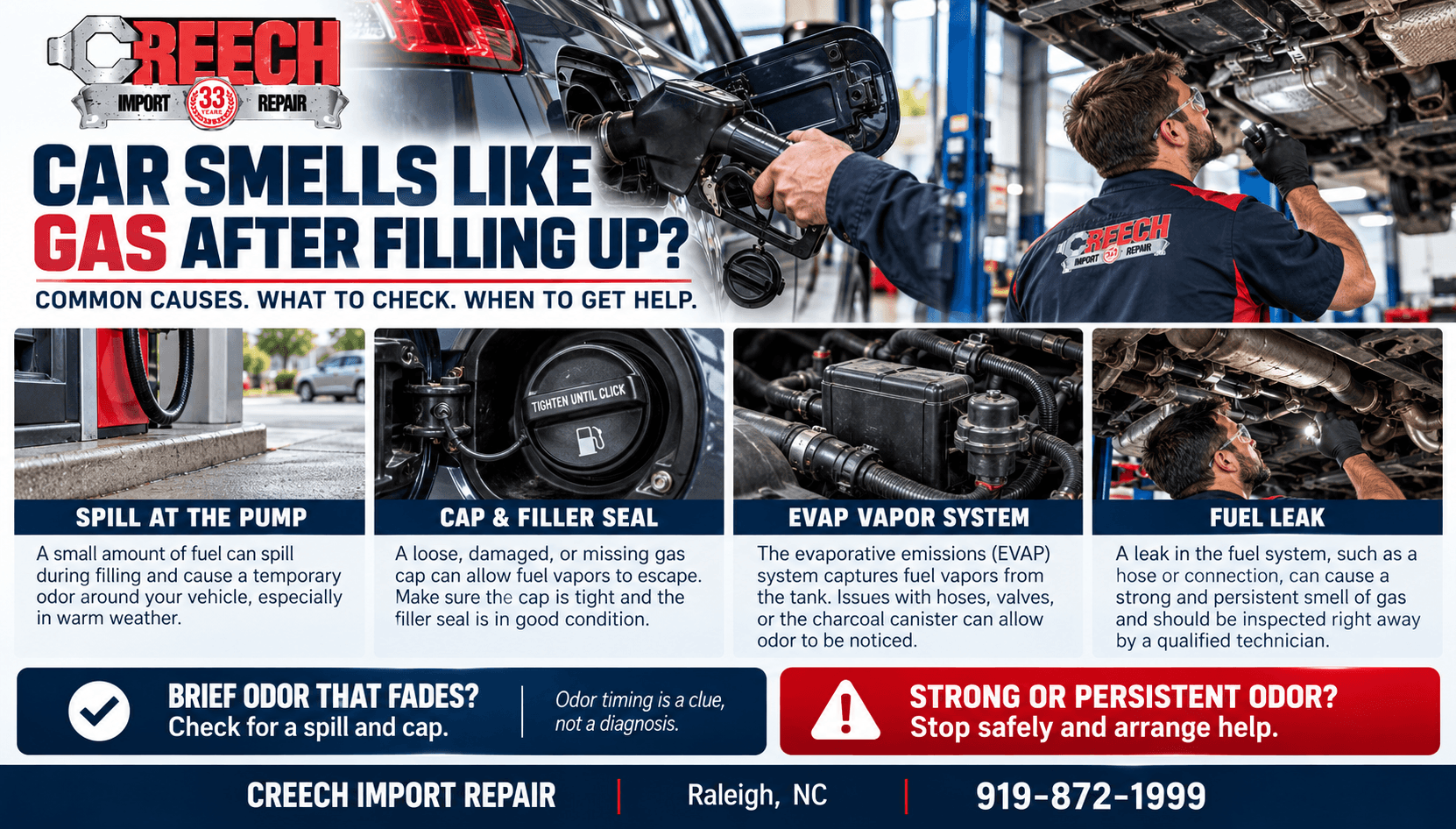
1. Fuel spilled during refueling
A small splash at the nozzle, filler opening, vehicle body, or pavement can create an odor near the pump. A spill is more plausible when you saw fuel splash and the smell fades after the station handles the spill and you leave the immediate area. Do not touch or investigate a significant spill yourself. Notify the attendant. If the smell travels with the vehicle or returns on later trips, look beyond the spill explanation.
2. Loose, damaged, or missing fuel cap
On a vehicle with a removable cap, an improper seal can allow vapor to escape and may set an EVAP-related check engine light. The cap could be loose, its seal could be damaged, or the filler opening could have a sealing problem. Some newer vehicles use a capless filler instead; their sealing mechanism needs vehicle-specific inspection. A cap is a reasonable visual check when there is no strong odor or suspected liquid leak, but tightening it is not proof that the concern has been resolved.
3. Filler neck or seal concern
The path between the fuel door and tank includes a filler neck and vehicle-specific connections or seals. If one is damaged or poorly sealed, vapor or fuel may become noticeable around the rear of the vehicle, particularly when the tank is full. A smell limited to the first part of a trip after refueling can be an observation worth sharing with a technician. It cannot distinguish a filler issue from a tank, vapor-line, or other fuel-system problem by itself.
4. EVAP vapor-system fault
The evaporative emissions system is designed to contain and manage fuel vapor rather than routinely venting it into the air. Depending on the vehicle, its parts may include vapor lines, valves, a charcoal canister, sensors, and tank or filler seals. A damaged line, sealing problem, or control fault can lead to an odor and sometimes an emissions-related diagnostic code. EPA materials describe onboard refueling vapor recovery as a way gasoline-powered vehicles capture vapor during refueling. The system’s exact design varies, so a scan result is only a starting point for testing.
5. Liquid fuel leak
A leak may involve the tank area, fuel lines, connections, pump assembly, or components nearer the engine. It may not create an obvious puddle where you are parked; the source can be difficult to see from outside. A strong or persistent gasoline odor, wet fuel, or a smell beneath the hood deserves immediate attention. Do not crawl under the car, operate switches to experiment, or attempt a home repair around a suspected leak. Arrange professional assistance and tell the shop where and when the smell is strongest.
6. Overfilling after the pump clicks off
Continuing to add fuel after the nozzle automatically stops increases the opportunity for spills and can interfere with the way some vehicles manage fuel vapor. It does not mean that every smell after topping off is harmless or that the charcoal canister has definitely failed. Note whether the tank was topped off and whether the concern happens again when you stop at the first automatic click. EPA advises against topping off a gas tank.
What does the timing and location of the odor suggest?
Timing helps organize a diagnostic conversation. It does not make a smell test accurate enough to select a replacement part. For example, both a spill and a filler-area problem may be noticed beside the rear of the car after refueling. Both an EVAP concern and a liquid leak can be present without a visible puddle. Use the observations below to describe the problem, then let inspection and testing determine the cause.
| What you notice | Possible area to examine | Practical next step |
|---|---|---|
| Brief smell only beside the pump | Station vapors or a small refueling spill | Check for a visible spill from a safe position; notify the attendant if needed. |
| Smell returns each time the tank is filled | Cap, filler, EVAP, tank-area, or fuel-system concern | Record when it starts and arrange diagnosis; do not assume the cap is the only cause. |
| Gasoline odor inside the cabin | Possible vapor entry or fuel-system concern | Stop safely and arrange assistance, particularly if the odor is strong or persistent. |
| Wet fuel or dripping beneath the car | Possible liquid fuel leak | Do not drive or restart; keep clear and arrange towing or emergency help as appropriate. |
| Odor plus check engine light | EVAP or another monitored system; a leak remains possible | Treat odor severity as the safety priority; have codes and the vehicle tested. |
What can you safely check yourself?
If there is no strong odor, visible fuel, smoke, or other immediate warning sign, a few observations can make a service conversation more useful. Start with what happened at the pump: did the nozzle shut off normally, did you continue filling, did any fuel splash, and did the smell remain after leaving the station? You can look at the outside of the car and nearby pavement without handling a suspicious liquid. Keep clear of anything that appears to be leaking.
On a vehicle with a removable gas cap, check that it is present and properly secured according to the owner’s manual. Look for obvious damage to the cap or seal without taking apart the filler assembly. A capless vehicle uses a different design; follow its manual rather than attempting to force a tool into the opening. If an odor remains after a simple cap check, arrange diagnosis.
Write down whether the smell is stronger outside near the filler, inside the cabin, beneath the hood, or after the vehicle has been parked. Note the fuel level, whether the check engine light is on, and whether the engine starts and runs normally. These details help a technician reproduce an intermittent concern. They do not establish that a car is safe to drive.
Leave fuel-system testing to a professional
Do not loosen fuel lines, remove covers to hunt for a leak, introduce smoke or compressed air into the system, or repeatedly run the engine to trace a gasoline smell. Fuel systems differ by vehicle and may retain pressure. A qualified technician can use vehicle-specific procedures and appropriate equipment.
How is a post-refueling gasoline smell diagnosed?
Diagnosis begins with the complaint, not a preselected part. The technician needs to know whether the smell started after one particular fill-up or happens repeatedly, whether the tank was topped off, and whether it appears with a warning light or changes in how the vehicle runs. The vehicle’s year, make, model, and fuel-filler design affect the inspection plan.
A shop may inspect the cap or capless filler, visible tank and filler connections, vapor lines, and accessible fuel-system components. If there is a suspected liquid leak, locating it and addressing safety takes priority over an emissions-code investigation. Where appropriate, a technician may scan for diagnostic trouble codes, review supporting data, and perform manufacturer-appropriate EVAP or fuel-system tests. The exact sequence depends on findings and vehicle design.
An EVAP code can point toward a system that needs evaluation, but it does not automatically prove a gas cap, purge valve, or charcoal canister is defective. Likewise, a check engine light may be absent even when a driver reports an odor. Creech’s check engine light diagnostic service explains its inspection and testing approach. For broader vehicle concerns, see its Raleigh auto repair service.
What if the check engine light came on after refueling?
A loose cap or vapor-system fault can coincide with an illuminated check engine light. However, the light could represent another fault, and a strong fuel smell must not be dismissed because a cap seems loose. Record when the light appeared. If it flashes or the engine runs poorly, stop safely and seek assistance. For a steady light without a severe smell or drivability symptom, arrange diagnostic testing rather than repeatedly clearing codes. Creech has a related guide to check engine light diagnosis in Raleigh.
What if there is no puddle?
No puddle is reassuring only in a limited way: it means you have not seen pooled liquid where you looked. Fuel vapor may escape without an obvious wet spot, and a liquid leak may be hidden, intermittent, or located where it does not drip onto the ground while parked. Do not use the absence of a puddle to justify driving with a strong or persistent odor. Tell the shop that the smell occurs without visible fuel so it can investigate the right conditions.
Can you reduce the chance of a gas smell after refueling?
Good refueling habits reduce avoidable spills and make changes easier to notice. Turn the engine off at the pump, follow posted station rules, and do not smoke. The Petroleum Equipment Institute provides refueling safety guidance, including precautions related to static electricity. Pay attention to the nozzle and stop filling when it automatically shuts off rather than repeatedly topping off the tank.
After refueling, secure a removable cap as directed in the owner’s manual and close the fuel door. If the vehicle has a capless filler, use the manufacturer’s specified fueling procedure. Do not force the nozzle or another object into the filler. If a pump repeatedly shuts off early or the vehicle becomes difficult to fill, mention that symptom when scheduling inspection; it may help narrow the diagnostic process, but it does not identify a particular part.
Most importantly, pay attention to a change. A smell that follows you away from the station, grows stronger, appears inside the car, or returns at every fill-up is a reason to seek an inspection. Waiting for a warning light or visible puddle is not a dependable safety plan.
Where can Raleigh drivers get a gasoline odor checked?
Creech Import Repair is located at 1818 St. Albans Drive, Suite 106, Raleigh, NC 27609. The shop serves Raleigh-area drivers with vehicle diagnostics and auto repair. When contacting the team, describe whether the odor began immediately after filling up, whether it remains once you leave the station, and whether you have a check engine light, visible fuel, or a change in engine performance.
A vehicle with a suspected fuel leak should be handled as a safety concern. Call before bringing it in so the service team can discuss an appropriate next step; do not drive a vehicle that appears to be leaking gasoline. For a non-emergency appointment request, use Creech’s contact and appointment page or call 919-872-1999. Online requests are subject to confirmation by the service team.
Tell the shop exactly when the smell happens.
The fuel level, time since refueling, odor location, warning lights, and visible signs can help direct an efficient inspection. If the smell is strong or fuel is leaking, stop safely and arrange assistance.
Frequently asked questions
Is it normal to smell gasoline briefly while filling up?
A brief odor close to a gas pump can occur while fuel is being dispensed or after a small splash. It should not automatically be attributed to your vehicle. If the odor follows the car away from the station, enters the cabin, persists, or is accompanied by wet fuel, treat it as a potential vehicle or spill-related safety issue and arrange an inspection.
Can a loose gas cap cause a smell after filling up?
Yes, a loose, missing, or damaged cap may allow fuel vapor to escape and can sometimes trigger an EVAP-related check engine light. It is only one possible cause. If the cap is secure but the odor continues, or if the smell is strong or there is visible liquid fuel, seek professional assistance rather than assuming the cap is responsible.
What if my car has no gas cap?
Some vehicles have a capless filler with a sealing door or other vehicle-specific parts. A problem in that assembly or elsewhere in the vapor or fuel system can still produce an odor. Follow the owner’s manual when refueling; do not force the opening with a tool. A technician can inspect the correct components for your vehicle if the smell persists.
Why does the smell happen only when the tank is full?
A full tank can make a filler, tank-area, seal, vapor-line, or other fuel-system concern more noticeable. The same pattern can also follow a spill or overfilling. Record whether the smell starts immediately after the pump shuts off and whether it fades as the fuel level drops. That pattern guides inspection but does not identify the failed component.
Can I drive if I smell gas but see no leak?
A missing puddle does not rule out vapor escape or a hidden, intermittent liquid leak. If the odor is strong, persists away from the pump, reaches the cabin, or you are unsure about a leak, stop safely and arrange help. A faint odor confined to the fueling area that promptly disappears is a different situation, but monitor for a return.
Can an EVAP problem cause a gasoline smell?
Yes. The EVAP system manages fuel vapor, and a problem involving a seal, line, valve, or related component can sometimes produce an odor or diagnostic code. However, not every gas smell is an EVAP fault. A liquid fuel leak is a separate and potentially urgent possibility. Testing is needed to determine which system is involved.
Why did my check engine light come on after I got gas?
A fuel cap or EVAP sealing issue is one possibility, but the timing alone cannot prove that it caused the light. The vehicle may have stored a code for another concern. If a strong gasoline smell or poor running accompanies the light, address safety first. Otherwise, have the codes interpreted with inspection and testing before replacing parts.
Can topping off the tank cause a fuel smell?
Topping off increases the chance of a splash or spill and can interfere with vapor-control operation on some vehicles. It is not proof of a specific failure. Stop filling at the nozzle’s first automatic shutoff and follow the vehicle’s fueling instructions. If the smell is strong or returns even without topping off, arrange a professional inspection.
What if the gas smell is strongest inside the car?
Gasoline odor in the passenger compartment deserves prompt attention, especially if it is strong or persists after leaving the station. Stop safely, shut off the engine, and arrange assistance. Note whether the smell began at the pump, during driving, or after parking, but do not keep driving simply to collect more clues.
How can Creech Import Repair diagnose a recurring fuel odor?
Creech Import Repair can begin with the vehicle’s symptoms, fuel level, recent refueling history, visible condition, and any warning lights. Depending on the findings and vehicle design, the diagnostic path may include inspection of the filler and fuel system, code and data review, and appropriate tests. Call 919-872-1999 to describe the concern and discuss the next step.
The practical takeaway
A gas smell immediately after filling up might be a temporary odor at the pump, but a smell that is strong, persistent, or repeatedly follows the vehicle needs attention. A cap, filler seal, EVAP component, or liquid fuel leak may be involved. The timing and location help describe the symptom; inspection and testing establish the cause. When a leak is possible, put safety before convenience and arrange help instead of driving to see whether the odor goes away.
About Creech Import Repair
Creech Import Repair provides automotive diagnostic and repair services at 1818 St. Albans Drive, Suite 106, Raleigh, NC 27609. This guide offers general information for drivers and cannot diagnose an individual vehicle. Fuel-system designs and safe service procedures differ by year, make, and model. For an appointment request, visit the Creech Import Repair contact page or call 919-872-1999.
Sources and safety references
Find Creech Import Service articles useful?
Add this site to your Preferred Sources in Google Search.