


Humming noise gets louder with speed? At 25 mph it may sound like distant road noise. At highway speed it may become a steady drone or growl that makes you wonder whether a tire, wheel bearing, or another rotating part is wearing out.
A speed-related hum has several possible sources. Uneven tire wear, a wheel bearing or hub concern, brake contact, and drivetrain components can produce overlapping sounds. The safest and most useful approach is to notice when the sound changes, check for obvious tire damage from a safe position, and arrange an inspection before replacing parts based on sound alone.
Humming Noise Gets Louder With Speed: Quick Answer
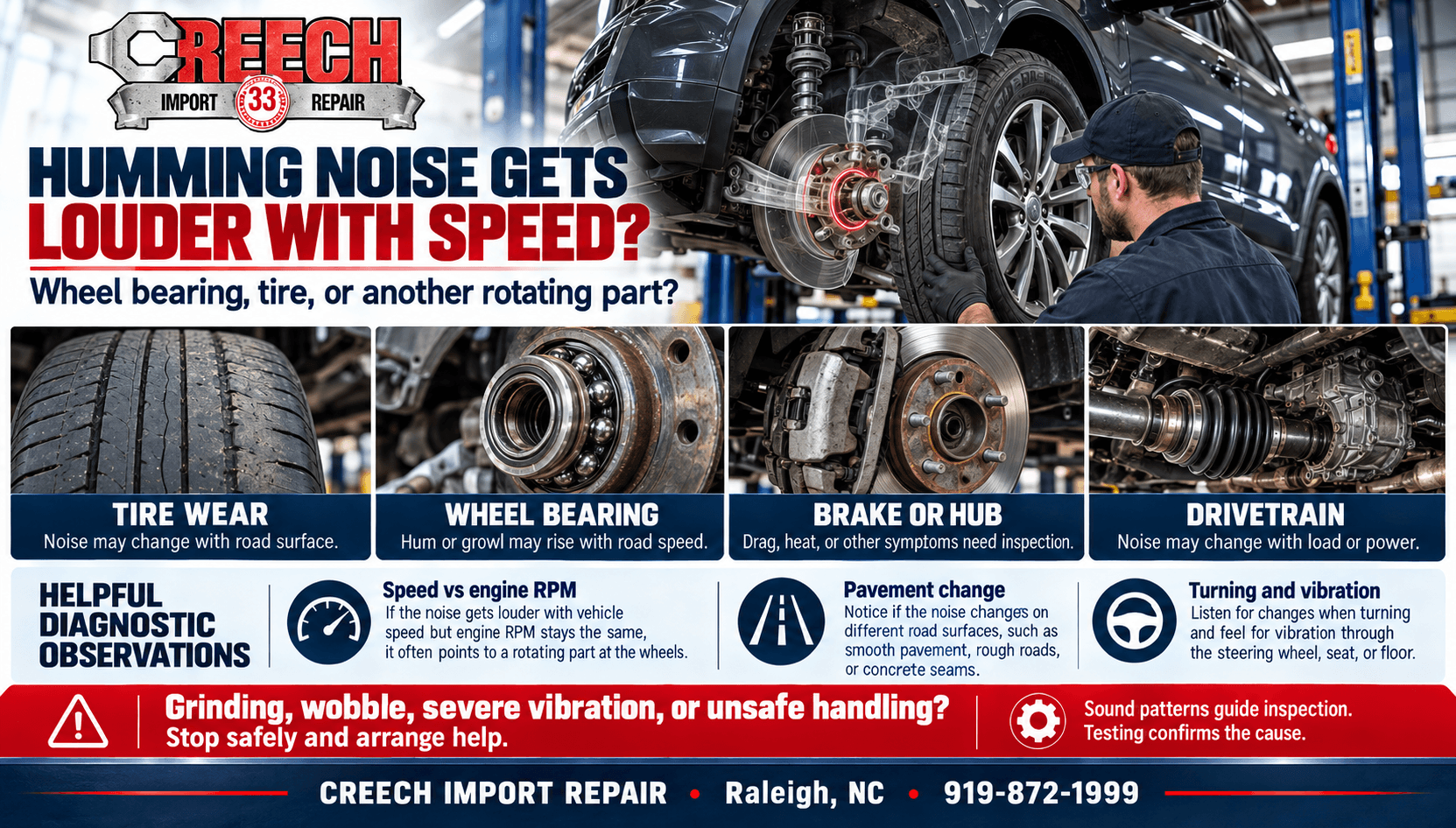
A hum that rises with road speed can come from rotating parts such as tires, wheel bearings, hubs, brakes, or drivetrain components. Uneven tire wear may change its sound on different pavement. A bearing may hum or growl and sometimes change during normal turns. Drivetrain noise may vary with power or load. None of these patterns proves the cause. If the noise comes with grinding, wheel wobble, severe vibration, or unstable handling, stop safely and arrange help.
In this guide
1. Safety first · 2. Possible causes · 3. Sound-pattern clues
4. Bearing versus tire · 5. Safe observations · 6. Diagnosis
Is it safe to keep driving with a humming noise?
A mild, newly noticed hum does not establish an immediate emergency, but it deserves timely attention. Its source may be a tire with irregular wear, a bearing beginning to make noise, or another component. You cannot judge remaining safe service life from loudness alone. A noise that changes quickly or appears with handling symptoms should move the inspection higher on your priority list.
If the vehicle begins to wobble, pulls unpredictably, develops severe vibration, makes grinding or heavy scraping sounds, or feels difficult to control, slow down without abrupt maneuvers and stop in a safe location. Do not continue a highway trip simply to see whether the sound gets worse. Arrange roadside assistance or towing when the vehicle may be unsafe to operate. A visibly damaged tire, bulge, exposed cord, or rapidly losing pressure also calls for a safety-first response.
The source matters because the possible remedies differ substantially. Replacing a wheel bearing will not correct tire noise caused by uneven tread wear. Balancing a tire will not repair a damaged hub. The goal is to identify the source while the problem is still manageable and before a driver has to make a decision on the shoulder of I-440 or another busy road.
Stop safely and request help if the hum comes with:
- Wheel wobble, a loose-feeling wheel, or unstable steering
- Severe vibration through the steering wheel, seat, or floor
- Grinding, harsh scraping, or a sudden major increase in noise
- A tire bulge, visible damage, rapid air loss, or a wheel that appears abnormal
- Unusual heat, smoke, or another sign that a wheel or brake area may be failing
What can cause a hum that increases with road speed?
When a humming noise gets louder with speed, attention often turns to something rotating with the wheels or reacting to vehicle movement. That still leaves several systems to inspect. The clues below are useful for describing your experience to a technician; they are not a parts list or a diagnosis.
1. Uneven or irregular tire wear
Tire tread can generate a pronounced hum or drone when wear becomes irregular. Cupping, feathering, or other uneven patterns can change the way the tread meets the road. The sound may shift on smooth asphalt versus rough concrete and may be accompanied by vibration or visible wear. Tire pressure, rotation history, wheel alignment, or worn suspension components can contribute to irregular wear, depending on the vehicle. Michelin notes that loud tire noise is commonly associated with uneven or irregular wear and recommends tire inspection. The tire itself and the reason for its wear both need attention.
2. Wheel bearing or hub wear
A wheel bearing allows a wheel to rotate while supporting loads at the hub. Bearing or hub damage can produce a hum, rumble, or growl that changes with road speed. The sound may also change as the vehicle naturally turns and load shifts from one side to the other. However, tire and drivetrain noises can behave similarly, and the loudest sound inside the cabin may not reliably identify the affected wheel. Timken’s wheel-hub guidance cautions that humming and growling can be associated with tire or drivetrain components as well as bearings. Inspection is needed before a bearing is replaced.
3. Brake contact or another wheel-end concern
A brake pad, rotor, backing plate, caliper, or other wheel-end part can sometimes produce a rubbing, scraping, or droning sound. The sound may change when the brakes are applied, but that pattern is not definitive. A dragging brake can also create unusual heat. Avoid touching a wheel, rotor, or brake assembly after driving; these parts may be very hot. A technician can inspect the brake hardware, wheel-end condition, and related components to determine whether the noise is actually brake-related.
4. Drivetrain or axle components
A hum or whine may come from a differential, axle-related component, driveshaft, or another drivetrain part, depending on the vehicle’s design. These sounds may be more noticeable while accelerating, easing off the accelerator, or maintaining a steady load. Some vehicles transmit the sound through the floor, making it difficult to locate from the driver’s seat. The repair path depends on the actual component and test findings. This article addresses the broad road-speed symptom rather than assuming a particular transmission or all-wheel-drive fault.
5. Tire construction, road surface, or recent changes
Not every audible hum represents a failed mechanical part. Different tire designs and road surfaces can create different levels of noise. A newly installed tire set may sound different from the previous set; rough pavement can make a normally quiet vehicle louder. However, “it is probably just the road” is not a sound conclusion if the noise is new, increasing, present on multiple surfaces, or paired with vibration. Recent tire replacement, rotation, curb impact, pothole contact, or wheel service is valuable information for the shop.
Which sound patterns help narrow the inspection?
The most useful distinction is whether the hum follows vehicle speed or engine speed. Vehicle speed is how fast the car moves down the road. Engine speed is how fast the engine turns, shown as RPM on many dashboards. If the road-speed hum remains similar while the engine’s RPM changes during ordinary driving, the wheel, tire, hub, or drivetrain path may deserve closer attention. This is an observation, not an instruction to perform special driving maneuvers or shift gears to test the car.
| Observation | What it may suggest | Important limit |
|---|---|---|
| Gets louder as the car goes faster | Tire, bearing, hub, or drivetrain rotation | Several parts change speed together. |
| Changes on different pavement | Tire and road interaction deserves inspection | Pavement changes do not rule out a second fault. |
| Changes during an ordinary turn | Load-sensitive wheel-end or tire concern | It does not prove which side or part is responsible. |
| Changes under acceleration or power | Drivetrain may need closer evaluation | Tire, bearing, and other noises can overlap. |
| Comes with steering-wheel or seat vibration | Tires, wheels, balance, suspension, or wheel-end concern | Vibration location alone is not a diagnosis. |
You can note these patterns during ordinary, legal driving without deliberately swerving, speeding up to reproduce the noise, or operating the vehicle in an unusual way. If the vehicle feels unstable, stop and arrange assistance instead of gathering more clues. A short description such as “the hum starts near 35 mph and changes on rough pavement” is often more helpful than guessing “front passenger bearing.”
Wheel bearing noise versus tire noise: Can you tell the difference?
Sometimes the pattern points a technician toward one area, but a driver usually cannot confirm the distinction by listening alone. A worn wheel bearing may create a steady hum, rumble, or growl that increases with speed and may change with the load of a normal turn. Irregular tire wear can also create a steady hum, and it may become more or less prominent on different pavement. Both can be audible at the same speeds. A noisy tire and a noisy bearing can even exist on the same vehicle.
A visible tire inspection is useful, but it has limits. Uneven tread wear, a bulge, damage, or noticeably low pressure deserves attention. A tire can also be noisy without an obvious pattern to someone viewing it on the ground. Conversely, normal-looking tread does not prove that a bearing has failed. Michelin advises inspection when tire noise is associated with irregular wear, while wheel-hub guidance identifies overlapping sounds from tires and other components.
In a shop, the comparison becomes more reliable. A technician can inspect all four tires for pattern and condition, assess pressure and wheel condition, evaluate the wheel ends, and reproduce the concern when safe. If tire noise is suspected, tire position and wear history may matter. If bearing or hub wear is suspected, the technician follows the vehicle’s appropriate inspection procedure. Replacing whichever part “sounds most likely” before those checks risks an unnecessary repair.
A useful way to describe the noise
“It is a low hum that grows with road speed. It is louder on coarse pavement, and I noticed vibration through the seat after the tires were rotated.” This gives the technician timing, sound quality, road condition, location, and recent service history without claiming a specific failed part.
What can you safely observe before an appointment?
Start with the circumstances. At what approximate speed does the noise begin? Is it present every trip? Does it change on asphalt versus concrete, or when you naturally turn into a street or ramp? Is there a vibration in the steering wheel, seat, or floor? Did the sound start after new tires, a rotation, a curb strike, a pothole, or a repair? These details can shorten the path from a general complaint to a focused inspection.
When parked safely with the vehicle off, look at the tires from outside the car. Watch for visibly low pressure, a bulge, a cut, exposed cord, or unusually uneven wear. Check pressures only by following the owner’s manual and the vehicle’s tire placard, using an appropriate gauge. NHTSA advises regular tire inspection for uneven wear and damage. Do not rely on a dashboard tire-pressure light to reveal every type of tire or wheel problem.
Do not jack up a car, spin a wheel by hand, crawl underneath, or touch brakes and hubs merely to investigate a humming noise unless you have the training and equipment for that work. Do not make sharp steering inputs to try to “load” a bearing on a public road. Professional diagnosis can use a safe road test and shop inspection suited to the vehicle.
How does a repair shop diagnose a speed-related hum?
The first step is to confirm the complaint. A technician asks when the sound began, the speed range, whether the pitch or volume changes with road surface or normal vehicle load, and whether vibration or handling changes are present. A safe road test may help distinguish a road-speed sound from an engine-speed, brake, or wind noise. The vehicle is then inspected for the most likely sources rather than immediately replacing a bearing.
Tire inspection can include inflation, visible damage, tread depth, uneven wear, wheel condition, and recent rotation or replacement history. If the problem includes a vibration at certain speeds, wheel and tire balance may be considered. Creech Import Repair offers road-force tire balancing, but balancing is appropriate only when the findings support it; it cannot repair a damaged bearing or correct every kind of tire wear.
The wheel-end inspection may assess hubs and bearings, brake hardware, and related steering or suspension parts according to the vehicle’s design. A bearing can be noisy without an obvious amount of looseness during a simple check, so the entire set of observations matters. If a tire has irregular wear, the technician may also investigate alignment or suspension conditions that contributed to it. Creech’s wheel alignment guide explains how tire wear and steering concerns can overlap with other problems.
If the sound changes with acceleration or power rather than pavement, the diagnostic path may expand to axle and drivetrain components. Vehicle configuration matters: a front-wheel-drive car, rear-wheel-drive truck, and all-wheel-drive crossover do not have identical drivetrains. A shop should explain the evidence for its recommendation and whether the source has been confirmed before work begins.
What repair might be needed?
The repair depends on what inspection finds. An unevenly worn tire may need replacement if it is no longer serviceable; the underlying pressure, alignment, suspension, or rotation issue may also need attention. A wheel with an imbalance may call for balancing, while a damaged wheel or tire needs a different remedy. A confirmed bearing or hub problem may require replacement of the vehicle-specific assembly or component. Brake contact or drivetrain noise leads to its own repair plan.
There is no dependable universal price for “fixing a humming noise.” Tire size and condition, hub design, labor access, vehicle make and model, whether other components are worn, and the diagnostic time all affect an estimate. A symptom-based price without identifying the source can be misleading. Ask which part was tested, what condition was found, and whether the proposed work addresses the sound and any safety concern.
After a repair, the shop should verify the result when appropriate. If the original noise remains, the diagnosis may have been incomplete or there may be more than one source. Tire tread that developed an irregular wear pattern can continue to make noise even if an underlying alignment or suspension cause is corrected; a technician should explain what to expect based on the tire’s condition.
Why can a new hum appear after tire service?
A tire rotation may move an already noisy tire to a position where it becomes easier to hear. Newly installed tires may have a different tread design and road sound from the old set. If a vibration begins after wheel work, installation and balance deserve inspection. The timing is worth mentioning, but it does not automatically mean the recent service caused a defect.
Likewise, a pothole or curb impact can damage a tire or wheel or change handling. If the hum began right after an impact, do not wait for visible tread damage to develop. Tell the shop exactly what happened and whether the vehicle now pulls, vibrates, or has a crooked steering wheel. Creech also provides tire services and alignment service when inspection shows they are appropriate.
Can you prevent a speed-related hum?
You cannot prevent every bearing or drivetrain fault, but regular tire care can reduce avoidable noise and reveal problems early. Check inflation according to the owner’s manual, look for damage and uneven wear, and follow the vehicle and tire maker’s maintenance guidance. Rotate tires when appropriate for the tire design and vehicle, and have unusual wear investigated instead of simply moving the tires to another axle.
After a substantial pothole or curb strike, pay attention to new vibration, tire damage, steering changes, and noise. If the car begins to hum more loudly over several weeks, schedule an evaluation rather than waiting for a warning light. Many tire, hub, and mechanical noise concerns do not announce themselves with a specific dashboard message. An early description of the symptom gives a technician more useful context than a late-stage emergency.
Where can Raleigh drivers get a humming noise diagnosed?
Creech Import Repair is at 1818 St. Albans Drive, Suite 106, Raleigh, NC 27609. The shop provides auto repair and tire-related services for Raleigh-area drivers. When you call, describe the sound in plain words: the speed when it begins, whether it changes on different pavement, whether you feel vibration, and any recent tire service or road impact. You do not need to decide whether it is a wheel bearing before scheduling an inspection.
For a vehicle that feels unstable, wobbles, grinds, or has a visibly damaged tire, stop safely and discuss towing or roadside assistance rather than driving it to the shop. For a routine appointment request, call 919-872-1999 or use Creech’s contact page. Online appointment requests are confirmed by the service team.
Get the source of the hum checked.
A road-speed noise may involve a tire, bearing, brake, or drivetrain component. Describe the sound and how it changes so the inspection starts with evidence.
Frequently asked questions
Does a humming noise that gets louder with speed mean a bad wheel bearing?
Not necessarily. A worn bearing or hub can hum or growl with road speed, but irregular tire wear, brake contact, and drivetrain components can make overlapping sounds. A technician needs to inspect the tires and wheel ends and reproduce the concern when safe. Replacing a bearing based only on the sound risks missing the real cause.
How can I tell tire noise from wheel bearing noise?
Tire noise from irregular tread wear may vary with pavement, while bearing noise may change as road speed or normal turning loads change. Those are clues, not reliable at-home diagnostic rules. Tires and bearings can sound similar, and both problems can occur together. A tire and wheel-end inspection is needed to confirm which component is responsible.
Why does the humming sound change when I turn?
Turning changes the load on tires and wheel-end components. A worn bearing may change volume with that load, but tire wear and other faults can also react. The sound inside the cabin does not reliably identify the affected side. Do not make sharp turns or swerve to test it; simply tell the technician what you noticed during normal driving.
Why is the hum louder on certain roads?
Different pavement textures create different tire and cabin noise. An irregular tire wear pattern can become especially noticeable on coarse or grooved surfaces. However, a road-surface change does not prove the tires are the only source. If the sound is new, growing, or accompanied by vibration, have the tires and other rotating parts inspected.
Can unbalanced tires cause humming?
Wheel and tire imbalance is commonly noticed as vibration within a speed range. A driver may also describe the overall sensation as droning or noise, but humming alone does not establish imbalance. Tire wear, damage, wheel condition, bearings, and other sources should be considered. Balancing is useful when testing shows an imbalance; it will not correct a damaged bearing.
Can I keep driving if the car hums but feels normal?
A mild hum without other symptoms may allow time to arrange a prompt inspection, but sound alone cannot establish that the vehicle is safe for an extended trip. Monitor for a rapid increase, grinding, vibration, wobble, steering changes, or visible tire damage. If any of those appear or the vehicle feels unsafe, stop safely and arrange assistance.
Why did the noise start after my tires were rotated?
Rotation may move an already noisy or unevenly worn tire to a position where the sound is easier to hear. The timing can also point a shop toward checking tire condition, installation, inflation, and wheel balance. It does not automatically prove the rotation caused a defect. Tell the technician when the service occurred and whether vibration appeared too.
Can a differential or drivetrain make a speed-related hum?
Yes. Depending on the vehicle, an axle, differential, driveshaft, or other drivetrain component may produce a hum or whine. The noise may change with acceleration or load, but that pattern does not rule out tire or bearing problems. Vehicle layout and inspection findings determine which components need testing. Avoid assuming an expensive drivetrain repair from the sound alone.
When should I stop immediately for a humming noise?
Stop as soon as it is safe if the hum suddenly becomes grinding, the vehicle wobbles, handling becomes unstable, severe vibration develops, or you notice a visibly damaged or rapidly deflating tire. Avoid abrupt steering and choose a safe stopping place. Roadside assistance or towing may be appropriate when a wheel, tire, or hub problem could make continued driving unsafe.
Where can I get a humming noise diagnosed in Raleigh, NC?
Creech Import Repair provides auto repair and tire-related services at 1818 St. Albans Drive, Suite 106, Raleigh, NC 27609. Tell the team the speed range, road surface, turning or acceleration changes, vibration, and recent tire or wheel work. Call 919-872-1999 or request an appointment online; the service team confirms online requests.
The practical takeaway
A humming noise that gets louder with speed is a symptom, not a component name. Tire wear, a wheel bearing or hub, brake contact, and drivetrain parts can all enter the diagnostic picture. Notice whether the sound changes with pavement, normal turning, power, or vibration, but do not perform unsafe road tests. If the vehicle remains stable, arrange an inspection. If it wobbles, grinds, vibrates severely, or feels unsafe, stop and seek help.
About this automotive guide
This guide was prepared for Creech Import Repair to help drivers describe a speed-related noise and understand the limits of symptom-based diagnosis. It cannot identify a fault in an individual vehicle. Tire, hub, brake, and drivetrain designs vary by year, make, model, and equipment. Creech Import Repair is located at 1818 St. Albans Drive, Suite 106, Raleigh, NC 27609. Call 919-872-1999 for service guidance.
Sources and further reading
Find Creech Import Service articles useful?
Add this site to your Preferred Sources in Google Search.