


Car heater blows cold at idle but warms while driving? That change can be more than an uncomfortable commute. In a conventional gasoline vehicle, cabin heat depends on warm engine coolant reaching the heater core and air being directed across it. A coolant, circulation, temperature-control, or HVAC fault can interrupt that process. The pattern is useful evidence, but it cannot identify one failed part on its own.
If your car heater blows cold at idle after the engine has warmed up, notice what the temperature gauge, vents, defroster, and coolant warning lights do at the same time. Those observations help separate an urgent cooling problem from a cabin-air control problem. Never open a hot radiator or coolant reservoir cap to investigate.
Car Heater Blows Cold at Idle: Quick Answer
After warm-up, heat that fades at a stop and returns while driving may reflect low coolant, trapped air, reduced heater-core flow, a circulation fault, or a heater-control issue. An engine that never reaches normal temperature points to a different path. If the temperature gauge rises, a warning appears, or the windshield will not clear, stop safely and seek help. Testing is needed before replacing parts.
On this page
Why does the heater get cold at a stoplight?
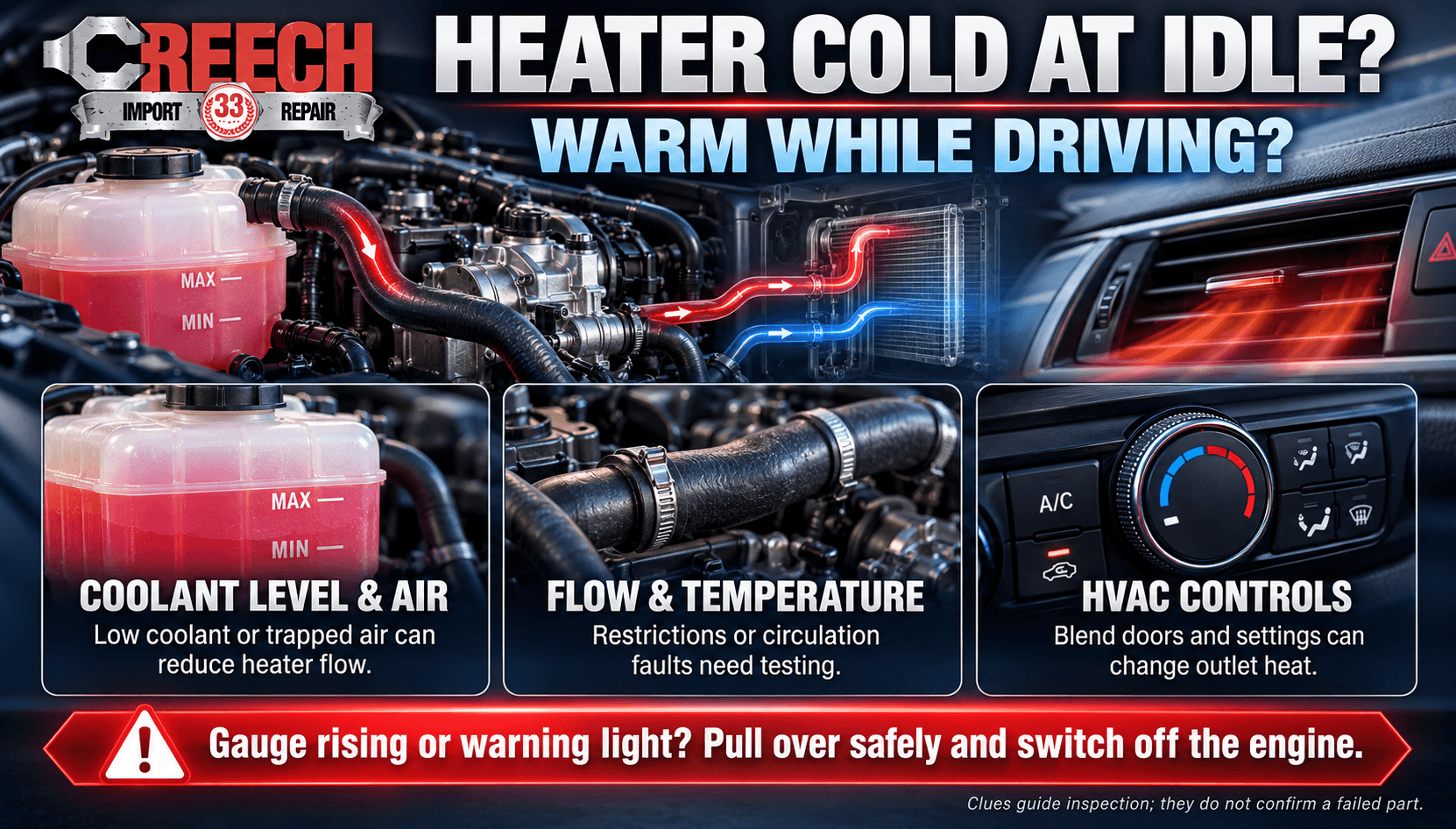
In many gasoline vehicles, a water pump circulates coolant through the engine and a small heat exchanger under the dashboard called the heater core. The blower moves cabin air across that core. A temperature door, sometimes called a blend door, determines how much of that air passes through the hot path. Depending on the vehicle, a valve may also regulate coolant flow to the core.
An idle-to-driving change can arise on either side of this system. The engine may produce less heat or coolant flow may be inadequate at idle; alternatively, an HVAC control may route air differently as conditions change. Vehicle speed and engine speed also change together in ordinary driving, so the observation does not prove whether the trigger is road speed, engine rpm, engine temperature, or time since starting.
The key question is what happens after the engine is normally warm. Brief cool air on a cold start can be expected because the heater core has not heated yet. Repeated loss of heat at every stop after warm-up deserves a closer look, especially if the gauge, coolant level, or defroster performance also changes. Haynes explains the basic coolant-to-heater-core path and the separate roles of coolant, thermostat, heater controls, and blend door in its car-heater troubleshooting guide.
Which pattern points toward which system?
The table is a way to organize observations before an inspection. It is not a parts list or a remote diagnosis. Dashboard gauges can be damped, imprecise, or absent, and the vehicle’s own warnings and owner’s manual take priority.
| Heat and airflow pattern | Engine-temperature clue | Possible area | Useful professional check |
|---|---|---|---|
| Cool at idle, warmer while driving; airflow remains strong | Gauge near its usual range | Coolant level, air, restricted flow, or heat distribution | Cold-system level and leak checks, warm-up data, heater inlet/outlet temperature and HVAC operation |
| Heat is weak throughout a drive | Slow to rise or stays unusually low | Engine warm-up and thermostat control | Compare scan-tool temperature data with actual warm-up behavior |
| Heat fades, then a temperature warning or steam appears | High, erratic, or warning displayed | Potential cooling-system emergency | Stop safely; arrange transport and a leak/cooling-system diagnosis |
| One side is cold, both sides weak, or heat changes with settings | Often otherwise normal | Blend door, control input, or distribution issue | Check commanded versus actual HVAC operation and both vent temperatures |
| Little air from the vents at any temperature | May be normal | Blower, air path, filter, or distribution | Inspect blower speeds, cabin-air path, and defroster output |
A weak airflow volume and a normal volume of cold air are different complaints. Describing them separately saves time. So does noting whether the change occurs after five minutes of warm-up, only after a long highway stretch, or immediately when waiting at a traffic light.
Can low coolant or trapped air cause heat to fade at idle?
Yes, on vehicles that heat the cabin with engine coolant. If the system is low or contains an air pocket, hot coolant may not reach or circulate consistently through the heater core. The loss of heat may be more obvious at idle. Heat returning when driving is a clue, not proof: a restriction, control fault, or other condition could create a similar report.
Coolant does not normally need repeated topping off. A low level may follow a leak, earlier cooling work, or another fault. Possible related observations include a sweet odor, damp carpet near the front of the cabin, visible coolant beneath the vehicle, fluctuating heat, or a temperature warning. An absence of a puddle does not rule out a leak because some leaks occur only while hot or under pressure.
If the vehicle has a visible reservoir, its markings can be observed only with the engine fully cool and according to the owner’s manual; level, tank design, and correct coolant specification differ by vehicle. Do not remove a hot pressure cap, reach toward fans or belts, or treat a top-off as a repair for recurring loss. Some systems require model-specific filling and air-removal procedures after service. The cooling system diagnosis in Raleigh page describes the shop’s inspection of leaks, overheating, heater cores, and coolant circulation.
A change immediately after a radiator, hose, water pump, thermostat, or coolant service is especially useful history. It may prompt a technician to verify level and the specified fill procedure, but it does not establish that the earlier work was wrong. A fresh leak, a failed component, or an unrelated HVAC issue can also appear around the same time.
How do flow restrictions and heater controls differ?
Coolant flow through the heater core
A restricted heater core, a vehicle-specific heater valve problem, a circulation fault, or trapped air can reduce the amount of heat available at the core. A technician can compare the temperature and flow behavior on the inlet and outlet sides under appropriate conditions. A single hose-temperature reading cannot by itself prove a clogged core; the vehicle’s coolant layout and control strategy matter.
Air mixing and distribution
An HVAC blend door mixes or routes air to deliver the requested temperature. A mispositioned door or faulty control can blow cool air even when the heater core is hot. Differences between left and right vents, a temperature change when the dial moves, unusual actuator noise, or defrost-only changes can help direct testing. They still cannot establish which actuator, sensor, door, or control is at fault.
These two paths require different repairs. Replacing a thermostat, water pump, or heater core on the basis of a symptom alone can miss the cause. A credible diagnosis compares coolant availability and temperature with HVAC commands, vent temperatures, and blower operation. The best explanation should account for both the idle behavior and any other observed warnings.
What does the temperature gauge tell you?
The engine-temperature pattern determines which question to ask next. A gauge that remains unusually low after a normal drive can point toward slow warm-up, including a thermostat that is not regulating as intended. Weak heat in that situation is different from a fully warmed engine that suddenly blows cold at a stop. A thermostat is only one possibility; sensor and gauge behavior also need verification.
A gauge moving higher than normal, an overheating warning, steam, or a sudden loss of heat alongside temperature trouble calls for a safety decision first. Coolant loss or poor circulation can affect both cabin heat and engine protection. Pull over as soon as it is safe, switch off the engine if overheating is indicated, and arrange assistance. Never remove a hot cap. Creech’s overheating guide covers the broader engine-temperature problem; this page concentrates on the idle-versus-driving heater pattern.
A gauge at its usual position is reassuring but does not certify that heater-core flow or air mixing is normal. Some dashboards show broad ranges rather than precise numbers. A shop may compare live temperature data with actual system behavior and the manufacturer’s specifications. Tell the technician if the gauge rose, fell, fluctuated, or never appeared to warm up.
Is the explanation the same for hybrids and electric cars?
No. A battery-electric vehicle may heat the cabin with an electric resistance heater, a heat pump, or a combination, rather than depending on a gasoline engine’s heater-core coolant loop. A hybrid may switch its engine on and off and may use additional electric heating or vehicle-specific thermal management. Even among conventional engines, valves and HVAC controls differ.
That means “warm while driving, cold at idle” is not a universal water-pump or coolant diagnosis. On an EV or hybrid, the shop needs the exact make, model, year, heating architecture, warning messages, and operating conditions before selecting tests. The U.S. Department of Energy describes the different cabin-heat technologies used by battery-electric vehicles in its EV winter guide. High-voltage heating components require qualified procedures; leave their inspection to trained professionals.
How does a shop find the actual cause?
A useful appointment starts with a clear symptom history and a repeatable test condition. The technician may reproduce the issue after the vehicle reaches operating temperature, compare idle with the condition you described, record engine temperature or vehicle-specific thermal data, and verify which vents are affected. They may inspect coolant level when safe, look for leaks or evidence of air, and evaluate the heater circuit and HVAC commands.
If coolant loss is suspected, appropriate pressure or leak checks can help locate it. If flow through the heater is uncertain, comparison of inlet and outlet temperature under controlled conditions can narrow possibilities. If one side behaves differently or commands do not produce the expected response, HVAC actuator and door testing becomes more relevant. The sequence depends on the vehicle; no one temperature reading or scan code should be sold as a complete answer.
Ask for a written explanation that states what was observed, what was tested, what fault the evidence supports, and how the proposed repair addresses both the heat complaint and any cooling risk. If coolant work is performed, verification should include the correct fill and air-removal procedure for that model and a follow-up check of heat and engine temperature. If HVAC parts are repaired, the shop should verify vent-temperature response to settings. Specific procedures and repair decisions belong to the vehicle’s service information.
Avoid approving a heater-core replacement just because the cabin is cold, or a water-pump replacement just because warmth returns while driving. The pattern supports a diagnostic route, not a replacement order. Creech Import Repair’s service information lists coolant leak detection, temperature-sensor diagnosis, heater-core diagnosis, and cooling-system checks, which are relevant depending on the findings.
What if the heater works only when accelerating?
This detail may help separate engine speed from vehicle motion. A driver may say “only while driving” even though the cabin warms whenever the engine runs faster, or may notice heat only after the vehicle has been moving long enough to finish warming up. Do not try to isolate the cause by deliberately revving a parked engine or driving with a temperature warning. Tell the shop exactly what happened during ordinary use: Was the engine already warm? Did the vent air cool immediately at a red light or gradually? Did the fan keep blowing at the same strength? A repeatable description guides a controlled test.
What if the heater is warm but the windshield still fogs?
Defrost performance depends on air volume, air distribution, temperature, and moisture control, not just the presence of warm air at a dash vent. If floor or dashboard vents work but the windshield outlets do not, the shop may need to inspect air-routing controls. Persistent interior moisture or a sweet odor also belongs in the symptom history. A windshield that cannot be kept clear is a visibility hazard: pull over safely and address the cause before continuing. Do not confuse a functioning cabin heater with proof that the engine cooling system is healthy.
What evidence should the estimate show?
The written findings should distinguish the complaint from the measured fault. For example, “cold at idle, normal air volume” describes the symptom; coolant-level findings, a verified leak, temperature data, or an HVAC command that fails to move an actuator are evidence that can support a repair. Ask how the shop will check the result at idle after normal warm-up and during the condition that originally caused the issue. If a leak was repaired, the final check should also address coolant level and engine-temperature stability according to the vehicle’s procedure.
When is cold cabin air an urgent problem?
Stop safely and seek help if:
- The temperature gauge climbs above its normal range, an overheating warning appears, or steam is visible.
- A significant coolant leak is visible or the vehicle shows another urgent cooling-system warning.
- The windshield cannot be kept clear enough for a safe view of the road.
A heater that is merely less warm with a stable engine temperature and clear visibility still merits an appointment, but its urgency differs from an overheating vehicle. If visibility deteriorates, pull over safely instead of trying to drive through a fogged windshield. In any overheating situation, do not keep driving to see whether revving or road speed restores heat, and do not open a hot radiator or pressure cap. AAA’s overheating safety guidance advises stopping safely and keeping the hot cooling system closed.
What should you record before calling?
A few safe observations can make the appointment more productive. Record them from normal use; there is no need to recreate the problem by driving an overheating vehicle or changing engine speed while parked.
- Vehicle year, make, model, engine or hybrid/EV version, and approximate mileage.
- Whether the engine was fully warm; when heat fades; and whether it returns at a steady road speed, after time, or with changing settings.
- Whether airflow is strong but cold, weak at every temperature, or different between left and right vents.
- What the gauge, warning messages, windshield defroster, and AC/heat controls did.
- Any coolant smell, visible fluid, damp front carpet, or level change observed only after the engine is fully cool.
- Recent cooling-system, heater, battery, or HVAC work and whether the symptom began afterward.
A photo of a dashboard warning or a short note about the route and weather can be useful if captured safely by a passenger or after stopping. Avoid assuming that a coolant color, a single gauge position, or the absence of a warning rules anything out. These are observations to pass to the shop, not instructions to open the cooling system.
Get the heat and cooling system checked in Raleigh
Creech Import Repair can inspect a repeatable heater complaint and determine whether cooling-system diagnosis or HVAC testing is appropriate. The shop is at 1818 St. Albans Dr #106, Raleigh, NC 27609. For inspection availability, call 919-872-1999 or request an appointment. An online request is subject to confirmation by the shop.
If the engine is overheating, there is steam, or you cannot maintain clear visibility, stop safely and arrange assistance instead of driving to the appointment.
Frequently asked questions
Why does the heater get warmer when engine speed increases?
In a conventional engine, higher engine speed can change coolant circulation, but the timing also changes engine heat and other vehicle conditions. Low coolant, trapped air, a restricted heater circuit, or a control issue could each contribute to an idle-to-driving difference. The change in heat does not prove that the water pump is bad. A technician should compare coolant condition, engine temperature, heater-circuit behavior, and HVAC operation under the same conditions you observed.
Can low coolant cause cold air at stoplights?
Yes. On many vehicles, low coolant or air in the system can limit the hot coolant reaching the heater core, and the loss of heat may become noticeable at idle. It is one possibility among several. If the level is repeatedly low, the reason for the loss needs diagnosis; adding coolant repeatedly does not fix a leak. Observe any visible reservoir only when the engine is fully cool and follow the vehicle’s manual. Never open a hot pressure cap.
Does cold cabin air always mean a bad thermostat?
No. A thermostat that stays open can make an engine warm slowly and weaken heat, often with a temperature reading that stays unusually low. But a warm engine with cold air from the vents could have low coolant, poor heater-core flow, a blend-door problem, or another fault. Gauge readings can be imprecise, so a shop should compare actual temperature data and heating behavior before recommending a thermostat.
Can a heater-core restriction cause inconsistent heat?
It can. A restriction may reduce the transfer of hot coolant through the heater core, which can affect vent temperature. A control problem or air in the cooling system may look similar from the driver’s seat. The shop can evaluate coolant level, warm-up, heater-circuit temperatures or flow, and commanded HVAC operation. A single cool vent or hose is not enough to authorize a heater-core replacement; tests should explain the whole symptom pattern.
Why did the heater change after coolant service?
If the timing closely follows radiator, hose, thermostat, pump, or coolant work, tell the shop. Some vehicles require a specific filling and air-removal procedure, and an air pocket or level change may affect heater performance. The timing alone does not prove a service error: a new leak or unrelated HVAC fault is possible. The vehicle-specific procedure, cooling-system integrity, and heating performance should be checked rather than relying on a generic bleeding method.
Can a blend-door problem imitate a coolant problem?
Yes. A blend door changes how air is routed through or around the hot heater path. If it does not respond correctly, the air may remain cool even though hot coolant reaches the core. One side being colder than the other or a lack of response to temperature settings may point toward HVAC testing, but neither is conclusive. A technician can compare vent temperatures, the requested setting, and the control system’s actual response.
Should I keep driving if the gauge rises and the heater turns cold?
No. If the temperature gauge rises above normal, an overheating warning appears, or steam is visible, pull over as soon as it is safe and switch off the engine. A loss of heater output together with a temperature problem may indicate that the cooling system cannot circulate or retain coolant properly. Do not continue driving to test whether the heat returns and never remove a hot coolant cap. Arrange roadside help and diagnosis before further driving.
Do hybrids and electric cars use the same heating system?
No single heating layout applies to all hybrids and EVs. Many battery-electric vehicles use electric resistance heating, a heat pump, or both. A hybrid can combine engine heat with vehicle-specific electric and thermal controls. An idle-versus-driving heater complaint in one of these vehicles therefore needs the model’s heating design and warning data, not an assumed gasoline-engine diagnosis. High-voltage components should be inspected only with the appropriate training and procedures.
Sources and editorial scope
Technical background: Haynes Manuals on car heater systems; U.S. Department of Energy on EV cabin heat; AAA on overheating safety. Local service scope: Creech Import Repair cooling system repair.
This guide is general education for Raleigh drivers. It does not diagnose a specific vehicle or claim that a named technician reviewed it. Vehicle-specific owner and service information governs warnings, coolant specifications, and repair procedures.
Find Creech Import Service articles useful?
Add this site to your Preferred Sources in Google Search.