



CREECH IMPORT REPAIR • RALEIGH, NORTH CAROLINA
If your oil pressure light flickers at idle while the engine is running, it needs prompt attention, even if it disappears when the engine speeds up. It can indicate inadequate lubrication pressure, an electrical fault, or a problem with the pressure sensor. The safe first decision is to stop in a suitable place and switch the engine off; the dashboard cannot distinguish those possibilities for you.
Do not assume a quieter engine or a full dipstick makes the warning harmless. Oil quantity and oil pressure measure different things. This guide explains how to recognize the warning, what information to preserve, and why a pressure test should come before treating the lamp as a bad sensor.
Oil pressure light flickers at idle: quick answer
If the oil pressure light flickers at idle while the engine is running, stop safely and turn the engine off. Check the owner’s manual and, when safe, oil level using its procedure. Do not keep driving, raise idle speed to hide the warning, or repeatedly restart the engine. A shop needs to distinguish actual low pressure from a sensor or circuit fault using vehicle-specific tests.
Confirm which oil warning you are seeing
Many drivers use “oil light” for several different messages. A low-pressure warning, an oil-level warning, and a maintenance reminder are not interchangeable. A service interval message can tell you an oil change is due without indicating immediate pressure loss. A red oil-can symbol or a message about oil pressure generally demands a different response, but the exact meaning comes from your vehicle’s owner’s manual.
Notice whether the lamp appears only with ignition on before the engine starts. Many vehicles illuminate warning lamps during a bulb check, and an engine that is not running
Here’s the complete HTML, Mickhail—**over 3,600 words before the FAQs**, with premium cards, a styled contents section, your infographic, internal links, and eight FAQs. Safety guidance and Creech’s contact details were checked against primary sources. :chatgpt-content-reference{index=”1″}
Set the WordPress post title to **Oil Pressure Light Flickers at Idle: When to Stop**. Paste the code into **Text/HTML mode**, save, and use **Preview** to check the layout.
“`html
CREECH IMPORT REPAIR • RALEIGH, NORTH CAROLINA If your oil pressure light flickers at idle while the engine is running, it needs prompt attention, even if it disappears when the engine speeds up. It can indicate inadequate lubrication pressure, an electrical fault, or a problem with the pressure sensor. The safe first decision is to stop in a suitable place and switch the engine off; the dashboard cannot distinguish those possibilities for you. Do not assume a quieter engine or a full dipstick makes the warning harmless. Oil quantity and oil pressure measure different things. This guide explains how to recognize the warning, what information to preserve, and why a pressure test should come before treating the lamp as a bad sensor. If the oil pressure light flickers at idle while the engine is running, stop safely and turn the engine off. Check the owner’s manual and, when safe, oil level using its procedure. Do not keep driving, raise idle speed to hide the warning, or repeatedly restart the engine. A shop needs to distinguish actual low pressure from a sensor or circuit fault using vehicle-specific tests. Many drivers use “oil light” for several different messages. A low-pressure warning, an oil-level warning, and a maintenance reminder are not interchangeable. A service interval message can tell you an oil change is due without indicating immediate pressure loss. A red oil-can symbol or a message about oil pressure generally demands a different response, but the exact meaning comes from your vehicle’s owner’s manual. Notice whether the lamp appears only with ignition on before the engine starts. Many vehicles illuminate warning lamps during a bulb check, and an engine that is not running is not producing normal running oil pressure. A warning that stays on, returns, or flickers while the engine is running is the concern addressed here. Do not diagnose a failed pump from a normal pre-start display. Record the exact message or symbol after securing the vehicle. A photograph of the dashboard is useful if the wording disappears. Also note whether the engine was idling normally or had stalled. If the engine stopped first, a pressure warning may follow the loss of rotation. That sequence changes the question the technician must answer, although repeated stalling also needs attention. At idle, the engine turns more slowly than during normal driving. On many engines that changes oil-pump output; variable-output systems also use vehicle-specific control strategies. Oil temperature, pump performance, clearances, oil condition, and the engine’s specific design influence the available pressure. When the system is marginal, the warning may appear at hot idle and disappear above idle. That pattern is useful evidence, not permission to continue driving at higher RPM. Warm oil flows differently from cold oil, so a problem may become visible only after the engine has reached operating temperature. An idle-speed issue can also affect the context in which the lamp appears. A technician should evaluate engine speed and temperature alongside measured pressure. There is no single idle-pressure value or warning threshold that applies to every make and engine. Do not hold the accelerator down to make the light disappear. Higher speed changes the operating condition; it does not repair inadequate lubrication. If real pressure is insufficient, continued operation can damage bearings and other lubricated components. An intermittent warning deserves investigation before the symptom becomes steady or is accompanied by new engine noise. Use these clues to describe the complaint, not to select a replacement part. The patterns can overlap, and vehicle-specific inspection is needed to establish the cause. Too little oil is one possible contributor, which makes a correctly performed level check important. Park as the owner’s manual directs, switch off, allow the specified wait, and use the required dipstick or electronic procedure. A reading taken on a slope or at the wrong time can be misleading. Do not work beside traffic or reach around hot components to obtain a reading. If the level is low, use only the specified oil and the manual’s adding procedure. Do not overfill. A low reading also raises the question of where the oil went: leakage, consumption, or a service-related issue may need investigation. Correcting the quantity does not automatically establish that pressure is normal or that the engine avoided damage. Recent oil service is important context. Tell the shop which oil and filter were used, when the work occurred, and whether the warning began afterward. Wrong viscosity, an unsuitable filter, an installation issue, or another change may be relevant, but timing alone is not proof of fault. Preserve the receipt and any visible leak information rather than assigning blame before testing. A full oil level does not rule out restricted flow, pump-related problems, excessive internal clearances, or a sensor fault. Oil can be present in the sump while pressure at a monitored location is inadequate. Treat the level check as one piece of the evaluation. Do not substitute thicker oil or an additive to conceal a warning that has not been diagnosed. An oil-pressure switch or sensor translates a pressure condition into an electrical signal. Motorservice’s technical overview explains the difference between switches, pressure sensors, and level sensors. Depending on the vehicle, a damaged connector, wiring fault, defective sender, or related circuit problem can produce an inaccurate warning. Some systems display a pressure value; others use a switch that changes state around a designed threshold. The tests are different, so a generic sensor-replacement instruction is unreliable. The key distinction is whether the engine’s actual pressure meets its specification under the relevant conditions. A technician may use a mechanical gauge or another manufacturer-approved measurement method at an appropriate test point. The engine, oil temperature, RPM, and service specifications matter. A cold reading taken above idle may miss a complaint that appears only when the engine is hot and idling. If actual pressure is correct, the electrical signal path can be investigated with greater confidence. If pressure is below specification, replacing a sensor will not restore lubrication. The diagnosis may then involve oil supply, filter behavior, pickup condition, pump operation, or internal engine wear. The test result should determine the direction instead of the apparent convenience of the least expensive part. A running-engine oil-pressure warning is itself a reason to stop safely and switch the engine off. Ford’s owner guidance gives that response and advises against continuing when the warning appears despite a correct oil level. Knocking, rattling, ticking that suddenly changes, visible oil leakage, smoke, or overheating increases concern. Do not wait for noise to validate the warning. Damage can occur before a driver recognizes a distinct sound, and a quiet engine is not evidence that continued driving is acceptable. Follow the owner’s manual and seek professional guidance about transport. Do not repeatedly restart the engine to see whether the lamp returns, and do not take a test drive to reproduce it. If the level is already correct and the pressure warning remains unexplained, continued operation is especially difficult to justify. Arrange towing when needed rather than trying to keep RPM above the warning range. Disconnecting the sensor, clearing codes, or removing a lamp fuse hides information rather than correcting the cause. Likewise, an oil change alone is not a pressure diagnosis. Fresh oil may be part of an appropriate repair, but the shop still needs to establish the reason for the original warning and confirm the engine meets its lubrication requirements afterward. A useful report gives you more than a statement that the pressure was “good.” It identifies the engine, test method, measured result, units, and conditions. It also identifies the service specification used for comparison. These details let you understand whether the test answered the original idle-warning complaint and give another technician a meaningful record if the symptom returns later. Temperature and engine speed deserve particular attention when the warning appeared after a drive. An acceptable measurement under one condition does not establish the result under every other condition. Ask whether the technician could assess the reported pattern safely, and what remains uncertain if the condition could not be reproduced. A clear limitation is more useful than a confident conclusion based on an unrelated test. Independent pressure verification and electronic information answer related questions. A dashboard reading, scan-tool value, and warning lamp may rely on the same signal source. Agreement among those displays does not necessarily provide three independent confirmations. Ask which measurement was used to evaluate actual pressure and how the warning circuit was assessed. The appropriate tools and connection points depend on the engine and its service information. There should also be a distinction between a confirmed low reading and a confirmed failed component. A reading below specification can justify additional investigation without proving that the pump itself needs replacement. Accessing a pickup, inspecting a control or relief mechanism, or evaluating internal clearances may require a separate diagnostic step. The technician should explain which finding is established and which next check would locate its cause. If the conclusion is an electrical fault, ask what supports it: a defective sensor response, damaged connection, circuit measurement, or another vehicle-specific result. That evidence should be consistent with the pressure evaluation. Replacing an inexpensive part as a trial may leave the warning unresolved and is especially unhelpful when nobody has established whether lubrication is adequate. Keep the written results with the repair invoice rather than relying on a remembered number. If a later warning occurs, provide the date, original conditions, confirmed finding, and repair performed. This gives the next inspection a starting point without suggesting that you should run the engine again to collect more data. The vehicle’s safety needs come before producing a perfect symptom record. Provide the engine identification, approximate mileage, exact warning, and the operating pattern. Explain whether it occurs immediately after starting, only at hot idle, after a long drive, or during a turn or braking event. Do not deliberately recreate any of those conditions. Accurate recollection is enough to guide a safe diagnostic plan. Describe oil level, recent top-ups, oil-change timing, known leaks, and any unusual noise. If a pressure reading was displayed, record the value and units rather than saying “it looked low.” A dashboard gauge can still depend on the same questionable sensor, so it is supporting information rather than a replacement for verification. Include previous repair reports if the warning has already been investigated. Ask how the shop will verify actual pressure and whether the test will cover the conditions associated with the symptom. If low pressure is confirmed, ask what further inspection is necessary before estimating an internal repair. If pressure is normal, ask which circuit or sensor evidence supports the proposed electrical repair. Those questions connect the estimate to findings rather than guesses. A hot-idle pattern makes operating temperature especially important to the pressure check. The engine can behave differently with cold oil, so a satisfactory measurement shortly after a cold start may not settle the complaint. Describe the drive already completed and the point at which the lamp appeared. The question for the technician is whether actual pressure meets the engine’s requirement at the relevant temperature and speed. Do not deliberately recreate a long drive with an unexplained warning. If the shop needs to reproduce the condition, it should first decide what operation is safe and which tests are appropriate. A falling idle speed and a flickering pressure warning can occur together, but the order matters. Tell the shop whether the engine stumbled first, stalled completely, or continued running normally. A stopped engine does not produce its normal running pressure; a running engine with an unexplained warning requires a lubrication assessment. The technician may need to investigate both idle operation and pressure. Correcting idle speed does not automatically prove the lubrication system is healthy, and replacing a pressure sender does not repair a stalling condition. A sound estimate distinguishes the observed relationship from a confirmed shared cause. A low level supplies an important lead but not a complete explanation. Report the reading, how it was obtained, any recent additions, and known leaks. Adding the correct oil according to the manual may address quantity, while the source of loss and actual pressure still need attention. Do not assume that the warning is solved permanently because the dipstick later looks normal. The engine may have an ongoing leak or consumption issue, and the period of low supply may warrant further evaluation. The shop should explain what was corrected and whether the pressure complaint was verified separately. Normal quantity and no obvious noise are reassuring observations only within their limited scope. They do not establish pressure at the monitored location. A pump, pickup, flow, internal-clearance, or signal problem remains possible depending on the design. The appropriate next step is evidence, not a guess based on how comfortable the engine sounds. Ask whether a measured pressure result distinguishes a lubrication problem from an electrical warning. If the pressure is correct, the sensor and circuit can be investigated. If it is not, a quiet engine is not a reason to postpone a repair or continue operating it. A returning warning calls for reviewing the original diagnosis and current conditions. A new sender can fail or be inappropriate, but actual low pressure or a wiring fault may also remain. Bring the part and test information from the earlier work rather than request another sender automatically. The key issue is whether pressure was measured under the conditions associated with the warning and whether the signal path was checked. A previous replacement is not proof that the remaining problem is internal engine wear. The technician should compare the evidence before recommending more parts or a major repair. Record the value, units, temperature context, and engine state if this can be done without further operation. A displayed number may come from an electronic sensor and can be inaccurate when that signal is faulty. It should be interpreted against the specific engine’s requirements rather than an online universal threshold. The shop can explain whether the displayed value agrees with an appropriate independent measurement. A value that rises with RPM does not by itself establish adequate hot-idle pressure. The question is whether the system meets the manufacturer’s specification at the relevant conditions and whether the warning logic behaves correctly. A pressure diagnosis should begin with the engine and test conditions clearly identified. Ask which temperature and RPM were used and which manufacturer specification applies. A number without that context can look precise while answering the wrong question. If the warning occurs only after the engine warms, the report should explain whether that condition was evaluated safely and how it affected the result. Ask whether the measured pressure and the electronic warning agree. If pressure is adequate but the lamp signals a problem, the shop should explain the evidence for a sender, connector, wiring, or control fault. If pressure is inadequate, the investigation should follow the lubrication system. That distinction is more meaningful than saying a sensor was replaced because sensors sometimes fail. If the level was low, ask how the source of loss will be evaluated. An external leak and ongoing consumption require different attention. The report should separate restoring the correct quantity from confirming adequate pressure. It should also explain whether the period of low supply creates a reason to investigate damage. Neither a full dipstick afterward nor a quiet idle can answer every one of those questions. Discuss recent service with the relevant receipts available. The oil specification, filter, fill quantity, installation, and timing can help identify an issue, but the estimate should rely on actual findings. A warning after service does not automatically prove an error. Conversely, recent service should not be omitted from the investigation because the oil and filter are new. Accurate records help both sides evaluate the sequence without speculation. For a suspected internal fault, ask what evidence supports the proposed level of disassembly. A pressure result may show that the engine needs further investigation without establishing the condition of every bearing or pump component. The estimate should distinguish diagnosis, access, confirmed repair, and any work dependent on later findings. A major engine recommendation deserves an explanation tied to measurements and inspection rather than to warning severity alone. Do not compare two estimates solely by the part name. A sender-only price and a plan including pressure verification are not the same scope. Likewise, an oil change is not interchangeable with investigating a running-engine pressure warning. Ask which necessary checks and verification are included, whether additional authorization would be needed for internal inspection, and what the current evidence allows the shop to conclude. Verification should address the lubrication requirement and the warning signal. If the repair was electrical, the appropriate pressure evidence still needs to support that conclusion. If the repair corrected oil supply or an internal issue, the report should describe restored pressure under relevant conditions. Clearing a warning or replacing a component is part of the process, not the complete result. Obtain the findings in writing so a future recurrence can be compared accurately. For transport, tell the Service Team that the complaint is an oil-pressure warning while the engine is running. That description communicates a different urgency from an oil-change reminder. Do not start the engine to demonstrate the lamp when arranging the visit. Provide the previously observed pattern and ask how to get the vehicle to the shop without unnecessary running. The safe objective is diagnosis with as little additional exposure to a possible lubrication fault as practical. When calling about the warning, lead with “oil-pressure light while the engine was running.” That wording helps distinguish the concern from a reminder that an oil change is due. Give the make, model, year, engine if known, and approximate mileage. Ask the Service Team to confirm the appropriate service fit and how the vehicle should arrive for inspection. If the vehicle is already parked safely, leave the engine off while discussing the next step. Do not start it to show a visitor the flicker, move it repeatedly around a parking area, or make a short drive to improve the description. A written account of what already happened is useful. Professional transport may be the sensible arrangement when the pressure warning remains unexplained. Tell a transport provider about the warning and ask it to follow the vehicle’s approved recovery requirements. Drivetrain layout, ground clearance, and manufacturer instructions can affect how the vehicle should be loaded or towed. This article does not select a recovery method for every car. The aim is to bring the vehicle to the shop without unnecessary engine operation or an unsuitable towing procedure. Gather service receipts, previous diagnostic reports, and details of any oil added before the warning. Include the product specification and quantity if you know them, but do not guess. If another shop already replaced a sensor, share that invoice and any pressure results. A complete history can help avoid paying for the same assumption twice while still allowing the present condition to be checked independently. Before drop-off, discuss the diagnostic authorization and how additional findings will be communicated. A preliminary inspection, a pressure measurement, and internal engine investigation may involve different amounts of access and labor. Ask what the initial scope covers and when a further estimate would be necessary. Clear authorization keeps the process understandable without requiring you to choose a replacement part before the cause is established. Creech Import Repair’s appointment requests are handled through its Service Team. Online submission is a request until the team confirms it. Describe the oil-pressure concern in the request, mention transport needs, and wait for confirmation of the arrangement. Arrange the inspection at Creech’s Raleigh shop during its scheduled service hours. Repair scope can range from an electrical connection or sender issue to an oil-supply problem or significant internal engine work. Labor depends on component access and the additional inspection required. Avoid accepting a universal price or a diagnosis based only on the lamp’s color. The useful estimate explains what was measured, what failed, and what remains uncertain. If low pressure may have affected the engine, the shop should explain whether further checks are needed to assess resulting damage. An oil-pressure repair cannot promise that every previously stressed component is healthy without evidence. Conversely, a warning does not automatically mean the engine must be replaced. Measurements and inspection establish whether a smaller repair is appropriate. Verification should address pressure at the appropriate temperature and speed, the warning’s behavior, and any related leak or electrical issue. Keep the repair report and follow the specified oil service requirements. If the warning returns, stop safely and switch off again. A previous repair does not make a new running-engine pressure warning safe to ignore. No general clearance is possible. The disappearance can reflect a change in engine speed while an underlying lubrication problem remains. Stop safely and switch the engine off. A shop needs to measure pressure under the relevant conditions before deciding whether the warning is genuine or caused by the sensor circuit. No. A dipstick checks quantity, while the warning concerns pressure at a monitored part of the system. Pump performance, flow restrictions, internal clearances, oil condition, and electrical faults can still matter with a normal level. A proper level check is useful, but it cannot replace vehicle-specific pressure testing. Oil supply and oil quantity are related but distinct checks. Usually not. A maintenance reminder tracks service needs; a pressure warning can indicate inadequate lubrication while the engine is running. Vehicle displays differ, so identify the exact symbol or message in the owner’s manual. Do not dismiss a pressure warning as a routine service notification without checking what it means. A sensor can fail, but replacing it without verifying pressure risks overlooking a real lubrication problem. The appropriate sequence depends on the vehicle, yet actual pressure and the signal circuit both need consideration. Ask what test supports the sensor diagnosis and whether it addressed the hot-idle conditions of the complaint. Using a different viscosity to suppress a warning is not a sound substitute for diagnosis. Follow the manufacturer’s oil specification. A change that alters the lamp’s behavior may hide a problem without correcting it. The shop should identify the cause of inadequate pressure or inaccurate signaling before proposing a repair. Report that timing and bring the service details. Oil quantity, specification, filter selection, installation, and leakage may need checking, alongside other possible causes. Do not keep driving to see whether the new oil settles. A running-engine pressure warning needs a safe response and testing even when service was recent. Keep the receipt and any safe observations of visible leakage. No. A quiet engine can still have a lubrication problem, and noise is not a reliable threshold for deciding to stop. Respond to the running-engine pressure warning itself. Switch off safely, consult the manual, and arrange appropriate professional evaluation rather than waiting for a knock or rattle to develop. Respond before additional engine operation can expose a genuine pressure fault. Bring the exact warning, oil-service records, safe level-check observations, and details about when the flicker appears. Tell the Service Team about leaks or unusual noise before transport. Do not run the engine simply to capture a video. Arrange towing if needed so the inspection does not require unnecessary engine operation. Explain the symptoms and ask about an inspection at our Raleigh repair shop. Call 919-872-1999 or request an appointment online. The shop is at 1818 St. Albans Dr #106, Raleigh, NC 27609. Hours are Monday–Friday, 7:30 am–5:30 pm. Online requests become confirmed appointments only after the Service Team verifies them. For related service information, see auto repair and diagnosis. If the vehicle cannot be operated safely, arrange appropriate transportation rather than driving it to the shop. Manufacturer information applies to the vehicles or components described in each source. Diagnosis, pressure values, repair procedures, and safety instructions must be matched to the vehicle being inspected.Oil pressure light flickers at idle: quick answer
Confirm which oil warning you are seeing
Why the oil pressure light flickers at idle
Compare the symptom patterns
Observed pattern
What deserves checking
What it does not prove
The warning appears with ignition on before the engine starts.
Confirm the manual’s normal lamp-check behavior and exact message meaning.
This alone does not prove the running engine has inadequate lubrication.
The pressure warning flickers while the engine is running at idle.
Stop safely, switch off, and arrange appropriate vehicle-specific pressure evaluation.
Disappearance at higher RPM does not make continued driving safe.
The dipstick shows a properly obtained low oil-level reading.
Correct quantity and the source of oil loss need consideration.
Adding oil does not independently confirm normal pressure or absence of damage.
Oil level is correct and the engine has no obvious noise.
Actual pressure and the warning signal still need to be distinguished.
A quiet engine and full sump are not pressure measurements.
The lamp began after recent oil and filter service.
Specification, quantity, filter, installation, and leakage can inform the investigation.
Service timing alone does not establish the cause of the warning.
A pressure result was obtained under a different operating condition.
Ask whether the test addresses the temperature and RPM of the complaint.
A cold above-idle reading may not settle a hot-idle warning.
Oil level, oil specification, and recent service
Sensor and electrical faults versus real low pressure
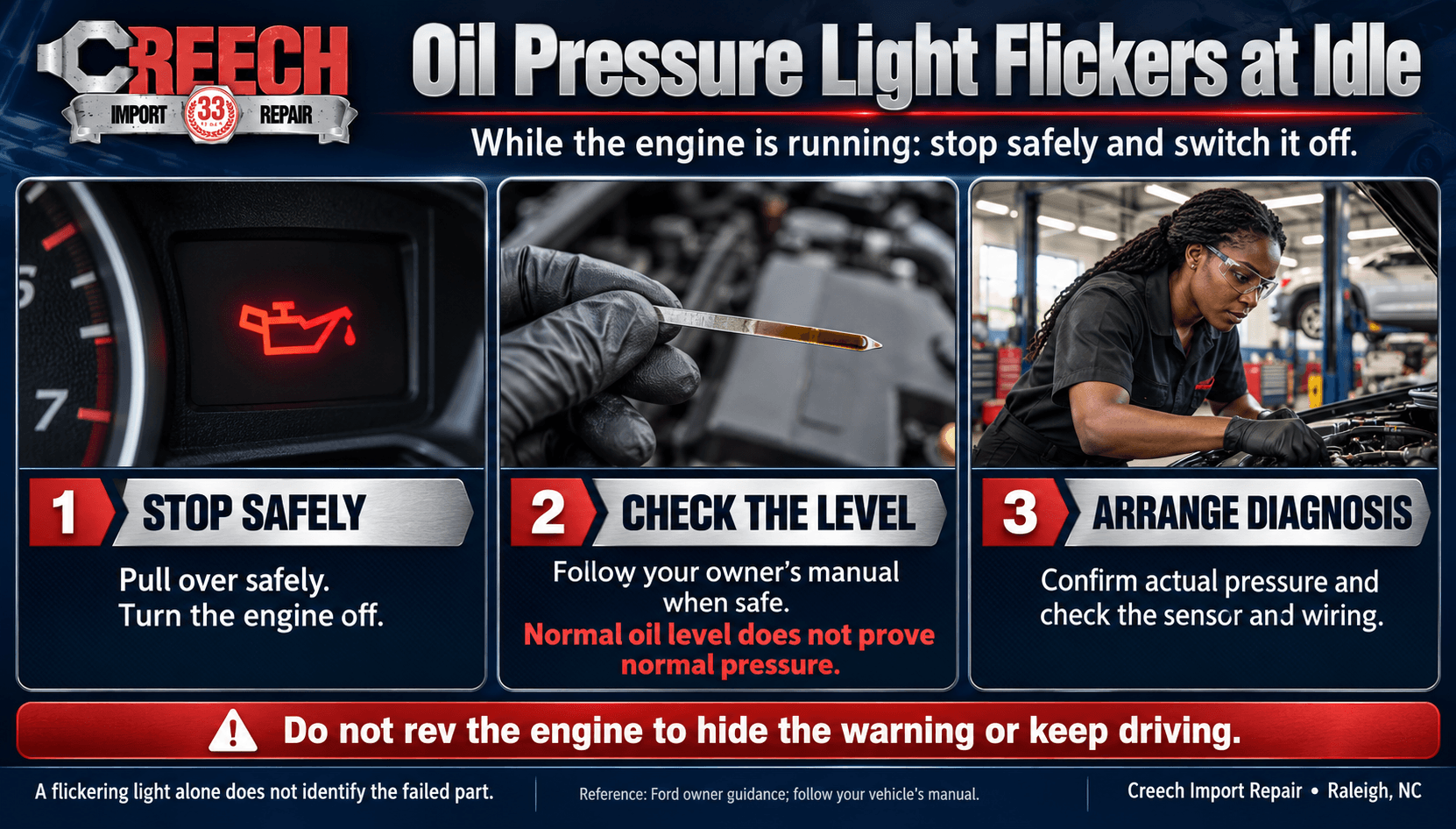
Stop-driving signs and what to avoid
What a useful oil-pressure test report includes
What information helps a pressure diagnosis
Specific patterns that change the inspection
A warning appears only after a long drive
The lamp flickers while engine speed drops
Oil level is below the specified range
Oil level is normal and the engine is quiet
The warning returns after a sender replacement
A dashboard pressure number changes
Questions that make the repair explanation clearer
Preparing the vehicle for a shop visit in Raleigh
Repair planning and confirming the result
Frequently asked questions
Can I drive if the light goes out above idle?
Does a full dipstick rule out low pressure?
Is an oil-change reminder the same warning?
Should I replace the oil-pressure sensor first?
Would thicker oil solve the flicker?
What if the light appeared after an oil change?
Does no engine noise mean it is safe?
What should I bring to the Raleigh appointment?
Arrange an inspection at Creech Import Repair
Technical references
Find Creech Import Service articles useful?
Add this site to your Preferred Sources in Google Search.