


Creech Import Repair | Raleigh, North Carolina
Car AC Blows Cold on One Side but Hot on the Other? 7 Causes
You turn on your car's air conditioning and feel cold air coming from the driver's vents, but warm or hot air reaches the passenger. Both temperature controls are set to cool, yet the difference continues. What could make one half of the same cabin feel so different?
A car AC cold on one side hot on other complaint often points toward a temperature-blend-door or climate-control problem, especially in vehicles with separate driver and passenger temperature settings. However, uneven cooling can also occur with certain refrigerant-related faults, sensor problems, restricted airflow, or wiring issues.
The most important distinction is whether the air-conditioning system is producing sufficient cold air but routing it incorrectly, or whether the refrigeration system itself is struggling to cool the evaporator consistently.
Those situations may feel similar from the driver's seat but can require very different repairs. Replacing a blend-door actuator will not solve a refrigerant leak, and adding refrigerant will not repair a broken temperature door.
This guide explains seven potential causes, how dual-zone climate control works, which symptoms help narrow the problem, and how an automotive technician can distinguish an HVAC door fault from a refrigeration-system fault.
We'll also cover safe owner checks, repair options, vehicle-specific differences, and when uneven AC temperature becomes a visibility or engine-safety concern.
Quick Answer
Car AC Cold on One Side Hot on Other: What Causes It?
When a car's AC blows cold on one side but hot on the other, possible causes include a failed temperature blend-door actuator, a stuck or damaged blend door, incorrect climate-control sensor data, calibration or module problems, low refrigerant or another refrigeration fault, airflow restrictions, and damaged wiring. Some dual-zone systems control left and right temperatures separately, so one side can malfunction while the other continues cooling.
First, set both temperature zones to the same cool setting and check whether one side responds when adjusted. If the difference persists, a technician can compare vent temperatures, commanded door positions, actuator operation, and refrigerant-system performance. Do not assume the actuator is faulty without testing; certain low-refrigerant conditions can also produce unequal vent temperatures.
How Does Dual-Zone Car Air Conditioning Work?
A dual-zone climate-control system allows the driver and front passenger to request different cabin temperatures. Some vehicles also have separate rear climate zones.
The refrigeration system typically cools air using an evaporator inside the HVAC housing. Air may then be directed through or around a heater core, depending on the requested cabin temperature and the vehicle's climate-control design.
Temperature-blend doors regulate the proportion or path of warm and cool air. On many dual-zone vehicles, separate doors or actuators help control the temperature delivered to each side.
The HVAC controller may use cabin-temperature readings, ambient temperature, sunlight information, evaporator temperature, and other inputs when operating in automatic mode.
When the system cannot position one temperature door correctly, that side may remain warmer or colder than requested even though the opposite side responds normally.
Why Can One Side Be Cold While the Other Is Hot?
One side may receive cooled air as intended while the other side receives air that has passed through a hotter portion of the HVAC housing. This can happen when a blend door does not move to the correct position.
However, one-sided warmth is not proof of a door problem. On certain HVAC designs, inadequate evaporator cooling or a low refrigerant charge can create uneven vent temperatures.
The difference may also reflect an intentional setting. A passenger temperature request or an activated dual-zone mode can make the two sides behave differently without any component failure.
Does Every Car Have Separate Temperature Doors?
No. Some vehicles use a single-zone system, while others have dual-zone, tri-zone, or more complex climate controls.
The number of actuators, sensors, doors, and evaporator arrangements varies. Even two vehicles from the same manufacturer can require different diagnostic procedures.
Before diagnosing the problem, a technician needs to confirm the vehicle's exact HVAC configuration rather than assume every dashboard contains the same components.
What Is the Difference Between Air Temperature and Airflow?
Vent temperature describes how warm or cold the delivered air is. Airflow describes how much air comes through the vents.
A vent may produce genuinely warm air at normal airflow, or it may produce cold air so weakly that the passenger feels little cooling.
Those are different diagnostic complaints. A dirty cabin filter or blocked duct may reduce airflow, while a temperature door fault may deliver the wrong air temperature at normal volume.
Unequal Temperatures
Both sides move normal amounts of air, but one is substantially warmer. Investigate temperature control and cooling distribution.
Unequal Airflow
One side has less air movement. Investigate vents, duct routing, filters, and air-distribution controls.
Both Sides Warm
Cooling may be inadequate throughout the cabin. Investigate overall AC performance before focusing only on one blend door.
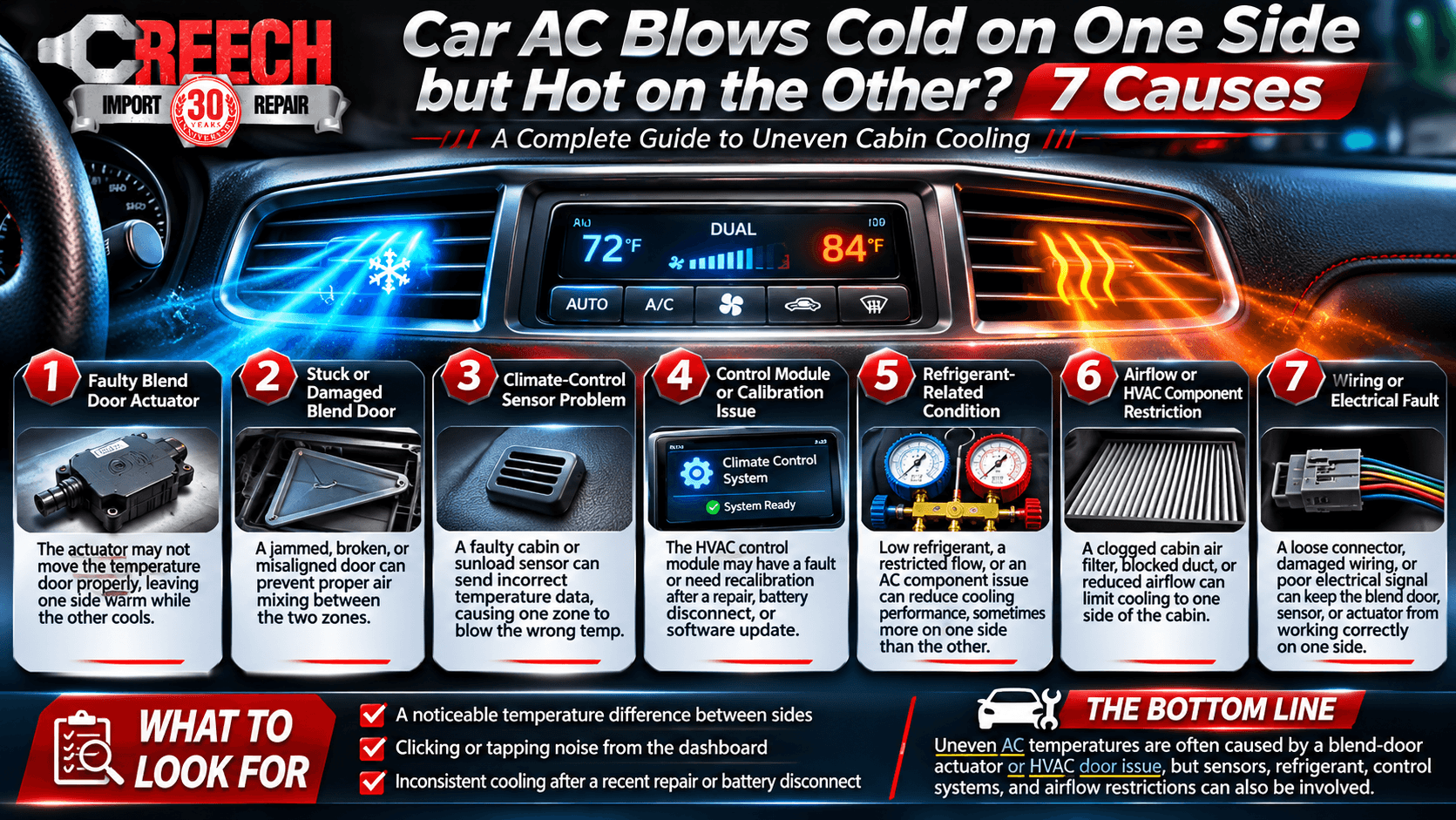
7 Possible Causes of Car AC Blowing Cold on One Side and Hot on the Other
The following seven categories represent possible explanations rather than a statistical ranking. Some overlap, particularly blend-door actuator and wiring faults, or module and calibration problems.
The correct diagnosis depends on the specific system, whether the temperature difference occurs at equal settings, and how each side responds to control changes.
Faulty Temperature Blend-Door Actuator
A blend-door actuator moves a temperature-control door within the HVAC assembly. Depending on the vehicle, it may be an electric motor and gear assembly that receives commands from the climate-control system.
In a dual-zone vehicle, one side may have its own temperature actuator. If that actuator stops moving, moves to the wrong position, or cannot complete its travel, one side can remain warm while the other cools.
Actuator failures can involve worn internal gears, motor faults, position feedback problems, or other mechanical and electrical conditions.
A clicking or repeated tapping noise behind the dashboard may accompany a damaged actuator gear. However, not every failed actuator clicks, and a clicking noise can have other sources.
A technician should verify that the controller commands the correct movement and that the actuator responds before recommending replacement.
Possible clues: One temperature zone does not respond to adjustments, clicking behind the dash, or one side staying warm at full-cold settings.
Diagnostic approach: Compare commanded temperature settings with actuator movement, position feedback when available, electrical operation, and the actual vent temperatures.
Stuck, Broken, or Misaligned Blend Door
Even when an actuator receives the correct electrical command, the door itself may be damaged or unable to move through its normal range.
The HVAC housing contains internal air-routing components. Depending on the design, temperature doors may use shafts, hinges, seals, or other mechanical parts.
A broken door shaft, binding mechanism, distorted seal, or disconnected drive can prevent the air from following the intended hot or cold path.
This failure may resemble a defective actuator because the selected temperature does not match the delivered temperature.
In some cases, replacing the actuator alone will not fix the problem because the door or housing mechanism remains damaged.
The accessibility of the door varies considerably. Some components can be inspected or repaired through limited dashboard access, while others require more extensive HVAC housing work.
Possible clues: The actuator responds but vent temperature does not change correctly, or a mechanical obstruction prevents complete door travel.
Diagnostic approach: Verify actual door movement and linkage condition using the vehicle-specific service procedure.
Climate-Control Sensor Problems
Automatic climate-control systems may use cabin temperature, outside air temperature, sunlight, evaporator temperature, and other signals to determine how much cooling or heating is needed.
If an input is inaccurate, an automatic system may make temperature adjustments that do not match the conditions occupants expect.
For example, a sensor that incorrectly reports cabin temperature may lead the controller to request a different blend-door position or fan behavior.
Not every sensor affects the two zones independently. Its role depends on the climate-control system's design.
A temperature difference that appears in automatic mode but improves under consistent manual settings may be useful diagnostic information, though it does not prove sensor failure.
A blocked or damaged in-cabin sensor aspirator, where equipped, may also affect temperature sensing.
Possible clues: Unexpected automatic temperature changes, inaccurate temperature readings, or one zone behaving inconsistently despite stable settings.
Diagnostic approach: Compare sensor data against actual temperatures, inspect sensor placement and operation, and assess climate-control commands.
HVAC Control Module or Door Calibration Problem
Many electronically controlled HVAC systems use a control module to calculate and command temperature-door positions.
Some systems also use calibration procedures to learn the limits of actuator or door travel.
If the controller loses correct position information, receives conflicting commands, or experiences an internal fault, air temperature may not match the requested settings.
Certain vehicles may require recalibration following repairs, component replacement, or specific electrical events. However, battery disconnection does not universally cause lost calibration, and reset procedures are not interchangeable across makes.
A module-related diagnostic code may reflect an external wiring, sensor, or actuator issue rather than internal controller failure.
Replacing an HVAC controller can require programming or configuration, depending on the vehicle.
Possible clues: Temperature imbalance after HVAC service, inconsistent commands, calibration faults, or several HVAC functions behaving abnormally.
Diagnostic approach: Inspect relevant fault information, verify actuator operation, and perform manufacturer-approved initialization or calibration when indicated.
Low Refrigerant or Another Refrigeration-System Problem
Uneven cabin cooling does not always originate in the dashboard temperature controls.
In certain AC systems, insufficient refrigerant charge or another refrigeration fault can produce uneven evaporator cooling. That may cause one side to receive colder air than the other even when the temperature doors are functioning correctly.
For example, an ALLDATA diagnostic case involving a Mitsubishi Outlander Sport described one side cooling poorly because of a low refrigerant charge associated with a condenser leak. After the confirmed leak was repaired and the system recharged correctly, both zones cooled properly.
This is a vehicle-specific example, not evidence that low refrigerant is the most frequent cause in all vehicles.
Other refrigeration concerns may include restrictions, compressor-control problems, condenser issues, or thermal expansion components depending on system design.
A technician needs to verify cooling performance and refrigerant conditions instead of assuming the refrigerant level from vent temperature alone.
Adding refrigerant without identifying the reason for insufficient charge can leave an active leak unresolved. Overcharging can also impair operation or damage components.
Possible clues: Overall AC performance becoming weaker, uneven cooling without an obvious door-control fault, or cooling that deteriorates over time.
Diagnostic approach: Evaluate system operation, applicable pressure and temperature data, leak evidence, and refrigerant charge using approved equipment and service procedures.
Airflow Restriction or HVAC Distribution Problem
Sometimes one side does not actually produce significantly warmer air; instead, the occupants feel less cooling because fewer airflows reach that side.
A dirty cabin air filter, internal HVAC obstruction, duct restriction, blower problem, or incorrectly positioned distribution door may affect air delivery.
A cabin filter commonly influences airflow through a shared portion of the HVAC system, so it should not automatically be blamed for a left-versus-right temperature difference.
However, restricted airflow can alter occupant comfort and complicate diagnosis when combined with uneven cooling.
A technician may compare vent airflow volume, temperatures, fan-speed response, and the positions of mode and distribution doors.
The distinction matters because a weak-flow complaint requires a different repair approach from a full-flow vent delivering hot air.
Possible clues: One vent produces much less air than another, the airflow pattern changes unexpectedly, or the cabin filter is heavily restricted.
Diagnostic approach: Inspect filter condition, blower operation, internal air routing, mode doors, and duct restrictions.
Damaged Wiring, Connectors, or Electrical Control Circuits
Climate-control actuators, sensors, and modules depend on reliable electrical circuits.
A loose connector, damaged wire, corroded terminal, power problem, or communication fault can prevent one part of the HVAC system from operating correctly.
Electrical problems may appear intermittently. A temperature zone might work after startup, stop responding later, or behave differently after vibration or temperature changes.
Some vehicle architectures communicate with actuators over dedicated control circuits or electronic networks rather than simple direct power connections.
That means the correct testing method depends on the specific system.
Replacing an actuator without verifying that it receives the appropriate commands and power may not resolve the condition.
Possible clues: Intermittent zone behavior, inconsistent actuator operation, circuit-related codes, or a problem following dashboard or electrical work.
Diagnostic approach: Inspect connections and wiring, verify power, grounds, signals, and communication as specified by the manufacturer.
One Side Cold, One Side Hot: What Do the Symptoms Suggest?
The exact pattern matters. One side failing to respond to a temperature change points toward a different diagnostic path from both sides gradually losing cooling.
| What You Notice | Possible Areas to Investigate | Important Limitation |
|---|---|---|
| Driver side warm, passenger side cold, both set to full cool | Driver temperature door or actuator, zone sensor/control, refrigerant performance | Side-to-side difference alone does not confirm actuator failure. |
| Passenger side warm, driver side cold | Passenger temperature-control components or uneven evaporator cooling | The problem does not necessarily originate on the warmer side. |
| Clicking or tapping behind dashboard during temperature adjustment | Actuator gears, linkage, temperature-door movement | Noise location and exact door must be confirmed. |
| Both vents blow cold when first started, then one warms | Control feedback, automatic sensor behavior, actuator movement, or AC performance | Operating time and temperature can affect several systems. |
| One side has much weaker airflow | Duct restriction, mode door, vent position, filter, blower or internal airflow problem | Low volume is not the same as incorrect temperature. |
| Problem appears after HVAC repair or battery replacement | Actuator installation, calibration where applicable, electrical connections | Timing does not prove the earlier service caused the fault. |
| Both sides gradually become warmer | Refrigerant leak, compressor/control issue, condenser or overall AC performance | Check refrigeration performance before replacing a zone actuator. |
| One zone refuses to heat as well as cool | Temperature-door travel, actuator or control logic, vehicle-specific heater system | Heating-system design and coolant operation also matter. |
Why Is the Driver's AC Hot but the Passenger Side Cold?
On a vehicle with separate driver and passenger temperature controls, the driver's temperature door may not be reaching the requested cool position.
A faulty actuator, mechanical door problem, incorrect command, or sensor input could contribute.
Certain refrigeration-system problems can also create unequal cooling, so a technician should not order a driver-side actuator solely from this symptom.
Why Is the Passenger Side Hot but the Driver's Side Cold?
The same diagnostic categories apply, but the vehicle's actual HVAC layout determines which parts are responsible for that zone.
The passenger-side control, its temperature door or actuator, or an uneven evaporator-cooling condition may be relevant.
Confirm whether the passenger temperature setting is independent, whether SYNC is selected, and whether the affected vent changes temperature when commanded.
What If Both Sides Are Set to 68 Degrees but Feel Different?
Matching displayed settings do not guarantee matching vent temperatures in every situation, especially with sun exposure, automatic temperature regulation, and cabin conditions.
However, a substantial and persistent difference under comparable conditions suggests a problem worth diagnosing.
A technician may place the system into a controlled test mode and compare vent temperatures while monitoring relevant door commands.
Bad Blend-Door Actuator or Low Refrigerant: How Can You Tell?
A blend-door problem affects how cooled and heated air is routed or mixed. A refrigerant-system problem affects how much cooling the AC system can generate.
Both can create unequal temperatures in some vehicles. The diagnosis should determine which process is malfunctioning.
| Diagnostic Question | More Consistent With Door/Control Fault | Can Occur With Refrigeration Fault |
|---|---|---|
| Does one zone ignore temperature commands? | Yes, if a door fails to move or its control is incorrect | Possible, but not proof of a refrigerant issue |
| Is there repeated clicking during temperature changes? | Can indicate actuator or linkage problems | Not usually a characteristic refrigerant symptom |
| Does overall cooling become weaker over weeks? | Possible but less specific | Yes, particularly with progressive refrigerant loss |
| Can the system cool both sides during a controlled test? | May indicate a control or door movement issue | Insufficient cooling capacity may prevent it |
| Will replacing the actuator always fix unequal cooling? | Only if actuator failure is confirmed as the cause | No; refrigeration faults require different repairs |
| Will adding refrigerant fix the problem? | No, if a door or actuator is the confirmed fault | Only after the refrigerant condition and cause have been properly diagnosed |
Can Low Refrigerant Really Make Only One Side Warm?
Yes, in some vehicle designs. Uneven evaporator cooling caused by inadequate refrigerant charge can make the difference more noticeable at one section of the HVAC airflow path.
A published ALLDATA repair case documents this symptom on a specific Mitsubishi vehicle, with a condenser leak identified as the cause.
This does not establish that low refrigerant is the cause in most cars. It does demonstrate why a diagnostic process should consider refrigeration performance instead of automatically replacing a blend-door actuator.
Can You Tell if a Blend-Door Actuator Is Bad by Listening?
Clicking or tapping behind the dashboard may support investigation of an actuator, particularly when the sound coincides with temperature adjustments.
However, many failed actuators make no noise, and noises from other HVAC components can sound similar.
Actual command and movement testing is more reliable than deciding from sound alone.
Should You Recharge the AC Before Checking the Blend Door?
No. Refrigerant should not be added as a speculative first step.
A trained technician can assess cooling performance, system pressures or other applicable data, and door behavior to determine where further testing is needed.
If refrigerant charge is confirmed inadequate, the system should be inspected for leaks and serviced using approved equipment and the specified refrigerant quantity.
The U.S. Environmental Protection Agency regulates paid motor-vehicle AC service under Clean Air Act Section 609. Refrigerant must not be intentionally vented.
What Can You Safely Check When One Side of Your Car AC Is Hot?
You can gather useful information without removing dashboard components, accessing refrigerant lines, or performing electrical tests.
Set Both Temperature Zones to the Same Setting
Choose the same requested temperature for driver and passenger. If the vehicle has a SYNC function, check whether it links both zone settings. A control setting can sometimes explain the apparent imbalance.
Compare Similar Vents
Compare the left and right center or side vents under the same operating conditions. Note which is warmer and whether their airflow volumes also differ. Avoid blocking vents or touching internal moving components.
Change One Temperature Setting at a Time
While parked safely, observe whether the affected side responds to a normal control adjustment. Record if it remains unchanged, moves slowly, or changes only intermittently.
Note Unusual Sounds
Clicking or repeated tapping behind the dashboard during normal temperature adjustments is useful information. Do not repeatedly force operation if the system makes harsh mechanical noises.
Observe Whether Cooling Changes With Conditions
Note whether the imbalance occurs at idle, during driving, in direct sunlight, or only in automatic mode. These observations help separate overall cooling performance from temperature-control behavior.
Review the Cabin Filter and Service History
Check the owner's manual for the cabin-filter location and maintenance interval. Also note recent HVAC repairs, dashboard work, refrigerant service, or battery-related work.
Schedule a Vehicle-Specific Diagnosis
Provide the technician with the exact side affected, the controls used, and whether the problem occurs with normal airflow or weak airflow. These details help guide testing.
Should You Disconnect the Battery to Reset the Blend-Door Actuator?
Battery disconnection is not a universal blend-door repair or calibration procedure.
Some vehicles have specified initialization steps; others require diagnostic equipment or a different process entirely.
Improper resetting may create additional issues or erase useful diagnostic information. Follow the manufacturer's procedure rather than online instructions intended for a different model.
Can You Drive With One Side of the AC Blowing Hot?
An isolated cabin-temperature problem is often a comfort issue rather than an immediate mechanical emergency.
However, malfunctioning climate control can affect windshield defogging and driver concentration in hot conditions.
If the windshield cannot be cleared safely, stop until visibility is restored. If the vehicle also displays an engine-overheating warning, treat that as a separate urgent condition.
How Does a Mechanic Diagnose Uneven Dual-Zone AC Temperatures?
A proper diagnosis compares the requested air temperature, actual vent temperatures, door-control behavior, and refrigeration performance.
Confirm the Vehicle's HVAC Architecture
The technician identifies whether the vehicle has single-zone, dual-zone, or multi-zone controls and which doors and sensors manage each temperature area.
Reproduce the Complaint Under Controlled Conditions
The system is operated at consistent settings. Left and right vent temperatures and airflow strength are compared while conditions such as engine speed and cabin temperature are documented.
Check Temperature-Door Commands and Response
Where the system supports it, diagnostic equipment can compare requested and reported door positions. A technician may inspect actuator movement or test electrical operation.
Review Climate-Control Sensor Data
Relevant cabin, ambient, sunlight, and evaporator sensor readings are evaluated where available. Incorrect readings or automatic-control behavior may direct further testing.
Evaluate Overall AC Cooling Performance
If door operation appears correct, the technician investigates refrigerant-system performance, compressor control, airflow, and possible leaks using the appropriate procedures.
Inspect Mechanical Doors and Electrical Circuits
When evidence indicates a door, actuator, module, or wiring fault, the affected components are inspected according to their accessibility and manufacturer guidance.
Explain the Repair and Verify Both Zones
After the confirmed defect is corrected, both temperature zones should be tested again under appropriate operating conditions.
Does a Scan Tool Always Show a Blend-Door Fault?
No. Some climate-control systems store actuator or position-related trouble codes, but others offer limited diagnostic reporting.
A mechanical door problem can exist without an easily readable fault code.
A capable technician may need to use electrical testing, commanded movement checks, physical inspection, and temperature measurements together.
Will a Shop Have to Remove the Entire Dashboard?
Not necessarily. Access varies by vehicle and by which component is defective.
Some actuators are accessible behind trim panels, the glove box, or a portion of the lower dashboard. Other temperature doors or HVAC housing components may require more extensive disassembly.
The location and repair method should be confirmed before quoting labor.
How Much Does It Cost to Fix Car AC That's Cold on One Side and Hot on the Other?
The cost depends on the confirmed cause, not simply on the symptom.
An accessible actuator replacement can involve a different level of labor from repairing a broken internal HVAC door or refrigerant leak.
Some vehicles also require calibration, software configuration, or additional AC service after component replacement.
| Confirmed Problem | Possible Repair | Cost Factors |
|---|---|---|
| Blend-door actuator failure | Replace or repair confirmed actuator and perform appropriate initialization | Dashboard access, part availability, calibration |
| Damaged temperature door or linkage | Repair affected mechanical components or housing as appropriate | Access to HVAC case, disassembly, associated damage |
| Climate-control sensor fault | Repair or replace confirmed sensor/circuit | Location, testing, vehicle-specific part |
| Module or calibration problem | Perform prescribed initialization or repair confirmed controller issue | Programming, diagnostic equipment, module design |
| Refrigerant leak or charge problem | Find and repair leak; recover and recharge correctly when indicated | Leak location, refrigerant type, component access |
| Airflow restriction | Repair duct, vent, distribution, blower, or filter issue | Access and exact obstructed component |
| Electrical or wiring fault | Repair verified connectors, wiring, power, or communication circuit | Harness access, damage severity, testing |
Is a Blend-Door Actuator Usually Cheaper Than a Compressor Repair?
The repairs are fundamentally different, and cost varies by vehicle.
An easily accessible actuator may require less extensive work than a compressor replacement, but a deeply located actuator or broken internal door can require substantial dashboard disassembly.
A compressor repair may also involve refrigerant recovery, related-component inspection, and system servicing.
Ask for a written estimate based on the actual defect rather than comparing generic online prices.
Can You Repair Only the Side That's Blowing Hot?
Sometimes. On vehicles with separate zone actuators, a fault may be confined to one side.
But not every uneven-temperature complaint has a separate failed driver- or passenger-side component.
Shared refrigerant performance, central HVAC controls, or sensor signals can affect both zones differently.
Should You Replace Both Blend-Door Actuators Together?
Not automatically. Replacement should be based on verified failure, manufacturer service recommendations, and the condition of related components.
A technician should explain whether additional work is justified by shared access or confirmed wear rather than recommending both parts simply because the vehicle has dual-zone controls.
When Is Uneven Car AC Cooling a Safety Concern?
Uneven cabin cooling is often not an immediate mechanical danger, but certain accompanying symptoms require a different response.
- Windshield fogging: If the defroster cannot clear the glass sufficiently for safe visibility, pull over and resolve the visibility problem before continuing.
- Engine overheating: If the temperature gauge enters the danger zone, a warning appears, or steam is visible, stop safely and shut off the engine. Do not treat the issue as only a cabin AC problem.
- Electrical burning smell or smoke: Stop safely, switch off affected systems, and obtain professional assistance.
- Extreme cabin heat: Do not continue driving if driver alertness or comfort is impaired enough to make vehicle control unsafe.
- Refrigerant-related work: Do not loosen refrigerant lines or vent refrigerant. Professional service requires proper equipment and certification.
If there are no serious warning signs, schedule diagnosis for the uneven cooling complaint rather than attempting risky repairs or repeatedly adding refrigerant.
Can One-Sided AC Problems Cause Engine Overheating?
A malfunctioning blend door typically does not cause engine overheating.
However, AC and engine cooling systems can interact through fans and airflow. If the engine temperature gauge is rising, investigate the cooling system separately.
Creech's AC-versus-engine-overheating guide explains that distinction in more detail.
Is It Safe to Use the AC With a Bad Blend-Door Actuator?
A confirmed actuator problem may primarily affect temperature control, but continued operation should be considered in context.
If a door is binding or making harsh mechanical noises, avoid repeatedly forcing temperature changes. If visibility is affected by poor defogging, do not continue driving until the windshield can be cleared.
The appropriate repair depends on the actual fault and vehicle design.
Does One-Sided AC Cooling Affect Different Car Brands Differently?
Yes. The same symptom may arise from different components and layouts across vehicles.
Honda and Acura
Honda and Acura vehicles include different climate-control configurations across generations and trims. Some have separate driver and passenger control components.
The correct actuator or HVAC fault cannot be identified merely by knowing the brand. The exact model, year, and control system matter.
Toyota and Lexus
Toyota and Lexus vehicles may use single-zone or multi-zone automatic climate control with several actuators and sensors.
Some systems also include manufacturer-specific initialization and feedback procedures. A general battery-reset method should not be assumed appropriate.
Nissan and Infiniti
Nissan and Infiniti models may have different temperature-door arrangements, including electronically controlled components.
A technician should distinguish HVAC control faults from refrigerant performance before ordering parts.
Subaru
Subaru models vary by generation and trim. A side-specific temperature problem may be related to door positioning, control inputs, or refrigeration performance.
A complete diagnosis should account for the exact climate-control system rather than a generic actuator location.
Hyundai, Kia, and Mazda
These vehicles also use different HVAC arrangements and control strategies.
Depending on the model, professional diagnosis may include actuator command testing, sensor readings, electrical checks, and AC performance measurement.
Domestic Vehicles
Some Chevrolet, GMC, Ford, and other domestic models use separate zone temperature actuators.
However, repair access and electronic procedures vary. A temperature-control fault should be confirmed before dashboard parts are replaced.
Hybrid and Electric Vehicles
Hybrid and electric vehicles may use electrically driven compressors, heat pumps, or other integrated thermal-management arrangements.
Some HVAC systems are associated with high-voltage components that require specialized training and service procedures.
Do not apply conventional gasoline-vehicle compressor or refrigerant assumptions to every hybrid or EV. Confirm that the repair shop supports the exact vehicle and equipment.
Can You Prevent Uneven Car AC Temperatures?
Not every blend-door actuator, sensor, or HVAC component failure is preventable through maintenance.
However, certain practices help preserve system performance and make problems easier to identify.
Replace the Cabin Filter at the Recommended Interval
Follow the owner's manual and consider dusty operating conditions. A heavily restricted filter can reduce airflow even if it is not the cause of a side-specific hot-air complaint.
Investigate Gradually Declining Cooling
If both sides lose cooling performance over time, have the refrigerant system checked before the condition becomes more severe.
A sealed refrigerant system should not require repeated unexamined top-offs.
Address New Dashboard Clicking
New clicking that occurs with temperature changes can be useful evidence of a developing actuator or door issue.
Document the timing instead of repeatedly cycling controls until the noise stops.
Keep Maintenance and Repair Records
Tell the shop about prior AC recharges, dashboard work, battery changes, HVAC controller replacement, or previous refrigerant leaks.
The timing can help guide diagnosis, although it does not automatically prove a past repair caused the new symptom.
Test Climate Control Before Severe Weather
Checking cooling performance before peak summer heat can reveal an early problem while there is more flexibility to schedule service.
Raleigh's hot, humid weather can make uneven vent temperatures especially uncomfortable, but local climate alone does not establish the mechanical cause.
Car AC Cold on One Side and Hot on the Other in Raleigh, NC? Get It Diagnosed.
If your driver-side and passenger-side vents deliver noticeably different temperatures despite matching settings, Creech Import Repair can help determine whether the problem involves temperature doors, electronic controls, airflow, or the AC refrigeration system.
Creech Import Repair provides automotive AC diagnosis and repair in Raleigh, North Carolina, including climate-control concerns, refrigerant leak detection, compressor problems, airflow issues, and related electrical faults.
The shop services many supported Asian import and domestic vehicles. Describe the vehicle's year, make, model, which side is warmer, whether the temperature changes with the controls, and any unusual clicking or recent service.
This information helps the service team understand the complaint before the diagnostic appointment.
Creech Import Repair
1818 St. Albans Dr #106
Raleigh, NC 27609
Phone: 919-872-1999
Hours: Monday-Friday, 7:30 AM-5:30 PM
For the shop's broader AC diagnostic and repair services, visit Auto AC Repair in Raleigh, NC.
Online appointment requests are not confirmed until verified by the Creech Import Repair service team. If engine overheating, severe electrical symptoms, or unsafe visibility occurs, address that condition immediately instead of driving normally to an appointment.
Frequently Asked Questions About One-Sided Car AC Cooling
1. Why is my car AC cold on one side but hot on the other?
A car AC system may blow cold on one side and hot on the other because of a defective temperature blend-door actuator, damaged blend door, incorrect climate-control sensor input, module or calibration problems, low refrigerant, airflow restrictions, or electrical faults. Dual-zone climate systems can regulate left and right temperatures separately, so one side may malfunction while the other cools normally. However, certain refrigeration faults can also produce uneven cooling. Diagnosis should compare temperature settings, vent temperatures, door operation, and overall AC performance before parts are replaced.
2. Does one-sided hot AC always mean the blend-door actuator is bad?
No. A failed blend-door actuator is one possible explanation, particularly when one temperature zone ignores commands or clicking occurs behind the dashboard. However, a stuck blend door, sensor fault, wiring problem, control calibration issue, or certain refrigerant-related conditions can produce similar symptoms. Some low-refrigerant systems may cool unevenly across the evaporator. A technician should confirm commanded and actual door movement, compare vent temperatures, and evaluate AC refrigeration performance before recommending actuator replacement.
3. Can low refrigerant cause one side of my car AC to blow warm?
Yes, on some vehicles. An insufficient refrigerant charge can create uneven evaporator cooling, making one section of the cabin receive warmer air than the other. The effect depends on the AC system's design, so it is not a universal symptom of low refrigerant. Other possible causes include blend-door and electronic control problems. A qualified technician should inspect refrigeration performance and check for leaks before adding the manufacturer-specified refrigerant. Random recharging may not correct the cause and can create additional problems.
4. Why is the driver's AC hot while the passenger side is cold?
On a dual-zone climate-control system, the driver's temperature door, its actuator, or the command controlling it may not be operating correctly. Other possibilities include inaccurate sensor data or a refrigerant-system condition that creates unequal cooling. First, confirm both zones are set to the same cool temperature and check whether the driver's vents respond to adjustments. The symptom alone cannot identify a failed component. A technician should test the zone controls, actual vent temperatures, and cooling system before recommending repair.
5. Why is the passenger side AC hot while the driver side is cold?
The passenger side may remain warm because its temperature door is stuck, its actuator is defective, the climate controller is sending an incorrect command, or the AC system is cooling unevenly. Some vehicles also use separate passenger temperature sensors or settings. Begin by confirming that passenger and driver temperatures are matched or synchronized. If the difference persists, professional testing can determine whether the affected zone responds correctly and whether the refrigeration system provides sufficient cooling. Avoid replacing parts based solely on which side is warmer.
6. Can a bad cabin air filter make one side of the AC hot?
A dirty cabin air filter can restrict airflow, reducing how effectively the cabin cools. However, many vehicles use a shared filter, so a clogged filter does not typically explain truly hot air from only one side at otherwise normal airflow. A blocked duct, distribution-door problem, or another HVAC restriction can also change how air reaches certain vents. Compare actual airflow volume and temperature separately. If one vent is weak rather than hot, airflow inspection may be more useful than immediately replacing a blend-door actuator.
7. Can I reset a blend-door actuator by disconnecting the battery?
Disconnecting the battery is not a reliable universal method for repairing or recalibrating a blend-door actuator. Some vehicles require a manufacturer-specific initialization procedure, while others require diagnostic equipment or mechanical repair. Battery disconnection can also clear useful information or affect other electronic settings. A reset will not repair stripped actuator gears, a broken door shaft, or damaged wiring. A technician should verify the exact HVAC system and follow its prescribed calibration procedure only when that process is appropriate.
8. Is it safe to drive if only one side of the car AC works?
An isolated one-sided AC temperature problem is often primarily a comfort issue, and the car may otherwise operate normally. However, the HVAC system also helps with windshield defogging, so reduced visibility can make driving unsafe. Excessive cabin heat may also affect comfort and concentration. If the windshield cannot be cleared, stop safely until visibility is restored. If the vehicle also has an engine-overheating warning, smoke, or serious electrical symptoms, address those separately and urgently rather than treating everything as an AC issue.
9. How much does it cost to fix car AC that's hot on one side?
The cost depends on the confirmed cause, vehicle design, labor access, and required parts. An accessible blend-door actuator may require different work from a damaged internal HVAC door, sensor circuit, module, or refrigerant leak. Some repairs require dashboard disassembly, electronic calibration, or refrigerant recovery and recharging with approved equipment. There is no single reliable price for uneven AC temperature because it describes a symptom, not a particular failed component. Request a vehicle-specific diagnosis and written estimate before approving repairs.
10. Where can I get uneven car AC temperatures diagnosed in Raleigh, NC?
Creech Import Repair provides automotive AC diagnosis and repair services at 1818 St. Albans Dr #106 in Raleigh, North Carolina. Call 919-872-1999 to describe your vehicle's year, make, model, which side blows warm air, whether the system has dual-zone controls, and any clicking or electrical symptoms. The service team can help arrange an appropriate diagnostic appointment. If engine overheating or a serious visibility problem accompanies the AC complaint, follow the vehicle manufacturer's safety guidance and seek urgent assistance when necessary.

Automotive Technical Review
Reviewed by Creech Import Staff
Creech Import Staff represents the automotive service team at Creech Import Repair in Raleigh, North Carolina.
The shop has served the Raleigh area since 1993 and provides diagnostics, maintenance, and repair for supported import and domestic vehicles, including AC and HVAC concerns.
Learn more about Creech Import Repair's service experience, technicians, and commitment to clear automotive guidance.
About Creech Import RepairTechnical Sources and Evidence Limits
This article describes potential causes of unequal cabin temperatures. The seven categories are diagnostic possibilities rather than statistically ranked failure rates. Exact HVAC architecture, control functions, refrigerant requirements, and repair procedures vary by vehicle. A warm vent alone cannot establish a defective actuator, refrigerant leak, or other specific failure.
- ALLDATA Tech-Assist / Fleet Maintenance. Tech Tip: What to Do if Dual-Zone AC Blows Warm on the Driver's Side (2020). Documented repair example showing that a refrigerant leak and insufficient charge can produce uneven zone temperatures on a specified vehicle.
- U.S. Environmental Protection Agency. Motor Vehicle Air Conditioner System Servicing. Official guidance on refrigerant servicing, equipment, and technician certification.
- U.S. Environmental Protection Agency. Regulatory Requirements for MVAC System Servicing. Requirements concerning refrigerant handling, approved equipment, and paid service under Clean Air Act Section 609.
- 1A Auto. Cold, Heat, Hot AC: Diagnosing Temperature Problems. Practical illustration of temperature blend doors and actuator operation in a dual-climate vehicle.
- Creech Import Repair. Auto AC Repair in Raleigh, NC. The shop's primary AC service page, including refrigeration, leak detection, electrical, compressor, and airflow services.
- Creech Import Repair. Car AC Blowing Warm Air Raleigh: AC or Overheating? Related guidance distinguishing cabin AC problems from engine cooling problems.
- Creech Import Repair. Contact and Appointment Information. Raleigh shop address, telephone number, hours, and appointment policies.
Find Creech Import Service articles useful?
Add this site to your Preferred Sources in Google Search.