


HORN OPERATION & ELECTRICAL DIAGNOSIS • RALEIGH, NC
Car Horn Not Working? 5 Safe Checks Before Repair
You press the horn and hear nothing—or the familiar sound becomes weak, distorted, or unpredictable. A car horn not working can involve the horn unit, its electrical supply, wiring, connections, or the command from the steering wheel. Silence alone does not identify the failed part.
The horn provides a warning signal to other road users. Arrange assessment when it stops working, even if the car otherwise feels normal. Report an airbag warning or steering-wheel control problem promptly rather than treating it as an unrelated inconvenience.
This guide explains five safe observations, what different horn symptoms can mean, and what diagnosis should establish before parts are replaced. It does not require removing the horn pad, working on the airbag, or bypassing an electrical circuit.
Quick Answer: What Should You Do If Your Car Horn Is Not Working?
Follow your vehicle’s manual for normal horn operation while safely parked. Record whether the horn is silent, weak, or intermittent, and report related warning lights, control problems, and recent work. Arrange vehicle-specific diagnosis. A fuse, relay, horn unit, wiring connection, or steering-wheel circuit may need attention, but the symptom does not select a part. Do not remove the horn pad or airbag, probe SRS wiring, or bypass a fuse.
Car Horn Not Working: 5 Safe Checks Before Repair
Use these checks to describe the complaint, not to dismantle the system. Keep the vehicle safely parked, avoid unnecessary noise near other people, and follow the operating conditions in the owner’s manual.
1. Read the manual and use the designated horn area
Identify where and how the manufacturer says to press. Do not assume every steering-wheel surface activates the horn. Hyundai’s horn guidance, for example, identifies specific operating areas and warns against striking the pad or pressing it with a sharp object. Use normal pressure; hitting harder is not a repair.
2. Note the sound pattern from normal use
Was there complete silence, a faint sound, a changed tone, or a response that came and went? Record when it began and whether the sound changed suddenly or gradually. Avoid repeated or prolonged activation simply to gather evidence. If the car horn stopped working completely, say so rather than describing every failure as “a weak horn.”
3. Report other symptoms
Tell the shop about an airbag warning, steering-wheel buttons that stopped responding, unusual electrical behavior, or a change you previously noticed during steering. Do not deliberately reproduce the fault while driving or turn the wheel repeatedly as a diagnostic experiment. Related symptoms can guide inspection without proving a common cause.
4. Review recent work and changes
Mention recent steering-wheel, steering-column, electrical, or front-end work, collision damage, or aftermarket accessories. Bring the invoice when available. The timing may help locate a disturbed connection or identify a relevant procedure, but it does not establish that the previous repair caused the failure.
5. Arrange diagnosis rather than ordering a guessed part
Contact the service team with the year, make, model, and symptom history. Ask for investigation of the actual complaint. A car horn not working does not automatically require a horn assembly, relay, clock spring, or steering-wheel replacement. If an airbag warning is present, explain that before discussing travel and testing.
What Can Cause a Car Horn to Stop Working?
The circuit must receive an appropriate command and deliver the required electrical conditions to the installed horn unit or units. The arrangement varies: a vehicle may use a relay, electronic control, different switch routing, or more than one horn.
- Horn-unit condition: an installed horn may no longer produce the intended sound.
- Power or circuit protection: the supply path, relevant fuse, or relay arrangement may require evaluation.
- Wiring and connections: damaged wiring, poor connections, or an inadequate ground may interrupt operation.
- Command or steering-wheel concerns: the switch, rotating electrical connection where fitted, or control circuit may need investigation.
HELLA’s workshop guidance on horn faults discusses electrical supply, ground connections, contacts, controls, and horn condition. Those categories support a systematic inspection; they do not establish which one applies to your car.
Do not rank causes from an online symptom chart alone. Vehicle identification, the wiring diagram, and findings under the correct test conditions should guide the repair.
What Do Different Horn Symptoms Suggest?
When your car horn is not working, explain the pattern as precisely as you can. These observations help organize diagnosis; none confirms a failed component.
| What you noticed | What needs distinguishing | Useful information for the shop |
|---|---|---|
| The horn is completely silent. | Missing command or electrical supply versus horn-unit failure. | Onset, related symptoms, and recent work. |
| The horn sounds weak or has a different tone. | Electrical conditions and the installed horn unit or units. | How the sound changed from normal. |
| The horn works intermittently. | A repeatable pattern versus a fault that is not present during testing. | Previous conditions when it failed; avoid driving experiments. |
| A locking chirp works but the steering-wheel horn does not. | The selected feature and its command path versus steering-wheel operation. | Which feature made the sound and whether that behavior is normal. |
| An airbag warning or steering-wheel control issue is also present. | A potentially related circuit concern versus separate faults. | The warning and affected controls; request prompt assessment. |
| A replacement fuse fails again. | The underlying electrical problem rather than a one-time fuse change. | The correct fuse information and any previous repair. |
| The problem appeared after front-end or steering work. | Relevant connections or components versus an unrelated failure. | The invoice, timing, and exact symptoms. |
A technician may need to evaluate several of these observations together. A sound returning once does not establish that an intermittent fault is repaired.
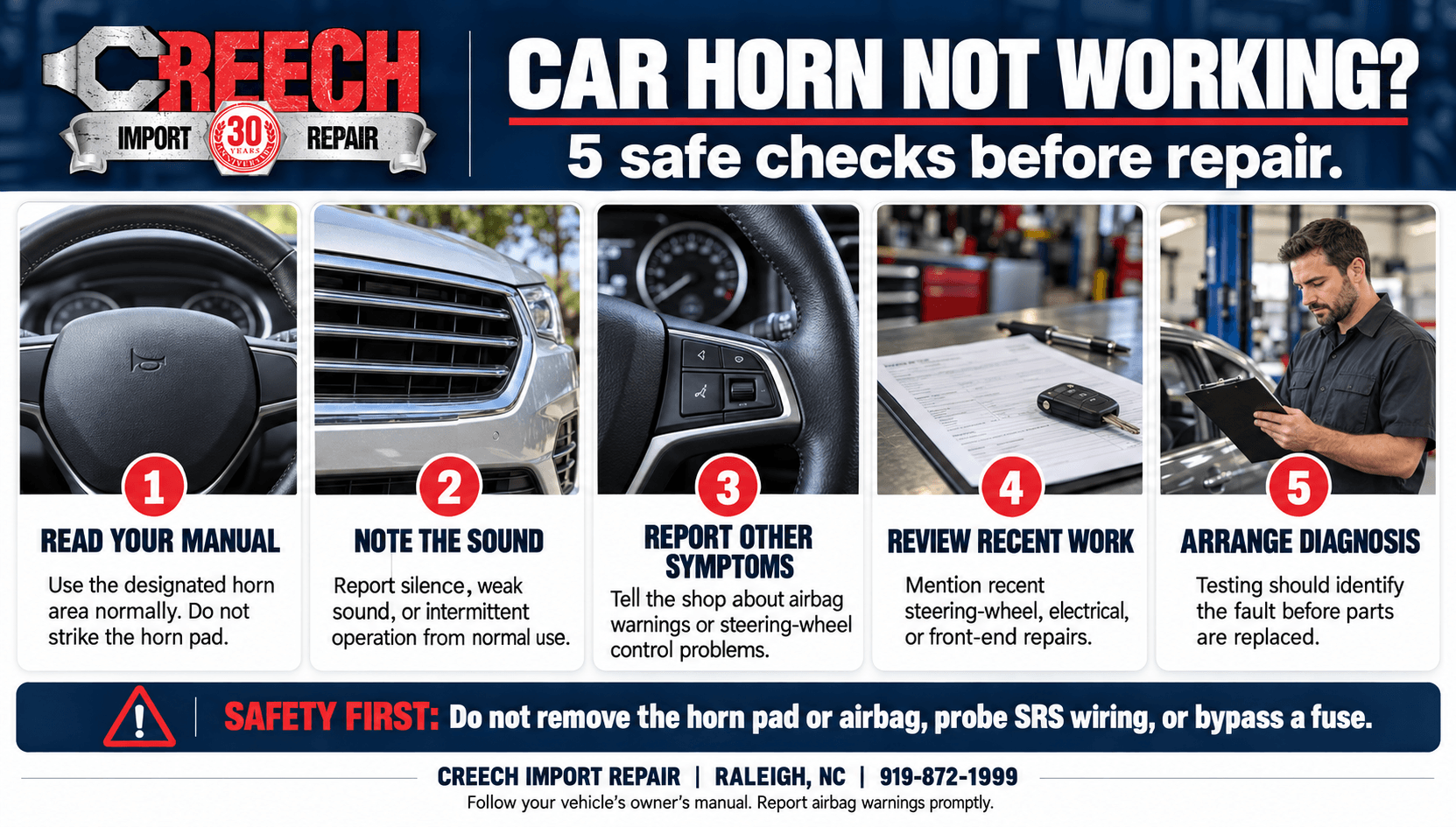
Car Horn Not Working: Five-Check Infographic
This infographic summarizes the safe approach: follow the manual, record the sound, report related symptoms, review recent work, and arrange diagnosis. Its safety reminder is especially relevant around the steering-wheel airbag.
Does a Weak Car Horn Mean the Horn Unit Has Failed?
Not necessarily. A weak, distorted, or changed horn sound deserves assessment of the electrical conditions and the installed sound-producing units. On a system with more than one horn, the technician should check the relevant units rather than treating any remaining sound as proof of normal operation.
Stellantis’ STAR case S2423000027 addresses weak, off-tone, or inoperative horns. It notes that some returned parts had no fault found and discusses checking both high- and low-note horns on the arrangement it describes. That example shows why diagnosis matters before replacement.
Tell the shop whether the sound became faint, changed pitch, or lost part of its familiar tone. Do not adjust a horn’s hardware, spray chemicals into it, or assume that installing a louder aftermarket unit will correct the original problem.
What If Your Car Horn Works Intermittently?
An intermittent horn may work during one attempt and fail during another. That makes a clear history useful: when did it begin, how often has it happened, and were there related symptoms or recent repairs?
Report any pattern you already noticed during normal use, including changes associated with steering or other controls. Do not test the horn through repeated turns in traffic or deliberately create a hazardous situation to reproduce the complaint.
A car horn not working at the appointment is easier to observe directly, but a successful response at that moment does not invalidate an earlier failure. Ask how the shop plans to assess an intermittent condition and what additional observations would help if it cannot reproduce it.
Why Might a Locking Chirp Work but the Steering-Wheel Horn Not Work?
A locking chirp or alarm sound and a steering-wheel horn request are different functions. The components and command paths used depend on the vehicle and selected feature. Do not assume a sound from one feature proves that the steering-wheel horn circuit is fully functional.
Even when a feature uses the same horn units, it does not necessarily exercise the same input path as the steering-wheel switch. The technician needs to identify the system and determine which part of the complaint is supported by testing.
If you already noticed a locking sound while the steering-wheel horn was silent, report the exact feature. Avoid repeatedly activating a panic alarm as a substitute for diagnosis. Also mention whether locking sound settings were recently changed, so an expected setting is not confused with a fault.
Car Horn Not Working With an Airbag Warning: Is It the Clock Spring?
A clock spring provides a rotating electrical connection in steering-wheel systems that use one. A relevant connection fault can affect more than one function, but combined symptoms do not prove that the clock spring is the failed component.
Ford’s recall reminder for campaign 23S63 describes a clock-spring issue on affected vehicles that can involve an airbag warning, steering-wheel switch problems, and an inoperative horn. This is a vehicle-specific example, not a diagnosis or recall determination for every car with those symptoms.
Report an airbag warning promptly and follow your owner’s manual. Hyundai’s SRS care guidance explains that owners cannot safely service SRS components themselves and calls for professional handling of steering-wheel and airbag work.
Do not remove the horn pad, disconnect airbag wiring, or use a test light or meter on SRS connectors. Do not clear a warning or disconnect the battery as a generic attempt to restore the horn. Ask the service team how to arrange appropriate assessment.
Should You Replace the Horn Fuse or Swap a Relay?
Use the exact owner’s manual to identify any permitted owner-accessible fuse check. There is no universal horn-fuse number, rating, or relay location. Some arrangements involve electronic control or components that cannot be treated as a removable relay.
Hyundai’s fuse guidance warns against higher-rated replacements and improvised substitutes such as wire or foil. If a replacement fuse fails again, the underlying electrical problem needs assessment rather than repeated replacement.
Do not bridge a fuse or substitute a relay based only on its external shape. Follow the complete procedure for your vehicle, including any specified precautions. If the manual does not provide an owner procedure or you are unsure what component you have identified, leave the check to the technician.
How Should a Shop Diagnose a Car Horn Not Working?
Good diagnosis distinguishes the requested function from the circuit conditions and the horn’s actual response. The inspection sequence must fit the vehicle’s wiring and service information. Ask the shop to explain its findings rather than approve a part solely because the horn is silent.
- Identify the system and confirm the complaint. Establish the vehicle, affected horn function, sound pattern, warning lights, and recent work.
- Review the applicable circuit. Identify relevant protection, relay or electronic control, wiring, connections, and horn units.
- Evaluate electrical supply and command where indicated. Use manufacturer procedures and suitable equipment to locate a supply, ground, connection, or control fault.
- Assess the horn unit or units. Establish whether their response is correct under the prescribed conditions before recommending replacement.
- Verify the repair. Confirm normal steering-wheel horn operation and address relevant related symptoms included in the repair scope.
The Stellantis case cited above directs technicians toward its service information, circuit checks, connector inspection, and horn evaluation. Its fuse references and testing details are specific to that arrangement; they should not be copied onto another vehicle.
Creech provides electrical system diagnosis and repair in Raleigh. Describe the symptom and ask which verified condition supports the proposed repair.
Can You Keep Driving With a Car Horn Not Working?
A horn failure removes a warning function. Do not treat it as harmless because the engine starts and the vehicle moves normally. Contact the service team promptly to discuss repair and appropriate arrangements for your situation.
The horn symptom alone cannot establish that a particular trip is safe. Explain an accompanying airbag warning, steering problem, smoke, burning odor, or other electrical concern before discussing travel. If there is immediate danger, stop safely and seek appropriate assistance.
Do not rely on shouted warnings, a portable noisemaker, or an improvised circuit as a replacement for the vehicle’s intended horn operation. The goal is dependable operation of the correct system.
Does a Horn Problem Matter for a North Carolina Safety Inspection?
Yes. The horn is one of the components the North Carolina Division of Motor Vehicles lists for safety inspection. If your vehicle is subject to an inspection, have missing or abnormal horn operation assessed before assuming it will be approved.
An inspection checks required items; it is not a substitute for diagnosing an intermittent electrical complaint. Tell the team if the horn sometimes fails even when it happens to work during a brief check.
Creech’s North Carolina inspection guide covers the broader inspection process. This article focuses on restoring horn operation and explaining what testing should establish.
How Much Does It Cost to Fix a Car Horn Not Working?
The symptom does not have one reliable repair price. A connection repair, a horn-unit replacement, circuit diagnosis, and work involving steering-wheel components require different parts, access, and labor.
Ask for an estimate based on the identified fault. Confirm diagnostic charges, the proposed part or wiring repair, access-related labor, and the planned verification. If the complaint returned after recent service, bring the earlier invoice and ask whether repair coverage applies.
A service bulletin does not automatically establish free repair eligibility. Check applicable U.S. safety recalls through the NHTSA recall lookup and confirm coverage with the manufacturer. A recall affecting a similar vehicle does not establish that your VIN is included.
Where Can You Get Car Horn Diagnosis in Raleigh?
Contact Creech Import Repair about a car horn not working, a changed horn sound, or an intermittent response. The shop’s listed services include automotive repair and electrical system diagnosis. Provide your vehicle information and explain any related warning before the appointment.
You do not need to identify a failed relay, horn, or clock spring. Bring a clear symptom history and relevant invoices. If a sound returned temporarily after earlier work, say when and how it failed again.
Need Help With a Silent or Unreliable Horn?
Call Creech Import Repair to discuss the symptoms and arrange an appropriate assessment.
Phone: 919-872-1999
Address: 1818 St. Albans Dr #106, Raleigh, NC 27609
Hours: Monday–Friday, 7:30 a.m.–5:30 p.m.
Online requests require confirmation from the service team. Mention an airbag warning or other safety concern before discussing travel to the shop.
Frequently Asked Questions
Why is my car horn not working?
The horn unit, electrical supply, wiring, connections, or command circuit may need attention. The cause depends on the vehicle and verified test results. Record whether the horn is silent, weak, or intermittent, and report related symptoms and recent repairs before requesting a replacement part.
Does a silent horn mean the fuse is blown?
No. A fuse is one possible area to investigate, but silence does not identify it as the cause. The shop may need to assess command, supply, connections, and horn response. Use the exact manual for any permitted owner check; never bypass a fuse or install a higher rating.
Why does my horn sound weak or different?
Changed sound can require evaluation of electrical conditions and the installed horn unit or units. On a system with multiple horns, remaining sound does not establish that every unit works properly. Describe the change rather than assuming the solution is a louder aftermarket horn.
Why does my car horn work intermittently?
A fault may be absent during one check and present during another. Record the conditions you already noticed during normal use, related warnings, and recent work. Do not deliberately reproduce it while driving. One successful response does not establish that the problem is repaired.
Why does the locking chirp work but the steering-wheel horn does not?
The selected locking feature and steering-wheel horn can involve different command paths. Even if they use the same horn units, one sound does not prove the steering-wheel input works correctly. Report the exact feature you observed so the technician can assess the vehicle’s actual arrangement.
Does an airbag light and a failed horn mean the clock spring is bad?
Not automatically. A relevant steering-wheel connection can affect multiple functions on some vehicles, but combined symptoms need vehicle-specific assessment. Report the airbag warning promptly. Do not remove the horn pad, disconnect SRS wiring, or probe airbag connectors to investigate.
Should I hit the steering wheel harder to make the horn work?
No. Follow the owner’s manual and press the designated area normally. Striking the pad or using a sharp object is not a repair and conflicts with manufacturer horn guidance. Arrange assessment if the intended operation does not produce a reliable response.
Can I swap relays or disconnect the battery to fix the horn?
Do not use either as a generic remedy. Relay arrangements and service procedures vary, and disconnecting power does not repair a damaged circuit or component. Follow the exact vehicle instructions and leave steering-wheel or SRS-related diagnosis to qualified service personnel.
Is the horn checked during a North Carolina safety inspection?
Yes. NCDMV lists the horn among the components examined during safety inspection. Tell the inspection team about missing, changed, or intermittent operation rather than assuming a brief successful response resolves the complaint. Diagnosis may be needed before the applicable inspection.
What should I ask before approving a horn repair?
Ask what fault was verified, which checks support the recommendation, and how the shop will confirm normal operation afterward. Request the diagnostic, parts, and labor charges. Provide earlier invoices if the symptom returned after repair, and confirm any applicable coverage rather than assuming it.
Sources and Vehicle-Specific Guidance
These manufacturer and agency references support the explanations above. Their vehicle-specific procedures and recall coverage should not be applied to another model without checking applicability.
- Hyundai: normal horn operation and handling precautions
- Hyundai: SRS and steering-wheel service precautions
- Hyundai: fuse protection and replacement precautions
- HELLA: horn fault categories and workshop diagnosis
- Stellantis: STAR case S2423000027, weak or inoperative horns
- Ford: recall 23S63 reminder describing affected clock-spring circuits
- NCDMV: vehicle safety inspection components
- NHTSA: U.S. vehicle recall lookup
References and business details checked October 1, 2026.
About Creech Import Repair
Creech Import Repair has served Raleigh drivers since 1993. Its listed services include automotive repair and electrical system diagnosis for import and domestic vehicles. Learn about Creech Import Repair or contact the service team to discuss a recurring horn complaint.
Find Creech Import Service articles useful?
Add this site to your Preferred Sources in Google Search.