


Creech Import Repair | Raleigh, North Carolina
Car Jerks When Accelerating? 9 Causes and When to Worry
You press the gas pedal to merge onto a highway, drive up a hill, or pull away from a stoplight. Instead of accelerating smoothly, your car hesitates, bucks, shudders, or suddenly loses power. The sensation can be unsettling, especially when surrounding traffic expects you to accelerate normally.
If your car jerks when accelerating, the cause may involve engine combustion, fuel delivery, airflow, throttle control, transmission operation, or drivetrain movement. Some problems are relatively straightforward to address once identified. Others may affect vehicle safety or cause additional damage if ignored.
The key is understanding exactly when the jerking happens, how it feels, and whether any warning lights or other symptoms appear. This guide explains nine possible causes, how technicians distinguish them, when driving may be unsafe, and how drivers in Raleigh, North Carolina, can approach professional diagnosis.
Quick Answer
Why Does My Car Jerk When I Accelerate?
A car can jerk while accelerating because the engine misfires, fuel delivery is inadequate, airflow or throttle control is inconsistent, or the transmission transfers power unevenly. Vacuum leaks, electronic pedal faults, exhaust restrictions, and worn engine or transmission mounts can also produce similar sensations. Jerking is a symptom, not a diagnosis. A flashing check engine light, severe power loss, smoke, or unpredictable acceleration requires immediate attention and may make continued driving unsafe.
What Does It Mean When a Car Jerks During Acceleration?
Acceleration requires the engine and drivetrain to respond to the driver's request for power. The engine must receive the appropriate amount of air and fuel, ignite that mixture, and produce torque. The transmission then transfers power through the drivetrain to the wheels.
If the engine delivers power inconsistently, or the drivetrain transfers that power unevenly, the driver may experience a sudden change in motion. The sensation is often described as jerking, hesitation, bucking, surging, or shuddering.
Those descriptions can point toward different problems. A technician needs to know whether the engine seems to stumble, the entire vehicle vibrates, or one noticeable jolt happens during a gear change.
Engine Hesitation
The engine briefly responds poorly when the accelerator is pressed, followed by a return of power.
Bucking or Surging
Repeated changes in driving force create an uncomfortable forward-and-back sensation.
Shudder or Jolt
A vibration or sudden impact-like sensation may accompany a transmission shift or drivetrain load change.
One important distinction is whether the symptom occurs only when accelerating or also while the vehicle is stationary. A car shaking at a stoplight can involve some of the same engine systems, but it requires a different diagnostic starting point.
For stationary vibration symptoms, read Creech's existing article about why a car shakes at idle. This article focuses specifically on problems that develop when the driver requests acceleration.
Why Does the Timing of the Jerk Matter?
Different parts of the engine and transmission operate under different conditions. A marginal ignition component may function normally under light load but misfire when more power is requested. A transmission may shift smoothly at low throttle yet produce a harsh engagement under heavier demand.
Temperature also matters. Some intermittent electrical faults become more noticeable as components warm up, while certain fueling and control problems may appear primarily after a cold start.
Record whether the problem happens from a stop, at cruising speed, while shifting, after warming up, or on hills. These details are often more useful than guessing which component needs replacement.
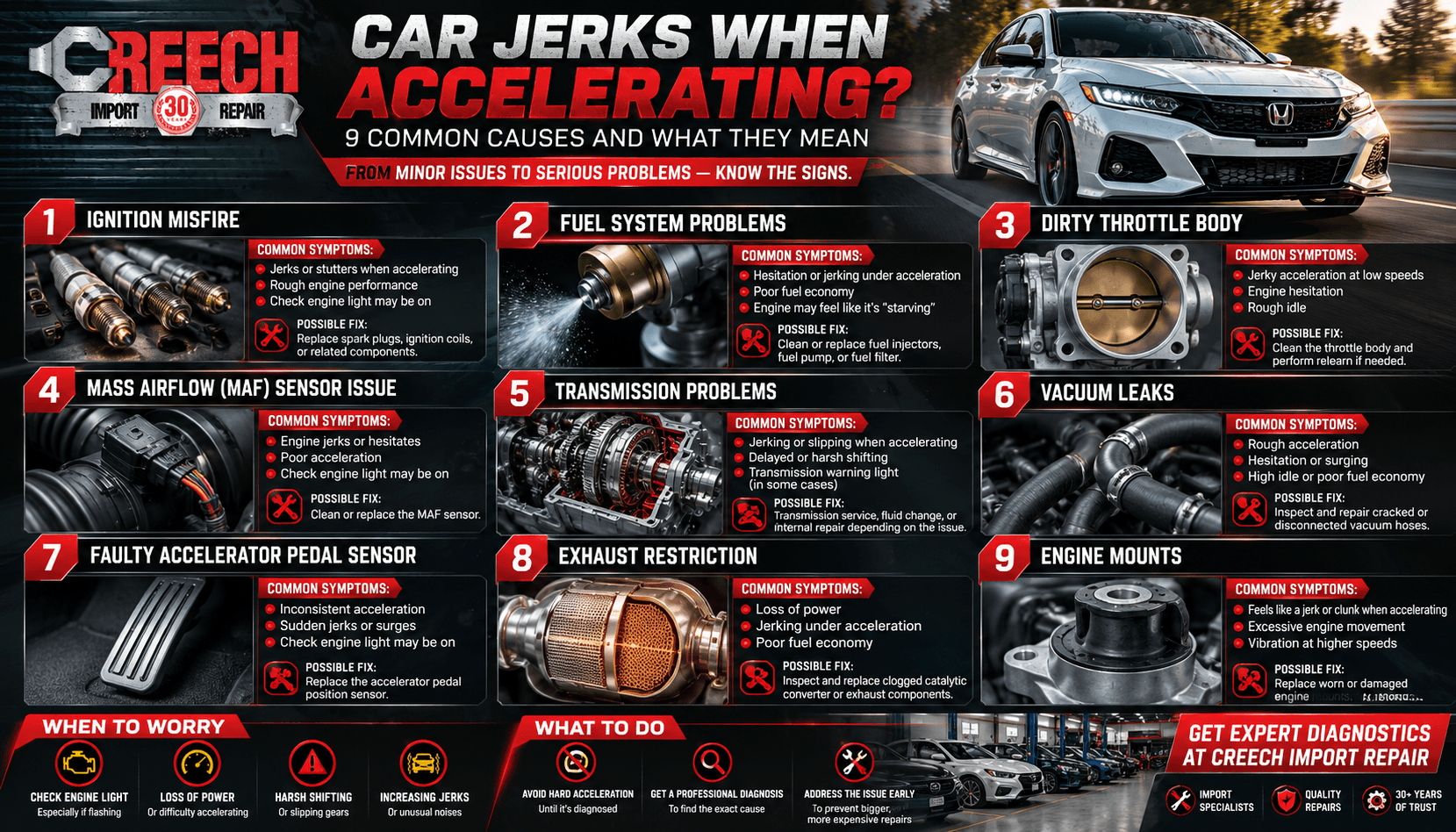
9 Possible Causes of a Car Jerking When Accelerating
The following are nine diagnostic possibilities, not a ranking of the most frequently failed parts. There is no reliable way to identify a defective component based on jerking alone. The correct diagnosis depends on vehicle design, symptoms, available trouble codes, and mechanical testing.
Ignition Misfires: Spark Plugs or Ignition Coils
Gasoline engines rely on a consistent spark to ignite the air-fuel mixture in each cylinder. When spark plugs become worn, an ignition coil becomes unreliable, or related electrical components malfunction, combustion may not occur properly.
The result can be a misfire that interrupts engine torque. During acceleration, the added load can make this interruption more noticeable, producing rapid stuttering, bucking, hesitation, or a loss of power.
A misfiring vehicle may also display a check engine light. Generic codes such as P0300 indicate detected random or multiple-cylinder misfires, while codes such as P0301 identify misfire detection associated with a particular cylinder.
However, these codes do not automatically prove an ignition component is faulty. Fuel delivery problems, air leaks, low compression, or other mechanical defects may create similar misfires.
Fuel Delivery Problems: Pump, Injectors, or Pressure Control
As you accelerate, the engine generally requires more fuel to produce additional power. If the fuel supply cannot meet that demand, combustion may become inconsistent.
Possible causes include a failing fuel pump, incorrect fuel pressure, restricted fuel flow, injector malfunction, or a problem with the fuel-pressure control system.
Drivers may notice hesitation while climbing hills, poor response during highway merging, or a vehicle that accelerates normally under gentle throttle but struggles when greater power is requested.
The exact testing procedure depends on the vehicle. Some engines use port fuel injection, while others use high-pressure direct injection or a combination of systems. These differences affect pressure specifications and diagnostic methods.
Professional testing may include pressure and volume measurements, injector evaluation, fuel-trim analysis, and comparison of commanded versus actual fuel pressure.
Dirty or Malfunctioning Throttle Body
The throttle body regulates incoming airflow on many gasoline engines. Modern electronic throttle systems use sensors and actuators to adjust airflow in response to accelerator input.
Carbon deposits around the throttle plate, an actuator malfunction, incorrect position feedback, or a related control issue may contribute to uneven engine response.
Some vehicles hesitate immediately after the pedal is pressed. Others may develop inconsistent low-speed response, unstable idle, or a reduced-power warning.
Not every throttle-related symptom means the assembly requires cleaning. The engine computer can compensate for some operating changes, and symptoms that resemble a throttle problem may originate elsewhere.
A technician may inspect the component, evaluate electronic throttle commands and actual position readings, and determine whether cleaning, calibration, wiring work, or replacement is appropriate.
Mass Airflow Sensor or Air-Measurement Problems
The engine control computer needs accurate information about incoming air to calculate the appropriate fuel delivery. Many vehicles use a mass airflow sensor, while others rely on manifold-pressure and temperature information.
Contamination, damaged wiring, sensor faults, or air entering through an unintended opening can interfere with those calculations.
Depending on the situation, the vehicle may hesitate, surge, or respond inconsistently during acceleration.
Fuel-trim information, airflow readings, intake-system inspection, and manufacturer-specific specifications help determine whether the sensor itself is responsible.
Blindly replacing the airflow sensor is not a dependable diagnostic method. An intake leak or another engine condition can produce similar readings without the sensor being defective.
Transmission Shifting or Torque-Converter Problems
Not every jerking sensation starts in the engine. The transmission may engage gears abruptly, hesitate during a shift, slip under load, or produce shudder during torque-converter clutch operation.
Automatic transmissions use hydraulic, electronic, and mechanical systems to transfer torque. CVTs and dual-clutch transmissions use different designs, so their failure patterns and diagnostic methods also differ.
A transmission-related jolt may appear during a repeatable gear change. A slipping transmission may allow engine RPM to rise without a proportional increase in vehicle speed.
However, engine performance problems can also affect perceived shifting quality. A misfire or inconsistent engine torque may make a properly functioning transmission feel harsh.
Technicians may examine commanded gear, shift timing, transmission speed sensors, fluid condition, operating temperature, and available clutch or torque-converter data.
Do not assume the vehicle requires a transmission replacement simply because it jerks. A confirmed diagnosis should come before major repair decisions.
For preventive maintenance information, see Creech's separate guide explaining why transmission service matters.
Vacuum Leaks or Unmetered Air
Air entering the engine through an unintended opening may upset fuel calculations and engine operation. Potential sources include damaged intake hoses, leaking seals, split ducting, and some crankcase ventilation faults.
The symptoms depend on the size and location of the leak and the engine's control strategy. Some leaks primarily affect idle, while others can influence acceleration or throttle transitions.
Turbocharged engines may require different diagnostic procedures because intake components experience pressure as well as vacuum under different operating conditions.
Professional testing may include fuel-trim interpretation, inspection of intake plumbing, or controlled smoke and pressure tests suited to the vehicle.
Avoid unsafe improvised leak-detection methods involving flammable sprays around hot or running engines.
Accelerator Pedal Sensor or Electronic Throttle Fault
Modern vehicles commonly use electronic accelerator-pedal sensors instead of a traditional mechanical throttle cable.
The pedal sensors, engine computer, electronic throttle components, and related wiring communicate the driver's request for power.
If the control system detects conflicting sensor signals or cannot provide the requested response, acceleration may become inconsistent or limited. Some vehicles enter a reduced-power operating mode.
Possible symptoms include intermittent hesitation, unusually weak throttle response, or a warning message related to the electronic throttle system.
Diagnosis involves inspecting relevant electrical circuits, checking control-module information, and comparing sensor and actuator data according to manufacturer procedures.
Do not replace the accelerator pedal assembly without evidence that it has failed. Several other problems can produce comparable sensations.
Restricted Exhaust Flow or Catalytic Converter Problems
An engine must efficiently release exhaust gases to continue producing power. A substantial restriction in the catalytic converter or another exhaust component can reduce performance under load.
Drivers may experience poor acceleration, bogging, or hesitation, particularly when higher engine output is required.
Severe exhaust restrictions can also create excessive heat. However, similar symptoms can originate in the fuel, ignition, or air-intake systems.
A catalytic converter should not be replaced merely because the vehicle lacks power or displays an emissions-related code.
Professional evaluation may include exhaust backpressure testing, inspection of the exhaust system, engine-performance analysis, and investigation of faults that could have damaged the converter.
Worn Engine or Transmission Mounts
Engine and transmission mounts support the powertrain and help control vibration and movement as torque changes.
When a mount becomes worn, cracked, or separated, ordinary changes in engine torque can produce an exaggerated jolt or clunk.
Unlike a misfire, a mount problem does not necessarily interrupt engine combustion. The vehicle may accelerate normally but feel as though something shifts when the driver presses or releases the pedal.
Similar symptoms can also come from worn drivetrain components, axle joints, or related mounting hardware.
A technician can inspect the relevant components using safe, controlled procedures. Avoid aggressive brake-and-throttle tests that may create unnecessary risk or damage.
Why Does My Car Jerk Only Under Certain Driving Conditions?
When the symptom occurs can help determine which system deserves attention first. Acceleration from a stop, highway passing, uphill driving, and shifting all place different demands on the engine and drivetrain.
| Driving Condition | Possible Areas to Investigate | Useful Detail to Report |
|---|---|---|
| Accelerating from a stop | Throttle response, initial gear engagement, ignition, mounts | One sharp jolt or repeated hesitation? |
| Accelerating uphill | Ignition under load, fuel supply, transmission operation | Does heavier throttle make it worse? |
| Accelerating at highway speed | Misfire, torque-converter operation, fuel delivery, drivetrain vibration | Does it happen while shifting or staying in gear? |
| During a gear change | Shift engagement, transmission pressure control, engine torque delivery | Which shift or approximate speed? |
| Only when cold | Temperature-dependent fueling, ignition, intake or transmission behavior | How long until the symptom stops? |
| Only after warming up | Heat-sensitive electrical faults, engine control, transmission operation | How long must the vehicle run first? |
| Immediately after pressing the pedal | Throttle control, air/fuel response, mounts, drivetrain movement | Does the engine stumble or the car clunk? |
Car Jerks When Accelerating at Low Speeds
Low-speed jerking may involve initial throttle response, uneven engine torque, transmission engagement, or excessive drivetrain movement.
Pay attention to whether the issue occurs immediately after pressing the pedal, while crawling through traffic, or during a specific early gear change. These patterns can suggest different diagnostic approaches.
Car Jerks When Accelerating at Highway Speeds
Higher-speed acceleration can reveal faults that are less noticeable under gentle driving conditions. Possible explanations include ignition misfire under load, inadequate fuel delivery, or transmission-related shudder.
Some drivers describe torque-converter clutch shudder as driving over a rough strip of pavement. However, engine misfires and mechanical vibrations can produce similar sensations. The description alone cannot confirm a converter problem.
Car Jerks When Accelerating Uphill
Climbing a hill generally increases power demand. A weak ignition component or marginal fuel delivery system may become more noticeable under that load.
Hills can also trigger transmission downshifts. Note whether the jerk happens before the shift, during it, or afterward.
Car Jerks Only After Warming Up
Heat-sensitive electrical components, changing engine-control strategies, or transmission operating conditions may make a symptom appear after several minutes of driving.
If the problem is repeatable, record the approximate driving time and conditions. Avoid deliberately provoking severe hesitation on public roads.
Engine Misfire or Transmission Problem: How Can You Tell?
An engine misfire interrupts normal power production. A transmission problem interferes with how that power is transferred. Both can create hesitation or jerking, but their associated symptoms may differ.
| Symptom | Possible Engine Explanation | Possible Transmission Explanation |
|---|---|---|
| Repeated rapid stuttering | Misfire or inconsistent fueling | Some transmission shudder conditions can feel similar |
| Single jolt during a gear change | Engine torque irregularity may contribute | Harsh transmission engagement |
| RPM rises without matching acceleration | Other operating conditions must be considered | Possible clutch or transmission slipping |
| Flashing check engine light with rough running | Potential serious misfire | Does not rule out additional transmission issues |
| Clunk when pressing or releasing accelerator | Powertrain mount movement | Drivetrain mount or mechanical wear |
A professional diagnosis may compare misfire counters, fuel trims, commanded throttle data, engine load, transmission speed readings, and shift information.
The goal is to identify which system behaves abnormally when the symptom begins. Replacing transmission components based only on a road-test sensation can be an expensive mistake.
If warning lights appear, Creech provides dedicated check engine light diagnostic services in Raleigh.
Is It Safe to Drive When Your Car Jerks During Acceleration?
The answer depends on the severity of the symptom and whether the vehicle can be controlled safely. Mild, occasional hesitation is not necessarily an emergency, but it should not be ignored.
Severe jerking can interfere with merging, passing, crossing intersections, or maintaining speed. Some underlying faults may also cause additional mechanical or emissions-system damage.
Stop Driving Safely and Seek Help If:
- The check engine light is flashing.
- The vehicle loses substantial power or accelerates unpredictably.
- The engine repeatedly stalls while driving.
- You notice smoke, overheating, or a strong fuel odor.
- The transmission slips severely or produces violent jolts.
- Steering, braking, or vehicle control becomes compromised.
Move to a safe location when possible and arrange professional assistance. If there is a fire risk, move occupants away from the vehicle and contact emergency services. Do not continue driving simply to see whether the problem disappears.
What Does a Flashing Check Engine Light Mean?
On many vehicles, a flashing check engine light indicates a potentially catalyst-damaging misfire or another serious engine-control condition.
Continuing to operate the vehicle during a severe misfire can allow unburned fuel to enter the exhaust system and expose the catalytic converter to damaging temperatures.
Follow your vehicle manufacturer's warning-light instructions. If the vehicle runs poorly or the light flashes, stop safely and seek professional assistance rather than repeatedly accelerating to reproduce the problem.
Can Acceleration Jerking Cause More Damage?
Some underlying problems can worsen with continued operation. Persistent misfires may damage emissions components, while certain transmission faults can increase heat and component wear.
However, jerking does not automatically mean major damage is occurring. The actual risk depends on the failed system, operating conditions, and severity.
Prompt diagnosis helps establish whether the vehicle requires immediate repair or whether a less urgent service plan is appropriate.
How Do Professional Technicians Diagnose a Car That Jerks When Accelerating?
Accurate diagnosis involves identifying the cause rather than replacing parts based on assumptions. Many drivability symptoms overlap, so a disciplined process is important.
Record the Driver's Observations
The technician begins by documenting when the jerking happens, whether the engine is warm, the approximate speed, how much throttle is applied, and any related warning lights. Maintenance history and recent repairs may also be relevant.
Check Diagnostic Trouble Codes
Professional scanning equipment can retrieve stored or pending trouble codes and available operating information. A code identifies a detected condition or system, not always a failed component.
Review Engine and Transmission Data
Relevant data can include misfire counts, fuel pressure, fuel trims, airflow, throttle response, transmission gear commands, and input or output speeds. Available information varies by vehicle.
Reproduce the Symptom Safely
When appropriate, a controlled road test may help establish whether the problem occurs under load, during gear changes, or after warming up. Severe or unsafe faults may require alternative testing.
Perform Component-Specific Tests
Depending on the findings, testing may include ignition evaluation, fuel-pressure checks, intake inspection, electrical testing, or transmission analysis.
Verify the Repair
After completing the authorized repair, the technician should confirm the original symptom has been addressed when practical and safe. Clearing a trouble code alone is not evidence that a vehicle has been repaired.
Can an OBD-II Scanner Tell You Exactly What's Wrong?
A basic OBD-II scanner can provide valuable clues, including emissions-related trouble codes. However, it may not access all manufacturer-specific data, advanced transmission information, or specialized tests.
For example, a P0302 code indicates that the computer detected a misfire associated with cylinder two. It does not establish whether the cause is a spark plug, ignition coil, injector, compression loss, wiring defect, or something else.
A trouble code should guide diagnosis rather than replace it.
What Information Should You Give the Mechanic?
A useful explanation focuses on what the vehicle actually does. For example:
That description is more helpful than saying the car needs a fuel pump or transmission without test results.
Also report recent maintenance, warning messages, unusual noises, and whether the symptom has become more frequent.
How Much Does It Cost to Fix a Car That Jerks When Accelerating?
Repair costs vary widely because acceleration jerking is not a single repair category. The problem could involve an accessible ignition component, complex fuel-injection equipment, a damaged engine mount, an electronic control issue, or internal transmission damage.
Labor requirements and parts prices also vary by vehicle make, model, engine, transmission type, and component location.
| Possible Repair Area | Potential Work | Main Cost Factors |
|---|---|---|
| Ignition system | Spark plug, coil, wiring, or related repair | Number of components, engine access, diagnostic requirements |
| Fuel system | Pump, injector, pressure-control, or supply repair | System design, testing, component location |
| Air intake or sensors | Leak correction, throttle service, or verified sensor replacement | Accessibility, calibration, required procedures |
| Engine or transmission mounts | Replacement of damaged supporting components | Drivetrain layout, labor access, affected parts |
| Transmission | Electronic, hydraulic, clutch, or internal mechanical repair | Transmission design, extent of damage, repair options |
Internet repair-price averages may not reflect your particular vehicle or the actual fault. A reliable estimate should be based on testing, the parts required, the labor involved, and any additional procedures.
Should You Replace Spark Plugs Before Getting a Diagnosis?
Not automatically. If spark plugs are overdue for scheduled service, replacing them according to the manufacturer maintenance schedule may be appropriate.
But an active acceleration problem can have many possible causes. Replacing ignition parts without verifying the source may fail to correct the symptom.
Does Early Diagnosis Help Prevent Expensive Repairs?
Sometimes. Identifying a severe misfire before it damages a catalytic converter, for example, may prevent additional repair needs. Addressing certain transmission problems before they become more severe may also limit further damage.
However, early diagnosis does not guarantee an inexpensive solution. Its value is in establishing the actual problem and helping the owner make an informed repair decision.
What Should a Repair Estimate Include?
Ask the repair shop to explain the confirmed fault, recommended parts and labor, any related repairs, and whether further testing is required.
For more information about Creech's capabilities, visit the company's auto repair services page.
Do Toyota, Honda, Acura, Subaru, and Nissan Vehicles Have Different Causes of Acceleration Jerking?
The general principles are similar across gasoline-powered vehicles, but individual models use different engine-management systems, transmissions, and control strategies.
Vehicle year, engine configuration, maintenance history, drivetrain type, and fault information all affect which tests are appropriate.
Honda and Acura
On some Honda and Acura vehicles, technicians may investigate ignition performance, fuel delivery, throttle response, or transmission operation when acceleration hesitation occurs. The correct procedure depends on the specific engine and transmission. An acceleration complaint alone does not establish a known model-specific defect.
Toyota and Lexus
Toyota and Lexus vehicles use conventional gasoline, hybrid, and other drivetrain configurations. Ignition, fuel delivery, engine controls, and transmission behavior may all be relevant depending on the system. Hybrid models require an understanding of how electric drive and gasoline-engine operation interact.
Subaru
Some Subaru models use continuously variable transmissions. Engine misfires, fuel issues, and CVT-related conditions can sometimes produce sensations that drivers describe similarly. A jerking complaint does not automatically establish a CVT valve-body failure or the need for a transmission replacement.
Nissan
Nissan vehicles use different transmission designs across model years and vehicle lines. Engine-performance diagnosis should be considered alongside transmission evaluation rather than assuming that every hesitation originates inside a CVT.
Why Vehicle-Specific Diagnosis Matters
Modern vehicles often contain multiple control modules that coordinate engine torque, shift operation, traction control, and emissions performance. A fault in one system can affect the behavior of another.
Before recommending repairs, technicians should evaluate the vehicle's configuration, applicable manufacturer procedures, and actual findings.
Creech provides additional information about its Toyota repair services and Honda repair services in Raleigh.
Car Jerking When Accelerating in Raleigh, NC? Get Professional Diagnostics.
When your vehicle bucks, hesitates, or shudders as you press the accelerator, an accurate diagnosis can help prevent unnecessary parts replacement and identify potential safety concerns.
Creech Import Repair provides professional automotive repair and diagnostic services in Raleigh, North Carolina. The shop specializes in Asian import vehicles and services selected domestic vehicles.
Whether you experience hesitation while leaving an intersection, accelerating uphill, or merging onto I-440, explain the exact symptoms to the service team when requesting an appointment.
If the vehicle is unsafe to drive, arrange appropriate assistance instead of attempting to reach the shop under its own power.
Shop Address:
1818 St. Albans Dr #106
Raleigh, NC 27609
Phone: 919-872-1999
Hours: Monday-Friday, 7:30 AM-5:30 PM
Online appointment requests are not confirmed until verified by the Creech Import Repair service team.
Frequently Asked Questions About Cars Jerking When Accelerating
1. Why does my car jerk when I press the gas pedal?
Jerking when pressing the gas pedal may result from inconsistent combustion, insufficient fuel delivery, airflow problems, throttle-control faults, transmission engagement, or drivetrain movement. The timing of the jerk can help narrow the possibilities. Repeated stuttering under load differs from one sharp jolt during a gear change. A qualified technician should evaluate the symptoms and available diagnostic data before recommending repairs. Severe power loss or a flashing check engine light requires immediate attention.
2. Can bad spark plugs cause a car to jerk during acceleration?
Yes. Worn or damaged spark plugs can contribute to engine misfires that become more noticeable during acceleration. The driver may feel stuttering, hesitation, or a reduction in power. However, ignition coils, injectors, wiring, compression problems, and other faults can cause similar symptoms. A misfire code does not automatically prove that spark plugs are defective. Diagnosis should establish the underlying cause before replacement parts are selected.
3. Why does my car jerk when accelerating at low speeds?
Low-speed acceleration jerking can involve initial throttle response, ignition or fuel control, transmission engagement, or excessive drivetrain movement. The sensation may occur immediately after pressing the pedal or during a particular gear change. Note whether the vehicle produces one strong jolt or repeated hesitation. This information helps a technician decide which systems to test. Low-speed jerking alone does not establish that the transmission or throttle body has failed.
4. Why does my car jerk when accelerating at highway speeds?
Highway acceleration can expose engine misfires under load, fuel-delivery limitations, transmission shudder, or certain drivetrain problems. The most useful distinction is whether the symptom appears during steady acceleration, at a particular gear change, or when the driver requests more power. Some torque-converter problems resemble engine misfires, so testing is required. If the vehicle loses power unpredictably, avoid further highway driving and arrange professional assistance.
5. Can my car jerk without the check engine light coming on?
Yes. Intermittent engine faults, developing mechanical problems, or drivetrain issues may cause jerking without immediately activating the check engine light. Some faults have not met the conditions required to trigger a warning, while others involve components not directly monitored by the engine computer. Pending or manufacturer-specific information may still be available. The absence of a warning light does not prove that continued operation is safe when acceleration becomes unpredictable.
6. Is jerking during acceleration a sign of transmission failure?
It can be, but it is not definitive evidence of transmission failure. Harsh shifts, delayed engagement, slipping, and torque-converter shudder may cause jerking. Engine misfires, throttle-response problems, and worn mounts can feel similar. Professional diagnosis should compare engine performance and transmission operation before major repairs are recommended. A complete transmission replacement should never be assumed necessary based solely on an acceleration complaint.
7. Why does my car jerk more when accelerating uphill?
Uphill driving increases the power needed from the engine and drivetrain. Additional load can reveal weak ignition components, inadequate fuel delivery, airflow problems, or transmission behavior that is less noticeable during light driving. A downshift may also occur while climbing. Report whether the jerk begins before or after a shift and whether stronger accelerator input makes it worse. These observations help guide testing but do not identify a specific defective part.
8. Can a dirty throttle body make a car jerk when accelerating?
On some vehicles, throttle-body deposits or an electronic throttle fault can contribute to hesitation when acceleration begins. However, ignition problems, intake leaks, fuel delivery issues, and transmission behavior can produce similar symptoms. Cleaning is not a guaranteed solution, and some vehicles require specific throttle adaptation procedures. A technician should inspect the system and review operating data before deciding whether cleaning or component replacement is justified.
9. Should I continue driving if my car jerks when accelerating?
Continued driving depends on the severity and associated warning signs. Occasional mild hesitation still deserves timely diagnosis, while severe bucking, flashing warning lights, overheating, stalling, smoke, or unpredictable loss of acceleration can make driving unsafe. Stop in a safe location and seek professional assistance when serious symptoms appear. There is no universal number of miles that can be considered safe for a vehicle with an undiagnosed drivability problem.
10. How much does it cost to fix a car that jerks when accelerating?
Repair costs depend on the confirmed cause, vehicle configuration, required parts, and labor. A spark plug or ignition-coil repair can involve different work from fuel-system testing, mount replacement, or transmission repair. The vehicle's year, engine, transmission design, and component accessibility affect the estimate. A trustworthy repair plan should explain what testing established, which components require attention, and why the proposed work should correct the acceleration problem.

Automotive Technical Review
Reviewed by Creech Import Staff
Creech Import Staff represents the automotive service team at Creech Import Repair, an established automotive repair business serving Raleigh, North Carolina, since 1993.
The company employs ASE-certified technicians and provides vehicle diagnostics, engine-performance services, transmission-related evaluations, and general automotive maintenance and repair.
Learn more about Creech Import Repair's history, professional team, automotive expertise, and commitment to customer service.
Meet Creech Import Repair →Sources and Further Reading
This guide explains general automotive diagnostic principles and is not a substitute for vehicle-specific testing. For further information, consult the owner's manual, manufacturer service procedures, and the following resources.
- Creech Import Repair - Check Engine Light Diagnostics
- Creech Import Repair - Automotive Repair Services
- Creech Import Repair - Car Shakes at Idle
- Creech Import Repair - Transmission Service
- Creech Import Repair - About Us
- National Highway Traffic Safety Administration - Vehicle Safety and Recall Information
- AAA Auto Repair - Vehicle Maintenance and Warning-Light Resources
Find Creech Import Service articles useful?
Add this site to your Preferred Sources in Google Search.