


Car shakes at idle but feels smoother once you drive? The vibration may come from an engine that is not running evenly, mounts that transmit more normal engine movement into the cabin, or an added load that becomes noticeable while the car is stopped. The feel alone cannot tell you which part needs work. A useful diagnosis begins with when the shaking happens, what the engine sounds like, and whether a warning light appears.
You might first notice the steering wheel trembling at a Raleigh stoplight, the seat vibrating with the air conditioning on, or the whole car shuddering while you hold the brake in Drive. This guide separates those patterns, explains what a technician may test, and tells you which symptoms call for a safe stop rather than an ordinary appointment.
Quick Answer: Why Does a Car Shake at Idle?
A car can shake at idle because combustion is uneven, a mount or nearby component is transmitting vibration, or the engine struggles with changing loads such as air conditioning. Ignition, air, fuel, engine mechanical condition, mounts, and accessory controls are all possible diagnostic directions. A flashing check engine light, stalling, major power loss, overheating, or a strong fuel smell requires prompt safe stopping and professional guidance.
What Does It Mean When a Car Shakes at Idle?
At idle, the engine runs at low speed while the vehicle is stationary. With less engine speed and more time to notice each pulse, a small irregularity can become obvious in the steering wheel, seat, or dashboard. Once you accelerate, different engine speed and road noise may mask the vibration. That change does not prove the fault has gone away.
First distinguish an engine that runs roughly from a car that carries vibration into the cabin. An uneven engine may stumble, have irregular exhaust pulses, hesitate, or show a check engine light. A mount that no longer isolates vibration may make the cabin shake even when the engine sounds comparatively steady. Both can occur at once, so replacing mounts without evaluating engine operation—or installing spark plugs without checking the mounts—can miss the cause.
Report whether the sensation appears with the transmission in Park or Neutral, becomes stronger in Drive while the brake is held, changes when the AC runs, or depends on whether the engine is cold or warm. Do not try to recreate the problem by revving the engine in traffic. Observe what happens during normal use and let the shop perform any stationary tests safely.
Three Diagnostic Paths, One Familiar Sensation
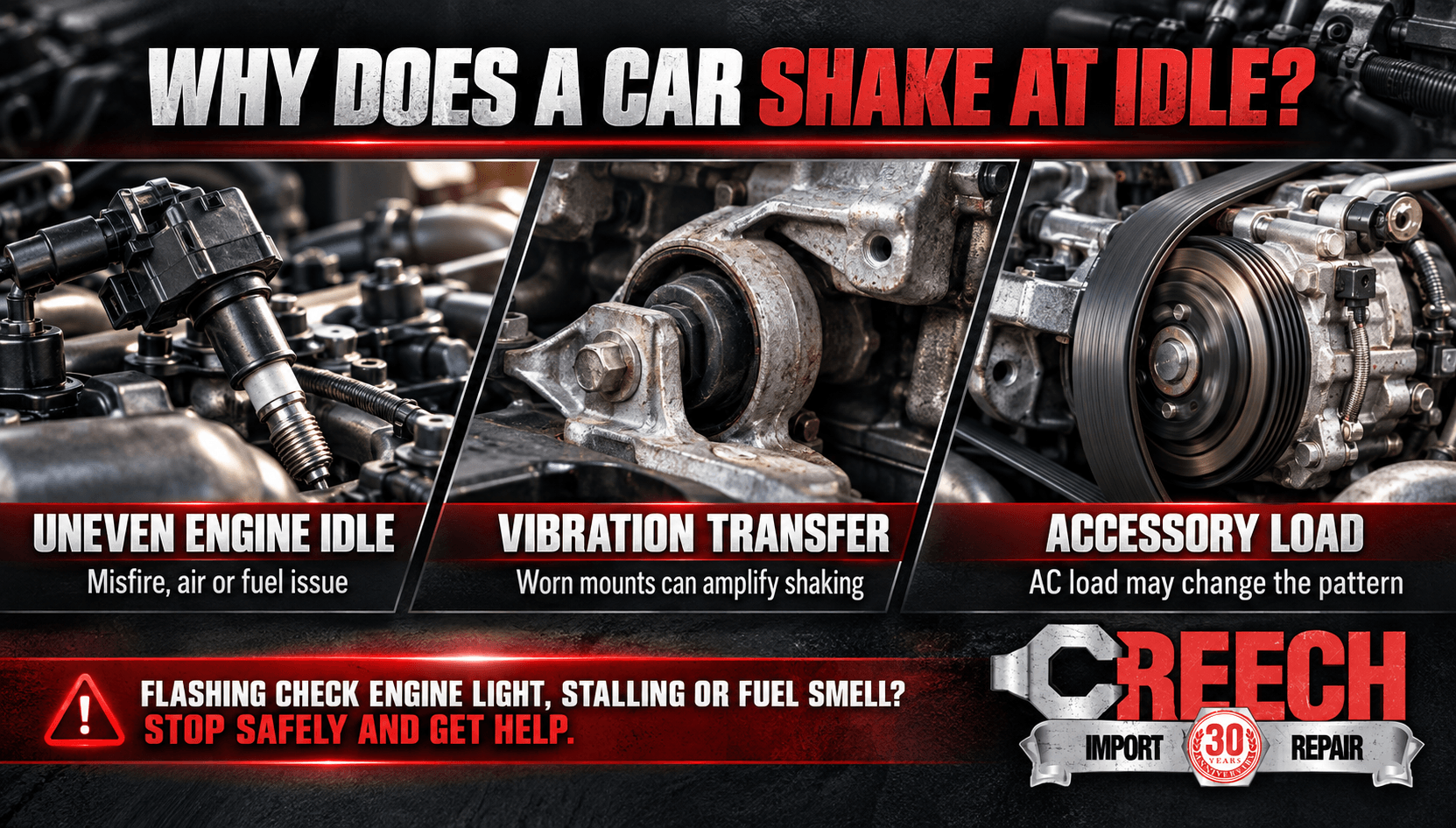
01 Uneven engine idle. A misfire, air or fuel problem, or other engine-performance fault changes the engine’s rhythm.
02 Transmitted vibration. A worn mount or unwanted contact between components and the vehicle body magnifies a pulse that might otherwise feel minor.
03 Load-related shake. AC operation or another accessory changes the demand placed on the idling engine and reveals a marginal condition.
Which Clues Help When a Car Shakes at Idle?
The table is a way to describe the symptom, not a parts list. A technician still needs to confirm whether the engine is running unevenly and which system is responsible.
| When it shakes | Possible direction | Useful next check |
|---|---|---|
| Idle sounds uneven; check engine light appears | Misfire or another engine-control issue | Codes, misfire data, and cause-specific testing |
| Cabin vibrates but engine sounds relatively steady | Mount or component touching the body | Inspect mounts and contact points |
| Much worse in Drive while stopped | Load amplifies mount or idle concern | Compare Park, Neutral, and Drive safely |
| Worse when AC switches on | Accessory load reveals marginal operation | Observe idle response with AC on and off |
| Only on cold starts or only after warm-up | Temperature-dependent air, fuel, or control behavior | Reproduce at the same engine temperature |
| New roughness after refueling | Fuel or evaporative-system clue | Report timing; inspect fault data |
Cause 1: The Engine Is Not Idling Evenly
A smooth-running engine produces power in a predictable rhythm. If one cylinder fires inconsistently or the engine cannot manage its air and fuel accurately, you may feel a stumble at low speed. The car may seem better when moving simply because the operating conditions change. A check engine light can appear, but the absence of one does not prove that everything is normal.
Ignition or Misfire Concerns
Spark plugs and ignition coils can contribute to uneven firing, but a cylinder-specific fault code does not automatically prove that its coil or plug is bad. Fuel delivery, an air leak, electrical connections, or an engine mechanical problem can produce related symptoms. A technician can review fault codes and live data, examine maintenance history, and test the suspected system before choosing a repair.
If the check engine light flashes, take it seriously. AAA notes that a flashing light may indicate a condition that can damage the catalytic converter. Find a safe place to stop and request guidance instead of continuing an ordinary commute. The correct response to any warning also depends on the vehicle’s owner’s manual and the other symptoms you observe.
Air, Fuel, and Idle Control
Unmetered air, an air-measurement issue, restricted or uneven fuel delivery, or a condition affecting how the engine maintains idle may also cause a shake. A dirty throttle body is one possibility on some vehicles, but offering a cleaning without confirming the problem is not diagnosis. Measurements such as fuel trims, intake behavior, and cylinder data can guide the next test when interpreted with the model’s service information.
Think about the timing. Does the shake appear only after the engine warms up, during the first minute after a cold start, or after a fuel stop? Does it come with hesitation when pulling away? A repeatable pattern often tells the shop more than a general request for a tune-up. Fuel or exhaust odors should also be reported promptly, particularly if they are strong.
Engine Mechanical or Electrical Conditions
Sometimes the cause lies outside the familiar plug-and-coil list. Compression-related concerns, wiring faults, low system voltage, or sensor and control issues can affect the consistency of combustion. These possibilities do not mean the repair will be complex; they mean a scan result is a starting clue rather than a replacement order. The right diagnostic path depends on the year, make, model, engine, and observed data.
Cause 2: Vibration Is Reaching the Cabin
Engine and transmission mounts support the powertrain while limiting the vibration passed into the vehicle body. As a mount wears or breaks, a pulse that the car once isolated can become noticeable at the steering wheel, floor, or seat. The effect may be stronger in Drive with the brake held because the engine is under a different load. A manufacturer communication submitted through NHTSA has described vibration felt through the wheel or floor at idle in connection with an engine-mount concern on certain vehicles; that is an example, not a diagnosis for every car.
A mount is not the only possible transfer path. Exhaust components, a heat shield, or another part touching the body can create a buzz or shudder. A shop can inspect the mounts and contact points while checking whether the engine itself runs evenly. If a misfire and a mount problem coexist, fixing one may not eliminate every sensation.
A mount generally will not announce itself with a check engine code. Conversely, an idle that feels smooth in Park but harsh in Drive does not prove a transmission failure. Tell the technician which gear positions change the vibration and whether the engine sound also changes.
Cause 3: The Shake Changes When the AC or Another Accessory Runs
At idle, switching on the air conditioning can add load as the compressor operates, depending on the vehicle design. The engine’s controls should respond appropriately. If the idle is already marginal—or the mounts pass through more vibration—the change can make a shake easier to feel. Fans and other electrical loads may also alter the pattern on some vehicles.
Compare what you notice with the AC on and off while you are safely parked. Does the engine stumble as the system switches, or does the engine sound steady while only the cabin vibration grows? Does the symptom happen with defogging or other settings that may request AC operation? These observations help the shop test the condition. They do not show that the AC compressor itself needs replacement.
If you also hear grinding, squealing, or knocking, report the sound separately. A technician may need to examine a belt-driven accessory, its mounting, and the engine’s response to the load. Avoid reaching into an engine bay while the motor or fans are running.
When Is Shaking at Idle an Urgent Problem?
A faint vibration without other symptoms is different from an engine that is stalling or struggling to make power. Do not use a fixed vibration level or a guessed number of miles to decide whether it is safe to continue. Pay attention to changes in how the car runs and to any warnings.
Stop Safely and Seek Help If You Notice:
- A flashing check engine light or severe misfire sensation.
- Stalling at intersections, substantial power loss, or difficulty maintaining control.
- A strong fuel smell, smoke, overheating, or a new loud mechanical sound.
Pull over where it is safe, switch off the engine if the vehicle is overheating or your manual directs you to, and ask a repair professional or roadside service about the next step. A tow may be appropriate.
If the check engine light is steady and the car otherwise seems to operate normally, schedule diagnosis promptly rather than waiting for the symptom to worsen. If the shake is new but there is no light, describe the exact conditions to the shop. An experienced technician can assess urgency after hearing about the vehicle and symptoms.
How Does a Repair Shop Find the Actual Cause?
A good diagnosis starts by reproducing the complaint safely. Creech Import Repair lists engine repair, check engine light, and performance-related auto services among its offerings. What a technician tests next should follow the observed behavior, not a standard list of replacement parts.
- Confirm the conditions. The technician asks whether the engine is cold or warm, which gear is selected, what the AC is doing, and whether the engine stalls or the warning light flashes.
- Separate rough running from vibration transfer. The engine’s sound and operating data are considered alongside how the steering wheel, seat, and body feel. Mounts and contact points may be inspected.
- Review fault information. Stored or pending diagnostic codes, freeze-frame details, and available live data can focus testing. A code describes what a system detected; it does not automatically name the failed part.
- Test the likely system. Depending on the evidence, the shop may examine ignition, air intake, fuel delivery, compression, electrical supply, engine controls, or accessory behavior using the correct procedure for that vehicle.
- Verify the repair under the original conditions. A successful result should address the customer’s actual idle complaint, including a Drive or AC-related pattern if that was how it first appeared.
Ask what observation supported the proposed repair. A technician who identifies the difference between a misfire and a mount-related shake can explain why the recommendation fits your car rather than simply saying “it probably needs a tune-up.”
What Should You Note Before Your Appointment?
If your car shakes at idle intermittently, you do not need special tools to give useful information. Make a short note after you have stopped safely:
- Timing: first start of the day, fully warm engine, after refueling, or every stoplight.
- Gear: Park, Neutral, Drive with the brake held, or Reverse.
- Accessories: AC, defogger, or another feature on or off.
- Feel and sound: steering wheel or seat vibration, an uneven exhaust beat, buzzing, or a mechanical knock.
- Other symptoms: steady or flashing check engine light, hesitation, stalling, odor, or poor acceleration.
- History: recent repair, maintenance, battery trouble, or the day the shaking began.
If the shake is intermittent, a passenger may be able to help record a brief description while the vehicle is parked. Do not use your phone to record or diagnose a vibration while driving. Give the shop the conditions that make the concern reproducible.
Is Idle Shaking the Same as a Vibration While Driving?
No. When a car shakes at idle while stationary, the first questions concern idle quality, mounts, and load at low engine speed. A vibration tied to road speed may require a different investigation involving tires, wheels, driveline components, or other systems. A shudder during acceleration or a shift is also a different pattern. Creech’s 10L80 transmission-shudder guide, for example, discusses a complaint occurring while a vehicle is moving under light throttle rather than sitting at idle.
That separation matters because one word—“shaking”—covers several unrelated symptoms. Tell the service advisor whether you feel it at a stoplight, as the car starts moving, only at a certain road speed, or during a shift. This article concerns the stationary, engine-running pattern.
Car Shakes at Idle in Raleigh: What Is the Next Step?
Creech Import Repair is located at 1818 St. Albans Dr #106, Raleigh, NC 27609. Call 919-872-1999 with your vehicle’s year, make, model, and a short description of when the shake appears. Say whether the check engine light is steady or flashing and whether the car has stalled. Those details help the service team discuss the appropriate next step.
You can also request an appointment online. The shop says online bookings are not confirmed until a member of its service team verifies them. If the car shows any urgent signs listed above, call for transport guidance rather than assuming it is safe to drive to the shop.
Frequently Asked Questions
Why does my car shake at a stoplight but not on the highway?
At idle, low engine speed can make an uneven firing rhythm or transmitted engine vibration easier to notice. Engine speed, load, and road noise change once the car moves and can mask the symptom. Mounts, ignition, air, fuel, and accessory load are possible directions, but the shop must reproduce and test the condition before identifying a cause.
Can an engine mount make the car shake without a check engine light?
Yes. A worn mount may pass more normal engine vibration into the body without setting a diagnostic code. A technician should inspect the mount and nearby components while confirming that the engine itself runs evenly. Replacing a mount will not fix an untreated misfire, and an engine can have both problems at once.
Does a rough idle always mean bad spark plugs?
No. Plugs are one possible cause, but ignition coils, air intake, fuel delivery, wiring, engine mechanical condition, or control faults can produce related symptoms. A trouble code can guide testing without proving that a particular plug is defective. The repair should be based on the vehicle’s service procedure and confirmed findings.
Why is the shaking worse when the AC is on?
Air-conditioning operation can increase engine load at idle. A marginal idle condition or a mount that transfers more vibration can then become more noticeable. The AC compressor itself is not automatically faulty. Tell the shop whether the engine stumbles, the cabin alone vibrates, or a new noise appears when the AC switches on.
Can I drive with a car that shakes at idle?
A mild vibration without other symptoms still deserves diagnosis, but safety depends on the full situation. Stop safely and seek prompt guidance if the check engine light flashes, the car stalls, power falls sharply, it overheats, or you notice a strong fuel smell or smoke. Do not assume a safe driving distance from the vibration alone.
Can a dirty throttle body cause shaking at idle?
It can be relevant on some vehicles, but it should not be the default explanation. An air leak, uneven combustion, a mount concern, or another engine-control issue may feel similar to a driver. A technician should inspect and test the suspected system before recommending cleaning or replacement, following the procedure for the specific vehicle.
What if the car shakes only in Drive with the brake held?
Placing an automatic transmission in Drive changes the load on the idling engine. That can reveal a marginal idle or make a worn mount more noticeable. It does not automatically mean the transmission has failed. Report whether the problem also occurs in Park, Neutral, or Reverse and whether the AC changes its intensity.
Could a flashing check engine light be related to the shaking?
Yes. A flashing light can accompany a significant misfire that makes the engine shake and may damage emissions components if driving continues. Find a safe place to stop and seek professional guidance. Check the instructions in your owner’s manual for your exact vehicle; do not treat a flashing light like a routine steady warning.
Why does the car shake only after it warms up?
Temperature changes how an engine manages air, fuel, idle speed, and some accessories. A problem that appears warm but not cold is a valuable diagnostic clue, not proof of one particular component. Note approximately when it starts, whether the AC is on, and whether a warning light appears so the shop can reproduce the same operating conditions.
What details should I give Creech when booking?
Share the vehicle year, make, and model; whether the engine is cold or warm; which gear it is in; and whether the AC is running when the shake occurs. Mention any warning lights, hesitation, stalling, fuel smell, unusual noise, or recent repair. If a check engine light is flashing or the vehicle stalls, ask about safe transport before driving it in.
Sources and Further Reading
- AAA: 13 Common Car Problems Explained — why a flashing check engine light needs prompt attention.
- AAA: The Check Engine Light — what a warning may mean and why diagnosis matters.
- Honda manufacturer communication via NHTSA — a vehicle-specific example of mount-related vibration felt at idle.
- Creech Import Repair: Auto Repair Services — the shop’s published repair and performance-service scope.
About Creech Import Repair
Creech Import Repair lists engine repair, check engine light, and performance-related services for Raleigh drivers. For an idle vibration, explain the exact conditions and ask how the test results distinguish rough engine operation from vibration transmitted through the vehicle. This article provides general information; your owner’s manual and a qualified inspection determine the appropriate action for your car.
Find Creech Import Service articles useful?
Add this site to your Preferred Sources in Google Search.