


Creech Import Repair | Raleigh, NC
Your engine dies just as you reach a stop. What should you check first?
A red light should be routine. When the RPM drops, the car shakes, and the engine suddenly shuts off, even a familiar Raleigh commute can become stressful. A vehicle that restarts immediately may still stall again at the next intersection.
If your car stalls when stopping at red lights, the exact timing matters. This guide explains the possible causes, the clues worth recording, what to do safely in traffic, and how a technician can find the fault without guessing at parts.
Quick answer: Why does a car stall at a red light?
A car often stalls at a stop because the engine cannot maintain a steady idle as it slows down. Possible causes include restricted airflow, an intake or vacuum leak, incorrect fuel delivery, an ignition misfire, an electrical fault, or a transmission component that does not release as expected. The symptom points toward systems to test; it does not identify a part to replace.
Safety first: If the engine stalls in traffic, keep control, turn on the hazard lights, and move to a safe location when possible. Repeated stalling, a flashing check engine light, difficulty controlling the vehicle, smoke, or a fuel smell calls for roadside help rather than another attempt to complete the trip.
Why does the engine shut off right as the car stops?
As you lift off the accelerator and brake, engine speed falls toward idle. At that point, the engine still needs the right amount of air and fuel, reliable combustion, and enough electrical power to remain running. The vehicle’s controls also have to account for added load from the air conditioner, alternator, and transmission.
When that balance is disrupted, RPM can drop below the speed needed to sustain combustion. Some vehicles hesitate or shake before stopping. Others shut off so quickly that the driver first notices the warning lights or the sudden quiet. The failure may happen during the last few feet of braking, after the wheels have stopped, or when the transmission is put into Drive. Those are different clues.
One distinction can prevent a wrong diagnosis: warning lights that appear after the engine stops do not necessarily mean the battery or alternator caused the stall. Several lights normally illuminate when the ignition is on and the engine is not running. Tell the shop which lights appeared before the engine stopped.
The most useful question is not “Which part is bad?” It is “What changed immediately before the stall?” Note the engine temperature, AC setting, RPM behavior, warning lights, braking, recent refueling, and whether the engine restarted.
Seven possible causes of stalling when stopping at red lights
The following causes are organized by the system a technician may need to investigate. Their order is not a prediction of what is wrong with your vehicle. Your year, make, model, engine, transmission, trouble codes, and symptom pattern determine which tests make sense.
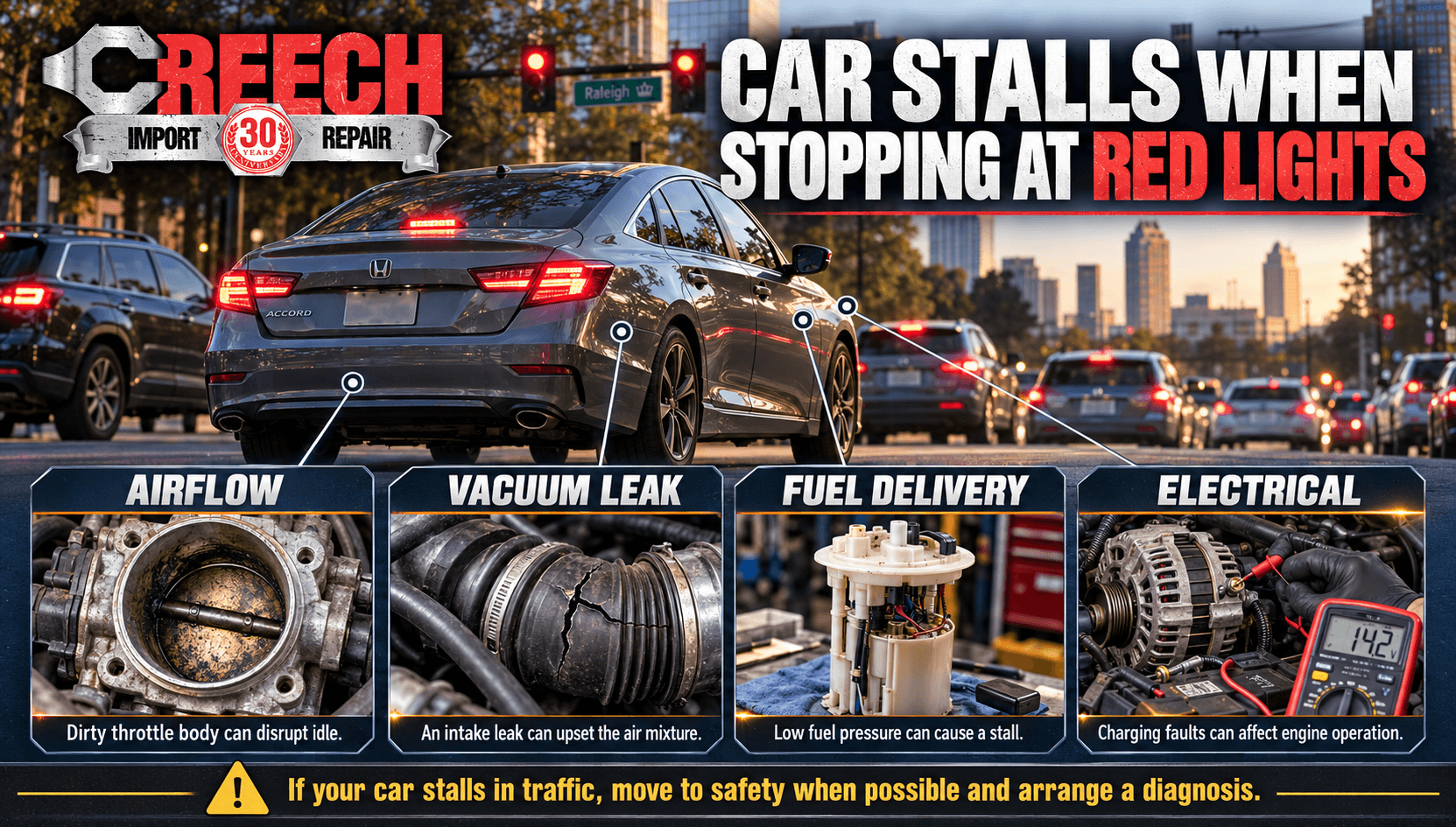
01 | Restricted airflow or idle control trouble
When the throttle is almost closed, the engine must still receive a carefully controlled amount of air. Deposits around a throttle plate can interfere with that airflow. Depending on the vehicle, an electronic throttle body, a separate idle air control valve, or another control system manages engine speed at idle.
A low or unstable idle, especially when the AC adds load, can make this system worth checking. Still, a dirty-looking throttle body does not prove it caused the stall. Some vehicles also require a specific idle relearn procedure after throttle work. Testing and the applicable manufacturer procedure should guide the repair.
02 | An intake or vacuum leak
A cracked intake tube, leaking hose, loose connection, or other air leak can let air enter where engine controls do not expect it. That may disturb the air-fuel mixture and cause a rough or unstable idle. Some vehicles will also set a check engine code; others may show a less obvious, intermittent symptom.
If the engine stumbles specifically when you press the brake pedal, a technician may also consider the brake booster’s vacuum connections where that design applies. A hard brake pedal or a change in braking performance deserves immediate attention. The timing is a clue, not proof that the booster needs replacing.
03 | Fuel delivery or fuel control problems
The engine needs adequate fuel pressure and accurately controlled delivery as it slows to idle. A pressure problem, injector issue, or another fuel system fault can contribute to stalling. These problems can resemble airflow or ignition faults from behind the steering wheel.
Tell the shop if the vehicle also hesitates during acceleration, is difficult to start, or stalls soon after refueling. A post-refueling pattern may direct attention to the evaporative emissions system on certain vehicles. It should not be used as a reason to replace a fuel pump or purge valve without a confirming test.
04 | Ignition misfires or incorrect sensor information
Spark plugs and ignition coils help the engine produce steady power at low speed. A misfire may feel like shaking or repeated stumbling before the engine shuts off. Sensors also supply information used to calculate airflow and fuel. Incorrect information can interfere with the engine’s ability to recover a steady idle.
A stored trouble code is useful, but it identifies a detected condition rather than automatically naming the failed component. For example, an air-fuel mixture code could lead a technician to inspect for air leaks or fuel problems before replacing a sensor. Creech describes its check engine light diagnostic service separately.
05 | Charging or electrical faults
An alternator, electrical connection, ground, or other supply fault may affect the engine’s control systems. Dimming lights, unusual electrical behavior, or a battery warning that appeared before the stall are details worth reporting.
A battery light that appeared only after the engine stopped means something different. Testing may need to cover charging output, battery condition, cables, and connections under the conditions where the fault occurs. Creech’s electrical system service page explains the related service area.
06 | Torque converter clutch behavior
On an automatic vehicle, a torque converter clutch that fails to release at the appropriate time can drag engine speed down as the wheels stop. The driver may feel a pronounced shudder during the last part of braking, somewhat like stopping a manual-transmission car without disengaging its clutch.
A manufacturer bulletin documents this mechanism for certain vehicles, but it does not apply to every automatic transmission. A technician needs to compare the vehicle’s symptoms, codes, transmission data, and applicable service information before recommending a transmission repair.
07 | A vehicle-specific control or software issue
Manufacturers sometimes publish service bulletins describing stalling under specific conditions for particular vehicles. The bulletin may call for a diagnostic procedure, software update, or component repair. It applies only to the models and conditions it names.
Give the shop your year, make, model, engine, and VIN so it can check the correct service information. You can also check your vehicle’s VIN using the NHTSA recall lookup. A service bulletin is different from a safety recall, and recall work may need to be performed through a manufacturer dealer.
Match the symptom pattern to the next diagnostic question
You do not need to know the answer to every question below. Even two or three accurate observations can help a technician reproduce an intermittent problem and avoid chasing an unrelated warning light.
| What happens? | What might be checked? | What should you record? |
|---|---|---|
| RPM falls and the engine dies at the final stop | Idle response, airflow, fuel control, transmission behavior | Did it die before or after the wheels stopped? |
| Shaking occurs before the stall | Misfires, air leaks, mixture, engine condition | Was the check engine light flashing or steady? |
| It happens more often with the AC on | Idle response, added load, charging system | Does the pattern change with the AC off? |
| It happens shortly after refueling | Evaporative emissions and fuel control | How long after filling the tank did it occur? |
| The car shudders as it finishes braking | Engine performance and, in some automatics, converter control | Does it feel as if the drivetrain drags the engine down? |
| Battery warning or dim lights came first | Charging system and electrical connections | Which warning appeared before the engine stopped? |
| Stalling is tied to pressing the brake pedal | Idle response and applicable brake vacuum connections | Does the brake pedal also feel unusually hard? |
Example of a useful description: “The engine was warm, the AC was on, the RPM dropped while I braked, and the battery light appeared only after the engine stopped.” That description is more useful than saying, “I think I need a new battery.”
What should you do when your car stalls in traffic?
Your first job is to avoid a collision and get to a safer location if you can. A disabled car in an intersection or active lane is exposed to passing traffic. Steering or braking may feel different after an engine stalls, depending on how the vehicle provides assistance.
A practical roadside sequence
- Keep control. Hold the wheel, monitor surrounding traffic, and avoid an abrupt lane change.
- Make the car visible. Switch on the hazard lights when safe to do so.
- Move clear of traffic if possible. If the vehicle can be moved safely, aim for a nearby parking area or another safer stopping place.
- Secure it. Once stopped, select Park where appropriate and set the parking brake.
- Get help if needed. If you are stuck in traffic, the engine will not restart reliably, or conditions feel unsafe, contact emergency services or roadside assistance as appropriate.
If there is no smoke, fuel smell, overheating, or other urgent warning, you may attempt a normal restart from a safe position according to your owner’s manual. A successful restart does not show that the underlying problem is gone. Do not repeatedly test the car by driving it through busy intersections.
When is towing the safer choice?
Arrange roadside assistance if the car repeatedly stalls, shuts off while moving, fails to restart reliably, displays a flashing check engine light, or develops unusual brake or steering behavior. Smoke, a fuel smell, or overheating are additional reasons to stop in a safe place and seek help. The risk of a second stall matters more than whether the car can be restarted once.
AAA recommends moving as far from passing traffic as safely possible, using hazard lights, and remaining with the vehicle when doing so is safer. Whether to stay inside or exit depends on the road, traffic, and immediate hazards around you.
Why does it stall only with the AC on, when warm, or after refueling?
Only with the AC on
The air conditioner adds engine load. A weakness in idle response, airflow, fuel control, or electrical supply may become noticeable when that load is added. It does not automatically mean the AC compressor is faulty. Note whether switching the AC off changes the pattern, and mention whether lights or the rear defogger have a similar effect.
Only after the engine warms up
Some faults become apparent once the engine reaches operating temperature and its controls change from cold-start behavior. Record how long the vehicle had been running, whether you were idling in traffic, and whether it restarted immediately. A warm-only pattern is a direction for testing, not proof of one sensor or part.
Shortly after filling the tank
Refueling timing may direct a technician toward fuel and evaporative emissions controls on some vehicles. Record whether it happens after every fill-up, whether the car is also hard to restart, and whether a check engine light appears. Replacing a valve based only on the timing may miss a different cause.
Why does the engine die when you shift into Drive or Reverse?
Selecting a gear adds load to an idling engine. A vehicle that runs acceptably in Park but stalls in Drive may have an underlying idle, airflow, fuel, ignition, or electrical problem that becomes apparent under load. Depending on the vehicle and accompanying symptoms, transmission operation may also need investigation.
Describe whether the engine dies immediately on selecting a gear, during the last part of braking, or only after the vehicle is fully stopped. Mention any harsh engagement, shudder, or transmission warning. These distinctions help the shop decide whether to begin with engine performance checks, transmission data, or both.
How should a technician diagnose this problem?
A good diagnostic process tests the explanation against the vehicle. It does not start by ordering a throttle body, fuel pump, alternator, or torque converter because that part appears on a list of common causes.
Step 1: Reconstruct the stall
The shop asks when it occurs, whether the engine is warm, what accessories are running, how the RPM behaves, and which warnings appeared before the engine stopped. Recent repairs, a battery replacement, and refueling timing are also useful.
Step 2: Read codes and available vehicle data
Stored and pending codes, freeze-frame information where available, and live readings can help identify the conditions around a fault. The absence of an illuminated check engine light does not rule out a real stalling problem.
Step 3: Inspect and test the relevant systems
The tests may include intake and hose inspection, idle or throttle response, air leaks, fuel control, ignition performance, charging output, and transmission behavior. The symptom pattern determines which checks have the highest value.
Step 4: Check model-specific information
Manufacturer procedures, bulletins, software information, and open recalls may change the approach for a particular model and VIN. A bulletin for a different vehicle should not be treated as a repair instruction for yours.
Step 5: Verify the result
After a confirmed fault is addressed, the technician should check that the engine idles and behaves properly under the conditions that previously caused the complaint, when it is safe and practical to reproduce them.
Intermittent stalling can take time to reproduce. Ask what test results support a recommended repair and how the shop will verify it. A trouble code is a starting clue, not a substitute for finding the cause.
Can maintenance prevent stalling at stoplights?
Following your vehicle’s maintenance schedule and addressing rough running, damaged intake parts, and warning lights can help catch some problems before they become breakdowns. Maintenance cannot prevent every electrical fault, unexpected component failure, or vehicle-specific control issue.
If the problem began soon after maintenance, a repair, or battery work, tell the shop. The timing may matter, but it does not necessarily mean that work caused the stall. Creech’s tune-up service covers maintenance needs; a current, unexplained stall requires diagnosis of that specific symptom.
Raleigh stalling diagnosis
Get the cause checked before the next busy intersection
Stop-and-go traffic around Raleigh leaves little room for an unpredictable stall. Creech Import Repair lists engine performance, fuel system diagnostics, check engine light work, and electrical service among its auto repair services.
The shop is at 1818 St. Albans Dr #106, Raleigh, NC 27609. Call 919-872-1999 or use the contact and appointment page. Tell the service team whether the car is safe to drive. Online appointment requests are not confirmed until the service team verifies them.
If the vehicle is currently disabled in traffic or unsafe to drive, arrange appropriate roadside help first.
Frequently asked questions
Why does my car stall only when I stop at a red light?
Stopping brings the engine down to idle, where it must keep running with little throttle opening. If airflow, fuel control, ignition, electrical supply, or transmission behavior is abnormal, RPM may fall too low. The timing helps narrow the tests, but it cannot identify the failed part without examining the vehicle.
Is it safe to drive a car that stalls at stoplights?
Repeated or unpredictable stalling is a traffic hazard even if the engine restarts. Move to a safe place when possible and arrange an inspection. If the vehicle stalls while moving, will not restart reliably, has a flashing check engine light, or becomes difficult to steer or brake, seek roadside assistance instead of continuing.
Can a dirty throttle body cause stalling when stopping?
Yes, deposits or a throttle control problem can disrupt idle airflow on some vehicles. The symptom alone does not establish that the throttle body is at fault. Intake leaks, fuel problems, misfires, charging faults, and transmission behavior can look similar. Any cleaning, repair, or idle relearn should follow the procedure for the specific vehicle.
Can a bad battery cause my car to stall at a red light?
An electrical supply problem may contribute, but a battery warning that appears only after the engine stops does not prove the battery caused it. Dimming lights, difficult starting, or a warning before the stall are more useful clues. A technician can test charging output, battery condition, connections, and grounds before recommending a replacement.
Why does my car stall when I press the brake pedal?
Braking usually happens as the engine returns to idle, so an idle or engine performance fault may appear at the same time. If the symptom is closely tied to pedal application, applicable brake booster vacuum connections may also need inspection. An unusually hard pedal or reduced braking assistance calls for prompt safety attention.
Can an automatic transmission make the engine stall at a stop?
Yes. In some automatic vehicles, a torque converter clutch that does not release can pull engine speed down as the wheels stop. A shudder near the end of braking may be a clue. An engine performance fault can feel similar, so transmission data, codes, road-test results, and vehicle-specific information should guide the diagnosis.
Why does my car stall after I fill the gas tank?
A stall shortly after refueling may point a technician toward fuel or evaporative emissions controls on certain vehicles. That timing is helpful but does not prove a particular valve has failed. Record whether it happens after every fill-up, whether starting is difficult, and whether a check engine light appears.
Will the check engine light always turn on when a car stalls?
No. An intermittent stall can occur without an illuminated check engine light, although a vehicle may store useful diagnostic information. Several dashboard lights can also illuminate after the engine stops while the ignition remains on. Report the lights that appeared before the stall and whether the check engine light flashed or stayed steady.
How much does it cost to fix a car that stalls at red lights?
There is no reliable single repair price because stalling is a symptom, not a diagnosis. The cause might be an air leak, maintenance item, electrical connection, fuel system issue, control fault, or transmission component. Ask about the diagnostic process and estimate first, then review the repair recommendation once the cause has been tested.
What should I tell the mechanic about an intermittent stall?
Give the year, make, model, and engine if known. Describe whether the engine was warm, the AC was on, you had just refueled, RPM dropped, the vehicle shook, and any warning appeared before it stopped. Mention recent work and whether it restarted immediately. A specific sequence is more useful than guessing which part needs replacement.
Sources and evidence limits
These sources support the safety guidance and selected mechanical possibilities. Manufacturer bulletins below apply only to the vehicles and conditions listed in those documents; they do not diagnose your car.
- Manufacturer bulletin hosted by NHTSA: air leaks, idle airflow compensation, rough idle, and stalling in specified vehicles.
- Manufacturer bulletin hosted by NHTSA: torque converter clutch behavior and stalling when stopping in specified vehicles.
- NHTSA vehicle safety recall lookup.
- AAA advice for motorists experiencing vehicle trouble.
About Creech Import Repair
Creech Import Repair provides automotive diagnostics and repair in Raleigh, North Carolina. If your vehicle stalls while stopping, call 919-872-1999 and describe the conditions before scheduling a visit. If it is unsafe to drive, arrange roadside help first.
Find Creech Import Service articles useful?
Add this site to your Preferred Sources in Google Search.