


Creech Import Repair | Raleigh, North Carolina
Car Won't Go in Reverse? 8 Possible Causes and Repair Options
You shift into Reverse, release the brake, and expect the car to back out of the driveway. Instead, nothing happens. Maybe the engine revs but the car doesn't move. Maybe the shifter won't enter Reverse at all. Or perhaps Reverse works only after a long delay, followed by a hard jolt.
When a car won't go in reverse, the problem can involve the gear selector, shift linkage, transmission fluid pressure, electronic controls, internal transmission components, or other parts of the drivetrain. The symptoms may look similar, but the repairs can be very different.
Some faults can be corrected without replacing the transmission. Others involve serious internal damage. The important step is identifying whether the vehicle cannot select Reverse, cannot engage Reverse, or cannot transfer power to the wheels after engagement.
This guide explains eight possible fault categories, what different symptoms suggest, when the car should be towed, and how an automotive repair shop determines whether the problem requires an external adjustment, an electrical repair, hydraulic work, or internal transmission repair.
It also explains why low transmission fluid is not the cause of every reverse failure and why repeatedly revving an immobile car can make a bad situation worse.
Quick Answer
Why Won't My Car Go in Reverse?
A car that won't go in reverse may have a shift-selector or linkage fault, an electrical range-sensor problem, inadequate transmission hydraulic pressure, a malfunctioning valve body or solenoid, damaged reverse-apply components, a shifter defect, drivetrain damage, or internal transmission failure. The correct cause depends on whether the selector physically enters Reverse, whether the transmission engages, and whether drive reaches the wheels. Do not force the shifter, repeatedly accelerate to make Reverse engage, or crawl under the vehicle while it is running. If Reverse fails, engagement is harsh or unpredictable, or the vehicle cannot be safely positioned, secure the car and arrange professional diagnosis or towing.
What Does It Mean When a Car Won't Go in Reverse?
The phrase "won't go in reverse" can describe several different failures. Identifying the exact situation is important because the gear selector, transmission, parking brake, and drivetrain perform different jobs.
Scenario 1: The Shifter Will Not Move Into Reverse
The gear selector may be physically stuck, resist movement, or fail to follow the expected shift path. This can involve the shift-lock system, shifter mechanism, cable or linkage, or another interlock or selector-related fault.
On certain automatic vehicles, the shift-lock system prevents shifting out of Park unless specified conditions are met. That is different from a transmission that engages Drive but has lost Reverse internally.
Manufacturer instructions should be followed if an interlock malfunction occurs. Forcing a stuck gear selector can damage mechanical or electronic components.
Scenario 2: Reverse Is Selected but the Car Does Not Move
The selector may display R correctly, yet the vehicle does not back up when normal driving input is applied. This may indicate the transmission has not developed the required hydraulic or mechanical engagement, or that drive is not reaching the wheels.
Potential causes include internal transmission faults, pressure-control problems, selector-position discrepancies, and other drivetrain issues.
Before assuming the transmission has failed, a technician also considers whether a parking brake, brake fault, or other condition is preventing movement.
Scenario 3: Reverse Engages Late, Slips, or Bangs Into Gear
A car may hesitate before backing up, move weakly, or engage Reverse with a harsh impact. These symptoms can relate to hydraulic pressure, valve control, fluid condition, clutch or band operation in applicable transmissions, or other powertrain concerns.
A delay does not necessarily indicate the transmission must be replaced, but repeatedly forcing engagement can increase wear or make an existing problem worse.
Cannot Select R
Investigate selector, interlock, linkage, and related electrical or mechanical controls.
R Selected, No Movement
Investigate actual gear engagement, hydraulic operation, driveline transfer, and vehicle restraint.
Delayed or Harsh R
Investigate pressure control, transmission operation, temperature, and relevant internal components.
Can a Car Drive Forward but Not Reverse?
Yes. Certain faults can affect Reverse while forward ranges continue operating. Automatic transmissions use different combinations of internal elements for different gear ratios and operating modes, so one direction may fail before others.
However, a car that moves forward does not prove its transmission is healthy. It may still have hydraulic, electronic, or mechanical defects that could worsen or affect other gears.
Likewise, being able to move in Drive does not establish that driving to a repair shop is safe. Parking, traffic, and maneuvering can require predictable reverse operation.
Does No Reverse Automatically Mean You Need a New Transmission?
No. A failed selector cable, external shifter issue, electrical control problem, or certain repairable valve body defects may be addressed without replacing the entire transmission.
Other situations may involve damaged internal reverse clutches, gears, hydraulic components, or major transmission wear. Those cases can require substantial repair or replacement.
Only a vehicle-specific diagnosis can establish which path is appropriate.
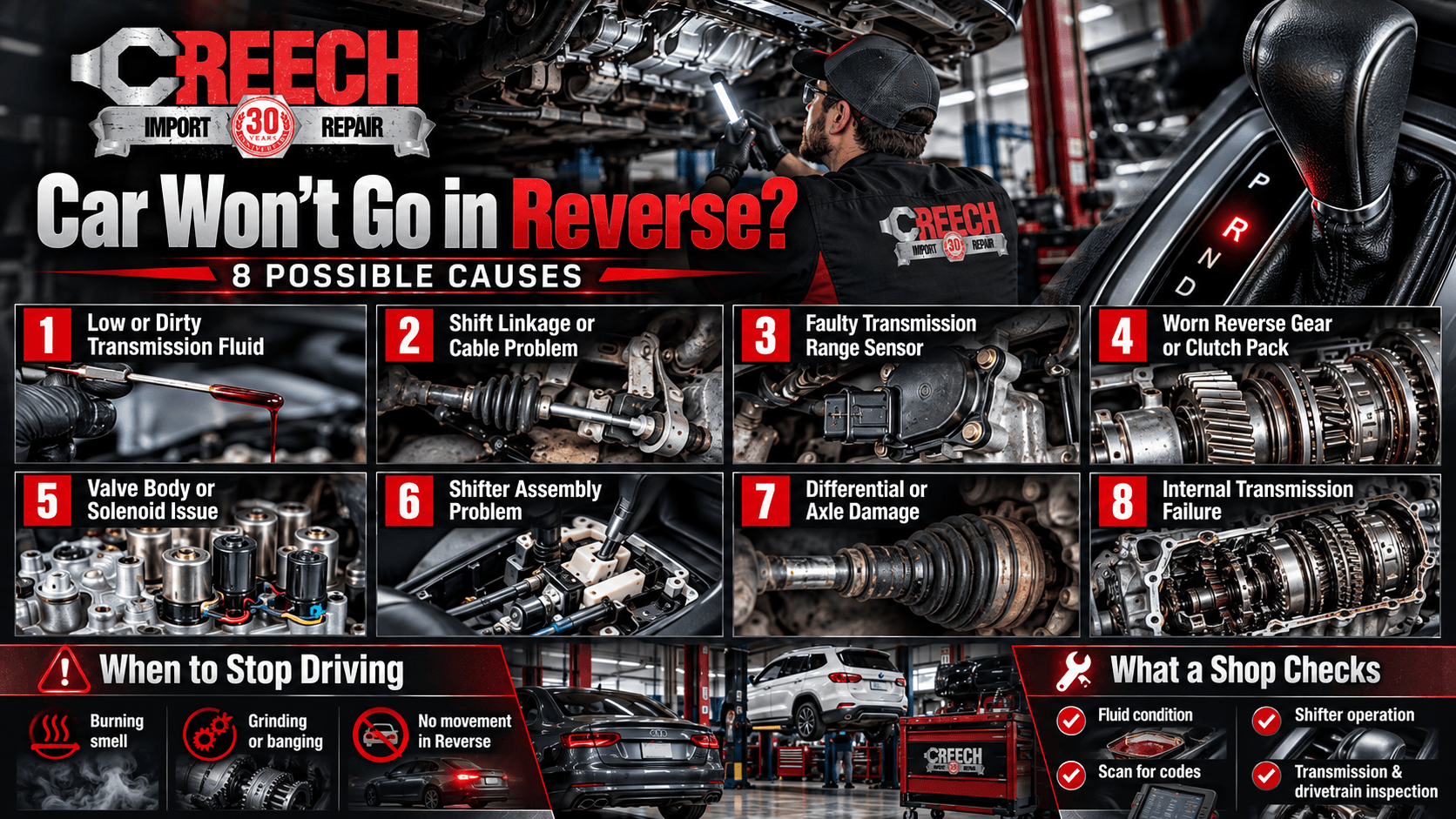
8 Possible Causes a Car Won't Go in Reverse
These eight categories are diagnostic possibilities rather than a ranking of how frequently each component fails. Some overlap because an internal transmission fault may involve multiple hydraulic, electrical, and mechanical parts. Not all categories apply to every transmission design.
Low, Incorrect, or Contaminated Transmission Fluid
Many conventional automatic transmissions use pressurized fluid to apply internal clutches and other elements. The correct fluid type, level, operating temperature, and hydraulic pressure are important for proper engagement.
If fluid is significantly low because of a leak, the transmission may struggle to develop adequate pressure. This can contribute to delayed engagement, slipping, or loss of operation in certain ranges.
Fluid that is badly contaminated or has deteriorated may be associated with internal wear or abnormal hydraulic operation. But discoloration alone is not a definitive explanation for missing Reverse.
Overfilling or adding the wrong fluid can also create problems. Some modern transmissions have sealed or specialized service procedures and require a specific temperature range for checking fluid level.
Owners should not add fluid simply because Reverse has stopped working. A shop should identify whether the vehicle has the correct fluid and whether a leak, pressure issue, or internal failure is present.
A fluid change cannot repair a broken gear, failed clutch assembly, or damaged hydraulic pump.
Diagnosis: Depending on the design, a technician may inspect for leaks, verify fluid level using the manufacturer's procedure, assess contamination, and determine whether pressure testing is justified.
Shift Linkage, Cable, or Selector Connection Problems
Some vehicles use a mechanical cable or linkage to connect the driver's gear selector to the transmission. Other vehicles use electronic shift-by-wire systems.
On cable-operated designs, a stretched, disconnected, misadjusted, or damaged linkage can prevent the transmission's range selector from reaching the position the driver intended.
The gear lever may appear to be in Reverse while the transmission's actual selector has not fully reached the corresponding range.
Some vehicles may also show unexpected gear-indicator behavior or difficulty selecting several positions, not just Reverse.
A technician can evaluate the connection between the shifter and transmission using the appropriate manufacturer procedure. Depending on the findings, repair may involve adjustment or replacement of a damaged cable, bushing, bracket, or other component.
Do not attempt to adjust linkage from beneath a running vehicle. Unexpected vehicle movement can cause severe injury.
Diagnosis: Compare the shifter's indicated position with actual selector movement and control-module range information where available.
Transmission Range Sensor or Related Electrical Fault
Electronic transmission controls often need to determine which driving range has been selected. Depending on the system, a transmission range sensor, position switch, electronic shifter, or control module provides that information.
If the range information becomes implausible or unavailable, some vehicles may restrict shift commands, display a warning, or fail to respond as expected.
Possible underlying problems include sensor faults, wiring damage, connector corrosion, selector misadjustment, power-supply problems, or communication faults.
A range-related diagnostic code does not automatically prove the range sensor itself has failed. The circuit and mechanical selector relationship must also be evaluated.
Some vehicles use highly integrated electronic selector systems, so diagnosis and repair procedures can differ substantially from older cable-operated transmissions.
Diagnosis: Scan relevant control modules, inspect applicable signals, confirm selector operation, and test circuits or components according to manufacturer specifications.
Worn or Damaged Reverse Clutch, Brake, or Gear Components
Many automatic transmissions achieve Reverse through a particular combination of planetary gearsets and friction elements. Depending on the design, reverse operation may depend on specific clutches, brakes, bands, or related components.
If an element necessary for Reverse cannot apply or hold correctly, the vehicle may fail to move backward even if forward gears still operate.
Internal wear, damaged seals, overheating, abnormal hydraulic pressure, or mechanical failure can contribute to these conditions.
However, a failed Reverse function does not prove that the reverse clutch has worn out. The clutch may be mechanically sound but unable to apply because the hydraulic or electronic control system is malfunctioning.
Some faults can be isolated through pressure and operating-data tests before major disassembly is considered. Other cases require internal inspection to determine the complete condition.
Internal clutch or gear work may be substantial. Before approving a rebuild or replacement, request an explanation of how the diagnosis established that the fault is internal.
Diagnosis: Compare commanded operating state with hydraulic pressure, available diagnostic data, and other mechanical evidence.
Valve Body, Shift Solenoid, or Hydraulic Control Fault
The valve body is a hydraulic control assembly found in many automatic transmission designs. Valves, channels, and electronically controlled solenoids help direct fluid pressure to different operating components.
If a valve sticks, a solenoid malfunctions, or pressure leaks internally, the transmission may not apply the required components correctly.
Depending on the vehicle, symptoms can include delayed Reverse, harsh engagement, intermittent selection, slipping, or failure to engage other ranges.
Solenoid-related trouble codes can be useful, but they do not always identify a failed solenoid. Wiring faults, control-module commands, hydraulic problems, and mechanical conditions can produce related symptoms.
Some valve body faults can be repaired without removing or replacing the entire transmission. Other issues involve substantial wear or contamination and may require more extensive work.
Creech's 10L80 valve body article discusses a specific GM transmission design. This general guide does not assume that the same failure applies to every make or model.
Diagnosis: Evaluate transmission codes, solenoid commands, operating pressures, electrical circuits, and manufacturer-specific hydraulic tests.
Defective Shifter Assembly or Shift-Interlock System
A failure at the driver's gear selector can look like a transmission failure even when the transmission itself is not the immediate problem.
The shifter may contain mechanical locks, electronic switches, range request controls, or other components. On some vehicles, brake-pedal and shift-interlock signals are required to leave Park.
When those systems malfunction, the driver may be unable to move the selector or request Reverse correctly.
A stuck shifter should not be forced. The issue may involve a brake-light switch, interlock solenoid, shifter mechanism, electrical supply, or other model-specific components.
Some vehicles have a manufacturer-defined manual shift-lock release procedure intended for specific circumstances. Consult the owner's manual rather than using improvised methods.
Even when the shifter moves normally, an electronically commanded system may not complete the requested shift if a control fault exists.
Diagnosis: Check selector movement, interlock operation, brake-related inputs, electronic shift requests, and related circuits as applicable.
Axle, Differential, or Other Drivetrain Damage
The transmission must transfer torque through the remaining drivetrain to move the vehicle. On different configurations, this can involve axle shafts, constant-velocity joints, a differential, driveshafts, and other components.
A mechanical failure outside the transmission can prevent the car from moving even when a gear is selected. However, a complete axle or differential failure often affects more than Reverse, so this category should not be treated as the default cause of Reverse-only failure.
For example, damaged axle components may cause abnormal sounds, loss of drive, or movement that differs from normal operation.
A technician should establish whether the transmission is producing output and where the transfer of motion stops.
This is especially important when the driver's description is simply that the car will not back up. The problem may be actual loss of propulsion rather than a reverse gear-selection failure.
Diagnosis: Inspect relevant driveline components, confirm the complaint, and determine whether output torque reaches the wheels, using safe manufacturer-approved methods.
Major Internal Transmission Damage or Hydraulic Pump Failure
Some Reverse failures result from more extensive transmission damage. Potential faults include hydraulic pump problems, internal pressure loss, damaged seals, worn clutch assemblies, or broken mechanical components.
Severe contamination, metal debris, repeated slipping, abnormal noises, or the loss of multiple ranges may increase concern about substantial internal problems.
But the absence of Reverse is not itself proof of a completely failed transmission.
Manufacturer diagnostic procedures can distinguish among hydraulic, electrical, and mechanical problems. In one Mitsubishi service example, failure to move backward calls for specific tests involving line pressure, control components, and internal elements rather than immediately assuming a single failed part.
If major damage is confirmed, possible options may include component repair, a transmission rebuild, or replacement, depending on the design, condition, parts availability, and economics of the vehicle.
Before choosing among those options, consider the car's overall mechanical condition, its value to you, the written estimate, and the likely reliability after repair.
Diagnosis: Follow manufacturer procedures for pressure testing, electrical evaluation, control data, and mechanical inspection before recommending major transmission work.
Car Won't Go in Reverse: What Do Different Symptoms Suggest?
Transmission problems can look alike from the driver's seat. This table explains how mechanics use the specific symptom to decide which systems need testing first.
| What Happens | Possible Fault Areas | Important Distinction |
|---|---|---|
| Shifter will not move into R | Shift lock, selector mechanism, brake-pedal input, cable or electronic control | The problem may occur before the transmission receives a valid Reverse selection. |
| Dashboard shows R but the car does not move | Range recognition, hydraulic pressure, internal apply elements, drivetrain or vehicle restraint | Displayed R does not prove Reverse has mechanically engaged. |
| Car drives forward but will not reverse | Reverse-specific hydraulic or mechanical elements, controls, selector position | Some faults affect Reverse before forward operation. |
| Reverse engages after a delay | Pressure buildup, valve body operation, fluid condition, internal seals or clutch function | Repeatedly revving the engine is not a diagnostic solution. |
| Reverse bangs into gear | Hydraulic control, mounts, driveline condition, internal transmission behavior | Harsh engagement does not automatically require total transmission replacement. |
| Reverse works cold but fails warm | Temperature-sensitive hydraulic, electrical, or mechanical fault | Actual temperature and transmission data help establish the reason. |
| No Drive and no Reverse | Broader hydraulic, transmission, selector, parking brake or drivetrain issue | This differs from a Reverse-only fault. |
| Grinding or banging when R is selected | Mechanical drivetrain, transmission, or selector issue depending on design | Stop repeated engagement attempts and seek diagnosis. |
Why Won't My Automatic Car Reverse but It Drives Forward?
Some automatic transmission designs use different friction elements or hydraulic circuits for forward and reverse operation. If a fault affects a component needed only for Reverse, forward movement may remain possible.
The problem can also involve a selector, pressure control, or range-recognition fault. A mechanic must determine whether Reverse was properly commanded and whether its required components operated.
Do not assume a transmission rebuild is required until diagnostic testing supports that conclusion.
Why Does My Car Go Into Reverse but Not Move?
The gear display and actual propulsion are different things. A display showing R may indicate the requested or recognized range, but the transmission must still engage the appropriate elements and transfer torque.
If the car does not move, the technician may investigate hydraulic pressure, range information, internal mechanical operation, and the drivetrain.
Additionally, a stuck parking brake or another restraint may prevent movement. Do not apply excessive throttle to overcome unknown resistance.
Why Is Reverse Delayed Only When the Car Is Warm?
Temperature can change fluid viscosity, electrical behavior, and the operation of hydraulic or mechanical parts. Some problems become more noticeable after extended driving.
That pattern may help a technician narrow testing, but it does not identify the cause by itself.
Describe whether the delay happens only after the transmission reaches operating temperature, whether it also affects Drive, and whether warning messages appear.
Why Does My Car Jerk When Reverse Finally Engages?
A hard jolt can occur when engagement is delayed and then happens abruptly, or when transmission and drivetrain behavior is abnormal.
Potential contributing systems include hydraulic control, engine or transmission mounts, shift-control operation, and internal transmission elements.
If engagement is unpredictable, do not keep experimenting in a driveway or parking lot. The vehicle could move suddenly and strike a person or object.
What Should You Do if Your Car Suddenly Won't Reverse?
Your priority is to prevent unexpected vehicle movement and keep people away from its path. A car that will not back up may still move forward unexpectedly or engage Reverse after a delay.
Apply the Service Brake and Secure the Vehicle
Keep the brake pedal firmly applied while safely stopping. When parked, follow the owner's manual for the appropriate Park or neutral procedure and parking brake use. If the vehicle is on an incline, take extra precautions against rolling.
Do Not Force the Gear Selector
A shifter that is physically jammed may have an interlock or mechanical problem. Forcing it can cause damage or unexpected movement. Refer to the owner's manual for vehicle-specific instructions.
Do Not Rev the Engine to Make Reverse Engage
Applying significant throttle to a transmission that has not engaged can worsen slipping, produce heat, or result in a sudden harsh engagement. Avoid repeating the attempt.
Record What the Vehicle Actually Does
Once safely parked, note whether the shifter moves into R, whether the dashboard recognizes Reverse, whether the engine revs without movement, and whether the problem happens cold or warm. Do not conduct risky tests to reproduce symptoms.
Check Warning Messages and Recent Service History
A transmission warning, check engine light, recent fluid service, or previous shift problem may help guide diagnosis. A warning code is not a confirmed failed part, but the information can be useful.
Arrange Professional Inspection or Towing
If the vehicle cannot reverse predictably, shows severe mechanical symptoms, or cannot safely leave its parking space, contact a repair facility and arrange appropriate towing or roadside assistance.
Should You Restart the Car to Fix Reverse?
Some electronic faults may temporarily change behavior after a restart, but restarting is not a repair for damaged linkage, inadequate hydraulic pressure, worn clutches, or failed mechanical components.
Do not repeatedly restart and cycle the shifter in hopes of forcing engagement. If a warning disappears, the underlying intermittent fault may still be present.
Preserve any warning messages and arrange diagnosis.
Can You Back Up by Revving the Engine Higher?
That is not recommended. Excessive throttle during delayed or failed engagement can overheat transmission components or cause sudden vehicle movement if the gear engages unexpectedly.
It also does not tell you whether the root cause is fluid pressure, a control fault, or internal wear.
A controlled diagnostic procedure should be performed by a qualified technician rather than attempted in traffic or an occupied driveway.
Should You Add Transmission Fluid Yourself?
Do not add fluid based on the symptom alone. Many transmissions require a specific fluid specification and a temperature-dependent level-checking procedure.
Incorrect fluid, overfilling, or underfilling can create further problems.
If you see an obvious leak, report it to the repair shop. Fluid condition and level should be evaluated using the appropriate manufacturer procedure.
When Should You Stop Driving and Arrange Towing?
Stop operating the vehicle and seek professional assistance if:
- Reverse engages unpredictably or the car lurches suddenly.
- The vehicle cannot reliably select or hold a gear.
- You hear severe grinding, banging, or other abnormal mechanical noises.
- There is a strong burning odor or evidence of major overheating.
- Transmission fluid is leaking significantly.
- The car cannot move safely in either direction.
- Drive engagement is also slipping or unpredictable.
- The vehicle is immobilized in an unsafe location or cannot be parked securely.
Keep people clear of the vehicle's path. Do not crawl underneath or stand between the car and another object while someone attempts to engage a gear. If it cannot be safely positioned or controlled, use appropriate professional recovery services.
Is It Safe to Drive a Car With No Reverse?
Driving safety depends on the fault and circumstances. A vehicle that still moves in Drive may appear operable, but the cause of Reverse failure may also affect other ranges or worsen without warning.
A failed reverse gear also makes normal parking and maneuvering more difficult. In some locations, avoiding Reverse may not be possible without creating a hazard.
When the cause is unknown, especially if engagement is harsh, slipping, or unpredictable, it is safer to arrange professional advice and towing rather than drive normally.
Can Driving With No Reverse Damage the Transmission?
Potentially. If the underlying fault involves inadequate hydraulic pressure, internal slipping, overheating, or damaged components, continued operation may increase wear or worsen the failure.
Some external shifter problems may not create the same internal mechanical risk, but that cannot be assumed without diagnosis.
Do not treat continued forward movement as proof that the vehicle is safe from further damage.
Can a Car Suddenly Lose Forward Gears Too?
Some faults that initially affect Reverse may progress or involve systems shared by other ranges. The risk depends on the exact transmission and problem.
A car with severe fluid loss, pressure problems, or major internal damage may eventually experience broader loss of operation.
Prompt diagnosis can help identify the issue before making a repair decision, although it cannot guarantee that additional damage has not already occurred.
How Does a Mechanic Diagnose a Car That Won't Go in Reverse?
A useful diagnosis distinguishes a failed gear request from a failed gear engagement and a failure to transfer power to the wheels. The appropriate tests depend on whether the vehicle uses a conventional automatic, CVT, dual-clutch transmission, manual gearbox, or another system.
Confirm the Exact Complaint Safely
The technician records whether the selector cannot move, whether R is displayed, whether engagement is delayed, and whether other gears operate. The vehicle is secured before any engagement testing.
Inspect External Selector and Interlock Operation
Applicable linkage, cables, bushings, shifter mechanisms, brake-pedal inputs, and electronic shift-request systems are assessed. A selector problem should not be mistaken for internal transmission failure.
Scan the Correct Vehicle Control Modules
Relevant engine, transmission, and electronic-shifter data may provide fault codes, range information, solenoid commands, temperatures, or other useful evidence. Generic OBD-II readers may not access all transmission information.
Evaluate Fluid and Hydraulic Operation
When the transmission design requires it, fluid level and condition are assessed using the proper procedure. Hydraulic pressure or other control tests may help establish whether the transmission can apply its operating elements.
Check Mechanical and Drivetrain Components
If the transmission appears to engage but the vehicle does not move, technicians may evaluate axles, output components, differential operation, or other mechanical systems using safe service procedures.
Confirm Root Cause and Explain Repair Options
The shop should explain which findings support the recommendation and whether the work involves adjustment, electrical repair, valve body service, internal transmission repair, or replacement.
Verify Operation After Repair
After approved work, the appropriate checks should confirm reliable range selection and engagement, normal shifting, and resolution of related faults when safe to evaluate.
What Can a Transmission Scan Tool Tell a Mechanic?
Depending on the vehicle and tool, a scan may reveal transmission fault codes, recognized range, commanded solenoid states, temperature, input and output speeds, or other electronic data.
This information helps narrow possible causes, but a stored code does not automatically establish that a particular part is defective.
A transmission can also have a mechanical failure without a conveniently identifying diagnostic code.
What Is a Transmission Line-Pressure Test?
Some automatic transmission designs allow technicians to measure hydraulic pressure under specified conditions to determine whether pressure generation and control are functioning correctly.
Manufacturer-specific service information defines the correct test connections, conditions, pressures, and safety procedures.
Abnormal pressure may be caused by several different hydraulic or mechanical problems, so the result must be interpreted with other findings.
Does the Transmission Pan Need to Be Removed?
Not always. External selector inspection, code review, electrical testing, and some hydraulic tests may be completed before disassembly.
Pan removal may be appropriate when the diagnostic path requires inspection of fluid contamination, wear particles, or accessible hydraulic components.
Some transmissions use different designs that do not permit the same inspection procedures. A technician should explain why a particular disassembly step is necessary.
Can a Bad Sensor Cause a Car Not to Reverse?
Yes, in some electronically controlled systems. An incorrect range signal or another relevant control fault can interfere with transmission operation.
However, not every sensor fault disables Reverse, and a code referencing a sensor does not prove the sensor itself needs replacement.
Electrical supply, wiring, connectors, mechanical adjustment, and related control information may all need evaluation.
How Much Does It Cost to Fix a Car That Won't Go in Reverse?
There is no reliable universal cost because the symptom can arise from a relatively accessible selector component or extensive internal transmission damage.
Vehicle year, make, model, transmission design, labor time, parts availability, required programming, and the extent of internal damage affect the estimate.
Instead of selecting a repair price from a generic online list, ask for a written estimate based on the actual diagnosis.
| Confirmed Fault Area | Possible Repair | What Affects the Decision |
|---|---|---|
| Selector or linkage fault | Repair or adjust relevant mechanical components | Access, design, damaged parts, and verification |
| Electronic range recognition | Repair confirmed sensor, wiring, switch, or control fault | Electrical testing, adjustment and calibration |
| Fluid leak or incorrect fluid level | Repair leak and restore appropriate fluid condition | Whether secondary transmission damage occurred |
| Valve body or solenoid fault | Repair or replace verified defective hydraulic-control components | Transmission design and extent of contamination or wear |
| Reverse clutch or mechanical component failure | Internal transmission repair or rebuild when feasible | Disassembly, parts, and overall transmission condition |
| Axle or differential damage | Repair confirmed drivetrain defect | Location, damage severity, and related components |
| Major transmission failure | Evaluate rebuild, remanufactured unit, or replacement | Vehicle condition, warranty, total cost, parts availability |
Can Reverse Be Fixed Without Replacing the Transmission?
Yes. A diagnosed shift cable problem, selector defect, electronic circuit fault, or some hydraulic control issues may be repairable without complete transmission replacement.
The appropriate repair depends on the specific transmission and whether internal damage has occurred.
Even a seemingly simple fault may require proper calibration or confirmation after repair.
Does a Transmission Fluid Change Restore Reverse?
A fluid service is not a universal remedy for missing Reverse. If the transmission has lost hydraulic pressure because of a leak or incorrect level, correcting that condition may be part of the repair.
But replacing fluid cannot restore broken mechanical parts or severely worn friction components.
Do not approve fluid service solely as a guess when the car no longer moves backward. Request diagnosis first.
Should You Rebuild or Replace a Transmission With No Reverse?
If serious internal damage is confirmed, the shop may discuss rebuilding, replacing affected components, or installing another transmission assembly.
The best option depends on cost, condition, parts supply, vehicle value, warranty terms, and the expected result.
Not every transmission is equally repairable or available in remanufactured form. Some modern designs also require software programming or other procedures.
Before authorizing major work, ask which components failed, what evidence confirms the fault, and what protection or warranty applies.
Is It Worth Repairing an Older Car That Has Lost Reverse?
Sometimes. A properly maintained car with a confirmed, isolated fault may be worth repairing. A car with major engine deterioration, structural corrosion, or several costly approaching repairs presents a different decision.
Creech's separate repair-versus-replace guide for high-mileage cars explains how to compare repair costs with the full cost of obtaining another vehicle.
Do not assume that a costly transmission estimate automatically means the entire vehicle should be replaced, or that continuing repairs is always economical.
Does the Cause Differ Between Automatic, CVT, and Manual Cars?
Yes. Different transmission types generate reverse movement in different ways. A diagnosis that applies to one design may not apply to another.
Conventional Automatic Transmission
Many conventional automatics use hydraulic pressure and internally controlled friction elements to establish Reverse. Problems may involve controls, pressure, range selection, or internal mechanisms.
A delayed engagement or Reverse-only failure can be a useful clue, but the correct testing sequence must follow the particular unit's service information.
Continuously Variable Transmission (CVT)
CVTs vary significantly by manufacturer and model. Many use a mechanism that provides forward and reverse direction in addition to variable ratio operation.
Depending on the design, problems can involve range selection, hydraulic or electronic control, internal components, or other drivetrain systems.
Do not assume that every CVT reverse failure involves a belt, pulley, or a complete unit replacement.
Dual-Clutch or Automated Transmission
Some vehicles use electronically controlled clutch and gear-selection mechanisms. A Reverse complaint can involve actuators, controls, clutch operation, mechanical selection, or related faults.
These systems may require specialized diagnostic equipment and calibration procedures. Traditional automatic-transmission assumptions may not apply.
Manual Transmission
A manual car that cannot select Reverse may have a shift mechanism, clutch-release, synchronizing or non-synchronizing gear design issue, or an internal mechanical fault.
Some manual transmissions behave differently when Reverse is selected compared with forward gears, and specific owner-manual procedures may apply.
Grinding when selecting Reverse does not automatically mean the entire gearbox is damaged. Clutch drag, selection technique, and mechanical issues must be considered.
Do not force the lever or keep attempting a noisy engagement.
What About Reverse Problems on Toyota, Honda, Nissan, Subaru, and Other Vehicles?
Creech Import Repair services a broad range of supported vehicles, but no single reverse-failure diagnosis applies to every brand, model, or transmission.
Toyota and Lexus
Automatic, hybrid, and other transmission arrangements differ across Toyota and Lexus models. A problem with Reverse may involve the shift-control system, a transmission component, or another drivetrain fault depending on the vehicle.
Hybrid vehicles can have additional operating characteristics that affect how propulsion requests are interpreted. Follow vehicle-specific service and high-voltage safety requirements.
Honda and Acura
Honda and Acura vehicles have used multiple transmission types and control strategies. A reverse engagement problem needs diagnosis based on the exact year, model, transmission, warning messages, and driving symptoms.
Do not assume a transmission must be replaced because the gear indicator shows R but the car fails to move.
Nissan and Infiniti
Nissan and Infiniti vehicles include conventional automatic and CVT-equipped models. Their reverse mechanisms and diagnostic procedures vary.
The appropriate evaluation may involve range recognition, hydraulic control, internal components, or another fault. A general claim about CVT reliability is not a diagnosis of a specific vehicle.
Subaru
Subaru vehicles have used manual, conventional automatic, and CVT designs across different generations. Reverse problems must be interpreted in the context of the actual drivetrain and controls.
AWD systems add related driveline components that may need evaluation when a vehicle cannot move or produces abnormal mechanical noises.
Kia and Hyundai
Different Kia and Hyundai models may use conventional automatics, dual-clutch transmissions, or other systems. Failure to engage Reverse is not necessarily related to the same fault on every model.
Creech already maintains a separate Kia Sorento transmission guide focused on that vehicle. This article addresses the broader no-Reverse symptom without reproducing model-specific material.
GM and Other Domestic Vehicles
Creech also offers services for domestic vehicles. Some GM models use electronically controlled transmissions that require enhanced diagnostics and specific hydraulic procedures.
Existing Creech articles such as 8L90 transmission repair in Raleigh and 10L80 transmission problems address specific systems.
Those articles should remain the primary resources for their model-specific transmission keywords; this guide targets a general failure to reverse.
How Can You Reduce the Risk of Additional Transmission Damage?
Not every transmission problem is preventable. However, following manufacturer maintenance requirements and responding to unusual operation can help limit avoidable risks.
Use Vehicle-Specific Transmission Maintenance Intervals
Transmission fluid specifications and service intervals differ widely. Some vehicles have more frequent service requirements under severe operation, while others use different schedules.
Follow the owner's manual and manufacturer service guidance rather than applying one mileage interval to every transmission.
Address Leaks and Temperature Warnings
Fluid loss and overheating can interfere with proper transmission operation in certain designs. If a significant leak or warning appears, arrange timely inspection.
Do not attempt to compensate for a serious problem by repeatedly adding fluid without confirming its type and level.
Avoid Repeated Harsh Engagement
When Reverse delays or slips, applying heavy throttle can produce excessive heat or sudden engagement. It can also create a collision hazard.
Stop attempting to force the transmission and seek diagnosis.
Report Early Changes in Shifting
Delayed engagement, harsh shifts, unexpected warning messages, and recurring inability to select a gear deserve attention before the vehicle becomes immobilized.
Early diagnosis may reduce the risk of continued operation with a damaging condition, but it does not guarantee an inexpensive repair.
Keep Records of Transmission Service
Accurate maintenance records help technicians identify recent fluid changes, repairs, software work, and whether the correct procedures were followed.
If a problem develops immediately after service, report that timing without assuming the work caused the fault.
Car Won't Go in Reverse in Raleigh, NC? Get the Problem Diagnosed.
If your car drives forward but will not back up, Reverse engages late, or your gear selector refuses to select R, you need to know whether the problem is an external control issue or a transmission fault before approving a major repair.
Creech Import Repair provides automotive diagnostics, maintenance, and repair services in Raleigh, North Carolina. The shop has served local drivers since 1993 and works on supported import and domestic vehicles.
Creech's automotive services include transmission diagnosis and repair. Contact the team to describe your specific vehicle and symptoms so they can advise you about the appropriate diagnostic appointment.
Tell the service advisor whether the shifter moves into R, whether the car moves forward normally, whether Reverse engages after a delay, and whether there are warning lights, noises, or fluid leaks.
If the car cannot be safely parked, moved, or controlled, arrange towing rather than attempting to drive it to the shop.
Creech Import Repair
1818 St. Albans Dr #106
Raleigh, NC 27609
Phone: 919-872-1999
Business Hours: Monday-Friday, 7:30 AM-5:30 PM
Online appointment requests must be confirmed by the Creech Import Repair service team. Explain the vehicle's year, make, model, and symptoms when requesting service.
Frequently Asked Questions About Cars That Won't Go in Reverse
1. Why won't my car go in reverse?
A car may fail to reverse because of a shifter or linkage fault, incorrect gear-range recognition, inadequate automatic-transmission hydraulic pressure, a valve body or solenoid issue, worn reverse clutch components, internal transmission damage, or another drivetrain problem. The correct diagnosis depends on whether the selector physically enters Reverse, whether the transmission engages, and whether power reaches the wheels. A mechanic should inspect relevant systems and perform vehicle-specific tests before recommending a repair or replacement transmission.
2. Why does my car drive forward but not reverse?
Some transmission faults can affect Reverse while forward gears continue working because different internal components and control functions may be used for each operating range. Possible causes include a range-selection problem, hydraulic control fault, or damaged reverse-apply component. Forward movement does not prove the rest of the transmission is healthy. A qualified technician should examine the actual gear request, relevant control data, hydraulic operation, and mechanical condition rather than assume that a complete transmission replacement is necessary.
3. Can low transmission fluid cause a car not to reverse?
Yes, on some automatic transmissions, inadequate fluid supply can interfere with the hydraulic pressure needed to engage Reverse. However, low fluid is not the only possible cause, and a vehicle that will not reverse does not automatically need more fluid. Internal damage, hydraulic control problems, sensor faults, or selector issues may produce similar symptoms. Transmission fluid specifications and level-checking procedures vary by vehicle, so have the system inspected before adding fluid or authorizing a fluid service.
4. Does no Reverse mean my transmission is bad?
Not always. A car with no Reverse may have an external shifter, linkage, electrical, or range-recognition issue that does not require replacing the entire transmission. Other cases involve hydraulic or internal mechanical failure. The severity depends on the actual defect and the design of the transmission. A professional diagnosis should distinguish whether Reverse is being requested, whether the required components engage, and whether torque reaches the wheels before recommending major transmission work.
5. Why does my car shift into Reverse but not move?
A dashboard showing R means the vehicle may recognize or display the Reverse selection, but that does not prove the transmission has engaged mechanically. Possible explanations include hydraulic pressure loss, incorrect range information, internal clutch or gear problems, drivetrain damage, or another condition preventing movement. A parking brake or brake fault can also restrain the vehicle. Do not apply excessive throttle to force movement. Secure the car and arrange diagnosis to identify whether the fault involves selection, engagement, or propulsion.
6. Can a transmission sensor stop Reverse from working?
In some electronically controlled vehicles, an incorrect or missing transmission-range signal can interfere with gear engagement or cause a warning. However, sensor behavior differs by transmission design, and a diagnostic code mentioning a sensor does not necessarily prove the sensor has failed. Wiring, connectors, mechanical alignment, electrical supply, and control modules may also be involved. A technician should compare gear-selection information with actual operation and perform appropriate electrical tests before replacing components.
7. Is it safe to drive a car that won't go in Reverse?
Driving may be unsafe because the fault can worsen, affect other gears, or make parking and maneuvering unpredictable. A vehicle that still drives forward is not necessarily safe to operate normally. Do not drive if engagement is harsh or unpredictable, the transmission slips badly, major noises occur, or the car cannot be secured. Avoid forcing the shifter or revving the engine to make Reverse engage. Seek professional advice and arrange towing when normal vehicle control cannot be assured.
8. How much does it cost to fix Reverse gear on a car?
The cost depends on the confirmed cause, vehicle model, transmission design, and extent of damage. A selector or linkage repair may differ greatly from valve body work, internal clutch repair, or complete transmission replacement. Diagnostic labor, parts availability, calibration requirements, and related mechanical damage also affect the estimate. There is no single price for a car that will not reverse. Request a vehicle-specific diagnosis and written estimate before approving major repair work.
9. Can a transmission fluid change fix a car that won't reverse?
A fluid service is not a guaranteed fix for missing Reverse. If the transmission has a confirmed fluid-level or fluid-related problem, correcting that condition may be necessary. However, changing fluid cannot repair broken gears, damaged clutches, faulty shift controls, or many hydraulic and mechanical failures. Some transmissions also require specialized fluid-checking and filling procedures. A technician should diagnose why Reverse is not engaging before recommending fluid service as the solution.
10. Where can I get a car that won't reverse diagnosed in Raleigh, NC?
Creech Import Repair provides automotive diagnostics and repair services at 1818 St. Albans Dr #106 in Raleigh, North Carolina. The shop works on supported import and domestic vehicles and provides transmission-related service. Call 919-872-1999 to describe the vehicle's year, make, model, warning lights, and whether it can select Reverse or move after Reverse is selected. If the vehicle cannot be controlled, parked, or driven safely, arrange appropriate towing or roadside assistance instead of driving it to the shop.

Automotive Technical Review
Reviewed by Creech Import Staff
Creech Import Staff represents the automotive service team at Creech Import Repair, a Raleigh automotive repair business serving drivers since 1993.
The shop provides diagnostics, transmission-related repair, maintenance, and general automotive service for supported import and domestic vehicles.
Learn more about Creech Import Repair's experience, technicians, services, and approach to customer care.
Meet Creech Import Repair →Technical Sources and Evidence Limits
This guide summarizes general automotive troubleshooting principles. "Car won't go in reverse" is a symptom, not a confirmed transmission failure. The eight categories are illustrative and overlap in some designs. Exact test procedures, transmission fluid specifications, repair options, and safety requirements depend on the year, make, model, and powertrain.
- Mitsubishi Motors service information. Inspection Procedure: Does Not Move Backward. A manufacturer-service example showing how missing Reverse can involve hydraulic pressure, valve body, controls, and internal transmission components. Procedures apply only to the specified transmission.
- Creech Import Repair. Auto Repair Services in Raleigh. The shop's general repair, diagnostic, and transmission-service information.
- Creech Import Repair. Kia Sorento Transmission Issues. Related model-specific transmission symptoms and diagnostics.
- Creech Import Repair. 10L80 Valve Body Issue. Technical discussion of a particular transmission hydraulic-control design.
- Creech Import Repair. 10L80 Transmission Problems. Vehicle- and transmission-specific repair considerations.
- Creech Import Repair. 8L90 Transmission Repair in Raleigh. Additional model-specific transmission diagnostic guidance.
- National Highway Traffic Safety Administration. Vehicle Safety Recalls. Official resource for checking applicable vehicle recalls by VIN.
- Creech Import Repair. Contact Creech Import Repair. Current Raleigh shop address, telephone number, and appointment information.
Find Creech Import Service articles useful?
Add this site to your Preferred Sources in Google Search.