


Creech Import Repair | Raleigh, North Carolina
Is It Worth Fixing a Car With 150,000 Miles? Repair vs. Replace
Your car has 150,000 miles on the odometer, and now the mechanic has recommended a major repair. Maybe it needs a transmission repair, a timing belt service, an engine repair, or several smaller jobs that add up to a large estimate. Suddenly, a simple question becomes a difficult financial decision: Is it worth fixing a car with 150,000 miles, or should you replace it?
The answer depends less on the odometer reading than on the vehicle's condition, maintenance history, reliability, safety, expected future repairs, and the true cost of buying something else.
For some drivers, spending $2,000 or $3,000 on an otherwise dependable, paid-off car may be a sensible choice. For others, even a smaller repair may be difficult to justify if the car has serious rust, repeated breakdowns, or several expensive problems developing simultaneously.
High-mileage vehicles are not automatically worn out. A well-maintained Toyota, Honda, Lexus, Subaru, Nissan, or another vehicle may have substantial useful life remaining. But no brand name, reputation, or mileage figure guarantees the condition of an individual car.
This guide shows you how to evaluate the decision using real financial questions, mechanical risk, repair estimates, replacement costs, and a practical checklist you can discuss with an automotive technician.
Quick Answer
Is a Car With 150,000 Miles Worth Repairing?
Yes, repairing a car with 150,000 miles can be worthwhile if it is structurally sound, generally dependable, appropriately maintained, and the repair is likely to restore reliable service at a reasonable cost. Replacing it may be smarter when there are major safety concerns, extensive corrosion, recurring expensive breakdowns, or multiple approaching repairs that exceed your budget and the benefits of keeping it. Compare the cost of fixing and keeping your present car with the full cost of buying, financing, insuring, and maintaining a replacement. Get an accurate diagnosis and written repair estimate before deciding.
Is 150,000 Miles a Lot for a Car?
One hundred fifty thousand miles represents substantial use, but it is not a universal point at which vehicles become uneconomical or unsafe. An odometer reports distance traveled; it does not reveal how carefully the vehicle was maintained, whether important components have already been replaced, or how much deterioration has occurred.
A highway-driven car that received consistent maintenance can be in better mechanical condition than a lower-mileage vehicle with severe neglect, overheating history, corrosion, or poorly performed repairs.
Vehicle design, driving environment, service history, and individual component condition matter. So do the age of rubber parts, corrosion exposure, cooling-system health, and the availability of replacement components.
Can a Car Last Beyond 150,000 Miles?
Yes. Many vehicles operate well beyond 150,000 miles, but expected lifespan cannot be determined from mileage alone. Some engines and transmissions provide years of further service with proper upkeep; others may encounter significant problems earlier.
The most useful question is not, "How many miles can this model theoretically reach?" It is, "What is the condition of this particular vehicle, and what repairs will it reasonably need over the period I intend to keep it?"
For related maintenance guidance rather than a financial decision framework, see Creech's guide to extending vehicle lifespan.
Why Maintenance Records Matter More Than a Mileage Milestone
Consistent oil service, coolant maintenance, manufacturer-recommended timing-belt replacement when applicable, brake servicing, and prompt response to problems can substantially affect the condition of major vehicle systems.
Complete records also help a technician distinguish work that has already been performed from work that may be approaching. A vehicle with documented major maintenance may be financially different from an otherwise identical vehicle with no reliable service history.
Missing records do not prove neglect, but they introduce uncertainty. When a costly decision is involved, a vehicle inspection is more useful than making assumptions.
Mileage
Tells you distance traveled, but not the amount of wear in every system.
Condition
Reveals current safety, mechanical health, corrosion, and outstanding repairs.
History
Shows which preventive services and significant repairs were completed.
Should You Replace a Car Simply Because It Hits 150,000 Miles?
Usually, mileage alone is not enough reason to replace an otherwise satisfactory car. Replacing a reliable vehicle can introduce acquisition expenses, taxes, financing costs, and uncertainty about the condition of a different used car.
Conversely, keeping an unreliable or structurally compromised vehicle simply because it is paid off may not be sensible.
The decision requires a forward-looking evaluation, not an automatic mileage rule.
When Does It Make More Sense to Repair or Replace a High-Mileage Car?
The strongest argument for repair is that the expense addresses a known problem in a car with a reasonably favorable overall condition. The strongest argument for replacement is that the repair does not meaningfully resolve the vehicle's broader reliability, safety, or ownership problems.
Repair May Make More Sense When
- The vehicle has been generally reliable.
- Its maintenance history is reasonably complete.
- A technician identifies a specific repairable fault.
- There is no serious structural corrosion or unresolved safety problem.
- The engine and transmission are otherwise healthy.
- You intend to keep the vehicle for several more years.
- The repair fits your budget better than replacement.
- The vehicle still meets your transportation needs.
Replacement May Make More Sense When
- Multiple major systems are deteriorating.
- Repeated repairs create costly downtime.
- Severe rust or structural damage affects safety.
- The vehicle has a history of major overheating or extensive mechanical damage.
- The needed work exceeds a realistic repair budget.
- The car no longer fits family, accessibility, or commuting needs.
- A replacement would materially improve necessary reliability or safety.
- You can afford the true ongoing cost of another vehicle.
Is One Expensive Repair a Reason to Replace Your Car?
Not necessarily. A large estimate can feel alarming, but some repairs address one isolated failure and may restore many more miles of useful operation.
For example, a vehicle needing a water pump, timing-belt service, or suspension work might remain a reasonable car afterward if the rest of its major systems are healthy.
The significance changes when a large estimate is only the beginning. If the transmission is failing, the cooling system is unreliable, the structure is corroded, and the engine is consuming excessive oil, additional spending carries much greater uncertainty.
A useful diagnostic inspection distinguishes a single manageable repair from a pattern of expensive deterioration.
What If Your Old Car Is Paid Off?
Having no monthly loan payment can make repairs financially attractive, particularly when you have a known service history and the vehicle meets your needs.
However, a paid-off car is not cost-free. Maintenance, repairs, fuel, tires, insurance, registration, and the value lost as the vehicle ages still matter.
Likewise, a replacement vehicle is not simply its advertised monthly payment. Down payment, borrowing costs, taxes, insurance changes, routine maintenance, and possible repairs all affect the outcome.
Compare complete costs over the same period of time rather than contrasting one repair bill with one monthly car payment.
How Do You Compare Car Repair Costs With Replacement Costs?
The most useful approach is to compare what you expect to spend from today forward under two scenarios: keeping and repairing the current vehicle, or replacing it with a realistic alternative.
Past spending on the current car is already gone. Although service records are useful evidence of its condition, money already spent should not by itself justify another repair.
Step 1: Get the Current Repair Diagnosed
A guess is not a reliable basis for a financial decision. Ask the repair shop to identify the failed component or system, explain its findings, and prepare an itemized estimate.
It helps to distinguish required safety or drivability repairs from optional improvements, cosmetic repairs, and maintenance that can reasonably be scheduled separately.
If the problem involves a check engine light, transmission behavior, or unexplained performance loss, diagnosis can prevent spending thousands of dollars on the wrong repair.
Creech provides automotive repair and engine diagnostic services in Raleigh for applicable vehicles.
Step 2: Estimate the Cost of Keeping the Vehicle
Start with the confirmed repair estimate. Then consider routine maintenance, tires, brakes, future scheduled services, any other known defects, and reasonable contingency savings for unexpected work.
Do not automatically add every possible future failure. Instead, identify which components have observable problems and which major maintenance services are due under the vehicle's actual schedule.
The objective is to create a realistic cost range, not to predict every repair with certainty.
Step 3: Estimate the True Replacement Cost
Research actual local asking prices for comparable vehicles, then account for taxes, registration, dealership or transaction fees, financing interest if applicable, insurance, and any immediate maintenance the replacement might need.
A used replacement vehicle may also have deferred maintenance or hidden problems. Consider a qualified pre-purchase inspection when buying one, even if its mileage is significantly lower.
Do not assume a newer used car will have no repairs during the first year.
Step 4: Use the Same Ownership Period
Choose a period that matches your plans, such as two or three years. Compare the costs of both scenarios over that same period.
A one-time $2,400 repair spread over 24 months is equivalent to $100 per month before other ownership costs. That calculation does not guarantee that the vehicle will remain repair-free, but it makes the expense easier to compare with the monthly and upfront cost of replacement.
For a more complete analysis, account for estimated resale or trade-in value at the end of the chosen period as well. This prevents the comparison from treating cars as if they retain identical value.
Repair vs. Replace: Which Costs Belong in the Comparison?
| Cost Category | Repair and Keep | Buy a Replacement |
|---|---|---|
| Immediate expense | Diagnostic and approved repair bill | Purchase down payment or full purchase price |
| Financing | Any financing used for repairs | Loan principal and interest, if financed |
| Insurance | Current coverage and premiums | Potentially different coverage and premiums |
| Maintenance | Scheduled services and known wear items | Services due on the replacement vehicle |
| Unexpected repairs | Risk based on current vehicle condition | Risk based on replacement condition and history |
| Taxes and fees | Normal ongoing registration costs | Purchase-related taxes, fees, and registration |
| Depreciation/resale | Expected change in current car's value | Expected change in replacement car's value |
| Downtime and reliability | Expected repair disruptions | Purchase process and future reliability uncertainty |
Repair vs. Replace Example: Is a $3,000 Repair Worth It?
Imagine you own a paid-off car with 150,000 miles. A technician confirms a repair costing $3,000. The vehicle is otherwise in good condition, has a documented maintenance history, and meets your family's needs.
You are considering replacing it with a used vehicle that costs $19,000 before taxes, fees, or financing.
Over the next two years, your expected keep-the-car spending might include the confirmed repair and planned maintenance. The replacement decision includes the purchase outlay, any financing costs, and anticipated maintenance.
| Example Item | Keep Current Car | Buy Used Replacement |
|---|---|---|
| Confirmed repair today | $3,000 | Not applicable to replacement |
| Planned maintenance over two years | $1,200 assumed | $800 assumed |
| Replacement purchase price | No purchase | $19,000 assumed |
| Two-year vehicle value | Must estimate current car's resale value | Must estimate replacement's resale value |
| Other ownership costs | Insurance, fuel, registration, unforeseen work | Insurance, fuel, taxes, financing and unforeseen work |
In this example, the current car's $4,200 repair-and-maintenance spending is much smaller than the replacement's $19,000 purchase price, but that is not a complete total-cost comparison. The replacement remains an asset with resale value. The current car also has resale value. Taxes, financing interest, insurance changes, and the possibility of additional repairs can materially change the outcome.
This scenario therefore illustrates the questions to ask, not a universal conclusion that repairing always saves $14,800 or more.
To make the comparison accurate for your situation, insert real estimates for both vehicles, consider the value of each car at the end of the same ownership period, and weigh reliability and safety alongside the dollars.
What If the Repair Costs More Than the Car Is Worth?
A repair that exceeds the car's private-party or trade-in value deserves careful scrutiny, but it is not automatically unreasonable.
Suppose your existing vehicle is worth relatively little on the used market but could provide two more years of dependable use after one verified repair. If replacing it with a safe, appropriate vehicle would require much more money, the repair might still meet your needs.
On the other hand, when major damage is accompanied by uncertain engine life, substantial corrosion, and multiple other faults, replacing the vehicle may be the more prudent choice.
Market value is one factor in a larger ownership decision.
Should You Use a Car Loan Instead of Paying for Repairs?
Not automatically. A loan can spread payments over time, but it also creates a longer financial obligation and may increase total spending through interest and fees.
Compare the complete financing terms and insurance requirements with the expected cost of repairing the vehicle you already own. Avoid making the choice using the monthly payment alone.
If your current car is unsafe or cannot meet basic transportation needs, financial considerations should not override that safety concern.
Which Repairs Are Common on Cars With 150,000 Miles?
At higher mileage, various wear-related services and failures become more likely, but not every vehicle needs the same repairs. Maintenance intervals and failure patterns differ by make, model, engine, transmission, and previous service history.
The following categories are examples of repairs that can influence a keep-or-replace decision.
01Timing Belt or Timing-Chain Problems
Some engines use timing belts that require replacement at specified mileage or time intervals. Neglecting the interval can create a risk of severe engine damage on certain designs. Other engines use timing chains, which generally follow different service and diagnostic requirements.
A scheduled timing-belt replacement is not the same as a diagnosed internal engine failure. The decision should reflect the specific engine design, maintenance interval, current condition, and related work such as applicable tensioners or water-pump service.
02Cooling-System Repairs
Radiators, hoses, water pumps, thermostats, fans, and related cooling components can deteriorate over time. A manageable cooling-system repair can be reasonable when the engine has not suffered related damage.
However, repeated overheating or evidence of serious internal engine damage changes the financial picture significantly. A reliable estimate requires inspection rather than assuming every overheating problem is a simple thermostat replacement.
03Suspension and Steering Work
Shocks, struts, control arms, bushings, ball joints, and steering components can wear with accumulated mileage and road exposure. Some repairs improve comfort; others are important for vehicle safety and control.
Worn suspension components do not automatically mean the vehicle is nearing the end of its life. But extensive corrosion or multiple damaged safety-critical parts can make repairs more complicated and expensive.
04Air Conditioning Repairs
An air conditioning system may develop compressor, condenser, refrigerant leak, control, or electrical problems. The cost varies greatly depending on the actual failed component and required system work.
For some owners, an A/C repair is important for year-round usability. For others, it may be less urgent than essential braking, steering, or engine repairs. Consider its importance to your driving needs and your overall repair budget.
05Transmission Problems
Transmission concerns range from electrical or control faults to significant hydraulic or mechanical damage. Harsh shifting or delayed engagement does not automatically mean the entire transmission must be replaced.
Before deciding to retire a high-mileage vehicle, determine what diagnostic testing has confirmed, whether the problem is repairable, and what other major systems need attention.
Creech's used-vehicle repair guide offers related information about maintenance priorities on aging vehicles.
06Engine Oil Leaks, Seals, and Gaskets
Gaskets and seals may leak as vehicles age. The severity depends on the source, leak rate, oil level, accessibility, and possibility of damage to surrounding components.
Some leaks are relatively straightforward to repair; others require substantial labor. A leak near an engine does not necessarily mean the engine needs replacement.
Serious oil loss, low oil-pressure warnings, or signs of internal damage require prompt attention. Do not continue driving with a critical oil-pressure warning.
How Much Do Major High-Mileage Repairs Cost?
There is no accurate universal price sheet for all vehicles. Labor hours, component design, parts availability, shop rates, condition, and necessary related work differ substantially.
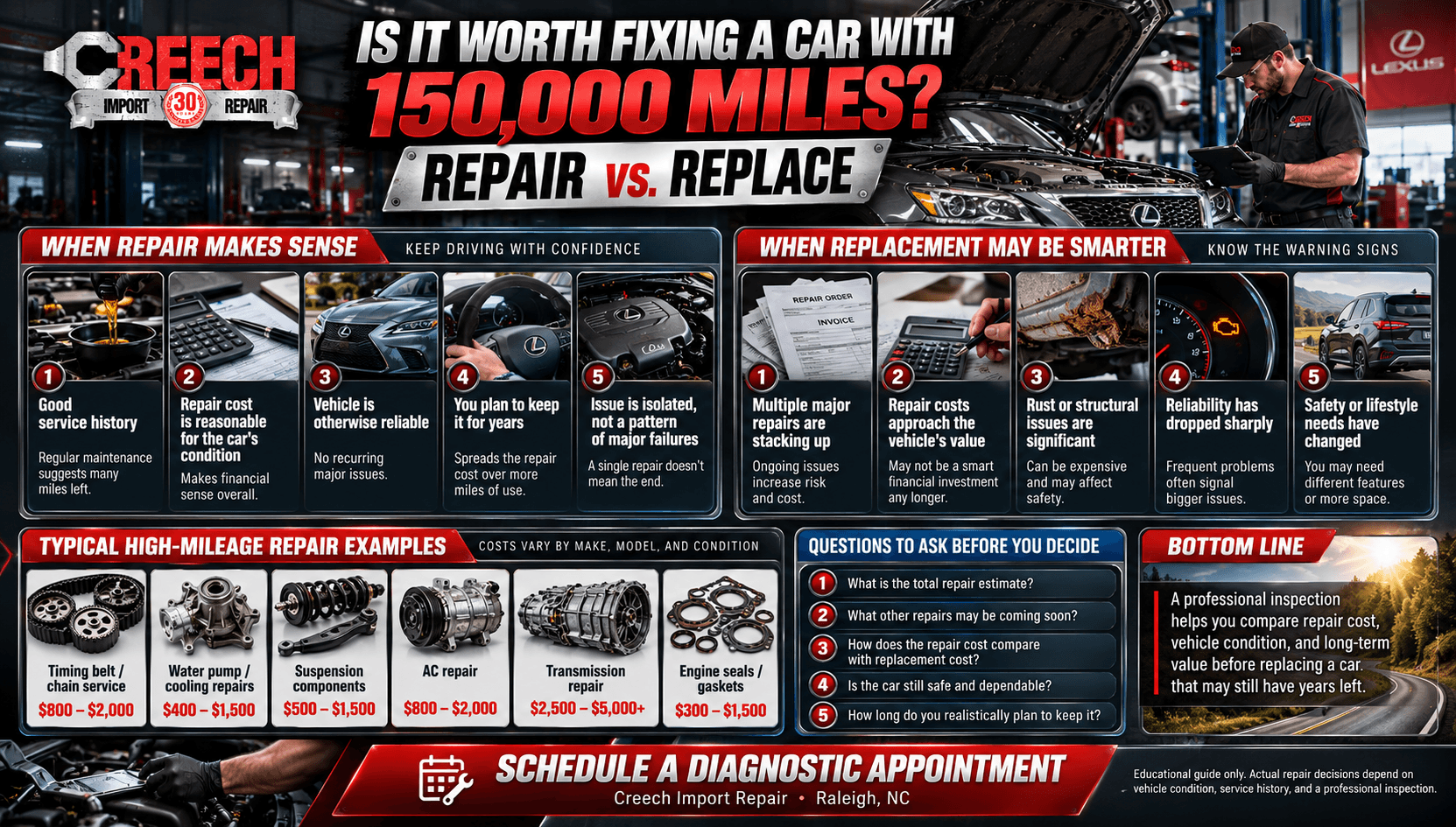
The infographic below illustrates possible repair categories and example costs, but its figures are not current Creech Import Repair estimates and should not be used as firm local price quotes. Some repairs can cost considerably more or less than the amounts shown.
It is also important to distinguish a partial transmission repair from replacement of a complete transmission, and scheduled timing-belt service from repair of a damaged timing system. Those are not interchangeable jobs.
When making a financial decision, ask for a written vehicle-specific estimate and clarify which work is confirmed, which work is recommended, and which additional problems might be discovered after disassembly.
What Should a Mechanic Check Before You Spend Thousands on an Older Car?
Before approving a major repair, it can be useful to understand the overall mechanical condition of the vehicle. The appropriate inspection depends on the complaint, vehicle design, and the level of certainty needed for the financial decision.
| Inspection Area | Questions to Resolve | Why It Matters |
|---|---|---|
| Engine | Any overheating history, abnormal noises, serious oil consumption, or confirmed internal defects? | Major engine condition can determine remaining reliability and repair scope. |
| Transmission | Does it engage and shift properly? Are faults mechanical, hydraulic, or electronic? | Helps separate a manageable fault from a major drivetrain repair. |
| Cooling system | Are there leaks, abnormal temperatures, or evidence of previous overheating? | Cooling failures can damage otherwise serviceable engines. |
| Braking and steering | Are safety-critical components in suitable condition? | Safety problems must be addressed regardless of resale value. |
| Suspension and tires | What wear is present, and what work is needed soon? | Multiple needed repairs can change the true cost of keeping the car. |
| Body and structure | Is there severe corrosion, accident damage, or compromised structure? | Structural problems can make investment impractical or unsafe. |
| Electrical systems | Are charging, starting, warning lights, and communications operating normally? | Intermittent electrical issues can increase diagnosis and downtime. |
| Maintenance history | Were factory-scheduled services performed and documented? | Reduces uncertainty about near-term service requirements. |
Can a Mechanic Predict Exactly How Many Miles Your Car Has Left?
No. A skilled inspection can identify existing defects, abnormal wear, unsafe conditions, and some risks that might lead to future repairs. It cannot guarantee that the engine, transmission, or other systems will operate for a specified number of additional miles.
Maintenance history and the vehicle's reputation provide context, but individual failures remain uncertain.
Be cautious of either extreme: a promise that the car will definitely reach 250,000 miles, or a claim that 150,000 miles means it is automatically finished.
What About Hidden Repairs That Appear After Work Begins?
Some conditions cannot be completely assessed until a component is disassembled. Corroded fasteners, additional wear, concealed damage, or related component failures can affect the final repair scope.
Ask the shop which findings are confirmed and which remain uncertain. Discuss whether additional authorization will be required if more damage is discovered.
A written estimate, explanation of possible additional work, and clear authorization process make a major repair decision easier to manage.
Are Toyota, Honda, Lexus, Subaru, and Nissan Cars Worth Fixing at 150,000 Miles?
These brands include many vehicles that can remain useful at higher mileage. However, the value of a specific repair depends on the actual vehicle, not its badge.
Toyota and Lexus
A Toyota or Lexus with a strong maintenance record and a well-functioning engine and transmission may be a reasonable candidate for a substantial isolated repair. These vehicles should still be evaluated for cooling-system problems, suspension wear, oil leaks, brake condition, and model-specific issues.
A reputation for reliability does not justify neglecting a serious warning or assuming that a major repair will always be economical.
Honda and Acura
Honda and Acura owners should consider the specific engine and transmission design, maintenance schedule, vehicle condition, and past repairs. Timing-belt requirements on applicable engines, fluid maintenance, and known model-specific concerns may affect future ownership costs.
Do not assume that every Honda uses a timing belt or that every transmission complaint requires replacement. Exact year, model, and drivetrain details are essential.
Subaru
Subaru vehicles may have different engine and transmission configurations across model years, including CVT-equipped versions. Cooling-system condition, fluid service requirements, suspension wear, and confirmed drivetrain concerns can influence the decision.
A properly diagnosed, isolated repair can differ greatly from a vehicle with repeated overheating, chronic transmission complaints, or several unresolved problems.
Nissan and Infiniti
Nissan and Infiniti models vary significantly in transmission design and repair needs. An owner should not generalize from another model's CVT or automatic transmission experience.
A vehicle-specific diagnostic review is especially important when the estimate involves a costly drivetrain component. Ask what testing distinguishes a control or sensor issue from a confirmed internal failure.
What About Other Imports and Domestic Vehicles?
The same decision framework applies to other makes: verify mechanical condition, safety, repair scope, parts costs, and the true replacement alternative.
Creech states that it specializes in Asian vehicles and also provides limited domestic vehicle services. Contact the shop to confirm whether it can evaluate your specific year, make, model, and requested work.
For routine care of Asian vehicles, Creech also has a separate Asian import maintenance guide. That article addresses preventive maintenance, whereas this guide focuses on the financial repair-or-replace decision.
When Is It Better to Stop Putting Money Into an Old Car?
There is no universal number of repairs or dollar threshold that means a vehicle must be retired. However, several patterns should make you reconsider a large investment.
Multiple Expensive Repairs Are Approaching
One confirmed repair may be manageable. A transmission problem combined with serious engine deterioration, badly worn suspension, major cooling issues, and electrical faults creates a different risk profile.
Ask for a prioritized list of needed work. Distinguish urgent safety repairs from maintenance that can be scheduled and components that only need monitoring.
The Car Has Significant Structural Corrosion
Serious corrosion involving the structure, attachment points, or other safety-critical areas can undermine the value of mechanical repairs. The actual severity needs professional assessment.
Cosmetic surface rust is not the same as a structurally compromised vehicle. Decisions should be based on inspected condition rather than appearance alone.
Repeated Breakdowns Disrupt Your Life
Reliability has a real cost. Missed work, towing, alternative transportation, and unpredictable breakdowns may outweigh an apparently inexpensive repair plan.
If your car repeatedly fails after repairs and the underlying condition is still uncertain, factor downtime and confidence into the decision.
The Vehicle No Longer Meets Your Needs
You may need more space, different accessibility features, improved suitability for a long commute, or particular safety equipment.
These are legitimate reasons to consider replacement even if the current vehicle is mechanically repairable. However, make sure the replacement truly solves those needs at an affordable total cost.
When Safety Comes Before Repair Economics
Do not continue driving a vehicle with serious symptoms simply because you are trying to avoid an expensive repair.
- Critical oil-pressure or engine-temperature warnings
- Severe brake or steering problems
- Major fluid leaks that create a driving hazard
- Smoke, suspected fire, or a strong fuel odor
- Severe engine knocking, stalling, or unpredictable power loss
- Known structural damage affecting safe operation
Stop in a safe location when possible, follow manufacturer guidance, and arrange appropriate professional assistance or towing. The repair-versus-replace decision can wait until the vehicle is safe.
How to Decide Whether to Repair or Replace Your Car: 7 Steps
Confirm the Actual Mechanical Problem
Get a diagnosis instead of deciding based on a warning light, a brief description of symptoms, or an unverified assumption that the engine or transmission has failed.
Request a Written, Itemized Repair Estimate
Understand what work is required to restore safe operation, which related work is recommended, and whether the estimate includes necessary labor, parts, and other charges.
Evaluate the Entire Vehicle
Ask about major outstanding concerns involving the engine, transmission, cooling system, steering, brakes, tires, suspension, and structure. A single repair estimate tells only part of the story.
Review Maintenance History and Upcoming Services
Identify major services that have already been completed and those approaching under the manufacturer's schedule. Avoid counting completed maintenance as if you will have to pay for it again immediately.
Research a Realistic Replacement
Choose a comparable replacement that actually meets your needs. Review price, taxes, financing, insurance, condition, and any likely immediate maintenance.
Compare Costs Over the Same Period
Estimate two or three years of ownership under each option, allowing for reasonable uncertainty and possible future resale values. Avoid treating either vehicle as maintenance-free.
Balance Cost With Safety and Reliability
Decide which option best meets your financial capacity, transportation needs, and tolerance for downtime. The cheapest initial option is not always the best long-term choice.
What Questions Should You Ask the Repair Shop?
Before authorizing a major repair, ask:
- What specific tests confirmed that this component has failed?
- Is the vehicle currently safe to drive?
- Which parts of the estimate are essential and which are optional?
- Are other major repairs likely based on observed condition?
- Does the repair resolve the main problem or only one symptom?
- What uncertainties remain until the repair begins?
- Will programming, calibration, or additional services be required?
- What warranty applies to the proposed repair?
- Would a different repair approach be appropriate?
- What is your assessment of the car's overall mechanical condition?
These questions help you make an informed decision without expecting any mechanic to guarantee a fixed remaining lifespan.
Should You Get a Second Opinion on a Major Repair?
A second opinion can be useful when the proposed work is particularly expensive, the diagnosis is unclear, or you are deciding whether to replace the vehicle entirely.
Bring the original estimate and any available diagnostic information. A second shop may need to perform its own testing to verify the findings; diagnostic labor is not necessarily duplicated unnecessarily if the information required was not available.
Compare the scope and evidence behind each recommendation, not only the final price.
Repair or Replace Your High-Mileage Car in Raleigh, NC? Start With a Diagnosis.
If you are facing a major repair on a car with 150,000 miles or more, the first useful step is understanding what actually needs attention and whether the vehicle has other significant problems.
Creech Import Repair provides automotive repair and diagnostic services in Raleigh, North Carolina. Its ASE-certified service team specializes in Asian imports and offers limited domestic vehicle service.
Whether you drive a high-mileage Honda, Toyota, Lexus, Subaru, Nissan, or another supported vehicle, contact the shop to discuss the symptoms, repair estimate, and appropriate next steps.
A diagnosis cannot guarantee how many years your car has left, but it can provide the evidence needed to compare a major repair against purchasing a different vehicle.
Shop Address:
Creech Import Repair
1818 St. Albans Dr #106
Raleigh, NC 27609
Phone: 919-872-1999
Hours: Monday-Friday, 7:30 AM-5:30 PM
Frequently Asked Questions About Fixing a Car With 150,000 Miles
1. Is it worth fixing a car with 150,000 miles?
Fixing a car with 150,000 miles can be worthwhile when it has a sound structure, a reasonably reliable engine and transmission, a good maintenance history, and a clearly diagnosed repair. Mileage alone does not determine whether a vehicle is worth keeping. Compare the repair estimate and likely future maintenance with the full cost of replacing the car. Serious safety concerns, extensive corrosion, repeated breakdowns, or several approaching major repairs may make replacement the better choice.
2. Is 150,000 miles too many for a car?
No. A car with 150,000 miles is not automatically worn out or unsafe. Some vehicles continue operating well beyond that mileage, while others develop significant problems earlier. Service history, driving conditions, engine and transmission health, corrosion, and maintenance quality matter more than one odometer number. The practical question is whether the individual vehicle remains safe, dependable, and affordable to maintain. A qualified inspection can identify existing problems, but cannot guarantee a particular remaining lifespan.
3. Should I spend $3,000 fixing a car with 150,000 miles?
A $3,000 repair may make financial sense if the car is otherwise dependable and the repair is likely to restore useful service. Compare that expense with the full cost of buying a suitable replacement, including taxes, financing, insurance, maintenance, and possible repairs on the replacement vehicle. If the current car also needs several other expensive repairs, the decision changes. Ask a technician to confirm the diagnosis and evaluate the vehicle's overall condition before approving the work.
4. When is a car too expensive to repair?
A car may be too expensive to repair when the necessary spending is beyond your budget or does not provide reasonable future reliability, safety, and usefulness compared with replacement. Serious structural corrosion, repeated costly breakdowns, and multiple failing major systems are important warning signs. There is no universal percentage of vehicle value that makes repair automatically wrong. Consider the complete ownership costs, how long you plan to keep the car, and the condition and price of a realistic replacement.
5. Is it better to repair a paid-off car or buy a newer one?
Repairing a paid-off car can be less expensive because it avoids taking on a purchase price or new loan. However, the existing vehicle still requires maintenance and may have future repair costs. A newer replacement may provide features or reliability benefits, but also brings taxes, financing costs, insurance changes, and its own maintenance needs. Compare both options over the same ownership period and account for their expected resale values. Safety and dependable transportation should remain central to the decision.
6. Can a Toyota or Honda last beyond 150,000 miles?
Yes. Some Toyota and Honda vehicles operate well beyond 150,000 miles, particularly with appropriate maintenance, but no brand guarantees a specific lifespan. Condition varies by model, engine, transmission, driving history, prior repairs, and maintenance practices. A well-kept high-mileage vehicle may be worth repairing, while one with major structural damage or several serious mechanical faults may not be. Evaluate the particular vehicle rather than assuming that every Toyota or Honda will reach a certain mileage.
7. Is replacing a transmission worth it on a high-mileage car?
Transmission replacement or major repair may be worthwhile if the rest of the vehicle is in good condition, the diagnosis is confirmed, and the total cost is reasonable compared with suitable alternatives. However, delayed shifting or poor acceleration does not always mean the complete transmission needs replacement. Electrical, control, hydraulic, and other problems can produce similar symptoms. Before committing to expensive work, request a detailed diagnosis and evaluate the engine, structural condition, maintenance history, and other approaching repairs.
8. How much longer will a car last after 150,000 miles?
There is no dependable way to predict exactly how many miles a car will last after reaching 150,000. Some vehicles continue for many years, while others experience major failures soon afterward. Maintenance records, current engine and transmission condition, corrosion, driving conditions, and existing defects help assess risk. A professional inspection can identify problems and prioritize maintenance, but it cannot guarantee another 50,000 or 100,000 miles. Plan around the vehicle's observed condition and a realistic repair budget.
9. What should a mechanic inspect before I decide to replace my car?
Before you replace a high-mileage car, a mechanic can evaluate the diagnosed problem and relevant major systems, including the engine, transmission, cooling system, brakes, steering, suspension, tires, electrical system, and structural condition. Maintenance records and existing warning lights also matter. The appropriate inspection depends on the vehicle and your concern. Request a prioritized explanation of confirmed problems, near-term maintenance, safety issues, and estimated repair costs to support a realistic repair-versus-replace decision.
10. Where can I get a high-mileage car evaluated in Raleigh, NC?
Creech Import Repair provides automotive diagnostics, maintenance, and repair services at 1818 St. Albans Dr #106 in Raleigh, North Carolina. The shop specializes in Asian import vehicles and offers limited domestic vehicle service. Contact the team at 919-872-1999 to discuss your car's symptoms, year, make, model, and a major repair estimate. A vehicle-specific diagnosis can help clarify repair needs before you decide whether to keep your current car or replace it.

Automotive Technical Review
Reviewed by Creech Import Staff
Creech Import Staff represents the Raleigh automotive service team at Creech Import Repair.
The team provides repair and diagnostic services and can help explain mechanical findings, major repair recommendations, and the condition of supported vehicles.
Learn more about Creech Import Repair's background, qualifications, services, and customer-care approach.
Meet Creech Import Repair →Sources, Further Reading, and Evidence Limits
This article provides general educational guidance about repair-versus-replace decisions. Repair-price examples, estimated maintenance, vehicle values, and remaining lifespan depend on individual circumstances and are not guaranteed. Model-specific manufacturer maintenance schedules and actual inspection findings take priority over general mileage rules.
- AAA. Should I Repair My Car or Buy a New One? Guidance on maintenance and repair expenses when deciding whether to keep a vehicle.
- AAA Via. Should I Repair or Replace My Car? Considerations involving safety, vehicle value, and repair estimates.
- AAA Club Alliance. Is It Cheaper to Buy a New Car or Keep Your Old One? Discussion of total ownership costs and replacement decisions.
- Creech Import Repair. What Are the Best Repairs for a Used Vehicle? Related guidance on repair priorities for aging vehicles.
- Creech Import Repair. How to Ensure a Long Car Lifespan. Maintenance practices for extending useful service.
- Creech Import Repair. 3 Ways to Make the Most of Your Auto Repair Investment. Related repair-planning guidance.
- Creech Import Repair. Complete Auto Repair Services. Raleigh services and shop information.
- National Highway Traffic Safety Administration. Vehicle Safety Recalls. Official vehicle-identification-number-based safety recall lookup.
Find Creech Import Service articles useful?
Add this site to your Preferred Sources in Google Search.