


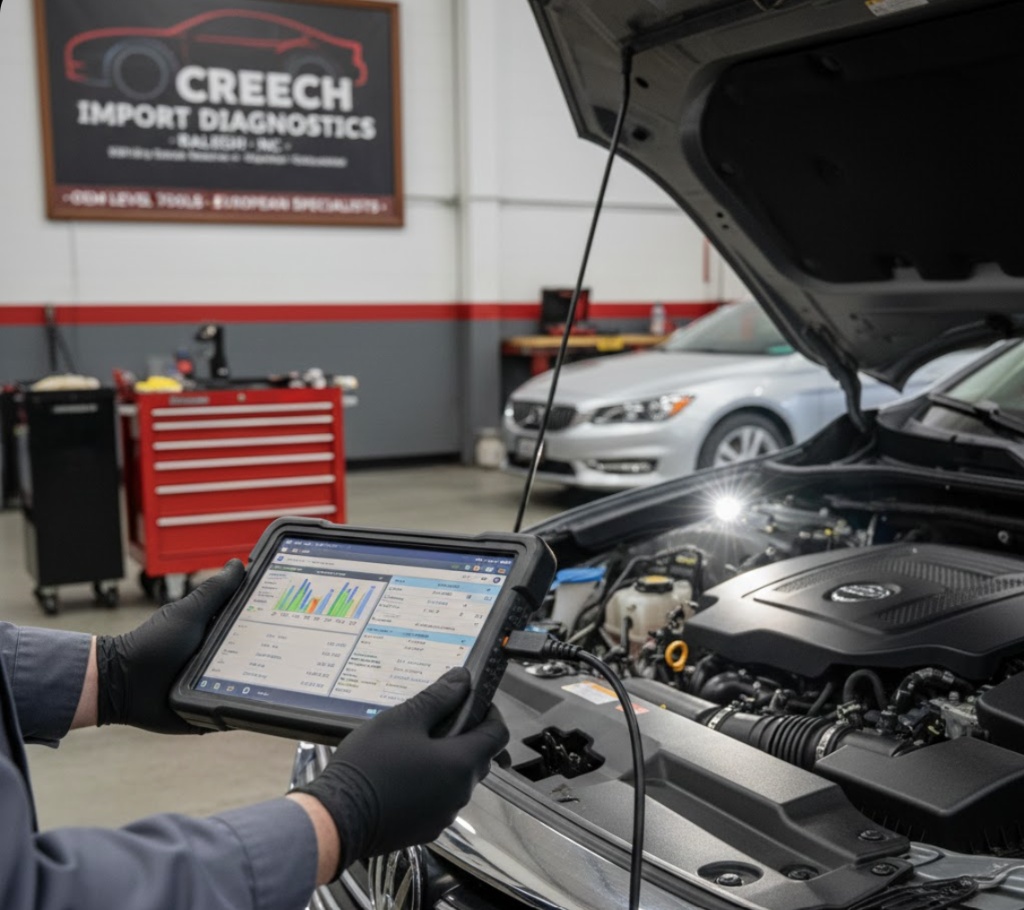
A warning light never switches on “for fun.” Modern imports—from Toyota, Lexus, Honda, Subaru, Mazda, and Nissan to BMW, Mercedes-Benz, Audi, and Volkswagen—run constant self-tests. When something falls out of spec, your car logs diagnostic trouble codes (DTCs), stores freeze-frame data, and may trigger the check engine, ABS, SRS, or hybrid system light. Guesswork at this moment is expensive; Import Diagnostics in Raleigh is how you replace uncertainty with a measurable plan.
Creech Import (1818 St. Albans Dr #106, Raleigh, NC 27609) performs OEM-level Import Diagnostics using manufacturer-capable scan tools, guided functional tests, Mode $06/monitor data, and targeted electrical/mechanical verification. The goal is simple: find the root cause, fix it the right way, and—when applicable—finish with an inspection-ready vehicle for Wake County’s OBD emissions program.
Why Import Diagnostics in Raleigh Matters
Local inspection reality: Wake County participates in North Carolina’s OBD-II emissions inspection. If the check engine light is on or too many readiness monitors are incomplete, you fail—even if the car “drives fine.” Understanding how monitors set (and how to complete the correct drive cycle) is core to passing. Creech Import aligns Import Diagnostics Raleigh with inspection requirements so your solution is both correct and compliant.
Cost control: Replacing parts based on a code name (e.g., “O2 sensor” or “EVAP leak”) without testing wastes money. A professional diagnostic path uses live data, bi-directional controls, and leak/pressure tests to confirm faults—cutting down comebacks and collateral damage.
Tech complexity: Imports often hide crucial data behind manufacturer-specific parameters. Generic tools may only see the headline DTC; Import Diagnostics in Raleigh with OEM-capable equipment reads the full picture—hybrid battery cooling behavior, turbo wastegate control, variable valve timing (VVT) targets vs. actuals, network faults, and more.
What Import Diagnostics Actually Involves (Beyond a Code Reader)
OBD-II essentials (J1979) in plain English
- DTCs: Codes that point to systems out of range (e.g., P0171 “system too lean”).
- Freeze-frame: Snapshot of sensor data when a fault occurred—useful for recreating conditions.
- Readiness monitors: Built-in self-tests (e.g., catalyst, O2, EVAP) that must complete for inspection.
- Mode $06: Test results for specific components/monitors. Even when no code is set, Mode $06 can show marginal results trending toward failure.
- PIDs (live data): Real-time values like fuel trims, O2/AFR switching, MAF/MAP readings, misfire counters, and temperatures.
Key point: A free scan lists a DTC; Import Diagnostics Raleigh explains why that DTC set—then proves the cause.
The Creech Import Diagnostic Workflow (Step-by-Step)
1) Symptom capture & intake
We interview you about conditions (cold start vs. hot, highway vs. city, A/C on, recent fuel or service) and note any intermittent patterns. Context helps us replicate the problem and shorten testing.
• Book your visit: Contact Us
• See service scope: Auto Repair Services
2) Global scan & network health
We interrogate every module: engine, transmission, ABS, SRS, body control, 4WD/AWD, hybrid/EV, and gateway. Network problems (CAN bus faults, module timeouts) can masquerade as sensor failures. We record DTCs, pending/permanent codes, and freeze-frame for each module.
3) Live data correlation & rationality checks
We examine relevant PIDs under the same conditions that set the fault. Examples:
- Fuel trims (STFT/LTFT) under idle/cruise/load to detect air leaks, metering bias, or fuel delivery issues.
- O2/AFR sensor activity (switching speed, amplitude, heater performance) and catalyst storage efficiency.
- MAF/MAP correlation for load calculation accuracy.
- ECT/IAT rationality (engine coolant vs. intake air temp sanity checks).
- Misfire counters per cylinder to isolate ignition, compression, or injector issues.
4) Guided functional tests (prove or disprove)
- Bi-directional controls: Command components (purge valve, EGR, fans, pumps) to watch system response.
- EVAP integrity: Smoke test lines/canister, verify venting and purge functions.
- Electrical verification: Voltage drop, continuity, and scope analysis (e.g., crank/cam signals).
- Induction leaks: Smoke/pressure testing to catch micro-leaks missed by visual inspection.
- Hybrid-specific: Battery isolation checks, coolant pump operation, temperature delta across modules, and contactor control.
5) Root cause, estimate, and readiness plan
We explain the cause in plain language, provide a prioritized estimate, and, if your inspection is due, outline the drive cycle steps to complete readiness monitors once repairs are finished. See inspection info: NC State Inspection.
6) Prove-out drive & documentation
After repairs, we road-test to verify live data and Mode $06 results, then confirm monitor completion where required. You leave with a clear record of what we found and what fixed it. For ongoing care, we can coordinate preventive visits via Auto Repair and Oil Change.
Raleigh-Specific Context That Affects Diagnostics
OBD emissions counties & readiness rules
Wake County’s OBD program checks for active MILs and a limited number of not ready monitors (varies by model year). Clearing codes right before inspection resets monitors and may trigger an automatic fail until drive cycles complete.
Seasonal impacts on imports
- Summer heat & humidity: Increases EVAP test frequency and can expose weak purge valves, vent valves, and canisters. Heat also stresses cooling fans, radiator efficiency, and A/C pressure sensors.
- Winter cold starts: Highlight weak batteries, sensitive AFR sensors, and sticky VVT components that depend on oil quality. Regular service via Oil Change protects timing actuators and chain tensioners in modern imports.
Fuel quality & short-trip driving
Short trips in Midtown/North Hills can leave monitors incomplete for weeks. We outline a drive plan to complete them efficiently after repairs.
Import-Specific Strengths (Where Expertise Pays Off)
- Asian & European brand depth: See All Makes for coverage; we use tooling that accesses manufacturer-specific data and tests.
- Hybrid systems: From Prius to Accord Hybrid, we test cooling loops, battery/contactors, isolation resistance, and hybrid drivability faults that generic scanners miss.
- Networked diagnostics: Modern imports are rolling networks. We diagnose CAN faults, gateway errors, and module power/ground issues that can cause symptom cascades.
- Data plus verification: We don’t “vote” on parts. We prove failures.
Common Scenarios: How Import Diagnostics Raleigh Solves Them
P0420/P0430 (Catalyst efficiency below threshold)
Symptoms: MIL on; sometimes sulfur smell or reduced power.
Why it’s tricky: The code points to the catalyst, but root causes include air leaks, biased O2/AFR sensor, misfires, or fuel trim skew.
Our approach:
- Verify upstream sensor switching and heater function
- Smoke test for leaks; correct MAF/air metering bias
- Recheck fuel trims under load; review Mode $06 catalyst data
- Replace the converter only if it fails criteria after upstream faults are corrected
(Any converter replacement should follow emissions/warranty guidance—verify specifics before publishing.)
EVAP small leak / loose cap codes
Symptoms: Occasional MIL, often after refueling.
Our approach:
- Cap integrity, purge flow checks, vent valve function
- Smoke the system; verify leak rate vs. spec
- Confirm monitor runs and passes during post-repair drive
Intermittent misfire under load
Symptoms: Hesitation, flashing MIL during acceleration.
Our approach:
- Coil/plug inspection and scope, injector balance tests
- Fuel pressure under load, MAF sanity checks
- Compression/relative compression where indicated
Hybrid warnings (HV battery, isolation, or cooling)
Symptoms: Power reduction, hybrid system MIL, unusual fan cycles.
Our approach:
- Battery isolation test and temperature delta mapping
- Coolant pump operation and bleed procedures
- Inverter/converter thermal monitoring and fault history review
“First-Time-Right” Saves Time & Money
- Avoid parts roulette: Every unnecessary part is cost and downtime. Root-cause Import Diagnostics in Raleigh means fewer surprises.
- Inspection confidence: We pair the fix with the right drive cycle so readiness completes and you can pass.
- Preventive insight: Borderline data (e.g., long-term trims drifting) becomes an early warning you can plan around.
(If citing averages or dollar figures—for example, national average check-engine repair cost—flag them [Human verification required] before publication.)
Preparing for Your Diagnostic Visit
- Don’t clear codes beforehand—this deletes freeze-frame and resets monitors, slowing inspection readiness.
- Bring details: When it happens (speed, temp, fuel level, A/C on/off), audio/video if safe, and any recent services.
- Share your timeline: If inspection is due soon, we’ll sequence the repair and the monitor-setting drive together.
Start here: Contact Us.
Local/Operational Details
- Address: 1818 St. Albans Dr #106, Raleigh, NC 27609
- Service area: Raleigh, Midtown/North Hills, North Raleigh, Cary, Wake Forest, and the Triangle
- Turnaround: Same-day or next-day diagnostics for most concerns; hybrids/network faults may require extended testing
- From diagnosis to fix: Explore Auto Repair Services and Auto Repair
- Preventive care: Keep modern imports healthy with scheduled Oil Change intervals and inspection readiness checks
- About the shop: Learn more about owner Stan Creech and our values: About Us
Case Examples (Anonymized Summaries)
2016 Lexus ES • Lean code (P0171) & rough idle
- Data: LTFT +9–12% at idle, MAF g/s low for displacement, purge duty unstable.
- Tests: Smoke found minor induction leak; purge valve intermittently sticking.
- Repair: Correct leak, replace purge valve, service MAF.
- Result: Fuel trims normalized; monitors set; passed OBD inspection.
([Human verification required] for exact numbers.)
2014 Subaru Forester • Catalyst efficiency (P0420)
- Data: Upstream O2 slow switching; exhaust leak at flex; trims elevated under cruise.
- Tests: Repair leak, verify trims; Mode $06 catalyst failed after upstream corrected.
- Repair: Replace converter; re-test.
- Result: MIL off; catalyst monitor passed drive cycle.
2017 Toyota Prius • Hybrid system warning under load
- Data: Hybrid battery temp delta exceeded spec on long grade; inverter temps normal.
- Tests: Pump command erratic; coolant flow weak; bleed procedure needed after pump replacement.
- Repair: Replace HV battery cooling pump, bleed system, confirm temps.
- Result: No further warnings; hybrid monitor completed within two drive cycles.
Ready to replace warning lights with certainty? Schedule Import Diagnostics in Raleigh now: Contact Us.
FAQs
1) What’s the difference between a free code scan and Import Diagnostics Raleigh at Creech?
A free scan lists a code name. We read all modules, analyze live data, use Mode $06, run guided tests, and confirm the failure before recommending parts.
2) Can you help me pass NC emissions if my monitors aren’t ready?
Yes. We identify why monitors won’t complete, perform the repair, and then follow the drive cycle so the car is inspection-ready at NC State Inspection.
3) Should I clear my codes before coming in?
No. Clearing codes erases freeze-frame and resets monitors, which delays both diagnostics and inspection readiness.
4) Do you handle hybrid/EV diagnostics?
Yes. We test hybrid battery cooling, isolation, and drivetrain modules using brand-appropriate procedures and safety protocols.
5) Do you work on my brand of import?
Very likely. See All Makes or share your VIN via Contact Us.
6) How long does a thorough diagnostic take?
Simple faults can be same-day; intermittent, network, or hybrid issues may require extended testing and road logs.
7) Will diagnostics actually save me money?
In most cases, yes—because the fix is based on proof, not trial-and-error. For any cost claims, we’ll reference your estimate and outcomes
8) Can you complete the drive cycle for me?
When appropriate, yes. After repairs, we can perform a prove-out drive to complete readiness.
Sources
- NCDMV — Emissions Inspections (OBD counties & requirements)
https://www.ncdot.gov/dmv/title-registration/emissions-safety/Pages/emissions-inspections.aspx - NC DEQ — Emissions Inspection Results & OBD Connection
https://www.deq.nc.gov/about/divisions/air-quality/motor-vehicles-and-air-quality/inspection-maintenance-im-program/emissions-inspection-results-information - NHTSA — OBD Basics & Diagnostic Framework (technical context)
https://static.nhtsa.gov/odi/tsbs/2014/MC-10115616-9999.pdf - EPA/OBD Program Notes & Readiness Topics
https://19january2017snapshot.epa.gov/state-and-local-transportation/vehicle-emissions-board-diagnostics-obd_.html - OBD Readiness Monitors & Drive Cycles (reference explainer)
https://epa.ohio.gov/divisions-and-offices/air-pollution-control/e-check/06-obd
https://www.ohioecheck.info/media/documents/OBDReadinessDriveCycles.pdf - OBD-II PIDs (J1979) overview
https://en.wikipedia.org/wiki/OBD-II_PIDs
https://github.com/OBDb/SAEJ1979
Average Check-Engine Repair Cost (context; verify)
https://www.cars.com/articles/report-average-car-repair-costs-were-down-in-2024-tariffs-threaten-to-increase-prices-507808/