


Creech Import Repair | Raleigh, North Carolina
Car Stuck in Limp Mode? 7 Possible Causes and What to Do
You're driving normally when the car suddenly stops responding to the accelerator as expected. It might struggle to climb a hill, refuse to shift into another gear, or display a warning such as "Reduced Engine Power." The engine still runs, but the vehicle feels unusually slow or restricted.
A car stuck in limp mode may have entered a protective operating strategy because one of its control systems detected an abnormal condition. Depending on the vehicle, that system may limit available engine torque, throttle response, transmission shifting, or other functions.
Limp mode is not a diagnosis and is not always caused by a transmission problem. It can involve the engine, throttle controls, electronic sensors, turbocharger controls, transmission, electrical supply, emissions equipment, or overheating.
The important questions are whether the vehicle is safe to control, what warning messages are present, and which fault caused the restriction. This guide explains seven possible cause categories, how to recognize restricted-power operation, why restarting the engine may not solve it, and what professional diagnosis involves.
Quick Answer
What Does It Mean When a Car Is Stuck in Limp Mode?
Limp mode is an informal term for a protective operating strategy that reduces vehicle performance when a control system detects certain faults. Depending on the manufacturer, the vehicle may limit acceleration, engine speed, available torque, or transmission gear selection. Common possible triggers include sensor problems, electronic throttle faults, transmission faults, turbocharger boost issues, electrical problems, emissions-system faults, and overheating. There is no universal limp-mode speed limit. If power loss makes the vehicle unsafe to drive, or if overheating, severe misfiring, smoke, or fluid leakage occurs, stop safely and arrange professional assistance or towing.
What Is Limp Mode and Why Does a Vehicle Enter It?
Modern vehicles use electronic control modules to monitor and coordinate engine operation, transmission functions, emissions systems, and other equipment. These modules receive information from sensors and calculate commands for components such as the throttle actuator, fuel system, transmission controls, and boost-control hardware where equipped.
When certain signals are implausible or a monitored condition is outside an acceptable operating range, the control system may select a fallback strategy. These strategies are sometimes called limp-home mode, failsafe operation, reduced-power mode, or protection mode.
The goal is usually to manage risk to vehicle components or maintain limited functionality under a detected fault. The exact behavior depends on vehicle design and the type of failure.
For example, one vehicle may restrict engine torque after detecting an electronic throttle-control problem. Another may limit transmission gear selection after a serious shifting fault. A third may reduce engine output because of high operating temperatures.
Not all reduced-power conditions are explicitly labeled "limp mode" by the manufacturer. Some vehicles display a descriptive warning, while others only show the check engine light or a transmission message.
Does Limp Mode Protect the Engine?
Some protective strategies are designed to reduce stress on the engine, transmission, or another system, but they do not guarantee that the vehicle can continue operating without damage.
If a severe overheating problem, major loss of lubrication, or internal mechanical defect exists, the vehicle may still sustain damage even with power restricted.
Think of reduced-power operation as a warning that the car is no longer functioning normally, not permission to finish a long trip.
Does Every Car Have a Limp Mode?
Many electronically controlled vehicles use some form of fallback or protective operation, but not every car implements the same strategy or uses the same term.
Some conditions cause reduced torque, others restrict a transmission to a limited number of gears, and some faults may prevent restarting altogether.
The owner's manual and manufacturer service information for the exact vehicle determine what a given message or operating condition means.
Engine Power Restriction
The vehicle limits available torque, acceleration, or throttle response.
Transmission Protection
Gear selection or shifting behavior changes because of a detected transmission-related concern.
Thermal Protection
Some vehicle systems reduce performance when monitored temperatures exceed specified limits.
Is Limp Mode the Same as a Check Engine Light?
No. A check engine light indicates a detected condition monitored by the vehicle's diagnostic system. The vehicle may operate normally, run poorly, or enter a restricted operating strategy depending on the fault.
Limp mode refers to the actual change in operation, not simply the presence of a dashboard light.
A steady check engine light without drivability symptoms is a different situation from a vehicle that suddenly loses most of its acceleration while merging into traffic.
For detailed information on warning-light diagnosis, see Creech's check engine light diagnostic services.
What Are the Signs of a Car in Limp Mode?
The strongest clues are an unexpected reduction in performance and a related dashboard warning or diagnostic fault. However, the same symptoms can occur when an engine is misfiring, a transmission is slipping, or another component fails without a deliberately commanded protective mode.
Common reported symptoms include restricted acceleration, a lower-than-normal speed capability, reduced throttle response, a transmission that remains in one gear, and warning messages.
Reduced Acceleration or Engine Power
The engine may produce considerably less torque than usual, making the car struggle during a hill climb or highway merge. Pressing the accelerator farther may produce little additional response.
This can happen during a commanded protective strategy, but it may also occur when the engine is physically unable to produce power. A technician must distinguish those possibilities.
Transmission Stuck in One Gear
Some transmission control systems restrict gear changes when they detect a fault. The vehicle may start moving slowly, operate at unusually high RPM for its speed, or refuse to upshift as expected.
However, a transmission that physically slips or has lost hydraulic pressure can also produce poor acceleration. An abnormal gear display or shifting pattern does not prove limp mode by itself.
Check Engine or Reduced-Power Message
Messages such as "Reduced Engine Power," "Engine System Fault," or "Transmission Malfunction" may appear, depending on the vehicle. These messages have manufacturer-specific definitions.
Some cars illuminate several warning indicators because related systems share information. For example, traction or stability-control functions may be affected when engine-torque information becomes unreliable.
Do not assume multiple warning lights automatically mean several separate parts have failed.
Engine RPM or Speed Seems Limited
Some vehicles limit engine speed or restrict available vehicle speed under certain faults. There is no universal cutoff such as 30, 40, or 60 mph that applies across manufacturers.
If the car cannot maintain a safe speed for prevailing traffic, continued driving can be dangerous regardless of the specific speed displayed.
Can Limp Mode Happen Without Warning Lights?
Drivers may experience restricted power without seeing a familiar warning message. Some alerts appear briefly, and some conditions are intermittent.
However, reduced acceleration without a warning does not necessarily mean the computer has deliberately entered a protective mode. Fuel, ignition, airflow, and mechanical faults can cause comparable symptoms.
Professional diagnostic data and the circumstances of the complaint help determine what occurred.
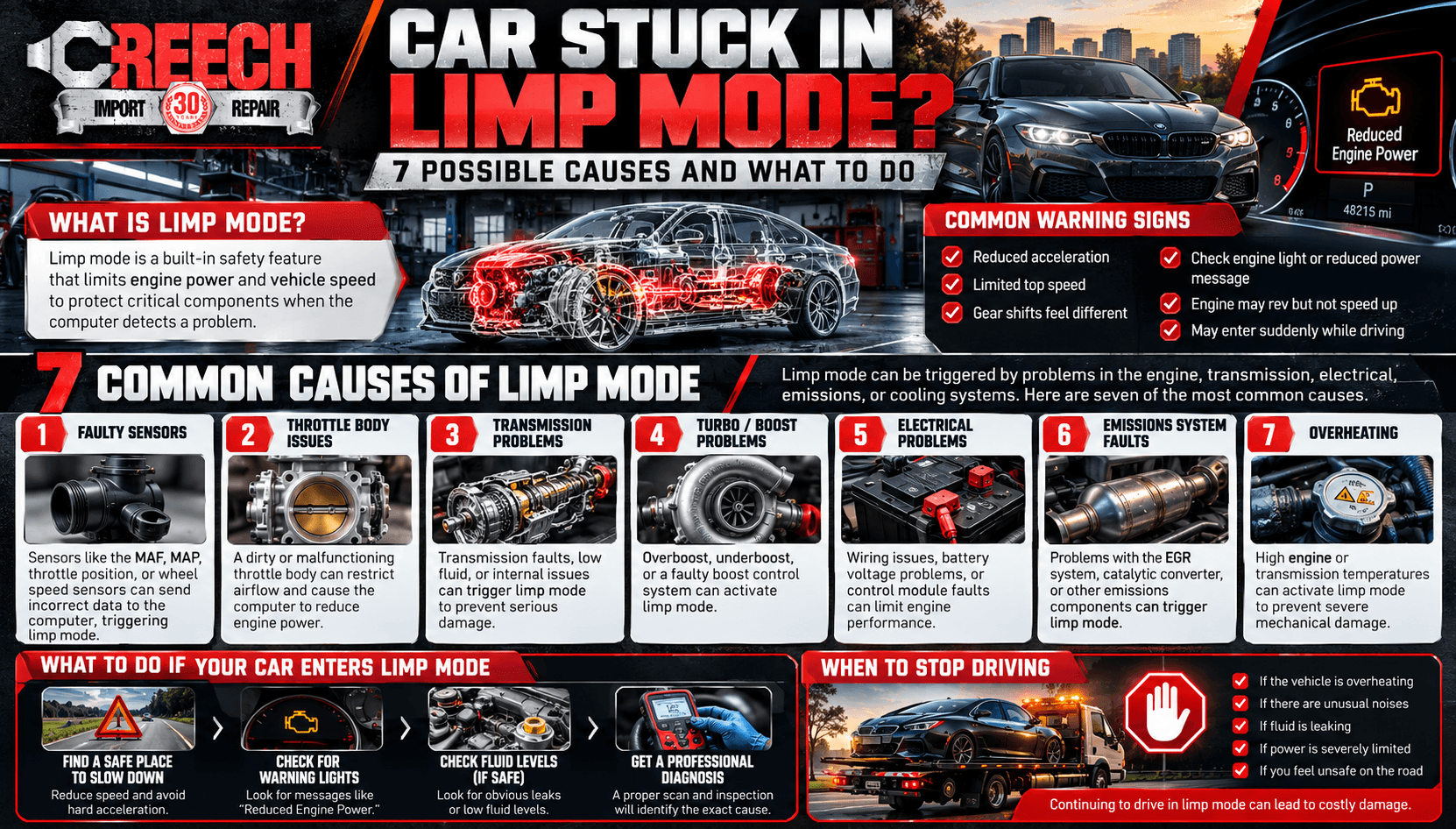
7 Possible Causes of a Car Being Stuck in Limp Mode
The seven categories below explain systems that may trigger reduced-power or failsafe operation in certain vehicles. They are not a statistical ranking, and not every category applies to every make or model.
Sensor Failures or Implausible Engine-Control Signals
Engine control modules depend on data from sensors to calculate airflow, fuel delivery, engine load, temperature, and throttle response. If certain sensor information becomes unreliable, the module may use a substitute value or limit engine operation.
Potentially relevant sensors include the mass airflow sensor, manifold absolute pressure sensor, throttle-position sensors, accelerator-pedal sensors, and other vehicle-specific inputs.
Some faults are electrical, such as damaged wiring or a poor connector. Others involve contamination, an internal sensor malfunction, or an operating condition that causes a valid sensor to report an abnormal value.
For example, an airflow-related diagnostic code does not automatically establish a failed MAF sensor. An intake leak, damaged duct, wiring issue, or another engine problem may produce unusual readings.
A professional diagnosis compares sensor data with actual operating conditions and manufacturer specifications. Replacing every sensor associated with a stored fault code is not a reliable repair strategy.
Wheel-speed sensors may also affect stability-control behavior on some vehicles, but a wheel-speed fault does not universally command engine limp mode. The exact relationship is manufacturer-specific.
Electronic Throttle Body or Accelerator Control Problems
Many modern gasoline engines use electronic throttle control. Instead of a simple cable directly connecting the accelerator pedal and throttle plate, the vehicle uses electronic signals and an actuator to regulate engine airflow.
These systems commonly include multiple monitored signals so the control module can detect certain inconsistencies. If the requested throttle position does not match expected operation, the control system may limit available engine power.
A driver might notice extremely weak acceleration, delayed throttle response, or a dedicated electronic throttle warning.
Possible causes include actuator faults, throttle-position signal problems, accelerator-pedal sensor issues, damaged connectors, wiring faults, or mechanical restrictions in the throttle assembly.
Carbon deposits can affect throttle operation on some vehicles, but cleaning a throttle body is not a guaranteed fix for reduced-power mode.
Some vehicles require manufacturer-specific adaptation procedures after throttle service or replacement. A technician should verify both the fault and any required calibration before returning the vehicle to service.
Transmission Faults or Transmission Protection Mode
Automatic transmissions depend on coordinated hydraulic, mechanical, and electronic controls. When certain monitored problems occur, a transmission control module may change its operating strategy to restrict gear selection or manage torque.
Possible fault areas include shift-control solenoids, pressure-control systems, transmission speed sensors, electrical connections, operating temperatures, and mechanical or hydraulic defects.
A driver may notice harsh shifts, no upshifts, a limited selection of gears, delayed engagement, or poor acceleration.
However, a transmission stuck in one gear is not automatically a software problem. Internal wear, low hydraulic pressure, mechanical damage, and other conditions can create similar behavior.
Transmission fluid condition and level matter for applicable designs, but some transmissions have specialized checking procedures. Owners should not add fluid without confirming the manufacturer's requirements.
Creech already has specific articles about Kia Sorento transmission issues and Equinox transmission-related reduced-power conditions. Those vehicle-specific details belong in those guides, not in this general article.
Here, the key question is whether the transmission controller has deliberately restricted operation or whether the vehicle has an uncommanded mechanical or hydraulic fault.
Turbocharger, Boost Pressure, or Air-Management Faults
Turbocharged engines use forced induction to increase the amount of air entering the engine. Control systems manage boost pressure using components that vary by design, such as wastegates, actuators, sensors, valves, and associated plumbing.
When actual boost differs significantly from the requested value, some engine controllers may reduce torque or select a protective operating mode.
Possible issues include underboost, overboost, damaged charge-air hoses, actuator faults, control problems, and incorrect pressure-sensor information.
Drivers may describe sluggish acceleration, unusual engine response, a warning light, or reduced power during a hill climb.
However, poor boost response does not automatically mean the turbocharger itself has failed. Leaks, control-system faults, sensor issues, and engine operating conditions can produce similar symptoms.
Technicians may compare requested and measured boost, inspect charge-air plumbing, evaluate actuator operation, and use manufacturer-specific tests.
Naturally aspirated engines do not have the same turbocharger control components, so this category does not apply to every vehicle.
Electrical Supply, Wiring, or Control-Module Communication Problems
Modern engine and transmission controllers rely on consistent electrical supply, sound wiring connections, reliable grounds, and communication between vehicle modules.
Low voltage, charging-system problems, corroded connections, damaged harnesses, or communication faults can sometimes cause a module to limit operation or set warning messages.
Some problems are intermittent, appearing after vibration, heat buildup, moisture exposure, or specific operating conditions.
A low-voltage warning does not automatically mean the battery needs replacement. The actual problem could involve the alternator, wiring, grounding, power distribution, or another component.
Similarly, a diagnostic communication code does not establish that the associated module is defective. Network wiring, electrical interference, voltage supply, and other conditions may affect communication.
Professional evaluation can include battery and charging tests, voltage-drop measurements, wiring inspection, module communication checks, and review of multiple stored diagnostic codes.
Creech provides further background in its article on GM electrical diagnosis. That page focuses on model and network-specific electrical problems; this section addresses electrical faults only as possible causes of restricted operation.
Emissions-System or Engine-Protection Faults
Modern emissions systems include oxygen or air-fuel sensors, catalytic converters, exhaust-gas recirculation equipment on applicable engines, evaporative controls, and other vehicle-specific components.
Some faults involving these systems can affect engine operation or trigger manufacturer-specific performance restrictions. Certain diesel vehicles also have emissions-related inducement strategies that are distinct from ordinary gasoline-engine limp mode.
However, not every emissions code causes reduced engine power. A loose fuel cap or a minor evaporative-emissions fault, for example, may illuminate a warning without commanding an immediate torque restriction.
Similarly, a catalytic converter fault code does not always establish a failed converter. Engine misfires, fueling problems, exhaust leaks, and sensor faults can influence emissions-system readings.
A technician may evaluate live sensor information, engine operating conditions, exhaust behavior, fault history, and applicable manufacturer diagnostic procedures.
The appropriate repair should address the verified root cause rather than bypass a control or remove emissions equipment.
For background on engine-warning diagnostics, see Creech's article Why Is My Check Engine Light On?.
Engine or Transmission Overheating
Engines and transmissions operate within specified temperature ranges. When operating temperatures exceed certain limits, some vehicles may reduce power, modify shifting, or use other protective strategies.
Potential causes of excessive engine temperature include coolant loss, cooling-fan malfunctions, thermostat problems, water-pump faults, airflow restrictions, or other cooling-system defects.
Transmission overheating can involve different causes, including cooling problems, excessive load, fluid-related concerns, or internal operating issues, depending on design.
The exact response depends on the manufacturer. Some vehicles provide an explicit high-temperature warning, while others may display a broader reduced-power or transmission message.
Overheating is not a condition to keep testing by driving. Continued operation can result in severe mechanical damage even if the vehicle remains capable of moving.
If the temperature gauge indicates overheating, a critical warning appears, or steam is visible, stop safely and follow manufacturer guidance. Never open a hot pressurized radiator or coolant reservoir cap.
A technician should identify why the system overheated rather than simply clearing a fault code or adding coolant without leak testing when warranted.
How Can You Tell Limp Mode From Other Acceleration Problems?
Not every vehicle that refuses to accelerate is in a commanded protection mode. A misfiring engine, slipping transmission, weak fuel supply, or mechanical problem can also cause sluggish performance.
The combination of warning messages, fault information, engine response, and transmission operation helps distinguish these conditions.
| What You Notice | Possible Explanation | Useful Diagnostic Information |
|---|---|---|
| Reduced Engine Power message with weak throttle response | Possible commanded engine torque restriction | Enhanced engine fault codes, throttle data, operating conditions |
| Transmission remains in one gear | Transmission protection or mechanical/hydraulic transmission fault | TCM codes, commanded gear, input/output speeds, hydraulic condition |
| Rapid bucking and flashing check engine light | Potential serious engine misfire | Misfire information, ignition, fuel and mechanical tests |
| RPM increases but vehicle speed does not | Possible transmission or clutch slip | Engine/transmission speed relationships and mechanical tests |
| Restricted power with overheating warning | Possible thermal protection or severe cooling fault | Temperature readings, coolant condition, cooling system inspection |
| Power loss with turbo/boost code | Possible boost-control restriction or unrelated engine fault | Requested versus actual boost and charge-air inspection |
| Loss of power with several electrical warnings | Possible voltage, communication or control problem | Battery/charging data, grounds and module communication |
Car Stuck in Limp Mode vs. Car Jerking When Accelerating
Jerking refers to an irregular change in driving force. It may result from a misfire, transmission behavior, airflow issue, or drivetrain movement.
Limp mode is a control-system response that may deliberately reduce performance. A car can jerk without being in limp mode, and a car in limp mode may accelerate smoothly but very slowly.
For repeated bucking, stumbling, or load-related hesitation rather than a persistent restriction, see Creech's separate guide to a car jerking when accelerating.
Can a Car Be in Limp Mode Without a Check Engine Light?
Possibly, depending on the vehicle and the fault. Some systems display a manufacturer-specific transmission or reduced-power message without using the familiar engine warning indicator in the same way.
Intermittent faults can also behave differently from persistent faults.
However, weak acceleration with no warning light can come from a fuel-supply problem, misfire, restricted airflow, or mechanical failure. A scan and diagnostic inspection are needed before concluding that a protective strategy is active.
Does Limp Mode Always Limit Speed to 30 or 40 MPH?
No. There is no single speed limit shared by all vehicles and all fault conditions.
Some systems limit engine torque or RPM rather than enforcing a fixed vehicle speed. Others restrict the transmission to particular gears, affecting attainable road speed indirectly.
The operating limits may also change with temperature, load, fault severity, and manufacturer programming. A speed limit mentioned in one model-specific article should never be assumed to apply to another vehicle.
What Should You Do If Your Car Goes Into Limp Mode?
When a vehicle unexpectedly loses acceleration, road safety comes first. Do not focus on clearing a warning message while the vehicle is still moving.
Maintain Control and Avoid Hard Acceleration
Keep your attention on traffic and avoid demanding more power from a vehicle that is not responding normally. Sudden or unpredictable acceleration loss can be particularly hazardous during highway merging or crossing intersections.
Find a Safe Place to Stop
Signal and move out of traffic when conditions allow. If the vehicle cannot keep up with surrounding traffic, do not attempt to complete a highway journey simply because the engine remains running.
Check Warning Messages Once Parked
Record any reduced-power, transmission, engine-temperature, battery or check engine light messages. A photograph taken while safely parked may help document an intermittent alert.
Assess for Serious Hazards
Without approaching dangerous moving or hot components, note any smoke, strong fuel odor, steam, major fluid leakage, severe mechanical noises, or other symptoms that indicate immediate concern.
Follow Vehicle-Specific Instructions
Consult the owner's manual for the displayed warning. Some warnings require stopping immediately, while others describe a restricted operating strategy. Do not assume one generic instruction applies to every vehicle.
Arrange Diagnostics or Towing as Appropriate
If the car remains substantially restricted, the cause is unknown, or safe travel cannot be maintained, contact a qualified repair shop and arrange towing or roadside assistance. Do not repeatedly test the problem under load.
Should You Turn the Engine Off and Restart It?
A restart may temporarily change the vehicle's operating state in some intermittent faults, but it is not a dependable repair.
Never stop the engine while the vehicle is moving to attempt a reset. Once safely parked, follow the owner's manual and the nature of any warnings before deciding whether a restart is appropriate.
If overheating, smoke, fuel leakage, severe mechanical damage, or another serious condition is suspected, do not restart the vehicle to see whether the warning disappears.
Should You Continue Driving Slowly?
Some manufacturer procedures allow limited operation under specific reduced-power conditions. However, this does not mean all limp-mode situations are safe to drive.
If the vehicle cannot accelerate predictably, maintain traffic speed, shift properly, or remain within normal temperature limits, continuing the trip can be unsafe.
Do not interpret a general reference to "limp-home mode" as permission to drive a particular number of miles.
When Should You Stop Driving Immediately?
Stop safely and seek professional or emergency assistance if:
- The vehicle is overheating or displays a critical temperature warning.
- The check engine light is flashing and the engine is running roughly.
- Severe power loss prevents predictable acceleration or safe road speed.
- The engine stalls repeatedly or the vehicle behaves unpredictably.
- There is smoke, a strong fuel smell, or a suspected fire.
- A major fluid leak or low oil pressure warning appears.
- The transmission behaves violently, will not engage correctly, or loses drive.
- Steering, braking, or general directional control is affected.
Move to a safe location if possible. Shut down when serious overheating, fire, or other conditions warrant it, following manufacturer guidance. Arrange towing rather than attempting to drive an unsafe vehicle to a repair facility.
Is It Safe to Drive a Car in Limp Mode?
The safety decision depends on the underlying fault, the manufacturer's instructions, current road conditions, and how severely the vehicle's performance is restricted.
The term "limp mode" can give a false impression that a vehicle is safe to drive indefinitely at reduced speed. In reality, it describes many different protective strategies with different limitations.
A vehicle that cannot safely merge or maintain normal traffic flow can create a collision risk even if there is no visible smoke or overheating.
On a busy Raleigh route such as I-440 or Capital Boulevard, sudden reduced acceleration can leave little room to adjust around faster traffic. If the vehicle cannot maintain a safe speed, get out of traffic when possible and seek assistance.
Can Driving in Limp Mode Cause Damage?
Potentially. Restricting performance may reduce certain stresses, but it does not repair the fault that caused the restriction.
For example, a vehicle experiencing a serious cooling problem may continue overheating even with reduced engine output. A transmission with insufficient hydraulic pressure can still suffer wear or mechanical damage.
Damage is not inevitable in every case, but the risk cannot be evaluated without identifying the actual problem.
What If Limp Mode Happens Only Once?
An intermittent event can still be important. Loose electrical connections, temperature-sensitive components, and certain sensor problems may behave normally between episodes.
Diagnostic information may remain stored even after the warning disappears, although available data varies by vehicle.
Record the date, conditions, warning messages, and recent repairs, then arrange evaluation. If the episode involved serious safety symptoms, seek advice before driving again.
How Do You Get a Car Out of Limp Mode?
The correct approach is to identify and correct the condition that caused restricted operation. There is no universal reset procedure that repairs every vehicle.
Some restrictions clear after the underlying condition is corrected and the control system confirms normal operation. Others require a repair, diagnostic procedure, calibration, or additional checks.
Will Disconnecting the Battery Reset Limp Mode?
Disconnecting the battery is not a dependable or recommended universal fix. On modern vehicles, this can affect learned settings, diagnostic information, or systems requiring specific initialization procedures.
It may also make an intermittent problem more difficult to diagnose if useful fault history is lost.
A battery reset does not repair damaged wiring, an overheated transmission, an electronic throttle fault, or a mechanical engine problem.
Will Clearing Trouble Codes Fix the Problem?
Clearing codes can turn off a warning temporarily without correcting the underlying failure. If the fault remains active or returns, the control system may reenter restricted operation.
Fault information and freeze-frame data can be valuable for diagnosis. When possible, that information should be preserved before clearing codes.
A successful repair requires appropriate testing and verification, not merely an empty code list.
Can You Fix Limp Mode Yourself?
Some underlying conditions may be straightforward after they are properly identified, but the symptom can also involve high-pressure fuel systems, electronically controlled throttles, transmission hydraulics, or other complex components.
Safe owner observations can include reading dashboard warnings and consulting the manual while parked. Avoid bypassing sensors, tampering with wiring, or repeatedly forcing the vehicle to accelerate.
Without a confirmed diagnosis, replacing parts one at a time can increase cost and delay the correct repair.
How Does a Mechanic Diagnose a Car Stuck in Limp Mode?
A useful diagnosis establishes whether a control module has commanded protective operation and why it did so. The repair shop must also distinguish commanded power reduction from a mechanical problem that merely feels similar.
Document the Original Complaint
The technician records warning messages, vehicle speed, throttle response, shift behavior, temperature conditions, and whether the problem occurred once or repeatedly. Recent maintenance and electrical work may be relevant.
Scan the Appropriate Control Modules
Engine, transmission, and other relevant modules may contain stored, pending, manufacturer-specific, or history codes. A basic generic code reader may not access all of this information.
Review Freeze-Frame and Live Data
Available measurements may include engine load, temperatures, throttle commands, sensor readings, boost pressure, transmission operating data, and control-system status. The vehicle's design determines which values are useful.
Perform Targeted Mechanical and Electrical Tests
Depending on findings, testing may involve wiring, charging-system measurements, intake inspection, hydraulic pressure, cooling-system evaluation, or manufacturer-specific actuator tests.
Confirm the Root Cause
A diagnostic code identifies a monitored condition or system, not automatically the exact defective part. The proposed repair should follow evidence that links the fault to the observed reduced-power operation.
Verify Normal Operation After Repair
After repairs, technicians should complete relevant calibration or verification procedures and confirm the original symptom is resolved when safe to do so. Any associated warning conditions should also be addressed.
Can a Cheap OBD-II Scanner Identify Limp Mode?
A basic scanner may display certain emissions-related codes and help reveal an engine control concern. However, advanced transmission information, enhanced manufacturer codes, network faults, and commanded torque-limit data may not be available through generic equipment.
Even when a scanner identifies a relevant code, component testing may still be necessary. A fault code for an electronic throttle system, for example, does not automatically mean the entire throttle body requires replacement.
Do Mechanics Need to Road-Test a Car in Limp Mode?
Not always. If the vehicle is severely overheating or has another immediate safety concern, a road test may be inappropriate.
Some faults can be evaluated through stationary inspection, fault data, electrical testing, or controlled procedures. A road test should only occur when the vehicle is safe and when it serves a defined diagnostic purpose.
Should You Replace the ECU or TCM?
Not solely because the vehicle is in limp mode. Engine and transmission control modules are possible fault sources, but wiring, voltage supply, sensors, mechanical defects, or other components are often relevant to diagnosis.
Module replacement may also require vehicle-specific configuration, programming, and security procedures. A repair recommendation should identify the testing that supports replacement.
Creech describes its general diagnostic and automotive repair capabilities on its complete auto repair services page.
How Much Does It Cost to Fix a Car in Limp Mode?
There is no single repair price because limp mode is a response to a fault, not a specific failed component.
A damaged sensor connector, faulty throttle actuator, boost leak, cooling-system defect, transmission problem, or electrical control issue may all require different parts, testing, and labor.
Vehicle year, make, model, engine configuration, transmission type, and component access also influence the estimate.
| Possible Fault Area | Potential Repair Work | What Affects Cost |
|---|---|---|
| Sensor or wiring fault | Repair wiring, connectors, or a verified defective sensor | Fault location, access, testing, parts |
| Electronic throttle | Repair electrical control, actuator, or related components | Assembly design, calibration and diagnosis |
| Transmission protection | Repair confirmed hydraulic, mechanical, or electronic fault | Transmission design, internal condition, required disassembly |
| Turbo or boost control | Repair charge-air leak, actuator, sensor, or other verified defect | Turbo configuration, access, specific failed component |
| Electrical supply or network | Correct voltage, ground, wiring, or module-related fault | Intermittent diagnosis, harness location, programming |
| Emissions-related fault | Repair verified engine or emissions-system problem | Root cause, emissions equipment, labor requirements |
| Overheating | Cooling-system or related repair | Source of heat, leakage, possible secondary damage |
Can Limp Mode Be Caused by an Inexpensive Problem?
Yes. Certain electrical connections or relatively accessible parts can create serious-looking symptoms. But the reverse is also true: a seemingly minor reduced-power warning can involve a costly internal or mechanical fault.
The warning message and the number of dashboard lights do not reliably predict the final repair cost.
Can a Limp-Mode Repair Require Transmission Replacement?
In some severe cases, major transmission work may be necessary. However, transmission replacement should not be assumed simply because the vehicle is stuck in a gear or displays a reduced-power message.
Appropriate diagnosis may reveal a serviceable electrical, hydraulic, or control issue. In other cases, internal damage may be confirmed.
Creech's existing transmission service guide covers maintenance and transmission warning signs in greater detail.
Does Early Diagnosis Save Money?
Prompt diagnosis may help prevent continued operation with a damaging fault, but it does not guarantee an inexpensive repair.
The principal benefit is establishing what has actually failed and helping the owner make a safer, better-informed decision.
What Should You Ask Before Approving the Repair?
Ask what tests confirmed the fault, whether the vehicle is safe to move, which components require replacement, and whether additional programming, calibration, or testing is necessary.
Request a vehicle-specific written estimate. A shop should explain the difference between an initial diagnostic charge and an approved repair.
Does Limp Mode Work Differently on Honda, Toyota, Subaru, Nissan, and Other Vehicles?
Yes. Protective strategies differ between manufacturers, models, engines, transmissions, and software versions. A message that appears on one vehicle may have no equivalent on another.
It is important not to assume that a fault commonly discussed for a particular model applies to every vehicle from the same brand.
Honda and Acura Reduced-Power Conditions
Depending on the model and generation, Honda and Acura vehicles can use electronic throttle control, integrated engine/transmission controls, and related safety strategies that affect acceleration.
If an engine or transmission warning appears with limited performance, diagnosis should begin with the exact warning and the applicable control modules.
A vehicle with a severe misfire or other mechanical engine fault may also lose power without a deliberate limp-mode command.
Toyota and Lexus Reduced-Power Operation
Toyota and Lexus vehicles include gasoline, hybrid, and other drivetrain configurations. Protective operation may involve engine, hybrid, transmission, or other control systems depending on the vehicle.
On hybrid vehicles, weak propulsion can involve systems that do not exist on conventional gasoline models. A general limp-mode guide cannot replace model-specific hybrid diagnostic procedures.
Follow manufacturer warning instructions and use qualified service personnel for high-voltage-related concerns.
Subaru Reduced-Power and CVT Concerns
Some Subaru models use continuously variable transmissions alongside electronically controlled gasoline engines.
Reduced acceleration may involve engine operation, transmission control, or another subsystem. A limited shifting response should not automatically be interpreted as complete CVT failure.
A proper investigation evaluates the specific transmission and engine data available on that model.
Nissan and Infiniti Limp-Mode Complaints
Nissan and Infiniti vehicles use different transmission and engine designs across their model lines. Some use CVTs; others have conventional automatic or manual transmissions.
Drivers may report power restriction, delayed response, or unusual shifting. Those descriptions alone do not establish the presence of a particular transmission defect.
Manufacturer-specific testing is needed to identify whether the problem originated in the engine, transmission, controls, or another system.
What About Chevrolet, GMC, and Buick?
Some GM vehicles display an explicit "Reduced Engine Power" message. Depending on the model, a fault may affect throttle response or other powertrain operation.
However, not every GM reduced-power concern has the same cause. Creech's existing Chevrolet and GM-specific articles address particular model systems and transmission configurations.
Use this general article to understand protective restricted-power behavior, then consult the appropriate model-specific information where relevant.
Car Stuck in Limp Mode in Raleigh, NC? Get Professional Diagnostics.
If your vehicle suddenly limits acceleration, displays a reduced-engine-power message, or refuses to shift normally, identifying the cause matters more than simply clearing the warning.
Creech Import Repair has served Raleigh since 1993. Its ASE-certified technicians provide automotive diagnostics, check engine light evaluation, engine-performance service, and general auto repair, with a focus on Asian import vehicles and limited domestic vehicle service.
Whether the problem appeared while commuting on I-440, accelerating onto Capital Boulevard, or driving through a neighborhood, tell the service team exactly what happened, including any warning messages, temperature changes, or unusual shifting.
If your vehicle cannot accelerate predictably, is overheating, or has another serious safety concern, arrange safe transportation rather than driving it to the shop.
Creech Import Repair
1818 St. Albans Dr #106
Raleigh, NC 27609
Phone: 919-872-1999
Business Hours: Monday-Friday, 7:30 AM-5:30 PM
Online appointment requests require confirmation from Creech Import Repair's service team. Report severe loss of power or other safety concerns when contacting the shop.
Frequently Asked Questions About Cars Stuck in Limp Mode
1. What causes a car to go into limp mode?
A car may enter limp mode when a control system detects a fault that requires restricted engine or transmission operation. Depending on the vehicle, possible triggers include sensor problems, electronic throttle faults, transmission-control issues, turbocharger boost faults, electrical supply problems, certain emissions-system faults, or overheating. The system may limit torque, acceleration, or gear selection. Because other mechanical problems can produce similar symptoms, diagnostic codes and vehicle-specific testing are needed to determine whether protective operation is actually being commanded.
2. How do I get my car out of limp mode?
The proper way to restore normal operation is to identify and correct the underlying fault. There is no universal limp-mode reset that repairs every vehicle. Some conditions may clear after an appropriate repair and verification procedure, while others require additional diagnosis, calibration, or programming. Restarting the engine or clearing trouble codes may only hide an intermittent symptom. If the car is overheating, severely underpowered, smoking, or otherwise unsafe, stop driving and arrange professional assistance rather than attempting repeated resets.
3. Can I drive my car while it is in limp mode?
Whether limited driving is possible depends on the manufacturer's instructions, fault severity, and road conditions. Some protective strategies allow restricted vehicle operation, but others accompany faults that make driving unsafe. If the car cannot maintain traffic speed, accelerate predictably, shift properly, or remain within safe operating temperatures, stop safely and seek assistance. A vehicle that still moves is not necessarily safe to drive, and there is no universal safe distance for every limp-mode condition.
4. Will restarting the engine clear limp mode?
A restart may temporarily change the operating state of some vehicles with intermittent faults, but it does not reliably repair the cause. Reduced-power operation can return as soon as the underlying condition is detected again. Do not switch off the engine while moving to attempt a reset. If there is serious overheating, smoke, fuel leakage, or mechanical damage, do not repeatedly restart the vehicle. Preserve warning information and arrange diagnosis to determine why the restriction occurred.
5. Can a bad battery cause limp mode?
In some vehicles, inadequate voltage or electrical supply problems can affect control-module operation and contribute to restricted performance. However, a reduced-power warning does not automatically indicate a defective battery. Charging-system problems, poor grounds, damaged wiring, connectors, and communication faults may also be relevant. A technician should test battery condition, charging output, power supply, and appropriate modules rather than replace the battery based solely on symptoms or warning lights.
6. Can a transmission problem put a car into limp mode?
Yes. Some automatic transmission controllers use protective strategies when they detect serious electrical, hydraulic, temperature-related, or shifting faults. The transmission may remain in a limited gear range or behave differently from normal. However, a vehicle that will not shift can also have a mechanical or hydraulic failure without a deliberate protection command. Diagnosis should compare transmission codes, commanded gear, speed readings, and relevant mechanical findings before determining whether a major transmission repair is needed.
7. Why is my car in limp mode with no check engine light?
Some vehicles use manufacturer-specific messages or transmission warnings rather than the familiar check engine light for certain conditions. Intermittent faults may also behave differently from persistent faults. However, limited acceleration without a light does not prove the car is in limp mode. Fuel delivery, ignition, airflow, and mechanical problems can also reduce power. A qualified technician can examine relevant module data and operating conditions to determine whether restricted performance was deliberately commanded.
8. How much does it cost to fix limp mode?
Limp mode does not have a standard repair price because it can be triggered by many different systems. A wiring repair, sensor replacement, electronic throttle fault, cooling-system problem, and internal transmission defect require very different labor and parts. Vehicle design, component access, testing time, and secondary damage also affect the estimate. The shop should verify the root cause and provide a vehicle-specific repair plan rather than quote a universal price for removing limp mode.
9. Can limp mode cause permanent engine damage?
Limp mode itself is usually a protective operating strategy, but the fault that triggers it may still cause damage if the vehicle continues operating. A severe cooling failure, inadequate lubrication, transmission defect, or persistent misfire can have serious consequences even if engine output is restricted. Reduced power does not guarantee the vehicle is protected from all harm. Follow manufacturer warnings, stop for serious symptoms, and obtain diagnosis before returning to normal driving.
10. How does a mechanic diagnose a car stuck in limp mode?
A technician first records the symptoms and warning messages, then scans the engine, transmission, and other relevant modules. Available freeze-frame and live data may reveal abnormal sensor readings, throttle commands, temperatures, boost pressure, transmission behavior, or electrical conditions. The technician performs manufacturer-specific tests to verify the actual fault before recommending repair. When safe, operation is checked after the repair to confirm that the original restriction and related warnings have been addressed.

Automotive Technical Review
Reviewed by Creech Import Staff
Creech Import Staff represents the automotive service team at Creech Import Repair, a Raleigh automotive repair business established in 1993.
The company employs ASE-certified technicians and offers diagnostic services, engine-performance evaluation, electrical system repair, general auto repair, and vehicle maintenance.
Learn more about Creech Import Repair's history, qualifications, technicians, service philosophy, and commitment to customer care.
Meet Creech Import Repair →Technical Sources and Evidence Limits
This article summarizes general automotive diagnostic principles. The term "limp mode" does not represent one standardized fault or operating speed. Vehicle-specific owner manuals, manufacturer diagnostic procedures, and observed test results determine the appropriate response and repair.
- Creech Import Repair. Check Engine Light Diagnosis. Information about vehicle fault warnings and professional diagnostic procedures.
- Creech Import Repair. Complete Auto Repair Services. Verified local business service information.
- Creech Import Repair. Why Is My Check Engine Light On? Related information about engine warnings and sensor-related faults.
- Creech Import Repair. Kia Sorento Transmission Issues. Vehicle-specific transmission fault and restricted-operation examples.
- Creech Import Repair. GM Electrical Diagnosis in Raleigh. Related electrical and control-module diagnostics.
- Creech Import Repair. Why Regular Transmission Service Is Crucial. Further information about transmission operation and maintenance.
- National Highway Traffic Safety Administration. Vehicle Safety Recalls. Official resource for checking applicable safety recalls by vehicle identification number.
- Creech Import Repair. About Creech Import Repair. Company history, experience, and technician qualifications.
Find Creech Import Service articles useful?
Add this site to your Preferred Sources in Google Search.