


Car battery dies overnight? The answer may be a battery that cannot hold enough charge, a charging problem during the previous drive, or an electrical device that continues using power after the car is parked. A jump-start may get you moving, but it does not tell you which of those happened. The useful question is where the charge went and whether the battery can still store enough energy to start the engine.
If your car battery dies overnight again after a jump-start, resist buying another battery on a guess. A new battery can also go flat if a circuit stays awake or the vehicle does not recharge it properly. This Raleigh-focused guide explains what to notice, which checks are safe to make, and how a repair shop separates the possible causes.
The Short Answer
An overnight no-start needs a battery condition test and a charging-system check. If those do not explain the repeated discharge, a technician can test for an excessive key-off electrical draw after the vehicle’s electronics enter their normal sleep state. Also check for an obvious light or accessory left on. The pattern offers clues; testing identifies the cause.
What Does “Dead Overnight” Actually Mean?
Start with what the car did when you tried to leave. Did the engine turn slowly, click repeatedly, click once, or stay silent? Did the interior lights dim sharply during the attempt? A drained or failing battery is one possibility, but loose terminals, a starter-circuit problem, or another no-start condition can feel similar from the driver’s seat. Lights that turn on are not proof that the battery can supply the much greater current needed to crank an engine.
Write down how long the car sat before it failed. An overnight problem is different from a car that sits unused for several weeks. Also note whether the issue happens every morning, only after a weekend, after a short drive, or after adding an accessory. These details help a technician reproduce the circumstances instead of testing a freshly jump-started car without its history.
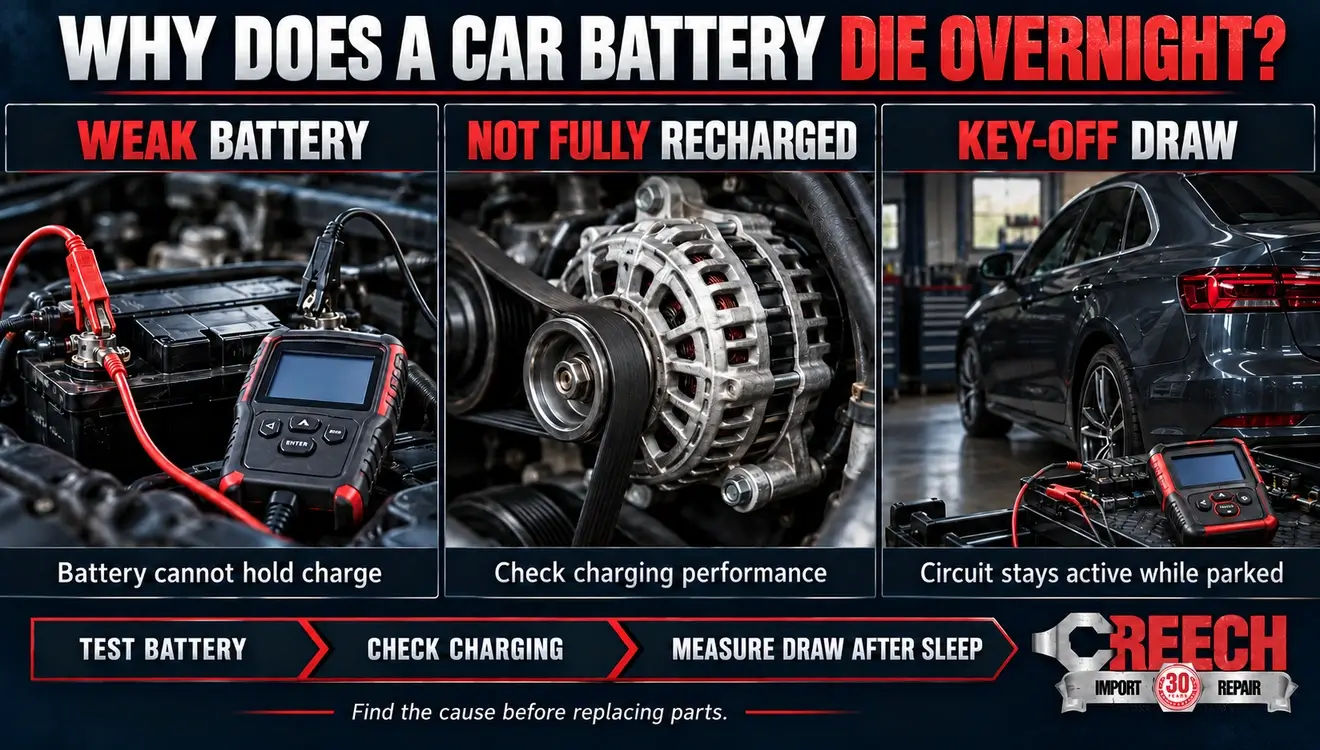
Three Possible Paths to the Same Morning Problem
01 The battery cannot hold charge. It may be aged, damaged, deeply discharged, or otherwise unable to deliver enough starting power.
02 It was not adequately recharged. A charging fault, connection problem, or driving pattern can leave the battery low when you park.
03 The parked car uses too much electricity. A light, added accessory, or electronic circuit may remain active after shutdown.
How Can You Tell Which Cause Is More Likely?
When a car battery dies overnight, the pattern can guide the first tests. None of the following clues is a diagnosis; use them to explain the timeline when you book an electrical inspection.
| What you noticed | Possible direction | Useful test or detail |
|---|---|---|
| Slow cranking that grew worse over time | Battery condition or incomplete charging | Battery health and charging performance |
| Battery warning during the previous drive | Charging system or its connections | Describe the warning; inspect charging and belt drive |
| Started after a dashcam or alarm installation | Possible key-off load or wiring issue | Installation history and parked-current test |
| Starts after a jump; dead again by morning | Weak battery, poor recharge, or parked draw | Test all three in the right sequence |
| Dash lights work but engine will not crank | Battery or starting-circuit concern | Battery under load, terminals, and starter circuit |
Cause 1: A Weak Battery That Cannot Hold a Charge
A car battery can be low on charge and still be healthy enough to use after proper recharging. It can also appear charged yet lack the capacity or starting performance the vehicle requires. Age, heat, repeated deep discharges, internal deterioration, and other conditions affect how well it stores and supplies electricity. A low voltage measurement alone cannot tell you whether the battery is the original problem or a victim of another fault.
Slow cranking, repeated jump-starts, or worsening starting after a period of sitting can point toward battery weakness. They do not prove it. Corroded or loose terminals can also restrict the power delivered to the starter, while an excessive parked draw can repeatedly flatten an otherwise serviceable battery. A technician may need to charge a discharged battery before testing its health so the result is meaningful.
Battery type matters as well. Some vehicles have specified battery technologies or replacement procedures. Tell the shop if a replacement battery was recently fitted and whether the problem began before or after installation. The repair should address the verified cause and confirm that the installed battery suits the vehicle.
Cause 2: The Battery Was Not Fully Recharged Before Parking
While many conventional engines run, the charging system supplies electrical power and replenishes the battery. If the alternator, drive belt, wiring, terminals, grounds, or charging controls do not work as intended, the car may reach your driveway with less stored energy than expected. The engine can sometimes keep running for part of the trip and then fail to restart the next morning. If your car battery dies overnight after an earlier battery-shaped dashboard warning, report that sequence to the technician.
A string of very short trips can also leave a battery with limited time to recover the energy used to start the car, especially when the battery is already weak or many accessories are in use. That pattern is a clue, not proof of a broken alternator. A shop should compare the vehicle’s actual charging behavior with the appropriate service procedure rather than condemn a component based on one reading.
If a battery or charging warning comes on while you are driving, treat the warning as its own immediate safety issue and find a safe place to stop. This article addresses a car that loses starting power after being parked; the driving warning calls for prompt attention while the car is still operating.
Cause 3: An Electrical Draw While the Car Is Parked
When a car battery dies overnight despite apparently normal charging, key-off electrical use deserves attention. A parked vehicle is not always electrically silent. Security equipment, memory functions, clocks, and control modules can use a small amount of electricity after shutdown. That normal use is different from a lamp left on, an aftermarket device with an unsuitable connection, or a module that fails to enter sleep mode. The amount of acceptable draw and the time required to settle vary by vehicle.
Possible suspects include a glove-box or trunk light that stays on, a dashcam in parking mode, an accessory connected to a socket that remains powered, an alarm or audio installation, damaged wiring, or a module that repeatedly wakes. The presence of any one device does not prove it is the culprit. A technician needs to measure the draw under the correct conditions and identify the responsible circuit.
Timing is crucial: opening a door, unlocking the car, or connecting a tool can wake electronics and temporarily increase current. A measurement taken immediately after switching the ignition off can mislabel normal activity as a defect. For a recurring overnight complaint, the shop should let the vehicle enter its expected sleep state, compare the stabilized reading with vehicle-specific information, and isolate the abnormal load if one exists.
What Can You Check Safely Before Booking an Appointment?
- Look for obvious lights. Confirm the cabin, trunk, and glove box close correctly and no visible light remains on. Do not dismantle trim or work around moving or hot components.
- List added equipment. Note any dashcam, tracker, alarm, stereo, charger, or recent electrical repair. If an accessory can be unplugged normally and safely, tell the shop whether doing so changed the pattern. Do not cut or disconnect unfamiliar wiring.
- Record the timeline. Write down the last successful drive, time parked, weather, whether the car was jump-started, and the exact starting symptom. A one-night failure and a several-week storage problem call for different questions.
- Watch for battery damage. If the case appears swollen, leaks, becomes unusually hot, or gives off a strong odor, avoid handling or jump-starting it and request professional assistance.
- Consult the owner’s manual. Use its vehicle-specific instructions for battery access and any permitted jump-start procedure, particularly on vehicles with special electrical systems.
If the car must be jump-started repeatedly, arrange diagnosis instead of treating each jump as the repair. A short drive may not fully recharge a depleted battery, and the original cause may still be present when you park again. If a battery warning appears during that drive, stop safely and request guidance.
When Should You Ask for a Tow?
Ask for transport advice if the car will not start reliably, a charging warning is on, it stalls, the battery appears damaged, or you are unsure whether it is safe to drive. Tell the service team about any overheating, smoke, strong odor, or electrical failures. Do not keep attempting to start a vehicle with a visibly damaged battery.
How Does a Shop Diagnose a Battery That Dies Overnight?
When a car battery dies overnight repeatedly, a useful diagnostic process follows the evidence rather than replacing the first part that seems plausible. Creech Import Repair lists battery, alternator, wiring, and other electrical-system services for Raleigh drivers. The exact tests depend on the vehicle and the complaint, but the sequence generally includes these steps:
- Confirm the symptom and history. The technician asks how long the vehicle sits before failure, whether the concern started after a repair or accessory installation, and whether there was a warning on the previous drive.
- Inspect the obvious power path. Battery terminals, cable connections, grounds, belt condition where applicable, and visible wiring should be considered. A loose connection can mimic a weak battery or create charging trouble.
- Evaluate charge and battery health. The shop determines whether the battery is simply discharged and whether it can perform once appropriately charged. A failed battery test may require replacement, but the reason it ran down still matters.
- Check charging operation. The technician measures charging performance under relevant conditions and considers the vehicle’s control strategy. An alternator is one possible fault, not an automatic conclusion.
- Investigate parked draw when indicated. After the car enters its normal sleep state, the shop checks current use against the correct vehicle procedure. If it is excessive, the technician narrows the responsible circuit and identifies its actual cause.
- Verify the repair. Once the cause is addressed, the battery and system should be checked again. A battery harmed by repeated deep discharge may also need attention even after a draw or charging fault is fixed.
Ask which test separated the possibilities. “The battery was low” describes its condition at one moment; it does not, by itself, explain why it was low. A clear repair recommendation should connect the symptom, test result, cause, and verification step.
Why Does a New Battery Die Overnight Too?
If a new car battery dies overnight, the fresh battery did not shut off an unwanted load or fix a charging fault. It may last longer before going flat, temporarily hiding a problem that affected the previous battery. A connection disturbed during installation or a battery that does not meet the vehicle’s specifications can also deserve inspection.
Tell the shop the battery’s installation date, type if known, and whether the car started normally immediately afterward. If the no-start repeats, the right response is to verify battery condition, charging behavior, connections, and parked draw as appropriate. Buying a second replacement without that evidence can leave the real problem in place.
Is This the Same Problem as a Battery Light While Driving?
They can be related, but they describe different moments. A battery-shaped warning while the engine runs often points toward the charging system and requires a safe response during the drive. An overnight no-start raises the additional question of what happened after the vehicle was switched off. A failing charging system can leave the battery low at parking time; an excessive key-off draw can use up charge later. Both may even exist together.
If the broader question is why your car will not start despite illuminated lights, Creech has a separate guide to a car that will not start when its lights still work. This guide focuses specifically on a battery that repeatedly loses usable starting power while the car is parked.
Battery and Electrical Diagnosis in Raleigh, NC
Creech Import Repair is located at 1818 St. Albans Dr #106, Raleigh, NC 27609. Call 919-872-1999 and share your car’s year, make, and model, how long it sat before failing, and whether it has a recently installed battery or accessory. Mention any charging warning, recent jump-starts, and whether the car can be driven safely.
You can also request an appointment through Creech’s contact page. Online bookings are not confirmed until a service-team member verifies them. If the car is stranded, call first to discuss the safest way to bring it in. The goal is an explanation of the cause and the tests supporting the repair, not another unexplained battery replacement.
Frequently Asked Questions
Can a car battery really die overnight?
Yes. A battery that is already low or can no longer hold enough charge may be unable to crank the engine by morning. An excessive electrical load while the vehicle is parked can also drain it. Battery condition, charging performance, and key-off draw need separate consideration; the fact that the car ran yesterday does not identify which one is responsible.
Does a new battery rule out a parasitic draw?
No. A new battery may take longer to discharge, but an abnormal parked load can still flatten it. Confirm that the replacement is appropriate and properly connected, check charging operation, and, if the problem repeats, test key-off current using the vehicle’s procedure. Replacing another battery without investigating the pattern may leave the cause untouched.
Can an alternator make the car dead the next morning?
Yes, if the battery was not adequately recharged during the previous drive, it may have too little energy for the next start. That does not mean the alternator drew power while the car was off. A shop should check charging behavior, battery health, and, when warranted, parked electrical use to distinguish the causes.
Could a dashcam or phone charger drain the battery?
Potentially. Some accessories operate in parking mode or use an outlet that remains powered after shutdown. Whether they cause a problem depends on their actual current use, installation, battery condition, and time parked. Make a list of installed devices for the technician; avoid disconnecting unfamiliar hardwired equipment yourself.
Why do the lights work if the engine will not start?
Cabin and dashboard lights can need much less current than the starter. A battery may light the dash but fail to crank the engine. Loose terminals, a starter-circuit problem, and other faults can also cause a no-start. Describe exactly what happens when you turn the key or press the start button rather than diagnosing by lights alone.
How does a technician find a key-off electrical draw?
After checking battery and charging condition, the technician measures parked current using a procedure appropriate for that vehicle. Electronics may take time to sleep, and opening a door can wake them, so timing matters. If the settled draw is abnormal, the technician isolates the affected circuit and identifies the device, module, or wiring condition responsible.
Will a drive recharge a battery that went flat overnight?
A functioning charging system adds energy while the engine runs, but a short drive may not restore a deeply discharged battery. The right charging and testing method depends on battery type and condition. If the battery repeatedly goes flat, a drive is not a reliable fix for a weak battery, charging fault, or excessive parked draw.
Is some electrical draw normal when the car is parked?
Yes. Memory, security, and control functions may use a small amount of power even with the vehicle switched off. A draw is a problem when it is excessive for that vehicle under the correct test conditions. The car must be allowed to settle into its expected sleep state before the reading is interpreted.
Why does the battery die after a weekend but not one night?
A weak battery or a modest but excessive parked load may take longer than one night to reduce available starting power. Several short trips before parking can also leave less charge to begin with. Record the number of days parked, trip pattern, and any accessories left connected so the shop can test the condition that actually produces the complaint.
What should I tell Creech when I call?
Share the vehicle’s year, make, and model; how long it sat; battery age if known; what happened during the starting attempt; and whether a jump-start helped. Mention a battery warning on the previous drive, recent electrical work, and any dashcam, alarm, tracker, or other added equipment. If the car is stranded or has a damaged battery, ask about safe transport.
Sources and Further Reading
- AAA: 6 Unexpected Reasons Your Car Battery Is Dead or Dying — common contributors to battery depletion.
- Interstate Batteries: How Long Can a Car Battery Sit Unused? — normal parked electrical use and battery condition.
- Interstate Batteries: Why Your Car Battery Died — battery wear, recharging, and power loss.
- Creech Import Repair: Electrical System Service — the shop’s published battery and electrical-service scope.
About Creech Import Repair
Creech Import Repair provides automotive electrical-system service in Raleigh, including battery, alternator, and wiring concerns listed on its website. For a car battery that dies overnight, a useful appointment starts with the timeline and ends with the cause supported by testing. This article offers general guidance; the correct procedure and repair depend on the vehicle and a qualified inspection.
Find Creech Import Service articles useful?
Add this site to your Preferred Sources in Google Search.