


CREECH IMPORT REPAIR | RALEIGH, NC
Clicking Noise When Turning: Is It a CV Joint or Something Else?
Understand the sound, recognize urgent warning signs, and know what to tell your repair shop.
A clicking noise when turning can make an ordinary parking maneuver feel unsettling. You may hear repeated clicks while pulling out of a space, one pop as you turn the steering wheel, or a scrape that appears only in a tight corner. Those differences matter: several parts move or carry changing loads during a turn, and they do not all require the same repair.
The most useful starting point is to notice whether the vehicle is moving, whether the sound repeats, and whether steering or braking feels different. This guide explains how those clues help narrow the inspection, when to stop driving, and how to prepare for an appointment with Creech Import Repair in Raleigh.
THE ESSENTIAL ANSWER
Quick Answer: What Causes Clicking When Turning?
Repeated clicking during a slow turn can indicate a worn outer CV joint, particularly when power is being applied. A pop while steering at a standstill may instead involve a strut mount or steering component. Brake hardware, a wheel-end problem, or tire contact can also create turning-related noises. The sound is a clue, not a confirmed diagnosis. Stop safely and arrange a tow if steering changes, a wheel wobbles, or severe grinding or vibration develops.
In this guide: Sound patterns | CV joints | Other causes | Driving safety | Diagnosis | Repair options | FAQs
01 / READ THE PATTERN
What Does Your Turning Noise Sound Like?
A repeating click, a single pop, and a continuous scrape describe different patterns. Explain what you hear in ordinary language before naming a suspected part. “It clicks repeatedly while I turn out of my driveway” gives a technician more useful information than “I need a new axle.”
The comparison below is an inspection guide, not a way to approve a replacement without examining the vehicle. Different faults can overlap, and more than one problem may exist. Include any recent tire, brake, axle, or suspension work when describing the sound.
| What you notice | What may need inspection | Useful detail to report |
|---|---|---|
| Repeated clicks during a slow turn | Outer CV joint and related axle components | Whether it changes when accelerating or coasting |
| Pop while turning the wheel when stopped | Strut bearing, mount, steering linkage or column | Whether the sound seems inside the cabin or near a wheel |
| Clunk during a turn over uneven pavement | Suspension joints, bushings, links and mounting hardware | Whether the same clunk occurs over bumps while going straight |
| Scrape that changes with braking or wheel position | Brakes, protective shield, debris and surrounding clearance | Whether braking feel has changed |
| Hum or growl that changes through a curve | Wheel bearing, tires and other rotating components | Whether noise also exists on a straight road |
| New noise immediately after repair work | Recently disturbed components, fitment and fasteners | The exact work performed and when the noise began |
For other sounds that occur outside turns, see Creech’s guide to seven warning sounds that may require car service. This article focuses specifically on separating turning-related symptoms so the inspection starts with a useful description.
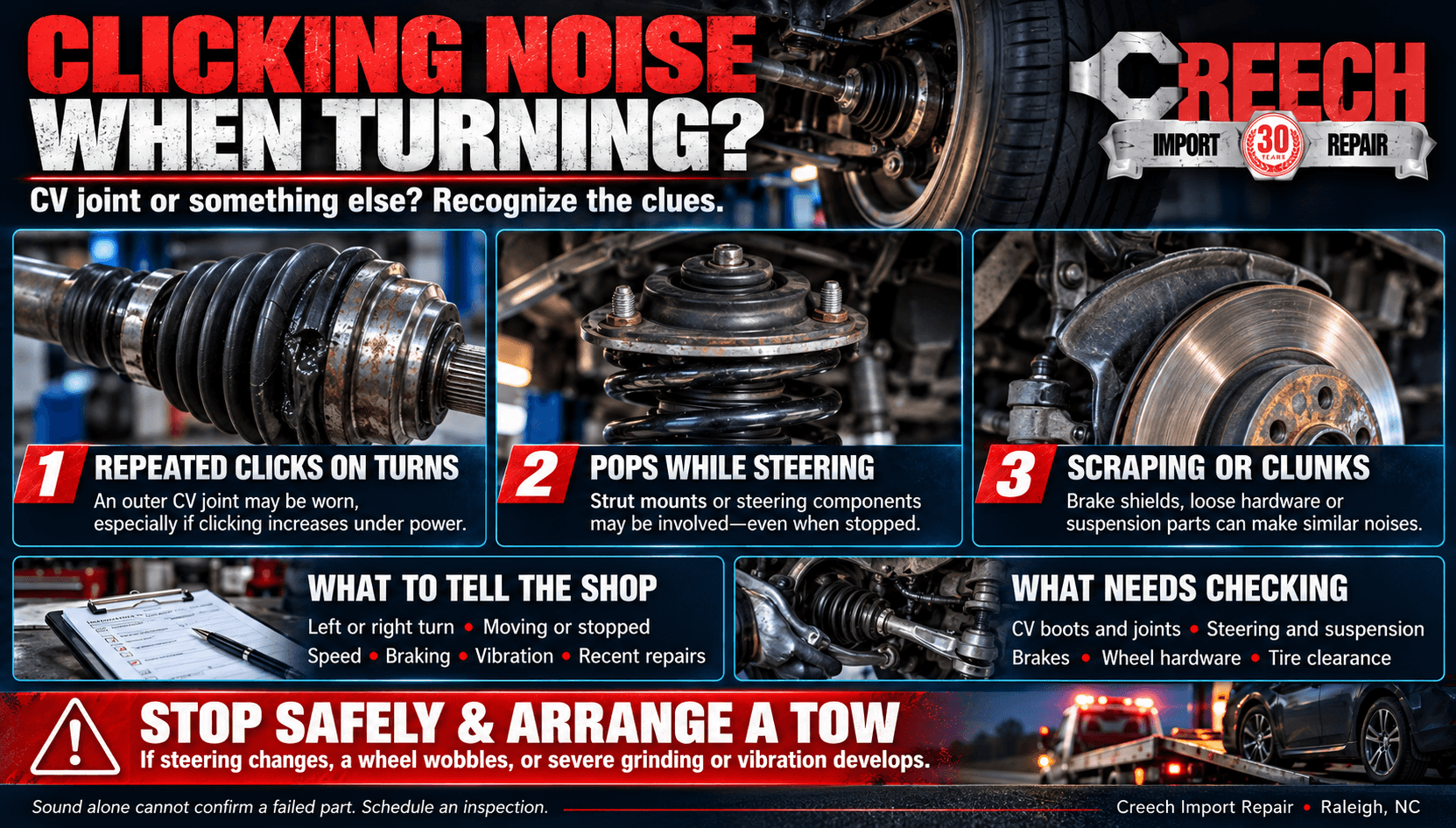
Clicking, popping, and scraping are useful clues. A vehicle inspection is needed to identify the cause and decide whether driving is safe.
02 / UNDERSTAND THE COMPONENT
When Does Clicking Point Toward a CV Joint?
An outer CV joint becomes a stronger possibility when clicking repeats while a driven wheel rotates through a turn. CV stands for constant velocity. The joint helps transmit power while accommodating changes in angle as the suspension moves and, at a driven front wheel, as the vehicle steers.
A CV axle is the shaft assembly connecting a drive unit to a wheel. It typically has an inner joint near the transmission or differential and an outer joint near the hub. The flexible boots around the joints retain grease and help keep contamination out. MOOG’s CV axle explanation describes low-speed turning clicks and grease leakage as reasons to have the assembly examined.
Why a damaged boot matters
A split boot can allow lubricant to escape and dirt or moisture to enter. Grease around the inside of a wheel or nearby components warrants attention, but it does not tell you how much internal wear has occurred. A boot that looks intact from one viewing angle also does not prove the joint is healthy.
Tell the shop if a boot was previously repaired or if an axle was recently replaced. A useful repair history includes which side was serviced, whether the original complaint disappeared, and whether today’s sound is new or unchanged. That information helps prevent an old assumption from becoming the basis for another repair.
Outer and inner joint symptoms are not interchangeable
Turning clicks commonly direct attention toward an outer joint; acceleration-related shudder can require a different investigation. TrakMotive’s noise bulletin distinguishes these patterns and notes that several other faults can resemble axle symptoms.
Describe a shake separately from the sound. Does the seat vibrate, does the steering wheel shake, or do you only hear a click? Avoid grouping all three under “front-end trouble.” Separate observations help the technician decide which complaint to reproduce first and whether the symptoms are connected.
03 / COMPARE OTHER CAUSES
What Else Can Cause a Clicking Noise When Turning?
Steering, suspension, brake, and wheel components can produce noises that resemble axle trouble. The inspection should follow the conditions that create the sound rather than automatically starting with a CV axle replacement. A noise heard through the body of the car may also seem closer to the driver than its actual source.
Vehicle design matters. Front-wheel-drive, rear-wheel-drive, and all-wheel-drive vehicles do not share every front-end component. Give the shop the year, model, and drivetrain rather than relying on a diagnosis from a similar-looking vehicle in an online video.
Strut mounts and upper bearings
On vehicles with a steering strut assembly, a mount or upper bearing can contribute to popping or binding sounds as the steering moves. Monroe recommends inspecting the upper bearing assembly for turning-related strut noise and checking mounting components when investigating clunks.
Report whether this started after strut replacement or an impact. The timing is a reason to recheck the area, not proof that a new part is defective. Inspection must distinguish the replacement component from adjacent hardware and other existing wear.
Steering linkage and suspension connections
Joints, bushings, links, and attachment points deserve attention when a turn also produces a clunk over a driveway transition or uneven pavement. Steering looseness changes the urgency: a noise accompanied by an unfamiliar delay or movement at the wheel needs prompt professional assessment.
Creech’s suspension maintenance guide covers broader handling and ride concerns. For this complaint, describe whether turning alone causes the sound or whether a bump must happen at the same time. Those are different conditions for a technician to investigate.
Brakes, shields, and nearby contact
A metallic scrape or click near a wheel may require examination of brake hardware, the protective shield, and nearby clearance. Do not assume every thin scraping sound is harmless debris. If it changes when you brake, mention that before the appointment; changed stopping performance makes the issue more urgent.
Request a brake inspection when the complaint includes brake-pedal changes, pulling during braking, or grinding. Do not reach behind a recently driven wheel to locate the noise. Brake components can be hot, and reaching into a confined area is not a reliable diagnostic method.
Wheel bearings, hardware, and tire clearance
A hum or growl through a curve can suggest a wheel-end investigation, while clicking can have several explanations. Timken’s wheel-hub symptom guide describes overlap between bearing-related sounds and outer CV-joint symptoms. Sound alone cannot determine which assembly needs replacement.
Report a recent tire installation, wheel removal, curb strike, or change in wheel size. Ask the shop to assess hardware security and clearance where relevant. A visibly wobbling wheel or sudden vibration after wheel service calls for stopping safely, not driving farther to see whether the noise settles.
04 / WHEN THE CAR IS STOPPED
What If It Clicks When You Turn the Steering Wheel While Stopped?
A sound produced at a standstill requires a different diagnostic approach from clicking as a wheel rotates. With the vehicle stationary, tell the technician whether the noise appears during steering-wheel movement itself, whether it is a single pop, and whether it seems to come from inside the cabin.
Do not assume that any mention of “turning” means a rotating axle joint is responsible. The shop may need to examine steering-column components, linkage, or strut-related movement. Avoid repeatedly forcing the wheel against its travel limit to demonstrate the complaint. A concise description of an ordinary parking maneuver is more useful than deliberately stressing the system.
Also separate an isolated steering sound from a change in steering assistance. If steering becomes unexpectedly heavy, catches, or behaves inconsistently, stop using the vehicle until the problem is assessed. A faint noise and a steering-control problem should not receive the same response.
05 / LOCATE THE SOURCE
Does Turning Left or Right Identify the Bad Side?
No. Turn direction alone is not a dependable rule for ordering a left or right axle. It is useful information, but the sound must be located and the relevant components inspected. Cabin acoustics and changing loads can make a simple “left turn means right side” assumption misleading.
Record whether the sound occurs on left turns, right turns, or both, and whether it occurs going forward or reversing during normal use. You do not need to repeat circles, accelerate hard, or perform a roadside test. Let the technician choose a controlled method after checking whether the vehicle is safe to move.
06 / KNOW WHEN TO STOP
Is It Safe to Drive With Clicking When Turning?
There is no reliable safe-mileage allowance for an unidentified turning noise. A written description cannot establish the condition of a wheel, steering connection, brake assembly, or axle. Even a noise that has existed for weeks deserves inspection rather than an assumption that continued driving is harmless.
Call the shop before setting out and describe the full symptom pattern. If the cause is uncertain or the vehicle feels different, towing avoids having to discover the severity while in traffic. Do not interpret the absence of a warning light as clearance to drive; a mechanical problem may not trigger a dashboard alert.
Stop safely and arrange a tow if you notice:
- Unexpectedly heavy, loose, catching, or inconsistent steering.
- A wheel wobble, severe shaking, or rapidly worsening vibration.
- Grinding accompanied by reduced braking control or a changed pedal.
- A sudden loud bang followed by abnormal handling or loss of propulsion.
- Visible wheel damage or a suspected loose wheel after service or an impact.
Move out of traffic only as safely as the vehicle allows. Use hazard lights when appropriate, stay clear of moving traffic, and contact roadside assistance. Follow emergency-service instructions if you cannot reach a safe location.
A minor-sounding click can still matter, but volume alone does not measure danger. What changes the immediate decision is loss of normal control, visible damage, or a sudden change in behavior. Tell the person arranging the tow about the drivetrain so the vehicle can be transported according to its manufacturer’s requirements.
07 / PREPARE FOR YOUR VISIT
What Should You Tell the Repair Shop?
Bring observations that describe the situation, not a parts shopping list. A technician can work more efficiently when the complaint identifies the maneuver, sound, and accompanying sensations. If the issue is intermittent, notes from an ordinary trip may help more than trying to reproduce it repeatedly before the appointment.
- Vehicle details: Year, make, model, mileage, and drivetrain if known.
- Movement: Stopped, moving forward, reversing, accelerating, coasting, or braking.
- Direction: Left, right, both, or only a tight parking turn.
- Sound: Repeated click, single pop, scrape, clunk, hum, or grind.
- Other changes: Steering feel, vibration, warning lights, or braking concerns.
- History: Recent repairs, wheel removal, impacts, or the first day you noticed it.
For example: “It makes several clicks when I pull forward out of a parking space with the wheel turned left. I have not noticed it while stopped. The front tires were replaced last week.” This description does not diagnose the fault, but it gives the shop a clear starting point and identifies relevant recent work.
If you already have a recording, share it with the shop. Do not hold a phone while driving or position someone beside a moving vehicle to capture the sound. Audio can document timing, but microphones and cabin reflections limit its ability to identify the source.
08 / THE INSPECTION PROCESS
How Is a Turning Noise Diagnosed?
Diagnosis should connect the reported sound to an observed fault before a repair is approved. The exact procedure depends on the vehicle and its condition. A technician may need manufacturer service information, a stationary assessment, an appropriately supported inspection, and a controlled road evaluation if safe.
These are useful stages to discuss when booking auto repair in Raleigh. They describe a reasonable investigation, not a promise that every vehicle requires the same sequence or that one test can settle every case.
1. Confirm the complaint and immediate safety concerns
The first task is to understand what the driver means by “clicking.” The shop should know about steering or braking changes before anyone attempts to reproduce the sound. An obvious wheel-security concern may need attention before any road evaluation, while a stationary steering noise may be assessed without driving.
2. Inspect the components that fit the pattern
The technician can examine boots, grease traces, hardware, contact marks, and relevant steering or suspension connections. Inspection methods differ by suspension design; a casual shake of a parked wheel is not a complete assessment. Ask what finding connects the suspected component to your specific complaint.
3. Check vehicle-specific procedures and repair history
Recent work can change the investigation. Correct fitment, assembly position, mounting condition, and specified fastener procedures may need verification. TrakMotive’s technical guidance on CV axle installation issues illustrates why installation and surrounding components matter when a complaint persists after replacement.
4. Explain the finding and verify the outcome
Before authorizing work, ask whether the noise was reproduced, what was found, and what the proposed repair is expected to correct. Afterward, the original complaint should be reassessed under comparable safe conditions. If the noise remains, request a follow-up evaluation rather than assuming it is normal because a part is new.
09 / MAKE AN INFORMED DECISION
What Repairs Might Be Needed?
The repair should match the confirmed fault. An axle assembly, an upper strut bearing, brake hardware, and a tire-clearance issue are different jobs. A useful estimate names the affected location and explains why the proposed repair addresses the sound you reported.
Ask the shop to separate the primary repair from additional maintenance recommendations. You should be able to tell which item addresses an immediate safety concern, which is intended to eliminate the noise, and which is an optional or future maintenance item.
Boot repair versus joint or axle replacement
Ask whether a damaged boot was found before internal joint damage, and whether servicing it is appropriate for that vehicle. Replacing a boot does not undo worn joint surfaces. Conversely, a visible grease leak alone does not provide a complete assessment of every component on that side of the vehicle.
Request an explanation of the proposed parts and labor, including whether the estimate is for a boot, a joint, or a complete axle assembly. Availability, condition, and service procedures affect the choice. If both sides are recommended, ask for the findings supporting each side rather than assuming one failed part proves two replacements are necessary.
Will an alignment fix clicking?
An alignment adjusts wheel geometry; it does not restore a worn joint or secure loose hardware. An alignment assessment may be appropriate after certain repairs or an impact, but it should follow the actual findings and the vehicle’s service requirements.
If an estimate includes alignment, ask whether the repair disturbs an adjustment, whether measurements are outside specification, or whether there is a separate tire-wear concern. This makes the reason for the service clear and helps avoid treating alignment as a universal answer to a front-end noise.
What affects the cost and appointment length?
The vehicle, confirmed component, parts selection, access, corrosion, and additional damage can all affect the estimate. A generic online price cannot establish what your vehicle needs. Ask whether diagnostic labor, required hardware, applicable fluids, taxes, and any recommended follow-up measurements are included.
For scheduling, distinguish inspection time from repair completion. The shop may first need to reproduce an intermittent sound, identify a part, and confirm availability. Share transportation needs when booking, but avoid assuming that a familiar symptom guarantees a same-day repair or a fixed price.
10 / LOCAL HELP
Schedule a Turning-Noise Inspection in Raleigh
Creech Import Repair is located at 1818 St. Albans Dr #106, Raleigh, NC 27609. If you notice clicking during parking maneuvers, describe the conditions when requesting an appointment. Include any steering or braking changes so the shop can discuss the appropriate next step before you travel.
A useful appointment request is specific: your vehicle details, the type of noise, when it happens, and recent work or impacts. You do not need to decide which part has failed before calling. If you are concerned about safe operation, say so directly and ask about arranging transport.
Get the cause checked before choosing a repair
Call 919-872-1999 or request an appointment with Creech Import Repair.
1818 St. Albans Dr #106, Raleigh, NC 27609
Monday–Friday, 7:30 a.m.–5:30 p.m.
11 / YOUR QUESTIONS, ANSWERED
Frequently Asked Questions About Clicking When Turning
1. Does clicking when turning always mean a bad CV joint?
No. A CV joint is one possibility, but a similar complaint can involve steering, suspension, brakes, or wheel components. Tell the shop whether the sound occurs while moving or stopped and whether it repeats or happens once. An inspection should connect the noise to a finding before a replacement is recommended.
2. Why does my car only click during parking maneuvers?
Parking combines low speed with larger steering movements, which can make certain noises easier to notice. The vehicle may also cross uneven pavement or change between forward and reverse. Report which part of the maneuver produces the sound. A parking-only noise is useful diagnostic information, but it does not establish a specific failed part or prove that driving is safe.
3. Can a turning noise happen without a warning light?
Yes. A mechanical noise may occur without a check-engine light or another dashboard alert. Warning lights do not monitor every joint, fastener, or contact point. Arrange an inspection for a new or worsening sound, and report any changes in steering, braking, or vibration. The absence of a light does not confirm that the vehicle is safe.
4. Can I tell which CV axle is bad from the turn direction?
Turn direction alone is not enough to choose a replacement axle. Tell the technician whether the noise occurs on left turns, right turns, or both, but let inspection establish its location. Sounds can travel through the vehicle, and different faults can overlap. Ordering a part based only on which way you turned can lead to an unnecessary repair.
5. Should I drive to the shop or have the vehicle towed?
Stop safely and arrange towing if steering changes, a wheel wobbles, severe vibration develops, or grinding accompanies braking problems. For an unidentified noise without those signs, call the shop and describe the complaint before traveling. A remote description cannot establish mechanical safety or promise a safe distance. When you are unsure about control or wheel security, choose towing.
6. Is a torn CV boot the same as a failed CV joint?
No. The boot protects the joint, while the joint transfers motion. A damaged boot needs assessment, but the repair decision depends on the joint’s condition and the applicable service procedure. Ask whether the recommendation is for a boot repair, joint replacement, or complete axle, and what inspection findings support that choice for your vehicle.
7. Why did clicking start after tire or brake work?
The timing makes recently serviced areas important to recheck, but it does not prove the work caused the noise. Tell the shop exactly what was done and when the symptom began. Request an assessment of the relevant hardware and surrounding components. Stop driving if the sound comes with wobbling, changed braking, or unusual steering behavior.
8. Will a wheel alignment stop a clicking noise?
An alignment is not a general repair for clicking. The source of the sound needs to be identified first. Ask why alignment is included if it appears on the estimate: it may relate to a particular repair, an impact, or measured wheel geometry. It should not replace diagnosis of a noise or a check for damaged components.
9. What if the shop cannot reproduce the noise?
Provide the most specific description you can, including direction, speed, braking, road surface, and whether the vehicle was stopped. An existing recording may help, though it cannot identify every fault. Ask what was inspected and what follow-up is appropriate. Avoid deliberately provoking the noise in traffic or continuing to drive if handling or braking changes.
10. What should a turning-noise repair estimate explain?
The estimate should identify the recommended repair, its location, the reason for it, and the included parts and labor. Ask which findings support the diagnosis and whether additional items are safety repairs or maintenance recommendations. Clarify any diagnostic charge and proposed follow-up checks before authorizing work so you understand what the repair is intended to accomplish.
12 / TECHNICAL REFERENCES
Technical Sources and Evidence Limits
This guide uses component-manufacturer explanations to describe possible noise patterns and inspection considerations. These are general technical references, not failure-rate studies or a diagnosis of your vehicle. Your vehicle manufacturer’s service information and an in-person inspection determine the appropriate procedure and repair.
- MOOG: What Is a CV Axle?
- TrakMotive: Top Five Noise Symptoms Associated With a Worn CV Shaft
- Monroe: Diagnosing Noise With New Shocks and Struts
- Timken: Symptoms of a Worn Wheel Hub Bearing
- TrakMotive: Addressing Common CV Axle Issues
About Creech Import Repair
Creech Import Repair is a family-owned auto repair business serving Raleigh since 1993. For questions about a turning noise or to arrange an inspection, contact the shop. General educational information cannot replace an assessment of your vehicle’s condition.
Find Creech Import Service articles useful?
Add this site to your Preferred Sources in Google Search.