


CREECH IMPORT REPAIR • RALEIGH, NORTH CAROLINA
A stuck shifter calls for a calm safety check—not more force.
If your car won’t shift out of Park, start by keeping the vehicle secured. A selector that refuses to move can involve the brake-shift interlock, electrical power, the selector itself, or pressure on the parking mechanism. It does not automatically mean the transmission needs replacement.
You might notice the problem in your driveway, a Raleigh parking deck, or after the car has sat overnight. The useful clues are whether the engine starts, whether the brake lights respond, whether the gear display agrees with the selector, and whether the vehicle is on an incline. Those observations help a technician choose tests; they cannot identify a failed part by themselves.
This guide explains safe observations, reasons a shifter may stay locked, and when professional help or towing is the better next step. It applies to automatic and CVT vehicles with a Park position. Controls and emergency procedures vary by year, model, and selector design.
Quick Answer: Why Won’t My Car Shift Out of Park?
A car that won’t shift out of Park may have a missing brake-pedal release signal, insufficient electrical power, a shift-lock fault, selector or linkage damage, or load on the parking pawl after parking on a slope. Keep your foot on the brake, apply the parking brake, and follow your owner’s manual’s normal shifting sequence. Never force the selector. If brake lights fail, braking feels abnormal, the vehicle cannot be secured, or normal operation does not return, arrange professional help.
In This Guide
What Should You Check Safely When Your Car Won’t Shift Out of Park?
Check the vehicle’s security, normal startup sequence, brake-light response, and visible electrical symptoms before considering any emergency release. Do these checks only from a safe location. A roadside lane, steep slope, or vehicle that cannot remain stationary is a reason to request help rather than continue troubleshooting.
1. Keep the vehicle secured
Stay in the driver’s seat with your foot firmly on the brake and apply the parking brake. Keep people clear of the vehicle’s potential path. If the parking brake will not apply or the car moves unexpectedly, stop the checks. Do not assume that a locked selector guarantees the vehicle is securely in Park, especially if the displayed gear is unclear or the handle feels disconnected.
2. Repeat only the normal shifting sequence
Consult the owner’s manual for the required ignition or power mode, brake application, and selector-button operation. Accessory mode is not necessarily the mode that permits shifting. With push-button start, an illuminated dashboard does not by itself confirm that the vehicle is ready. Use normal hand pressure; resistance is a signal to pause. Do not repeatedly yank the lever or strike the release button.
3. Observe the brake lights from a safe position
If a helper can observe without standing in traffic or the vehicle’s potential path, ask whether the rear brake lamps respond when you press the pedal. Check the center high-mounted brake light as well. A reflection may help in some locations, but uncertainty should be reported as uncertainty. Missing lamps can involve a switch, fuse, wiring, power supply, or the lamps themselves; this check does not isolate the cause.
4. Note power, warning messages, and recent changes
Record dim lights, clicking during a start attempt, a no-start condition, and the exact dashboard message. Mention recent battery replacement, electrical work, console damage, or a drink spilled near the selector. Look for obvious interference around the lever without removing trim. Do not reach into the mechanism, spray lubricant inside it, or disconnect the battery simply to try a reset.
How Does the Brake-Shift Interlock Keep a Car in Park?
The brake-shift interlock is a safety system that restricts shifting out of Park until specified conditions are met, commonly a brake-pedal input and the correct ignition state. It helps prevent an unintended shift into a driving range. A release actuator may unlock a conventional lever; an electronic selector can use additional control logic.
That is different from the parking pawl, a mechanical component used in many automatic transmissions to hold the drivetrain in Park. The interlock controls permission to select a gear. The pawl provides mechanical parking restraint. A problem with one does not establish a problem with the other, and neither makes the parking brake unnecessary.
The distinction also matters when describing the complaint. “The lever will not move” is different from “the lever moves, but the dashboard still shows P.” A vehicle that selects Drive but will not propel itself has another diagnostic starting point. Tell the shop exactly what happens rather than using “transmission failure” for all three experiences.
For example, Hyundai’s 2025 Tucson shift-lever instructions specify brake application and an appropriate ignition state. Those instructions illustrate the principle; your vehicle’s manual determines its actual sequence.
At a Glance: Four Safe Checks for a Car Stuck in Park
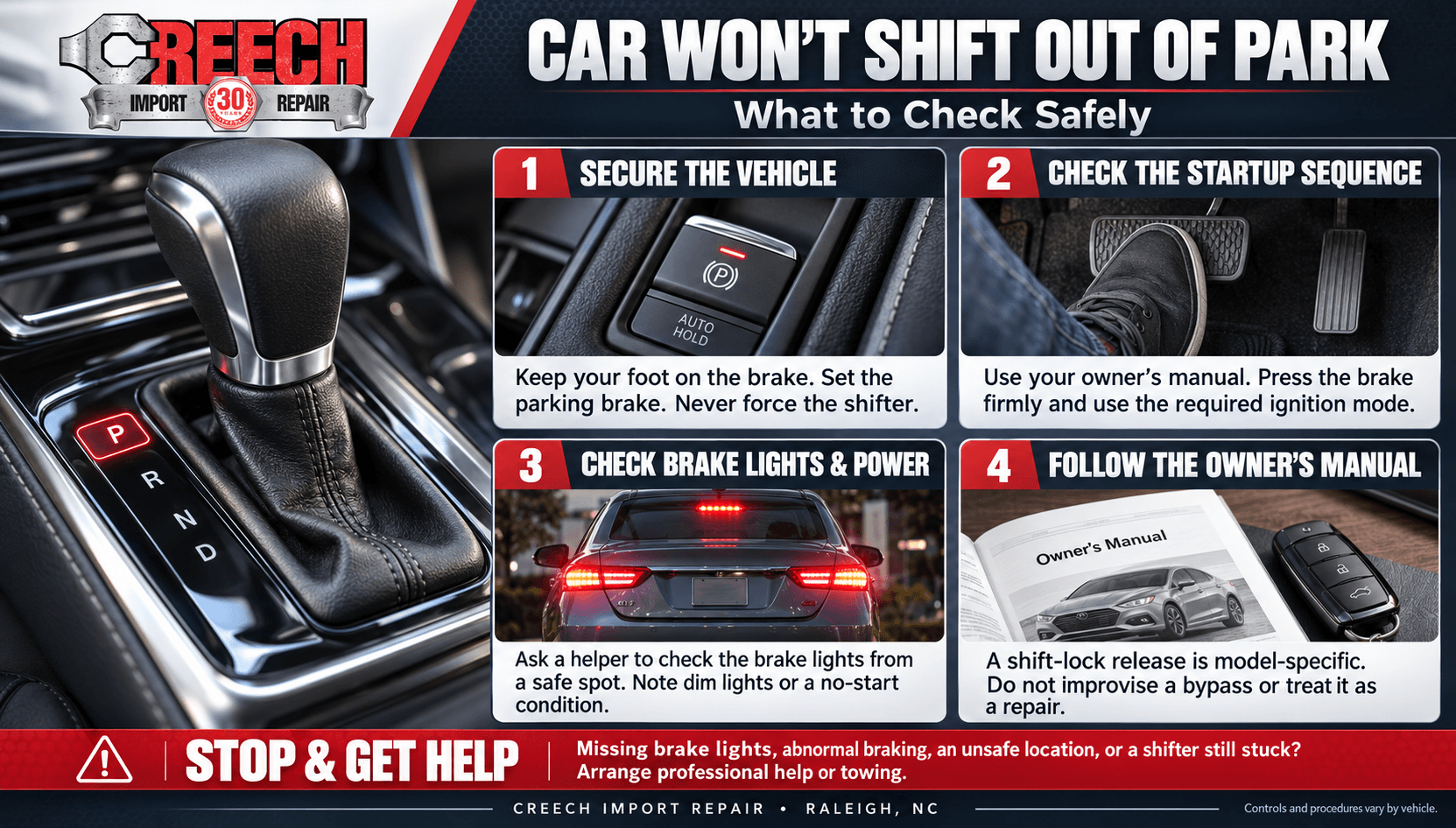
Secure the vehicle, follow the startup sequence, check brake lights and power, and consult the correct owner’s manual. An emergency release is not a repair or permission to drive.
What Can Different Stuck-in-Park Symptoms Suggest?
Symptom combinations help organize an inspection, but none of the patterns below proves which part failed. Brake lights, starting behavior, selector feel, and the displayed gear should be assessed together. A normal observation in one system does not clear the others.
| What you notice | What may need checking | Safe next step |
|---|---|---|
| The engine starts, but the selector stays locked and brake lights do not respond. | Brake-pedal signal, stop-lamp circuit, fuses, wiring, or power supply. | Do not drive with inoperative brake lights. Request inspection or towing. |
| Brake lights work, but the selector will not release. | Release actuator, interlock control, selector mechanism, or an input not reaching the relevant module. | Report the observation; do not assume the switch or entire interlock is healthy. |
| The car will not start and lights are dim or flicker. | Low battery charge, battery condition, connections, or another electrical fault. | Follow the vehicle’s approved roadside procedure or request assistance. |
| Resistance began after parking on an incline. | Load on the parking pawl, with other causes still possible. | Keep the vehicle secured. Do not push or rock it to unload the mechanism. |
| The selector moves loosely, but the indicated gear does not match. | Selector attachment, linkage or cable where fitted, range information, or electronic control. | Do not attempt to drive or rely on the handle position to secure the car. |
| The problem disappears and later returns. | Intermittent power, signal, connection, actuator, or mechanical operation. | Record the conditions and arrange diagnosis; temporary recovery is not a confirmed fix. |
A selector that moves into Drive while the vehicle fails to move needs a different inspection from a locked Park selector. If the gear display is uncertain, avoid a driveway “test” to see what happens. Unexpected movement is a more serious risk than remaining parked while arranging help.
What Can Cause a Car to Stay Stuck in Park?
Possible causes include brake-input faults, inadequate electrical power, interlock or selector defects, and mechanical loading or damage. The likely repair depends on testing and the vehicle’s design. A generic list should guide the conversation, not become a shopping list for replacement parts.
Brake-pedal input and stop-lamp circuit faults
A brake switch or sensor helps communicate pedal application. Problems can include adjustment, mounting, the circuit, or the signal received by a control module. Brake lamps that stay on continuously are also abnormal. Working lamps show that the visible lighting response exists at that moment; they do not verify every brake-related input or exclude an intermittent fault. The wiring diagram determines what is shared and what is separate.
A switch fitted near the pedal is not automatically a simple universal replacement. Installation and adjustment can be vehicle-specific. HELLA’s technical guidance for a self-adjusting stop-light switch demonstrates why the correct procedure matters. A technician should confirm the signal before recommending a part.
Low electrical power or poor connections
A discharged battery or inadequate voltage can prevent some release systems from working. The relevant battery in many vehicles is the low-voltage auxiliary battery, including vehicles that also contain a high-voltage battery. Bright dashboard lights alone are not a battery test. An engine that starts normally reduces some concerns about starting power but does not exclude an isolated interlock circuit fault.
If the vehicle also fails to start, Creech’s guide to a car that won’t start but the lights work addresses that separate symptom. Repeated overnight discharge belongs in the overnight battery-drain guide. Neither symptom should be expanded into a battery diagnosis based only on a stuck selector.
Shift-lock actuator, selector, or linkage problems
Depending on the design, the fault may involve the release actuator, a damaged button, internal selector hardware, or the connection between the selector and transmission. Conventional cable-operated systems differ from shift-by-wire systems. A cable problem cannot be assumed in a vehicle that has no such cable. Spills or broken trim deserve mention, but their presence does not prove they caused the complaint.
Fuses, wiring, and control-system faults
A fuse may protect an affected circuit, but fuse labels and locations vary. Never substitute a larger fuse or bridge the circuit. If a correctly specified replacement fails again, the underlying fault needs investigation. Dashboard messages or stored codes can guide testing, but a code naming a circuit is not proof that its sensor, actuator, or module requires replacement.
Why Can a Car Be Hard to Shift Out of Park on a Hill?
Parking on an incline can load the parking pawl and make the selector difficult to move. Manufacturers sometimes call this torque lock. It describes force on the parking mechanism rather than proof of a failed interlock or damaged transmission. An incline is a useful clue, but an electrical or selector problem can happen on a slope too.
The 2017 Chevrolet Trax owner’s manual discusses torque lock and use of the parking brake. Follow your own manual’s parking sequence while maintaining control with the service brake. Applying the parking brake after the vehicle has already settled onto the pawl may not remove the load already present.
Do not have someone push the car, bump it with another vehicle, or rock it while you pull the lever. Releasing the mechanism can allow sudden movement. A slope, garage ramp, nearby pedestrians, and limited clearance make that risk harder to control. If normal shifting does not work, tell the assistance provider that the car is stuck in Park on an incline so they can plan secure recovery.
Is It Safe to Use the Shift-Lock Release?
A manufacturer-provided shift-lock release may permit emergency repositioning on certain vehicles, but it is not a universal procedure or a repair. Whether you should use it depends on the exact manual, the location, your ability to keep the car secured, and the condition of the brakes and selector.
For example, Honda’s 2026 CR-V instructions for a shift lever that will not move describe a particular release arrangement and call for inspection afterward. Another model may require a different control, ignition state, external power, or a professional recovery procedure. A small cover near a lever is not evidence that the same steps apply.
Read the complete procedure and warnings before touching anything. If identifying the control requires guesswork, stop. Never use a screwdriver to probe an unconfirmed opening, bypass wiring, or leave the interlock disabled for daily use. A vehicle shifted into Neutral may roll and may have different steering, brake-assist, or parking-brake behavior when power is unavailable.
Release does not mean road-ready. Moving the selector after an override does not establish that brake lights, braking, gear selection, or parking restraint are reliable. If the release was needed because normal operation failed, arrange inspection. Where safe control or correct instructions are uncertain, let the towing professional handle repositioning.
What Changes With an Electronic Selector, Hybrid, or Electric Vehicle?
An electronic selector may remain in Park because the vehicle has not accepted a required input or because its power or control system has a fault. A rotary dial, button bank, or compact electronic lever should not be treated like a mechanical cable shifter. The same outward symptom can involve very different hardware.
Look at the displayed gear and exact messages. Some designs have automatic return-to-Park features or special requirements for remaining in Neutral during recovery. A lit screen is not necessarily confirmation of a running engine or a hybrid/EV ready state. A remote-started vehicle may also require its normal driver-entry and startup steps before shifting.
Check the manual rather than experimenting with doors, seat belts, ignition cycles, or selector combinations. Do not open high-voltage components or touch orange cables. Tell the repair shop and towing provider whether the vehicle is hybrid, electric, all-wheel drive, or four-wheel drive. That information helps them verify power support, neutral-release instructions, and transport requirements before moving it.
When Should You Stop Checking and Arrange Help or Towing?
Arrange professional help when the car cannot be kept stationary, the gear indication is unreliable, brake lights fail, braking feels abnormal, or the car remains stuck after the correct normal sequence. Towing is appropriate when safe driving or safe repositioning cannot be established. A selector that releases once does not override those concerns.
- Unsafe location: the vehicle is exposed to traffic, on a steep ramp, or near people with little clearance.
- Brake concerns: the pedal drops unusually, stopping ability has changed, or there is suspected brake-fluid leakage.
- Selector uncertainty: the handle feels disconnected, the display disagrees, or Park engagement cannot be confirmed.
- Continuing fault: a release procedure is repeatedly needed, or the problem returns after a restart.
If pedal travel is also changing, see Creech’s separate guide to a brake pedal that sinks at a stop. Do not use a Park-release procedure to work around a braking problem.
Tell the towing operator that the vehicle is locked in Park and whether the parking brake can release. Give the exact model and drivetrain. The operator should choose transport and loading methods using the manufacturer’s instructions. Do not arrange to drag the car with locked wheels or assume that selecting Neutral makes every vehicle suitable for towing with wheels on the ground.
How Should a Repair Shop Diagnose a Car Stuck in Park?
Professional diagnosis should confirm the complaint, identify the selector design, and test the conditions required for release before recommending parts. That approach distinguishes a brake-input or power issue from mechanical loading, selector damage, and a control-system fault. The appropriate sequence depends on service information for the vehicle.
- Confirm operation and security. Verify the indicated gear, selector response, parking restraint, and when the failure occurs.
- Check electrical supply. Assess battery condition, relevant voltage supply, grounds, and connections under the conditions that produce the complaint.
- Verify brake inputs. Compare lamp operation with the brake signal received by the relevant control system, using circuit tests or live data where appropriate.
- Test release and selector hardware. Determine whether the actuator receives a command and whether the mechanism responds; inspect linkage only where fitted.
- Review stored information. Evaluate applicable fault codes, manufacturer service guidance, and VIN-specific recalls without treating a code as a parts order.
- Verify the repair. Confirm normal release, accurate gear indication, and related functions under the conditions that previously caused trouble.
A generic engine-code reader may not access every module needed for this complaint. Ask whether testing addresses the actual interlock and selector system. Avoid assuming that transmission-fluid service will free a locked lever; maintenance and an interlock diagnosis address different questions.
What should a written repair estimate explain?
Ask for the confirmed findings, the proposed repair, parts and labor, any programming or adjustment requirements, and the planned verification. If further diagnosis is needed, ask what is still uncertain. Price depends on access, design, parts, and the fault found; a universal “stuck-in-Park repair cost” can be misleading. Do not approve transmission replacement solely because the shifter would not move.
What Should You Tell the Shop Before the Appointment?
Give the shop your vehicle details, the exact selector behavior, and any immediate safety concern. A clear description can help prepare the appointment or recovery without requiring you to diagnose anything. A brief photograph of a dashboard message can be useful if taking it does not distract you from keeping the car secured.
- Year, make, model, mileage, and whether it is hybrid, electric, AWD, or 4WD.
- Whether the engine starts or the vehicle reaches its normal ready state.
- Whether the selector is physically locked, moves loosely, or moves while the display stays in P.
- Whether brake lights respond, stay illuminated, or have not been safely checked.
- Whether the car is on a slope and whether the parking brake applies normally.
- Exact warning messages, unusual brake feel, and any recent battery, brake, or console work.
- Whether the fault is intermittent and whether an emergency release has already been used.
- Current location, access restrictions, and whether transport must be arranged.
Describe the sequence rather than only the outcome: “The engine starts, the brake lamps illuminate, but the lever remains locked” is more useful than “the transmission is broken.” If you do not know an answer, say so. Guessing that a light worked or a gear engaged can send the inspection in the wrong direction.
Where Can Raleigh Drivers Get Help With a Car That Won’t Shift Out of Park?
Creech Import Repair provides automotive repair services in Raleigh, including electrical-system repair and brake inspection and repair. A stuck-in-Park complaint may involve systems covered by either area, so explain the symptom before requesting a specific replacement. The shop can discuss the next step for your vehicle and situation.
The shop is at 1818 St. Albans Dr #106, Raleigh, NC 27609, with listed hours of Monday through Friday, 7:30 a.m. to 5:30 p.m. Call before arranging delivery to confirm appointment availability, vehicle access, and drop-off instructions. If the car is immobilized, explain that it remains in Park rather than trying to make it drivable for the appointment.
Explain the symptom. Get a clear next step.
Call 919-872-1999 or request an appointment with Creech Import Repair. Include the year, model, location, brake-light response, and any warning message.
Frequently Asked Questions
Can a weak battery keep a car from shifting out of Park?
Yes. Insufficient low-voltage power can prevent some shift-lock or electronic selector systems from operating. Dim lights, clicking, and a no-start condition are useful clues, but they do not prove the battery itself has failed. Connections, charging, or another circuit may need testing. Follow your vehicle’s approved assistance procedure, and arrange diagnosis if normal shifting does not return or the problem repeats.
Can the brake-light switch cause a shifter to stay locked?
Yes. On some vehicles, a fault affecting the brake-pedal signal can prevent the interlock from allowing a shift out of Park. Missing or continuously illuminated brake lights are important observations. The switch is one possible cause, alongside wiring, adjustment, power, and circuit faults. A technician should confirm the input and circuit operation before replacing it. Do not drive with inoperative brake lights.
What if my brake lights work but the car is still stuck in Park?
Working brake lights do not prove the whole interlock system is operating correctly. The release actuator, selector mechanism, power supply, or signal received by a control module may still have a problem. Report that the lamps respond, then have the appropriate inputs and release operation checked. Do not assume an actuator replacement is the answer solely because the lights work.
Does a stuck shifter mean I need a new transmission?
No. A selector locked in Park can result from an interlock, brake-input, electrical, or selector problem without requiring transmission replacement. Mechanical loading on a slope is another possibility. The distinction between a lever that will not move and a vehicle that selects Drive but will not move is important. Repair recommendations should follow testing that identifies the actual fault.
Why is the shifter harder to move after parking on a hill?
A vehicle’s weight can load the parking pawl when it settles on an incline, making release difficult. Some manufacturers call this torque lock. A slope does not exclude another fault, however. Keep the vehicle secured and follow its normal shifting instructions. Do not push, bump, or rock the car to free it. Request professional assistance if the selector remains resistant.
Can I drive after using the shift-lock release?
Using a release does not establish that driving is safe. The original fault may still affect brake lights, gear selection, parking restraint, or another required function. Follow the exact owner’s manual and arrange inspection when normal operation has failed. If braking is abnormal, lamps do not work, the gear display is uncertain, or safe control cannot be confirmed, arrange towing instead of driving.
Can I put a car stuck in Park into Neutral for towing?
Some vehicles have an approved emergency release or transport mode, while others require power support or a different recovery method. Neutral alone does not establish that towing with wheels on the ground is permitted. Tell the operator the exact model, drivetrain, selector condition, and parking-brake status. Let the operator verify the manufacturer’s loading and towing instructions before moving the vehicle.
Should I disconnect the battery to reset a stuck shifter?
Do not disconnect the battery as a generic stuck-shifter remedy. It may not address the cause and can change stored diagnostic information or require vehicle-specific reinitialization. The selector may also need electrical power for release. Use the owner’s manual’s normal sequence, record messages and symptoms, and request diagnosis if the problem remains. Power procedures should follow the requirements for your particular vehicle.
What if the problem goes away after restarting the car?
A restart that restores shifting does not confirm a repair. Intermittent signal, connection, power, actuator, or control faults may recur. Record when it happens, whether the brake lights respond, and any dashboard message. Arrange inspection rather than relying on repeated restarts or emergency releases. Stop driving if the event is accompanied by abnormal braking, uncertain gear indication, or another safety concern.
How much does it cost to fix a car that won’t shift out of Park?
There is no reliable single price without identifying the fault and vehicle design. A circuit repair, switch adjustment, selector assembly, and more extensive control or mechanical repair involve different parts and labor. Ask for diagnostic findings and an itemized estimate explaining the proposed repair and verification. Avoid approving expensive work based only on the symptom or a generic online cost range.
Sources and Vehicle-Specific Guidance
Evidence status: September 30, 2026. Manufacturer manuals explain operation and emergency procedures for the named vehicles; they are examples, not interchangeable instructions. This guide does not establish a diagnosis, a universal release method, or the frequency of each possible cause. Use the correct owner’s manual and current manufacturer service information for your vehicle.
- Hyundai: 2025 Tucson automatic transmission operation, shift-lever type.
- Honda: 2026 CR-V, Shift Lever Does Not Move.
- Chevrolet: 2017 Trax owner’s manual, torque lock and shifting out of Park.
- Ford: automatic transmission, brake-shift interlock and brake-lamp precautions.
- HELLA Tech World: installation of stop-light switches with automatic adjusters.
- NHTSA: check recalls using your vehicle identification number. A symptom alone does not establish recall eligibility, and the lookup has coverage limits.
About Creech Import Repair
Creech Import Repair is a Raleigh automotive repair business serving drivers since 1993. The shop works on import and domestic vehicles and lists electrical and brake services among its offerings. For vehicle-specific assessment, contact the service team with your symptoms and vehicle details.
Find Creech Import Service articles useful?
Add this site to your Preferred Sources in Google Search.