


Creech Import Repair | Raleigh, North Carolina
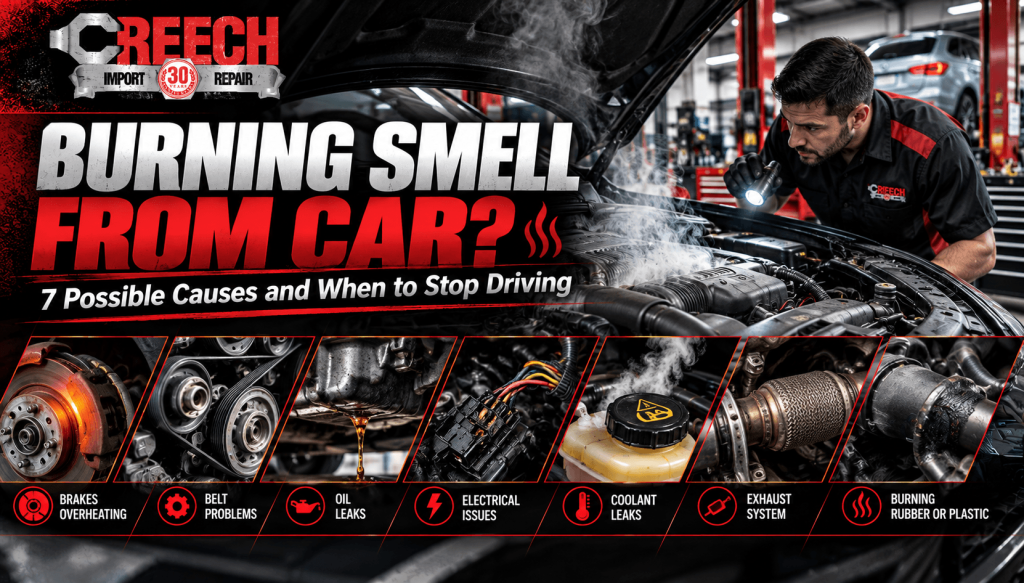
Burning Smell From Car? 7 Possible Causes and When to Stop Driving
You arrive home after a normal drive, step out of your vehicle, and notice an unfamiliar burning smell. Perhaps it resembles hot rubber, burnt oil, overheated brakes, or melting plastic. The car may still run normally, leaving you wondering whether the odor is harmless or a warning of something serious.
A burning smell from a car can come from several systems. Engine oil may contact hot exhaust parts, brakes may overheat, a drive belt may slip, electrical wiring may become dangerously hot, or a leaking fluid may reach a heated component.
The location, timing, and character of the odor can offer useful clues. However, smell alone cannot identify the failed component, and some odors can signal an immediate fire or vehicle-control hazard.
This guide explains seven possible causes, how different burning odors compare, when you should stop driving, what observations are safe to make, and how professional technicians investigate these problems. It focuses on burning, heated-material, and friction-related odors rather than ordinary fuel vapor during refueling.
Quick Answer
Why Does My Car Smell Like Something Is Burning?
A burning smell from your car may be caused by engine oil dripping onto a hot exhaust component, overheated brakes, a slipping belt, an electrical fault, coolant contacting hot surfaces, exhaust-system overheating, or plastic or insulation touching hot parts. Different odors and driving conditions provide clues, but the smell does not confirm a diagnosis. If you notice smoke, flames, a strong electrical or fuel odor, a temperature warning, significant fluid leakage, or reduced braking or vehicle control, stop safely, turn off the engine when appropriate, move away from a suspected fire, and arrange professional or emergency assistance.
What Does a Burning Smell From a Car Usually Mean?
Vehicles generate heat during normal operation. The engine, exhaust, brakes, transmission, electrical equipment, and certain auxiliary systems can reach elevated temperatures. These systems are designed to manage heat safely when operating as intended.
A burning odor becomes concerning when materials are exposed to temperatures or friction they were not meant to experience. For example, leaking oil may land on a hot exhaust shield, a brake may fail to release, or damaged wiring insulation may overheat.
Some smells result from a temporary condition, such as a small amount of residue on a recently serviced component. Others point to active fluid leakage, mechanical friction, or electrical damage.
Three observations are especially useful when describing the problem to a technician:
What Does It Smell Like?
Burnt oil, hot rubber, overheated friction material, sweet chemical odor, or sharp electrical and plastic odor.
When Does It Happen?
After braking, accelerating, warming up, using the heater, or parking after a drive.
What Else Happens?
Smoke, unusual noise, warning lights, reduced performance, fluid loss, or changes in braking.
These observations help prioritize an inspection. They are not precise enough to choose replacement parts. Oil, coolant, rubber, and other materials can produce overlapping odors, especially when multiple surfaces are hot.
Does the Location of the Smell Identify the Problem?
Not reliably. Odors move with airflow. A smell originating near the engine may enter the cabin through the ventilation system. An odor coming from beneath the vehicle may be more noticeable after parking when airflow slows.
A strong smell near one wheel can suggest a brake-related concern, but it should not be treated as proof of a seized caliper. Tire contact, a fluid leak, or another nearby hot component may also be involved.
Similarly, a burning smell from the dashboard could relate to electrical or HVAC components, but outside odors can also enter the cabin.
Use the location as a clue rather than attempting to diagnose the component by smell alone.
Is Every Burning Smell an Emergency?
Not every brief odor indicates an active fire. However, unfamiliar burning smells deserve attention because the risk cannot be reliably determined from odor alone.
Persistent odor, visible smoke, melted material, a worsening smell, or changes in braking, steering, temperature, or engine operation raise the urgency considerably.
If the vehicle appears unsafe or the source is unknown and the smell is strong, stopping safely and seeking professional guidance is more appropriate than continuing to drive to see whether it disappears.
What Should You Do First When You Smell Burning in Your Car?
Start by evaluating safety, not by trying to locate a defective component while the car is moving. Do not lean toward the engine compartment, look beneath the dashboard, or use your phone to photograph the problem while driving.
If the odor is strong, unfamiliar, persistent, or accompanied by warning signs, look for a safe place to pull over. Use your hazard lights when appropriate and avoid abrupt maneuvers.
Assess Driving Control
Notice whether braking, steering, engine power, and visibility remain normal. If a system is not functioning properly, prioritize getting out of traffic safely.
Stop in a Safe Location
Choose a place away from moving traffic and combustible surroundings if reasonably possible. Do not stop in an unsafe lane merely to investigate an odor.
Shut Down When a Serious Fault Is Suspected
If there is smoke, suspected fire, serious overheating, or another significant hazard, switch off the engine once stopped safely, following circumstances and manufacturer guidance.
Keep Away From Heat, Smoke, and Leaking Fluid
Do not open a smoking engine compartment, touch hot parts, remove a hot cooling-system cap, or reach into an area with damaged wiring.
Arrange Appropriate Assistance
Contact emergency services for suspected fire, or roadside assistance and a qualified repair facility when the vehicle cannot be driven safely. Do not restart the car repeatedly to recreate the odor.
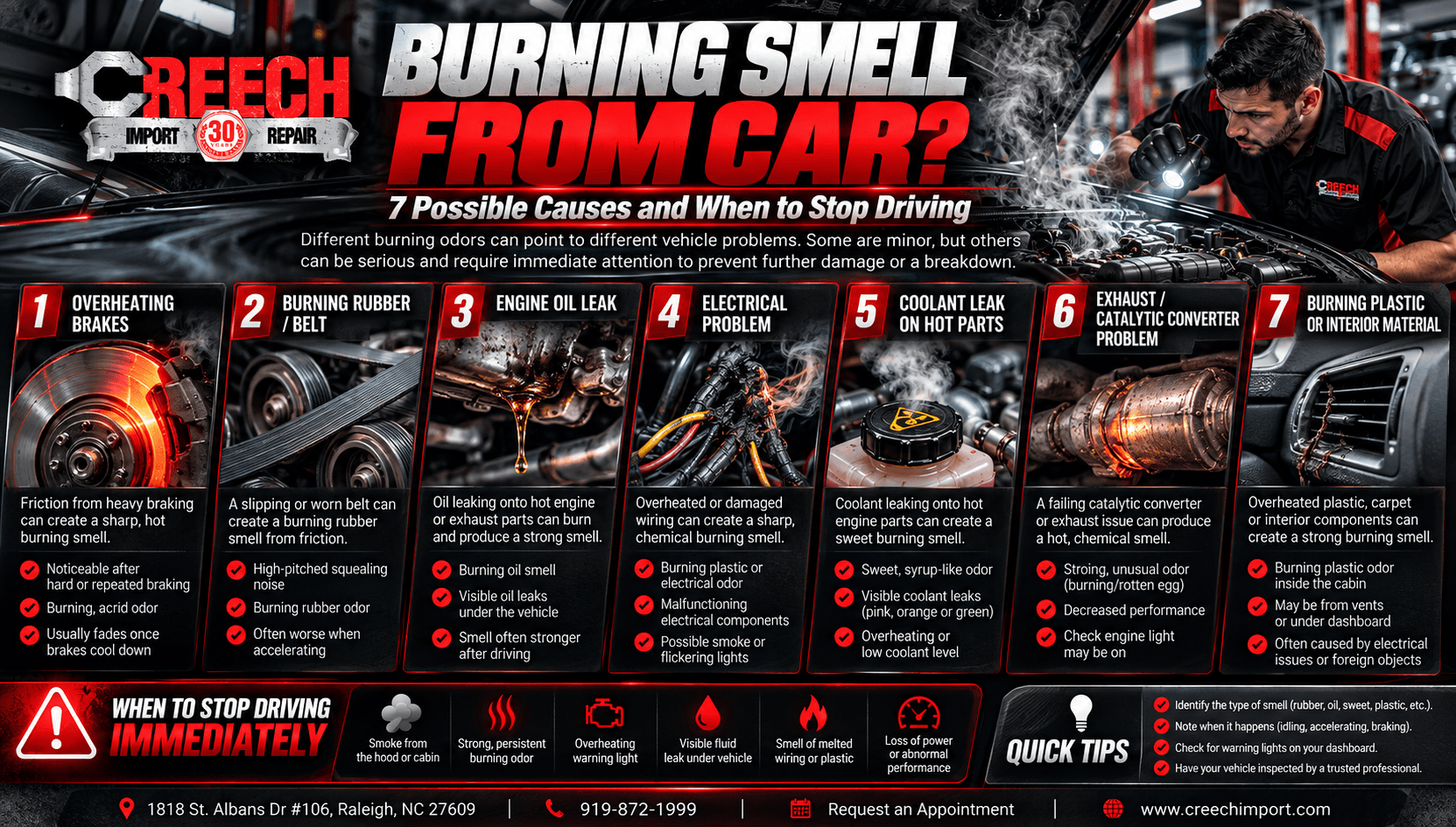
7 Possible Causes of a Burning Smell From a Car
The following seven categories explain common ways abnormal heat, friction, or fluid contact can create burning odors. These are diagnostic possibilities, not a ranking of the most common failures.
Engine Oil Leaking Onto Hot Engine or Exhaust Components
Engine oil lubricates moving components and helps carry away heat. If oil escapes through a damaged seal, gasket, line, or another connection, it may reach the outside of the engine.
When oil contacts a sufficiently hot exhaust manifold, exhaust pipe, turbocharger housing, or nearby heated surface, it can produce a distinct burnt-oil odor. Depending on the amount and temperature, visible smoke may develop.
Potential leak locations include valve cover gaskets, oil filter housings, oil pressure-related fittings, and other engine-specific connections. The correct inspection points depend on the vehicle.
The smell may become stronger after the engine has reached operating temperature or after the vehicle has been parked. When the car stops moving, airflow around the engine changes, making an existing odor easier to notice.
A burning smell does not automatically prove oil is leaking. Other fluids and overheated materials may produce related odors. A technician needs to confirm the fluid and its source.
Also, an oil leak does not always create a puddle. Oil may accumulate on an engine surface, collect in a shield, or burn away before reaching the ground.
Low oil pressure warnings, substantial oil loss, smoke, and visible leaking increase concern. Do not continue operating an engine with a low oil pressure warning.
Overheated Brakes or a Brake That Is Not Releasing Properly
Brakes convert vehicle motion into heat through friction. During ordinary braking, the system is designed to absorb and dissipate that heat.
Excessive temperatures can develop after prolonged heavy braking, repeated steep descents, or a mechanical or hydraulic fault that causes a brake to drag.
Possible contributing conditions include a sticking caliper, binding slide hardware, restricted brake hose, parking brake malfunction, or other brake components that fail to release normally.
Drivers may notice a hot, sharp friction smell near a wheel, unexpected resistance while driving, pulling during braking, or abnormal wheel-area heat.
However, the temperature and odor of one wheel cannot safely be assessed by touching the wheel, rotor, or brake hardware. These parts can cause serious burns.
A brake overheating concern is especially important when accompanied by reduced stopping ability, a changed pedal feel, smoke, or a vehicle that pulls strongly during braking.
If the main symptom is vehicle movement to one side when stopping, Creech already explains that separate issue in Car Pulls to One Side When Braking.
For repair-specific information, the shop also provides a dedicated brake repair and inspection service.
Slipping Serpentine Belt or Rubber Contacting a Hot Component
Many vehicles use an accessory belt to drive components such as the alternator, air-conditioning compressor, water pump, or power steering pump, depending on engine design.
A belt that slips excessively, becomes misaligned, contacts a stationary surface, or is damaged by a malfunctioning pulley can generate heat and a burning-rubber odor.
Potential causes include incorrect belt tension, deteriorated belt material, damaged pulleys, a seized accessory, or a failing tensioner.
Some drivers hear squealing before they notice the smell. Others experience charging-system warnings or changes in accessory operation.
A snapped belt can have serious consequences if it drives the water pump or another essential component. The exact accessory arrangement differs by vehicle, and not every vehicle has a conventional belt-driven water pump or power steering system.
Rubber odors may also originate from hoses or other materials touching hot exhaust components. Therefore, a burning-rubber smell does not necessarily mean the belt is defective.
Never reach toward a belt or pulley while the engine is running. Rotating components can catch clothing or fingers.
If a burning smell appears with a battery warning light, coolant-temperature warning, or loss of accessory function, stop safely and arrange appropriate inspection.
Overheating Electrical Wiring, Connectors, or Components
Electrical systems carry power throughout modern vehicles. Batteries, alternators, wiring, fuses, modules, motors, and connectors must handle their intended current safely.
Damaged insulation, excessive resistance at a connection, an electrical short, or a malfunctioning component can create abnormal heat.
When plastic insulation, connector housings, or nearby materials overheat, the driver may notice a sharp, acrid, chemical, or melting-plastic smell.
Some electrical problems occur intermittently when particular equipment operates. For example, an odor may coincide with the cabin blower, rear defogger, lighting system, or another accessory.
That timing is useful information, but it does not prove the accessory itself has failed. Wiring and power-distribution components elsewhere in the circuit may be responsible.
Visible melting, sparks, smoke, flickering equipment, or a strong electrical odor should be treated seriously. Do not continue operating a suspected defective circuit to test it.
Professional diagnosis may include a controlled electrical inspection, wiring integrity checks, circuit measurements, and manufacturer-specific procedures.
Creech has a dedicated automotive electrical repair service for electrical diagnosis and repair.
Coolant Leaking Onto Hot Engine or Exhaust Surfaces
Engine coolant circulates through the cooling system to help manage operating temperature. If coolant escapes through a hose, radiator, housing, water pump, fitting, or another cooling-system component, it may contact heated surfaces.
Some coolant formulations produce a sweet or chemical odor. Steam or vapor may be visible when coolant contacts sufficiently hot parts.
The odor can sometimes enter the cabin through the ventilation system, even when the leak is outside the passenger compartment.
A falling coolant level, coolant-temperature warning, visible liquid, or unexplained steam increases concern. An overheating engine can sustain serious damage if operation continues.
Not all steam is caused by coolant, and not every sweet smell indicates a cooling-system leak. Inspection is necessary to identify the fluid.
Never open a hot pressurized radiator or coolant reservoir cap. Hot coolant and steam can cause serious burns.
If the smell is accompanied by wet passenger carpet, unusual windshield film, or moisture near the HVAC housing, that points toward a different diagnostic pathway. Creech addresses those symptoms in its article Water on the Passenger Floor: AC Drain, Rain Leak, or Coolant?.
Exhaust-System Overheating or Catalytic Converter Problems
The exhaust system carries combustion gases away from the engine and operates at high temperatures. Components such as the exhaust manifold, catalytic converter, pipes, and heat shields are engineered to manage this heat.
Abnormal exhaust temperatures can occur for several reasons, including certain engine misfires, incorrect air-fuel operation, or other conditions that place unusual thermal loads on exhaust components.
A loose heat shield or displaced nearby material may also allow surfaces to contact components they should not touch.
Drivers may describe the resulting odor as extremely hot metal, overheated insulation, chemical burning, or another strong smell coming from beneath the car.
A rotten-egg or sulfur-like odor may occur with certain exhaust or fuel-related problems, but it does not by itself prove a catalytic converter has failed.
Exhaust leaks and converter overheating are different problems. An exhaust leak may allow harmful gases to enter the passenger compartment, while converter overheating may create a substantial heat hazard.
If occupants experience headache, dizziness, nausea, or unusual sleepiness along with possible exhaust entry, stop safely, leave the vehicle, and seek medical help. Carbon monoxide itself is odorless, so the absence of smell does not establish safety.
Diagnosis can involve engine operating data, misfire investigation, exhaust inspection, temperature interpretation, and tests appropriate to the particular vehicle.
A catalytic converter should not be replaced simply because the car produces an unusual smell.
Burning Plastic, Insulation, or Foreign Material Near Hot Parts
A burning smell can come from material that is not itself part of the engine, brakes, or exhaust system.
For example, a plastic bag or road debris may become trapped against a hot exhaust component. A loose underbody shield, displaced protective covering, or improperly routed wiring loom may also contact a heated surface.
Inside the cabin, an overheating accessory or a damaged electrical component may create a similar smell.
This category can be difficult to distinguish from an electrical short because both may involve melting plastic. The presence of smoke or a sharp chemical odor is not enough to identify a harmless source.
Never crawl beneath an inadequately supported vehicle or reach toward a hot exhaust system to pull off melted material.
If there is active smoke, flame, or a strong smell indicating material is still overheating, keep away and obtain assistance.
Professional inspection may identify trapped material, damaged protective shields, degraded insulation, or a related mechanical or electrical problem.
Removal of foreign material may be straightforward in some cases, but surrounding components should be checked for heat damage when appropriate.
Burning Rubber, Oil, Plastic, or Brakes: What Does Each Smell Suggest?
Drivers often search for an explanation based on the type of smell they notice. That information can be useful, but the human sense of smell cannot distinguish every vehicle fluid or overheated material.
The following table compares possible odor descriptions with additional symptoms and appropriate safety considerations.
| Smell Description | Possible Sources | Other Clues | Safety Priority |
|---|---|---|---|
| Burning rubber | Belt friction, rubber hose contact, tire or other material overheating | Squealing, accessory warnings, visible rubber debris | Stop safely if strong, persistent, or accompanied by smoke or warning lights |
| Burnt oil | Oil on engine or exhaust surfaces | Visible oil residue, smoke, low oil level or pressure warning | Do not operate with low oil pressure or a suspected fire |
| Hot friction material | Overheated brakes, dragging components, some clutch conditions | Appears after braking or engagement, altered stopping or vehicle movement | Stop if brakes are affected, smoking, or significantly overheating |
| Burning plastic or electrical insulation | Wiring, connectors, motors, plastic against hot surfaces | Electrical glitches, smoke, melted material | Treat as potentially urgent due to fire risk |
| Sweet or chemical heated odor | Coolant leak contacting hot parts | Steam, coolant loss, temperature warning | Stop for overheating or significant leakage |
| Strong exhaust or unusual chemical odor | Exhaust leak, excessive heat, engine-related exhaust condition | Noise, performance changes, fumes entering cabin | Stop and seek help if exhaust enters cabin or occupants feel unwell |
| Raw gasoline odor | Fuel vapor or liquid fuel leak | Refueling timing, visible fuel, smell inside cabin | Potential fire hazard; do not drive with suspected fuel leakage |
Important: The smell descriptions are illustrative, not reliable chemical identification tools. More than one fault can occur at the same time, and odors from several components can overlap.
What Does Burning Rubber Smell Like in a Car?
People often describe this odor as heated rubber, tire material, or a belt being dragged against a surface. A slipping accessory belt is one possibility, but hot brakes, hoses, plastic, and other materials can be mistaken for rubber.
If the odor accompanies belt squeal, a battery warning, or an overheating indication, the accessory drive deserves attention. Avoid inspecting moving belts with the engine running.
What Does Burning Oil Smell Like?
Burning engine oil may have a heavy, acrid, oily smell. It is sometimes most obvious after the vehicle has been driven and parked.
However, fluid identification requires inspection. Residue, leak location, operating temperature, and oil-level information provide better evidence than odor alone.
How Is a Burning Electrical Smell Different?
Overheated electrical insulation is often described as sharp, acrid, or similar to hot plastic. The odor may appear when a particular electrical accessory runs.
Do not deliberately cycle an accessory on and off to locate the source when a serious electrical fault is suspected. Smoke and melted wiring indicate a need for immediate caution.
Why Does My Car Smell Like Burning Only at Certain Times?
The conditions that precede an odor can narrow the next diagnostic step. Record these patterns if you have already observed them during normal operation. Do not deliberately provoke a potentially dangerous burning smell.
Burning Smell After Driving but Not While Driving
After a car is parked, airflow through the engine compartment and underside decreases. Components may remain hot for some time, allowing existing odors to become more noticeable.
Oil or coolant leaking onto hot surfaces, a belt-related problem, or foreign material near the exhaust can sometimes create a stronger smell once the car stops.
A smell noticed only after parking does not prove it is harmless. If smoke, worsening odor, or leakage appears, take the appropriate safety precautions.
Burning Smell When Braking
Brakes are designed to generate frictional heat, but an unusually strong odor after normal braking may indicate excessive heat or a component that is not releasing as intended.
A dragging brake can continue creating heat even when the driver is not pressing the pedal. Brake performance, wheel-area odor, and any pulling sensation should be reported to the repair shop.
Do not touch the wheel or brake components to compare temperatures. A wheel that looks normal can still be dangerously hot.
Burning Smell When Accelerating
Acceleration changes engine load, drivetrain torque, belt demand, and exhaust temperature. Some faults become noticeable only when those conditions change.
Possible areas for inspection include engine fluid leaks, accessory belts, clutch components on applicable manual-transmission vehicles, and exhaust-related concerns.
A burning clutch smell may occur with excess friction from slipping, but the odor alone does not establish clutch failure. Vehicle configuration and symptoms matter.
Burning Smell With the Heater or AC Running
Air from outside the cabin may enter through the vehicle's HVAC intake. A smell that appears when the fan operates might originate outside the HVAC assembly rather than inside it.
Potential inspection areas include cabin blower components, electrical connections, debris near the HVAC intake, or engine-compartment odors entering through ventilation.
A hot-plastic or electrical odor with malfunctioning fan operation deserves attention. Avoid repeatedly running an accessory that appears to be overheating.
Burning Smell After an Oil Change or Repair
A small amount of fluid residue on a hot surface can sometimes produce a brief smell after service. However, an odor that persists, worsens, creates smoke, or is accompanied by low fluid level should not automatically be dismissed as normal residue.
Contact the service facility, describe when the smell began, and ask for guidance. If there is significant smoke or any safety concern, stop driving and arrange safe transport.
Burning Smell in Stop-and-Go Traffic
Repeated braking and reduced airflow can make heat-related problems easier to notice. A brake that does not release fully may produce odor during city driving, while a hot engine or exhaust component may also become more noticeable at low vehicle speed.
These observations can be useful for Raleigh drivers navigating traffic near Capital Boulevard or I-440. They do not establish a particular defective part.
When Should You Stop Driving Immediately?
Stop safely and seek assistance if a burning odor is accompanied by any of the following:
- Smoke or flames from the engine, underside, wheel area, or cabin.
- A strong electrical, melting-plastic, or raw fuel smell.
- Engine overheating or a critical coolant-temperature warning.
- Low oil pressure or significant loss of engine oil.
- Reduced braking performance, a changed brake pedal, or a smoking brake.
- Unpredictable loss of power, severe mechanical noise, or vehicle-control problems.
- Visible fluid leaking onto hot parts or a rapidly worsening odor.
- Possible exhaust fumes entering the cabin or occupants feeling unwell.
If you suspect a vehicle fire, turn off the engine once safely stopped, move occupants away, do not open a smoking hood, and call emergency services. Follow the directions of responders.
Do not restart a smoking vehicle to drive it to a repair shop. A short distance does not make an active fire or major mechanical hazard safe.
Can You Drive With a Burning Smell but No Smoke?
The absence of visible smoke does not establish that continued driving is safe. Some overheating components produce odor before smoke becomes visible, and certain electrical faults may occur behind panels.
If the smell is strong, persistent, unexplained, or associated with abnormal vehicle behavior, stop safely and arrange professional guidance.
A faint odor that occurred briefly after a known minor event is a different situation, but any continuing or repeated smell still deserves inspection.
No online guide can determine a universal safe driving distance for a vehicle with an unidentified burning odor.
Should You Open the Hood to Find the Smell?
If smoke or fire is suspected, do not open the hood. Opening it may expose you to heat, flames, or additional oxygen that can intensify a fire.
Even without flames, hot engine components, rotating parts, pressurized coolant, and electrical equipment create hazards. A person unfamiliar with the vehicle should not probe the engine compartment to locate a source.
Instead, report any visible smoke, warning lights, fluid loss, and the circumstances in which the smell began.
What If the Smell Is Coming From One Wheel?
An odor concentrated near one wheel may suggest a braking or tire-related concern, but the precise source requires inspection.
Do not touch the wheel, rotor, caliper, or nearby parts. If the smell is strong, there is smoke, or braking changes, arrange assistance rather than continuing to drive.
Is It Safe to Drive if the Smell Goes Away?
A disappearing odor does not always mean the problem has resolved. An intermittent electrical fault, fluid leak, or overheating component can become noticeable only under particular conditions.
Record when the odor occurred and whether it returns. If it was intense or accompanied by serious warning signs, seek advice before operating the vehicle again.
How Do Professional Technicians Diagnose a Burning Smell From a Car?
Professional diagnosis begins by separating a possible safety hazard from a routine drivability concern. The technician must identify the area and material involved rather than select a component based only on the owner's description.
Document the Smell and Driving Conditions
The service team asks whether the smell resembles hot rubber, oil, electrical insulation, coolant, or friction material. It also records when the odor appeared, relevant warnings, recent repairs, and whether smoke or leakage was visible.
Check Immediate Safety Concerns
Before operating or road-testing the vehicle, the technician may inspect for suspected fire damage, fuel or fluid leakage, unsafe braking conditions, or severe overheating. A vehicle with an unresolved hazard should not be driven merely to reproduce the symptom.
Inspect the Likely Source Area
Based on symptoms, the technician may examine engine seals, nearby exhaust surfaces, belt routing, brake hardware, coolant connections, electrical circuits, or heat shields. The order depends on evidence, not a fixed list.
Use Component-Specific Testing
Appropriate tests may include cooling-system pressure checks, leak tracing, brake inspection, electrical circuit measurements, or diagnostic scan data. Manufacturer procedures determine safe testing methods and specifications.
Confirm the Fault Before Recommending Repair
The shop should identify the defect and explain why it accounts for the symptoms. Replacing a belt, brake caliper, sensor, or catalytic converter simply because an odor occurred is not evidence-based diagnosis.
Verify the Repair and Check for Related Damage
After repair, a technician should confirm that the affected system is operating properly and that relevant leaks, abnormal heat, or electrical problems have been addressed. Additional verification depends on the original fault and safe operating conditions.
Can an OBD-II Scanner Identify a Burning Smell?
A scan tool can help when a fault involves a monitored engine, emissions, transmission, or electrical system. For example, a misfire code may point toward engine operation that needs investigation.
However, many odor sources do not directly trigger a diagnostic trouble code. A leaking valve cover gasket, trapped plastic debris, or dragging brake may produce a strong odor without illuminating the check engine light.
Absence of a fault code is not proof that the vehicle is safe or functioning normally.
Can a Mechanic Diagnose the Source Without Driving the Car?
Sometimes. Visible residue, damaged wiring, fluid leakage, or a seized component may be identified through stationary inspection and testing.
In other cases, additional controlled checks are necessary. A dangerous condition should be stabilized before any test that could reproduce heat, smoke, or loss of vehicle control.
What Information Should You Give the Repair Shop?
Describe the symptom rather than guessing the repair. Include the vehicle's year, make, model, mileage, and the circumstances in which the odor began.
A second example might be: "There was a sharp burning smell after normal braking, and the brake pedal felt different." That combination should prompt a safety discussion rather than scheduling a routine visit without further assessment.
Photographs of existing stains or dashboard warnings can sometimes help, but do not approach smoke, hot parts, or live traffic to obtain them.
How Much Does It Cost to Fix a Burning Smell From a Car?
There is no dependable single cost because burning odor is a symptom rather than a repair category. A small amount of debris against the exhaust involves different work from an oil leak, a brake fault, overheated wiring, or internal mechanical damage.
Parts, labor, access, vehicle design, and additional heat damage all affect the final estimate.
| Diagnostic Area | Potential Repair | Main Cost Factors |
|---|---|---|
| Engine oil leak | Repair confirmed gasket, seal, line, or housing defect | Leak location, component access, engine design |
| Overheated brakes | Repair sticking or damaged brake components | Cause of drag, affected hardware, heat damage |
| Accessory belt | Repair belt, tensioner, pulley, or defective accessory | Root cause, component access, secondary damage |
| Electrical problem | Repair wiring, connector, motor, circuit, or other confirmed fault | Fault location, diagnostics, replacement components |
| Coolant leak | Repair failed hose, seal, housing, radiator, or related component | Leak source, cooling-system design, overheating damage |
| Exhaust overheating | Repair verified exhaust or underlying engine fault | Source of excessive heat, required emissions components |
| Foreign material | Remove debris and repair any heat-damaged components | Safe access, affected materials, extent of damage |
Can a Burning Smell Be an Inexpensive Repair?
Yes, some causes may involve relatively limited work once the source is confirmed. But a strong odor can also indicate a complex or dangerous fault.
The amount of smell is not a reliable predictor of price. A small fluid leak in a difficult-to-access location may require significant labor, while another problem may be more accessible.
Do not assume the repair will be minor without diagnosis.
Is It Better to Repair the Problem Early?
Prompt diagnosis can reduce the risk of continued operation with a damaging fault. For instance, addressing a verified fluid leak may help prevent repeated contact with hot surfaces, while repairing brake drag can prevent further overheating.
However, early diagnosis does not guarantee a low repair bill. The most important benefit is establishing what is actually wrong and reducing uncertainty about safety.
Should You Replace a Catalytic Converter Because of a Burning Smell?
No. A strong exhaust-related odor can result from several conditions, and some may originate in engine operation rather than converter hardware.
A proper investigation considers misfires, air-fuel control, exhaust condition, and other relevant findings before authorizing expensive emissions repairs.
What Should a Repair Estimate Explain?
Ask which component failed, how the problem was verified, what parts and labor are included, and whether additional heat or fluid damage was found.
If the vehicle needs towing or should not be operated until repaired, the shop should explain the safety concern.
How Can You Reduce the Risk of Burning Smells From Your Car?
Not every mechanical or electrical fault can be prevented through maintenance. However, proper inspection and timely attention to warning signs can help identify developing problems.
Keep Up With Fluid and Leak Inspections
Follow the manufacturer's recommended maintenance schedule. Pay attention to unexplained changes in oil or coolant level, visible residue, and recurring fluid spots.
If a fluid level is dropping repeatedly, investigate the cause. Refilling the reservoir without repairing a leak is not a complete solution.
Pay Attention to Brake Behavior
New braking noises, unusual pulling, abnormal pedal feel, or a hot smell after ordinary stops deserve inspection.
After brake-related service, report any unusual odor that persists or worsens. Do not assume that every post-service burning smell is normal.
Address Belt and Charging Warnings
Accessory-belt wear, tensioner problems, and abnormal charging-system behavior can sometimes be connected.
If a battery warning, belt noise, and burning odor appear together, seek guidance rather than continuing to drive.
Investigate Electrical Odors Promptly
An intermittent burning-plastic smell may indicate a fault that appears only when a particular accessory operates. Turning the accessory off does not establish that the wiring is safe.
Have the underlying problem assessed before returning to normal use.
Use Vehicle-Specific Maintenance Procedures
Oil, coolant, transmission fluid, belts, electrical systems, and exhaust components differ across models.
Follow manufacturer specifications and seek qualified assistance for unfamiliar procedures. Generic repair advice should not override the vehicle's service information.
Burning Smell From Your Car in Raleigh, NC? Get the Cause Checked.
If your vehicle smells like burnt oil, hot rubber, electrical insulation, or overheated brakes, identifying the cause is more important than masking the odor or replacing parts by guesswork.
Creech Import Repair provides automotive diagnosis and repair services in Raleigh, North Carolina. Established in 1993, the shop employs ASE-certified technicians and specializes in Asian import vehicles while also servicing selected domestic vehicles.
The team offers relevant services including general automotive repair, brake inspection and repair, electrical diagnostics, and engine-performance evaluation.
Whether the odor appears during stop-and-go driving, after a commute along I-440, or while parking after a trip, describe the timing, odor, warning lights, and any smoke or leakage to the service team.
If the car is smoking, overheating, leaking fuel, or unsafe to operate, arrange appropriate roadside assistance or towing rather than driving to the shop.
Creech Import Repair
1818 St. Albans Dr #106
Raleigh, NC 27609
Phone: 919-872-1999
Hours: Monday-Friday, 7:30 AM-5:30 PM
Online appointment requests require confirmation from the Creech Import Repair service team. Report serious safety symptoms when requesting assistance.
Frequently Asked Questions About Burning Smells From Cars
1. Why does my car smell like something is burning?
A burning smell from a car may come from engine oil or coolant contacting hot components, overheated brakes, a slipping belt, electrical wiring, exhaust-related heat, or plastic touching heated surfaces. The timing and smell provide clues, but do not identify the failed part. If the odor is strong, persistent, or accompanied by smoke, warning lights, fluid leakage, or impaired vehicle control, stop safely and arrange professional assistance rather than continuing normal driving.
2. Why does my car smell like burning rubber?
A burning-rubber odor can be associated with a slipping accessory belt, damaged rubber hose, tire contact, or other material overheating near an engine or exhaust component. Hot brakes and some plastic materials may smell similar. Belt squeal, accessory warnings, and the conditions when the odor occurs can help guide inspection. Do not approach rotating belts or touch hot components. A strong or persistent odor warrants stopping safely and obtaining professional guidance.
3. Why does my car smell like burning oil after driving?
Burnt-oil odors after driving may occur when engine oil leaks onto a hot exhaust manifold, pipe, or other heated surface. Reduced airflow after parking can make the smell more noticeable. However, odor alone does not prove an oil leak, and some leaks leave no visible puddle. A technician should inspect the fluid source and affected components. Smoke, significant oil loss, or a low oil pressure warning requires urgent attention.
4. Can overheated brakes cause a burning smell?
Yes. Braking creates heat, but a brake that drags, fails to release, or experiences excessive friction can become abnormally hot and produce a strong odor. Heavy braking may also increase heat. If the smell appears near a wheel or follows braking, report any changes in pedal feel, pulling, smoke, or stopping performance. Do not touch the wheel or brake hardware. Stop safely if braking is impaired or significant overheating is suspected.
5. Why does my car smell like burning plastic inside the cabin?
A burning-plastic smell inside the cabin may come from overheated electrical wiring, a malfunctioning accessory, damaged insulation, or material touching a hot component. Odors from the engine compartment can also enter through the ventilation system. If the smell is sharp, strong, or accompanied by smoke, malfunctioning equipment, or visible melting, stop safely and seek assistance. Do not repeatedly operate electrical accessories to recreate the smell.
6. Can a coolant leak create a burning smell?
Yes. Coolant that escapes onto hot engine or exhaust surfaces may produce a heated chemical or sweet odor, sometimes with steam. Coolant loss, residue, or an engine-temperature warning may also appear. However, a sweet smell is not proof of coolant leakage. The cooling system should be inspected using vehicle-specific procedures. Do not remove a hot pressurized coolant cap. Stop driving if overheating or significant coolant loss is suspected.
7. Why do I smell burning only when the heater or AC is on?
Operating the HVAC fan may bring odors from outside the cabin into the passenger compartment. A smell may also originate from a blower motor, wiring, trapped debris, or another HVAC component. The relationship to fan operation is a useful diagnostic clue but does not establish which part failed. A strong electrical or melting-plastic odor should prompt immediate caution. Avoid repeatedly running a potentially overheating accessory and arrange professional diagnosis.
8. Is it safe to drive with a burning smell if there is no smoke?
Not necessarily. Electrical components, leaking fluids, and overheated parts may create an odor before smoke becomes visible. A faint temporary smell following a known minor event differs from a strong or recurring unexplained odor, but the source still matters. If the smell is persistent, worsening, or accompanied by warning lights, fluid leakage, abnormal braking, or other symptoms, stop safely and seek professional assistance. No universal safe driving distance can be established remotely.
9. Can a catalytic converter cause a burning smell?
A catalytic converter or nearby exhaust component operating at abnormal temperatures can contribute to hot or chemical odors. However, engine misfires, incorrect fueling, fluid leaks, or foreign material on the exhaust may produce similar smells. A sulfur-like odor also does not prove converter failure. A technician should evaluate exhaust-system condition and relevant engine performance before recommending replacement. Severe heat, smoke, or exhaust entering the cabin warrants immediate safety attention.
10. How much does it cost to fix a burning smell from a car?
Repair cost depends on the confirmed source, vehicle configuration, labor, and any related damage. Removing foreign material from an exhaust component may involve different work from repairing an oil leak, dragging brake, electrical fault, or cooling-system problem. Odor intensity does not reliably predict repair expense. A professional estimate should explain the test findings, defective component, recommended repair, and any additional safety concerns rather than relying on a generic price for burning smells.

Automotive Technical Review
Reviewed by Creech Import Staff
Creech Import Staff represents the automotive service team at Creech Import Repair, an established Raleigh automotive repair business founded in 1993.
The company employs ASE-certified technicians and provides automotive diagnostics, engine repair, brake service, electrical system repairs, and general vehicle maintenance.
Learn more about Creech Import Repair's background, technicians, service philosophy, and commitment to customer care.
Meet Creech Import Repair →Sources, Technical References, and Evidence Limits
This article summarizes general diagnostic principles and does not establish a diagnosis for an individual vehicle. Odor descriptions vary among people and cannot independently identify a failed part. Manufacturer procedures and professional testing determine the correct repair.
- AAA Club Alliance. Why Does My Car Smell Like Burning Rubber? Background on belts, brakes, fluid leaks, and electrical sources of automotive burning odors.
- AAA. Guide to Vehicle Warning Lights and Other Signs. Guidance on warning indicators and concerning vehicle odors.
- National Highway Traffic Safety Administration. Vehicle Safety Recalls. Check for safety recall information using the correct vehicle identification number.
- Creech Import Repair. Brake Repair Service. Professional brake diagnosis and service information.
- Creech Import Repair. Electrical System Repair. Automotive electrical diagnostic services.
- Creech Import Repair. Car Smells Like Gas After Filling Up. Separate safety guidance for gasoline and fuel vapor odors.
- Creech Import Repair. Water on Passenger Floor: AC Drain, Rain, or Coolant? Separate guidance for interior moisture and possible heater-core leaks.
- Creech Import Repair. About Creech Import Repair. Business history and technician qualifications.
Find Creech Import Service articles useful?
Add this site to your Preferred Sources in Google Search.