


AUTOMOTIVE ELECTRICAL • RALEIGH, NC
Power Window Won’t Go Up: Safe Checks Before Replacing Parts
When your power window won’t go up, your car can be left exposed to rain and theft, but the symptom does not tell you which part needs replacing. A disabled control, interrupted electrical supply, failed component, or problem with glass movement can all require different attention.
Start by keeping the vehicle and the glass secure. Then record what you can observe safely: which window is affected, which controls respond, and whether the pane moves evenly or makes noise. Those details help a repair shop test the right system.
This guide explains practical observations for drivers, how window faults are investigated, and when to stop checking. It covers power windows in passenger vehicles, with vehicle-specific instructions taking priority. It does not provide a universal reset or a procedure for dismantling a door.
Quick Answer: What Should You Do?
If your power window won’t go up, park securely and follow the owner’s manual for power-mode and window-lock settings. Compare available switches only if the glass is stable. Stop operating it if it tilts, drops, grinds, or shows heat, smoke, or a burning odor. Do not force the glass or bypass safety features. Arrange diagnosis if normal operation does not return; a noise or switch response alone does not confirm a failed part.
In This Guide
- Start with safe checks
- Understand the motor and regulator
- Compare symptoms
- View the infographic
- Explore possible causes
- Window goes down but not up
- Window closes and reverses
- Battery work and reset questions
- Protect an open window
- Diagnosis and repair verification
- Repair cost and estimates
- Reduce repeat problems
- What to tell the shop
- Get help in Raleigh
- Frequently asked questions
- Sources and vehicle-specific guidance
What Should You Check First When a Power Window Won’t Go Up?
Start with the vehicle’s operating conditions and a few observations you can make without dismantling the door. A window that is disabled by a control setting needs a different next step from glass that is crooked, slipping, or grinding. Keep children and pets away from the opening throughout these checks.
1. Park securely and confirm the correct power mode
Stop in a safe location, apply the parking brake, and read the window-operation section of your owner’s manual. Some vehicles require the ignition or power mode to be ON; others allow operation for a limited period after shutdown. Opening a door may end that retained operation. A working radio does not establish that the windows should be enabled in the same state.
2. Identify the window-lock setting
Check whether a window-lock control is limiting passenger operation. The affected switches differ by vehicle. For example, Honda’s 2024 CR-V owner’s manual explains its driver controls, passenger lockout, and operating conditions. Use that information only for the named model; it is not a universal description of every car.
3. Compare available controls without repeated cycling
If the glass is straight and stable, note its response to a brief normal command. Where two controls operate the same passenger window, compare its local switch with the driver’s master switch. A difference is useful information for diagnosis, but does not establish that the unresponsive switch itself is defective. Stop if the glass becomes uneven or makes abnormal mechanical noise.
4. Record what happens rather than forcing a result
Note whether the window is completely silent, clicks, moves slowly, or reverses near the top. Mention whether other windows work. Do not repeatedly hold a switch against a stalled mechanism, slam the door while operating it, or pull the glass by hand. If these basic observations do not resolve an operating-condition issue, arrange inspection.
What Do the Window Motor and Regulator Actually Do?
The window motor supplies the motion, while the window regulator is the mechanism that raises and lowers the glass. A switch requests movement, wiring carries power or control signals, and guides keep the pane traveling in its intended path. Understanding those separate jobs helps explain why the same symptom can have several causes.
Regulators may use cables, sliders, arms, or other arrangements. A motor and regulator may be serviced separately or supplied as an assembly. Some systems also use electronics to manage automatic travel and obstruction detection. Dorman’s window-regulator information describes integrated assemblies that combine the regulator with a smart lift motor. The correct replacement therefore depends on the vehicle and its features.
“The motor makes a noise” and “the glass moves” are different observations. A sound inside the door does not show that the glass attachment, lift mechanism, and alignment are intact. Equally, a silent door does not prove the motor is bad: the required command or electrical supply may not be reaching it.
The repair question is which part of the system has failed under the conditions you reported. Replacing a regulator because an online chart mentions it can leave a switch or circuit problem unresolved. Conversely, a new motor cannot correct a damaged guide or a loose glass attachment.
What Can Different Power-Window Symptoms Tell You?
Failure patterns help a technician choose tests, but none of the observations below confirms a replacement part. Compare only what can be checked safely; do not intentionally repeat a failure involving unstable glass or electrical warning signs.
| What you notice | What may need checking | Useful next step |
|---|---|---|
| Only one window is unresponsive. | Its controls, wiring, motor, regulator, or glass movement. | Identify the exact door and compare available controls. |
| Several windows stop working together. | Operating mode, lockout behavior, shared supply, or control functions. | Report which windows and other electrical items are affected. |
| A passenger window works from one switch but not the other. | Switch input, lockout setting, wiring, or the relevant control path. | Describe both responses; do not buy a switch from this clue alone. |
| There is motor noise, but the glass does not rise. | Lift mechanism, glass attachment, binding, and motor operation. | Stop cycling the mechanism and arrange inspection. |
| The glass tilts, drops, or grinds. | Glass support, regulator, guides, or damaged hardware. | Keep hands clear and request help securing the window. |
| The window closes, then reverses. | Resistance, alignment, an accessory, or model-specific initialization. | Report where reversal occurs; do not bypass protection. |
The exact sequence matters. “It went down normally, then stayed open with no sound from either switch” is more useful than “the window is broken.” Include whether the symptom started suddenly or followed slow operation, a noise, recent work, or a change in weather.
If the car also will not start, that deserves its own assessment. Creech’s guide to a car that won’t start even though the lights work explains that separate complaint. A window fault by itself is not sufficient evidence that the battery needs replacement.
Power Window Won’t Go Up: Safe-Check Infographic
Use this visual guide to organize your observations before contacting the shop. It summarizes operating conditions, control response, movement and sound, and warning signs that mean you should stop checking.
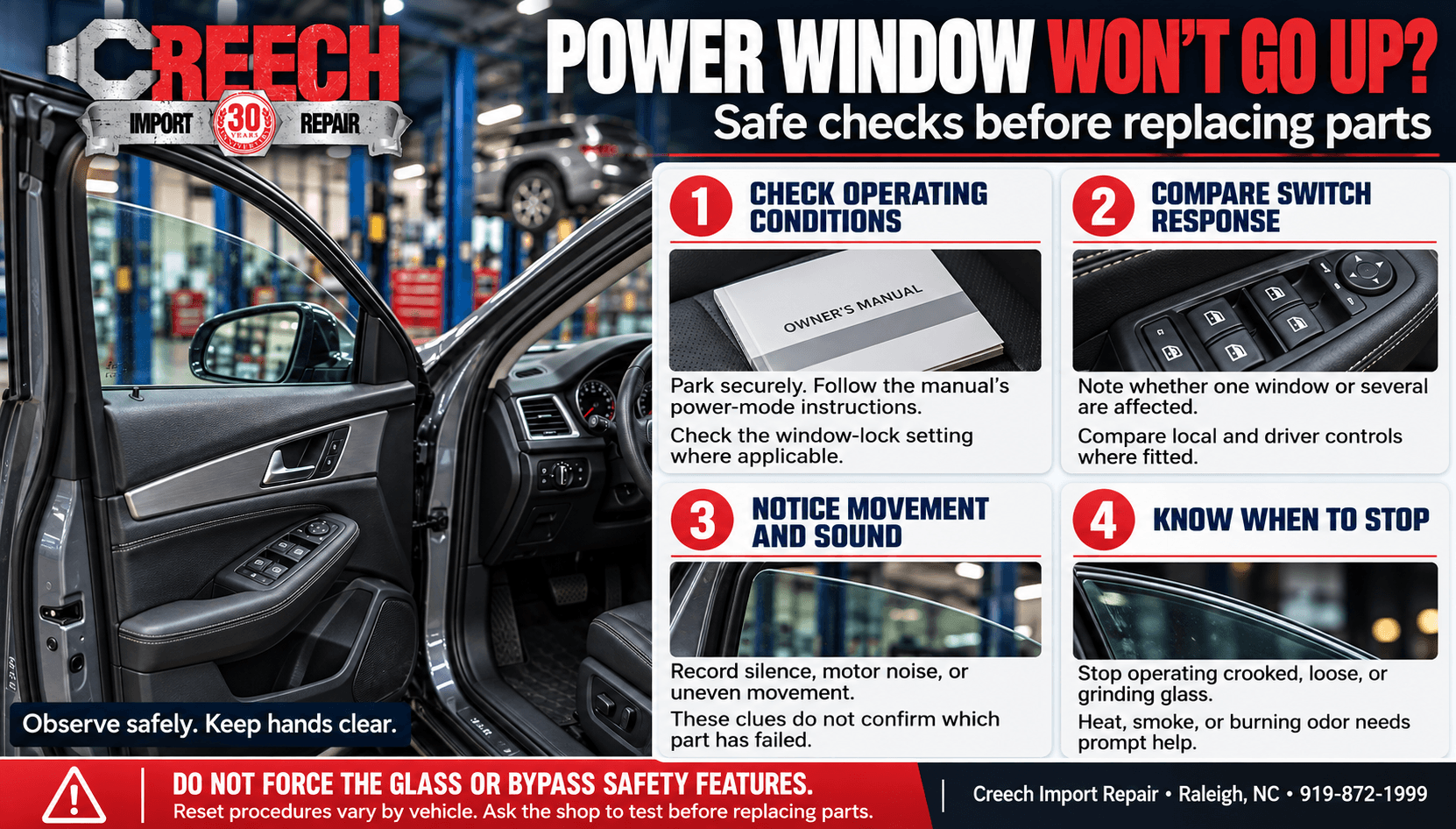
Four safe checks for a power window that won’t go up. Symptoms provide clues, but testing should guide repairs.
What Can Cause a Power Window to Stop Closing?
A power window may stop closing because of an operating-condition issue, a control or circuit fault, a motor problem, or resistance in the glass and lift mechanism. The possibilities below explain the systems involved; they are not a ranked list of causes or a reason to replace several parts together.
Switch inputs and control circuits
A window switch communicates the request to open or close. Depending on the design, it may switch motor current or send an input to electronics elsewhere. A fault can affect one direction, one control, or an intermittent command. Testing must establish whether the request reaches the appropriate circuit or module, rather than assuming the button is defective because the glass stayed still.
Wiring, connectors, and electrical supply
An interrupted connection or an inadequate supply can prevent movement. A technician may need to inspect the relevant door wiring, connector condition, grounds, and circuit protection. Failures affecting several electrical functions deserve a broader check, but a single-window problem should still be tested locally. ACI’s power-window troubleshooting guidance identifies wiring, switches, binding, fuses, and battery condition among areas to investigate.
Fuse locations, ratings, and circuit arrangements vary. Do not replace a fuse with a higher rating, bridge its terminals, or keep replacing one that fails again. A blown fuse describes an interrupted protected circuit; it does not establish why that happened. If the manual’s procedure is unclear or access is difficult, leave the check to the shop.
Motor or regulator trouble
A motor may fail to operate properly, while a damaged regulator may no longer move or support the glass as intended. Some assemblies can bind or allow the pane to fall. Dorman describes a specific regulator design with cable-related binding; that example illustrates one failure mode, not the diagnosis for every vehicle.
Glass that drops or leans should be treated as unstable. Do not grip it while someone uses the switch. Internal work requires securing the pane and following the correct removal and installation procedure, including any initialization required afterward.
Glass alignment, seals, and accessories
The pane must travel through its guides without abnormal resistance. A folded seal, misalignment, or interference can affect closure. Tell the shop if tinting, an in-channel deflector, door repair, or glass work preceded the problem. Dorman’s installation discussion notes that an incorrectly seated deflector can cause binding or retraction near the top.
Visible dirt or a displaced seal is an observation, not an invitation to pry the channel apart. Avoid spraying a general-purpose lubricant into the door or assuming it will fix slow movement. The appropriate product and procedure depend on the materials and the actual fault.
Why Does a Power Window Go Down but Not Up?
A window that moves down but will not rise needs testing of the closing command and the mechanism during upward travel. A direction-specific control problem, resistance, or a failing component may be involved. Downward movement alone does not establish that the motor, regulator, wiring, and switch are all healthy.
Raising glass and lowering it are different operating conditions. The technician should compare the command, available electrical supply, and mechanical response in the relevant direction. This is especially important when the window began moving slowly before it stopped closing, or when it still descends normally from one control but not another.
A useful description is: “The right-front window lowered normally, but neither switch raises it; the other windows still work.” If you heard a snap, noticed tilting, or saw the glass sink into the door, include that first. Do not lower a window again just to demonstrate the fault if it has already closed temporarily.
Temporary recovery can help keep the cabin dry, but it is not proof of a repair. Leave the affected window alone until it can be checked, particularly if closure required several attempts or the movement was abnormal.
Why Does the Window Close and Then Open Again?
A window that rises and then reverses may be responding to resistance detected by its automatic closing system. Alignment, seals, accessories, and model-specific settings or initialization can need attention. Reversal should not be dismissed as a nuisance that you can safely bypass.
First note whether the glass reverses at the same point and whether the symptom began after door, glass, or battery work. If a visible loose object is outside the mechanism, report it and keep the opening clear. Do not put fingers, tools, or another object into the moving path to test obstruction detection.
Manufacturer warnings matter here. Ford’s 2015 Edge power-window guidance explains that overriding bounce-back removes that protection during the override. A generic instruction to keep holding the switch can therefore change the safety behavior of a particular window.
A technician should determine what causes the reversal and verify the applicable automatic functions after repair. The aim is reliable normal closure, not simply getting past the point where the system stopped. Frameless doors and other specialized designs also require their own service information; do not transfer an online procedure from a different model.
Should You Try a Power-Window Reset After Battery Work?
Use a reset or initialization procedure only when it is specified for your exact vehicle and symptom. Some windows require a relearn after a power interruption or component replacement. A reset cannot repair broken hardware, unstable glass, or an interrupted circuit.
Distinguish a failed one-touch feature from a window that will not move at all. If normal manual operation remains available but automatic travel changed after battery work, tell the shop that distinction. If the pane is crooked, stuck, noisy, or loose, stop operating it rather than performing repeated full-travel cycles.
There is no universal “hold the button for ten seconds” remedy. Required conditions, timing, and safety behavior differ. Ford’s Fiesta bounce-back reset guidance, for example, warns about protection being unavailable until the memory is reset. Follow the complete instructions for your vehicle, not an isolated step.
Do not disconnect the battery just to experiment with a stuck window. That can introduce additional initialization needs without resolving the fault. Record when the problem began and disclose recent battery replacement, jump-starting, or electrical repairs during booking.
How Can You Protect a Car When Its Window Is Stuck Open?
The safest immediate option is usually to park in a secure, covered place and arrange assessment. Protecting the opening from weather is temporary damage control, not a repair. The pane may still move unexpectedly if its support has failed.
Remove valuables and avoid leaving the vehicle exposed overnight when a secure alternative is available. If rain has entered, keep the affected controls alone and tell the shop which areas became wet. Do not assume that drying the surface establishes that the switch or its internal connections are safe to operate.
A temporary exterior covering may be appropriate while the vehicle is stationary, provided it can be fitted without moving unstable glass or placing hands inside the mechanism. Ask the shop or roadside provider for advice if you cannot safely reach or cover the opening. Do not rely on adhesive tape to support a loose pane, and do not wedge objects into the door.
Before any travel, consider visibility, mirror use, weather, and the stability of the glass. A covering must not obstruct the view or become loose in traffic. If secure glass and safe visibility cannot be maintained, arrange assistance instead of improvising a drive to the shop. Smoke, excessive heat, or a persistent burning smell calls for stopping use and moving to safety; seek emergency help if there is an active fire.
Even with stable glass and clear conditions, an open window leaves the cabin vulnerable to weather and theft. Call before bringing the vehicle in so the shop can discuss access, timing, and whether the opening needs professional securing first.
How Should a Shop Diagnose a Power Window That Won’t Go Up?
A sound diagnosis should identify the window design, reproduce the complaint where safe, and distinguish an electrical command problem from a mechanical movement problem. The appropriate test sequence comes from vehicle-specific service information. It should provide evidence for the repair recommendation.
- Confirm the complaint. Identify the affected door, available switch responses, glass position, and whether normal or automatic operation is failing.
- Check operating conditions and circuit information. Verify the relevant supply, lockout behavior, and controls rather than assuming all vehicles use the same arrangement.
- Test commands and electrical delivery. Evaluate inputs, wiring, connections, and motor operation using the procedures appropriate to the system.
- Inspect glass support and travel. Check the regulator, attachments, alignment, guides, and seals when access and safe support have been established.
- Complete required setup and verification. After repair, check smooth closure and the manufacturer-required automatic or protection functions.
A basic engine-code reader may not cover the body systems relevant to the complaint. Equally, a stored fault code is a direction for testing, not automatic proof that the named module or motor needs replacement. Mechanical inspection can still be necessary even when electronics report no applicable fault.
Internal door repairs can involve delicate trim, sharp edges, and vehicle-specific safety components. Dorman’s installation guidance discusses limited access, fragile clips, and possible relearn requirements. A driver-facing check should stop before dismantling the door if the correct procedure, tools, or safe glass support are unavailable.
What Affects the Cost of Power-Window Repair?
Repair cost depends on the confirmed fault, the door design, required parts, access, and any setup or additional damage. There is no reliable single price for a car window that won’t roll up. A switch repair, wiring repair, alignment correction, and complete regulator assembly are different jobs.
Ask whether the motor and regulator can be serviced separately on your vehicle and why the proposed part is appropriate. A combined assembly can be the correct service option, but its presence on a parts website does not prove your car needs it. Trim level, door position, and automatic-window features can affect part selection.
An itemized estimate should explain diagnostic findings, parts, labor, any adjustment or initialization, and how normal operation will be checked. Ask whether damaged glass attachments, seals, clips, or water exposure add work beyond the original complaint. If testing is incomplete, ask what remains uncertain before authorizing replacements.
If coverage may apply, provide warranty documents or ask the manufacturer about relevant campaigns. You can also check NHTSA’s VIN-based recall lookup. A window symptom does not establish recall eligibility, and the lookup has limits, including certain older recalls and some newly announced VIN coverage.
How Can You Reduce Repeat Window Problems?
Use the window normally, keep its accessible surfaces clean according to the owner’s manual, and have changed movement inspected before it becomes a complete failure. Maintenance cannot guarantee that a switch, motor, or regulator will never fail, but reporting early symptoms gives the shop more information.
Watch for a pane that slows consistently, catches at one point, leans, or reverses unexpectedly. Avoid repeatedly testing it to see whether it eventually completes a cycle. If an accessory was fitted recently, provide its details rather than removing or adjusting it while the glass is moving.
Keep drinks away from switch panels and follow approved cleaning methods. Do not spray cleaners directly into controls or add lubricant without knowing the required product and location. On a frozen or visibly stuck window, stop using the switch and follow the vehicle’s cold-weather guidance instead of forcing the glass.
After any repair, report abnormal behavior promptly. A window that closes once should still move smoothly and operate as the manufacturer specifies. Keep the invoice and note which functions were verified so a returning symptom can be compared with the original complaint.
What Should You Tell the Repair Shop?
Give the shop a precise symptom description and mention whether the window is open, stable, or exposed to weather. You do not need to identify the faulty component before booking. A clear report helps the service team prepare the next step.
- Year, make, model, and the exact affected door.
- Whether one window or several are affected.
- Response from the local switch and driver’s control, where fitted.
- Glass position, noises, tilting, dropping, or reversal.
- Whether normal manual movement differs from one-touch operation.
- Recent battery, door, glass, tint, or accessory work.
- Any water exposure, unusual heat, smoke, or burning smell.
- Whether safe travel and secure parking are currently possible.
A short video may help with an intermittent symptom if it can be recorded without repeating unsafe movement. Say when an observation has not been checked. “I have not tested the passenger switch” is more useful than a guess that both controls failed.
Where Can Raleigh Drivers Get Help With a Stuck Power Window?
Creech Import Repair provides automotive electrical-system repair in Raleigh. Explain the window’s behavior before requesting a particular part. The service team can discuss your vehicle, the open-window concern, and an appointment for assessment.
The shop also lists window-related work within its Toyota Corolla repair services. Drivers of other makes should provide their exact model and symptom during booking. A general electrical service description is not a guarantee of a particular part’s availability or a same-day repair.
Creech Import Repair is located at 1818 St. Albans Dr #106, Raleigh, NC 27609. Listed hours are Monday through Friday, 7:30 a.m. to 5:30 p.m. If the window is stuck open, call before bringing the vehicle so you can discuss safe arrival and protection from weather.
Get the window problem checked before buying parts.
Call 919-872-1999 or request an appointment with Creech Import Repair. Include your model, affected door, and whether the glass is secure.
Online booking requests are confirmed by a member of the service team.
Frequently Asked Questions
Why won’t my power window go up when the other windows work?
When only one window fails, its controls, wiring, motor, regulator, or glass travel may need inspection. Working windows elsewhere do not identify the failed part or rule out an isolated circuit problem. Note the exact door and any switch response or noise. If the glass tilts, drops, or grinds, stop operating it and arrange help rather than repeating the test.
Why does my car window go down but not up?
Movement in one direction does not establish that the whole system is healthy. A closing-command fault, resistance during upward travel, or a component problem may be involved. Describe which controls work and whether the glass moves evenly. Do not pull the pane while using the switch. A technician should compare electrical operation and mechanical travel before recommending a switch, motor, or regulator.
Does motor noise mean the window regulator is broken?
No. Motor noise without glass movement is an important clue, but it does not confirm a broken regulator. The lift mechanism, glass attachment, alignment, binding, and motor operation may need inspection. Stop repeatedly cycling a mechanism that does not move the pane. Keep hands clear of unstable glass and have the shop establish the fault before replacing parts.
What if the window works from the driver’s switch but not its own switch?
Different responses from two controls can help narrow the inspection, but the local switch is not automatically defective. A window-lock setting, control input, wiring, or the relevant operating path may be involved. Check the owner’s manual and report the response from each control where fitted. Do not swap switches or dismantle the door solely on the basis of this observation.
Can a weak battery affect power-window operation?
Inadequate electrical supply can affect window operation, but a stuck window alone does not establish a bad battery. Report whether several windows or other electrical functions changed, especially after a power interruption. The shop can test the relevant supply and connections. Avoid disconnecting the battery as a generic reset, since doing so may introduce vehicle-specific initialization needs without correcting the original fault.
Can I pull a stuck power window up by hand?
Do not pull or push the glass while someone operates the switch. Movement can be sudden, and unstable glass may slip or break. Hand force can also worsen a damaged mechanism or alignment problem. Park securely, keep the opening clear, and ask a repair shop or roadside provider about securing the window. Internal work requires the correct procedure and safe support for the pane.
Why does my window roll up and then come back down?
A window may reverse when its automatic closing system detects resistance. Seals, alignment, accessories, or vehicle-specific initialization can need attention. Note whether it reverses at the same point and whether recent work preceded the problem. Do not defeat obstruction protection or test it with your fingers. Use the exact owner’s manual and arrange inspection if normal closure cannot be restored safely.
Will a power-window reset fix a window stuck open?
A reset may address a lost automatic function on some vehicles, but it cannot repair damaged hardware, unstable glass, or an interrupted circuit. Procedures and safety behavior vary by model. Follow a reset only when it is specified for your exact vehicle and symptom. If the pane is crooked, loose, grinding, or completely unresponsive, stop repeated cycling and request diagnosis.
Is it safe to drive with a window that won’t close?
Safe travel depends on glass stability, visibility, weather, and any electrical warning signs. Do not drive with loose glass, an obstructed view, smoke, or a suspected electrical hazard. A temporary covering must not block visibility or come loose in traffic. If safe travel cannot be established, arrange assistance. Otherwise, call the shop before arrival to discuss the open window and appointment.
How much does it cost to fix a power window that won’t go up?
Cost depends on the diagnosed fault, vehicle design, parts, access, and any adjustment or initialization. A switch repair and a complete regulator assembly involve different work. Ask for an itemized estimate explaining the findings, proposed parts, labor, and verification. Do not choose a repair from a generic online price range or assume the motor and regulator both require replacement.
Sources and Vehicle-Specific Guidance
Guidance checked October 1, 2026. Owner’s manuals establish operation and warnings for the named vehicles. Supplier guidance explains possible hardware and installation issues. Neither establishes the diagnosis or likelihood of a cause for your car. Use your exact manual and current vehicle-specific service information.
- Honda: 2024 CR-V, Opening and Closing the Power Windows.
- Ford: 2015 Edge, power-window operation and bounce-back warnings.
- Ford: Fiesta, resetting window bounce-back.
- ACI: Power Window Troubleshooting Tips.
- Dorman: window regulators and integrated lift assemblies.
- Dorman: regulator assembly 748-509, a model-specific cable-binding example.
- Dorman Shop Press: window-regulator installation considerations.
- NHTSA: VIN-based recall lookup and coverage limits.
About Creech Import Repair
Creech Import Repair is a family-owned Raleigh automotive repair business serving drivers since 1993. Its listed services include automotive electrical repair, and its website describes work on import and domestic vehicles. For assessment of a particular window problem, contact the service team with your vehicle details and symptoms.
Find Creech Import Service articles useful?
Add this site to your Preferred Sources in Google Search.