


HVAC & ELECTRICAL DIAGNOSIS • RALEIGH, NC
Car Blower Fan Only Works on High: What Needs Checking?
If your car blower fan only works on high, you lose the ability to choose a comfortable airflow setting. The cabin fan may be silent on the lower positions, then suddenly roar at maximum speed. That pattern is useful, but it does not identify a failed part by itself.
A conventional blower resistor circuit is one possibility. An electronic speed controller, damaged connection, control input, or blower motor problem may also need attention, depending on the vehicle. Buying the first part suggested by an online search can leave the original fault unresolved.
This guide explains safe observations, the difference between blower-control designs, and what a repair shop should verify. Whether you describe it as the heater fan, AC fan, or cabin blower, start with the same question: which commanded speeds actually work?
Quick Answer: Why Does the Fan Work Only on High?
On some conventional systems, high speed bypasses the resistor used for lower speeds, so a failure in that lower-speed path can leave high working. Other vehicles use electronic speed control and require a different diagnosis. Park safely, record which settings fail, and arrange testing before replacing parts. Stop using the blower if there is a burning smell, smoke, or unusual heat. Do not drive if windshield visibility cannot be maintained.
What Should You Check First When the Blower Only Works on High?
Start with a brief comparison of normal fan settings while the car is safely parked. The goal is to describe the failure accurately, not to force a stalled fan to run. Skip these observations if you already noticed smoke, a burning odor, or abnormal heat around the controls.
Confirm the operating mode
Apply the parking brake and follow your owner’s manual for the required ignition or power state. If the engine needs to run, remain outdoors, away from enclosed spaces. Check whether the climate system is in AUTO, a manual fan setting, or a maximum-defrost mode. Those modes can request different airflow even when nothing is broken.
Compare fixed fan commands
If your manual allows it, choose manual fan control and briefly compare the available settings. Note whether every lower position is silent, only one speed is missing, or the fan remains fast regardless of the displayed selection. Keep the same outlet setting during the comparison so that moving air between vents does not confuse the result.
Record sound and airflow separately
Listen for a change in motor sound as well as feeling the air at an open vent. A fan that changes speed but delivers little air presents a different complaint from a fan that will not respond to lower commands. Mention squealing, scraping, vibration, or operation that comes and goes.
Once you have a clear description, stop experimenting. Avoid reaching into the blower housing, tapping components to make them run, or repeatedly cycling a noisy motor. An observation such as “settings one through three are silent; four works in heat and AC” gives the shop a useful starting point.
Does Your Car Use a Blower Resistor or an Electronic Controller?
The correct diagnostic path depends on the actual circuit, not just the appearance of the dashboard controls. A car with numbered fan positions may use a resistor assembly; another may use an electronic regulator. Automatic climate systems commonly use electronic control, but the vehicle’s service information must establish the design.
Conventional resistor-controlled speeds
A resistor arrangement provides reduced blower speeds through selected electrical paths. DENSO’s HVAC resistor overview distinguishes fan-speed regulation from the actuators that manage air direction and temperature. These are different jobs inside the same climate system.
In certain circuits, the highest setting uses a path that bypasses the lower-speed resistor. Morgan Olson’s guide for HVAC system 555001107 documents that arrangement. It explains the familiar high-only symptom for that design; it is not a wiring diagram for every passenger car.
Electronic blower-speed control
An electronic controller regulates the motor in response to the climate system’s command. HELLA’s interior blower regulator information describes inputs from climate controls or switches and regulation of the motor’s electrical output. A technician must compare what is requested with what the controller actually delivers.
Parts catalogs may use names such as resistor, regulator, power module, or blower motor controller. Similar names and similar-looking parts do not guarantee compatibility. Correct identification includes the model year, vehicle configuration, connector arrangement, and HVAC equipment. A repair recommendation should explain the relevant design rather than treating “resistor” as a universal answer.
What Do Different Missing-Speed Patterns Mean?
Different patterns help determine which tests are useful. They do not confirm a replacement part. Describe the settings that fail and the conditions when they fail, including whether the problem affects a front blower, rear blower, or both.
| Observed behavior | What needs distinguishing | What to report |
|---|---|---|
| Lower settings are silent; highest works. | Lower-speed circuit failure versus electronic control trouble. | Exactly which settings work in manual mode. |
| One intermediate speed is missing. | A particular control or circuit path versus an intermittent fault. | The missing position and whether it fails consistently. |
| The fan stays fast at every selection. | Requested speed versus controller output and circuit behavior. | Whether the display changes while motor sound stays constant. |
| Motor sound changes, but vent airflow is weak. | Speed-control operation versus an airflow restriction or distribution problem. | Which outlets are weak and whether all speeds sound different. |
| The blower stops working at every speed. | Motor operation, supply, ground, protection, and control. | Whether the failure followed noise, odor, or intermittent operation. |
| The rear fan behaves differently from the front. | Separate blower equipment and control arrangements. | Which cabin area and which control are affected. |
Do not describe the fan as completely dead if it still works on maximum. Conversely, do not call it a high-only problem if the fan changes speed normally but the air is warm. Those distinctions prevent a speed-control complaint from being confused with a refrigerant, heating, or air-distribution complaint.
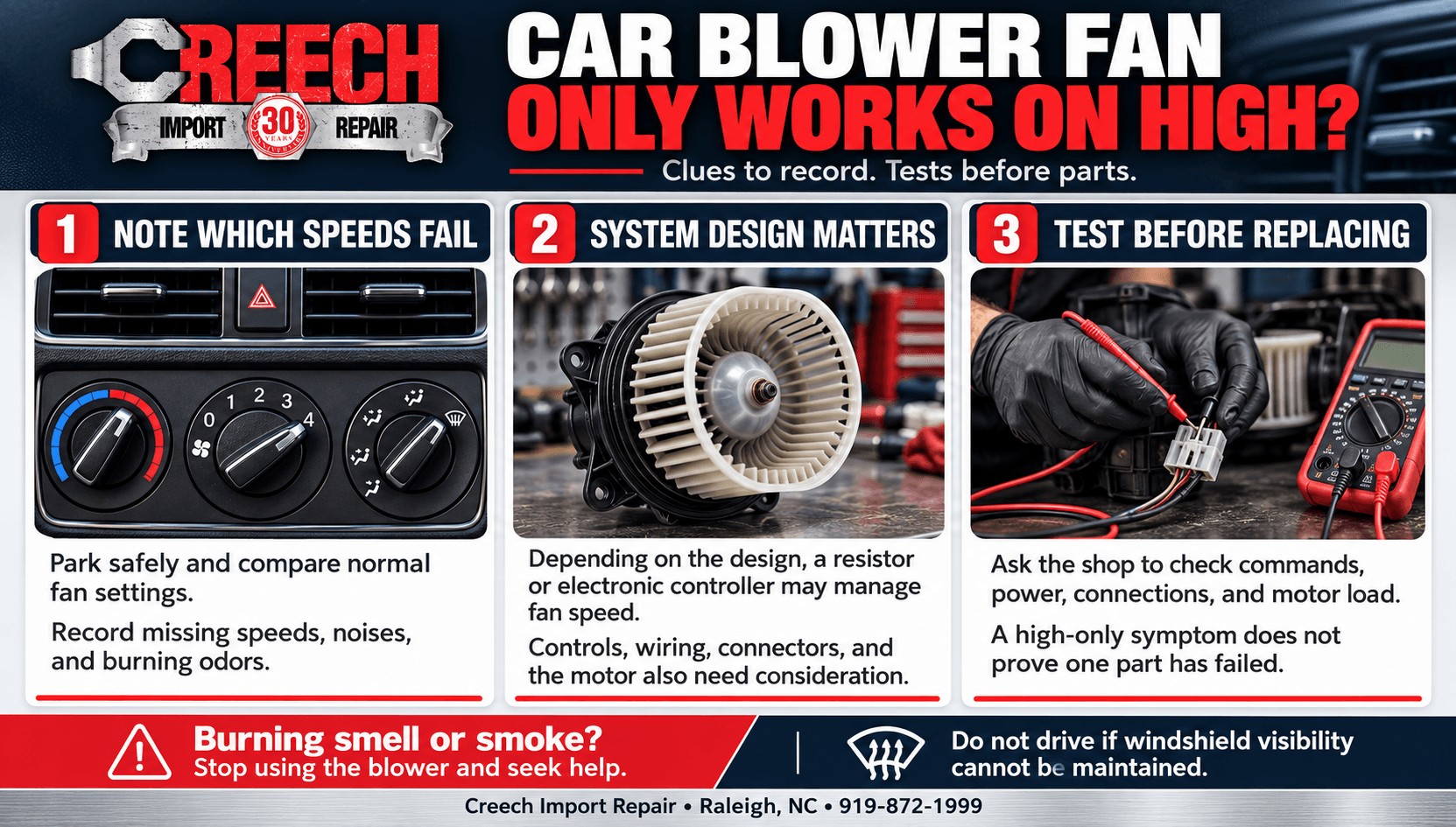
Car Blower Fan Only Works on High: Diagnostic Infographic
Use this infographic to organize the three most useful points: record the missing speeds, identify the system design, and test before replacing parts. It is a symptom guide, not a vehicle-specific wiring diagram.
What Can Cause the Lower Blower Speeds to Stop Working?
The possible causes include the speed-control component, its connections, the command circuit, and the motor it operates. These areas interact, so diagnosis should explain both the immediate failure and any associated damage. The list below is not a ranking of how frequently each part fails.
A failure in the resistor circuit
Where lower speeds depend on a resistor assembly, an interrupted path can remove those settings while another path remains usable. Testing should confirm the relevant failure and inspect the associated connections. A circuit can behave as though a resistor is faulty when the interruption is actually at a terminal or elsewhere in the same path.
An electronic regulator or command problem
An electronically controlled blower needs an appropriate speed request and a usable electrical supply. The regulator cannot be judged solely from the dashboard display. If the command is incorrect, absent, or not reaching the component, changing the output module may not resolve the complaint.
Damaged connectors or wiring
Heat damage, corrosion, poor terminal contact, or an interrupted wire can affect blower operation. Dorman’s replacement connector 973-302 is one application-specific example of a connector intended to replace an original damaged by overheating or corrosion. It demonstrates a real repair category, not that this particular connector fits your car.
If damage is found, the repair should address the affected terminals and wiring using the specified procedure. Simply installing a new controller into a damaged connection leaves an important issue unresolved. A warm or discolored connector also needs an explanation; visible damage alone does not establish what caused it.
Blower motor condition
A motor that runs on high still needs evaluation when its noise, mechanical condition, or electrical load is abnormal. The fact that it rotates does not establish that it is operating within specification. Its condition matters especially after repeat speed-control failures or when the fan began squealing before lower speeds disappeared.
Switches, control panels, and shared electrical paths
The fan selection must reach the relevant circuit or controller. A switch fault, wiring issue, or supply problem can interfere with that request. Report other electrical symptoms, but do not assume that a battery, relay, or entire climate-control panel needs replacement without evidence from the applicable circuit.
How Should a Shop Diagnose a Blower That Only Works on High?
A useful diagnosis connects the reported symptom to test results for the specific vehicle. It should distinguish a failed component from an incorrect command, inadequate electrical supply, damaged connection, or abnormal motor condition. The order and limits of the tests come from the vehicle’s service information.
1. Verify the complaint and identify the circuit
The technician should establish which blower is affected and compare the available commands where safe. Manual versus automatic operation, front versus rear equipment, and the exact installed controller matter. Relevant service information can also identify applicable bulletins or prescribed checks for that model.
2. Inspect the related connections
The inspection should consider connector condition, terminal damage, wiring, and signs of heat or moisture. Access varies significantly between vehicles. A visible inspection is one part of diagnosis; a connection that looks intact may still need electrical testing under operating conditions.
3. Compare commands, supply, and response
For an electronic system, a technician may compare the speed request with the controller’s response using appropriate diagnostic equipment. For a conventional circuit, testing follows the relevant switch and resistor paths. Power and ground checks should establish that the circuit can support operation, not merely that a voltage appears on an unloaded meter.
4. Evaluate motor operation and load
Motor checks should use the specifications and method for that application. There is no universal amp reading that proves every blower is healthy. Noise, mechanical interference, and abnormal current behavior may change the repair recommendation, particularly when the speed-control component has already failed more than once.
5. Confirm normal operation after repair
Verification should include the formerly missing settings, smooth response to commands, and relevant outlet modes. If the original fault was intermittent, checking the conditions that triggered it is valuable. Ask the shop what failed, what supporting tests were performed, and which functions were confirmed afterward. That explanation is more informative than a parts list alone.
Creech Import Repair’s automotive electrical service is relevant when blower commands, wiring, connections, or electrical operation need assessment.
Why Might a New Blower Resistor Fail Again?
A repeat failure is a reason to investigate the surrounding system, not simply install another identical part. Possible issues include an unresolved connection problem, abnormal motor operation, an incorrect replacement, or an installation concern. The shop should establish which explanation is supported on your vehicle.
The Morgan Olson guide cited above specifically directs attention to motor operation and interference when its resistor fails. That manufacturer example supports checking related conditions; it does not mean every failed passenger-car resistor requires a new motor.
Give the shop the previous invoice, replacement date, and mileage when the symptom returned. Mention whether all speeds worked immediately after the earlier repair, whether the same positions disappeared again, and whether a smell or noise developed. A different pattern after repair may point to a different fault.
Correct part selection and installation also matter. Standard Motor Products’ blower-resistor training guidance explains that some assemblies rely on air passing through their installed location for cooling. Operating them outside that location can damage them. The shop should consider the specified airflow checks, including the cabin filter where applicable.
Ask for the reason behind replacing multiple components; a verified related problem is a better basis than automatically replacing everything together. Filter maintenance alone does not establish that an already failed control component will recover.
Is This an AC Problem, a Heater Problem, or a Fan Problem?
A missing-speed complaint concerns how the cabin blower is controlled. The blower moves air used for ventilation, heating, cooling, and windshield clearing. Air temperature and outlet selection involve additional functions, so the name you give the fan does not identify the failed system.
DENSO’s cabin blower overview describes its role in delivering air through the vehicle’s ventilation system. If both heating and AC lose the same lower fan settings, report that shared pattern. If fan speed responds normally but cooling is poor, describe the temperature complaint separately.
Adding refrigerant is not a diagnostic step for missing electrical fan speeds. Refrigerant service should be based on evidence of a cooling-system problem and the correct service procedure. The same applies to coolant or heater work: those services should not be inferred from a fan-selection failure alone.
For normal airflow with inadequate cooling, Creech’s guide to a car AC blowing warm air addresses the separate temperature symptom. For speed-control trouble, give the service team the missing settings first, then mention whether the air also fails to heat or cool.
Can a Cabin Air Filter or AUTO Mode Explain the Symptom?
A restriction and a speed-control fault can feel similar from the driver’s seat, but they are different observations. If the motor clearly speeds up and slows down while vent airflow stays weak, the shop should investigate airflow as well as fan operation. A dirty filter should not be assumed to explain electrically missing speed settings.
Check the cabin-filter maintenance schedule in your manual and tell the shop when it was last serviced. Do not remove dashboard panels or disturb wiring merely to inspect it. Filter location and access differ, and some vehicles have separate equipment serving the rear cabin.
AUTO mode can also change airflow according to the system’s demand. Strong airflow at startup may be expected when the cabin needs substantial cooling or heating. That is different from a fan that refuses lower manual commands. Maximum-defrost modes can likewise change normal operating behavior.
Use the exact owner’s manual to distinguish intended automatic operation from a fault. If you cannot find the manual fan override or the system behaves differently than described, record the display settings and contact the shop. Do not use battery disconnection as a general-purpose blower reset.
Is It Safe to Drive With the Blower Working Only on High?
There is no universal assurance that continued driving is safe. A remaining high-speed setting does not establish the condition of the wiring, connections, controller, or motor. The immediate decision depends on warning signs and whether the windshield can remain clear throughout the trip.
Stop using the blower if you notice electrical warning signs
A burning smell, smoke, or unusual heat calls for stopping operation and seeking help. If smoke appears while driving, pull over safely and move away from danger. Seek emergency assistance for an active fire or immediate threat. Do not repeatedly turn the fan back on to locate the source.
Windshield visibility is a separate concern. Rain, humidity, cold weather, and passengers’ moisture can increase the need for reliable defogging. If you cannot maintain a clear view, do not continue driving. Arrange assistance instead of relying on open windows or a setting that is becoming intermittent.
When there are no warning signs and visibility is clear, contact the shop for advice about the specific symptoms before traveling. High speed working today does not guarantee it will remain available. Explain whether there is any noise, whether the fan cuts out, and whether windshield airflow responds normally.
How Much Does It Cost to Repair Missing Blower Speeds?
The cost depends on what testing finds, the installed system, access, parts, and related damage. A standalone resistor repair and a repair involving a controller, connector, and motor are different jobs. A symptom alone is not enough to provide a reliable price for your vehicle.
When requesting an estimate, provide the year, make, model, and HVAC details. Ask whether the diagnostic charge is separate and what the estimate includes. Depending on the findings, the work may involve only one component or may also require an identified wiring or connector repair.
- Diagnosis: What fault was verified, and what tests support it?
- Parts: Which component matches the installed HVAC configuration?
- Related work: Is there documented connector damage or abnormal motor operation?
- Labor: What access, installation, and verification are included?
- Coverage: Does an existing repair or parts warranty apply?
If the same symptom returned after a recent repair, bring the invoice and discuss coverage before authorizing additional work. An estimate should explain why each item is needed. Avoid treating an inexpensive part price as the total repair cost or assuming a more expensive quote is excessive without comparing the actual scope.
What Should You Avoid While Waiting for Diagnosis?
Keep owner-level observations separate from electrical repairs. The blower circuit can involve substantial current, and an improvised connection may bypass its intended control or protection. Restoring airflow temporarily is not evidence that a modification is safe.
- Do not jumper the resistor, bridge a connector, or bypass a thermal protection device.
- Do not install a higher-rated fuse or repeatedly replace one that blows again.
- Do not connect an unknown wire directly to the battery to test the fan.
- Do not reach into a blower wheel or housing while the system can operate.
- Do not replace several parts solely because they appear in a generic symptom chart.
Leave dismantling and energized testing to someone using the correct service procedure and equipment. Access may involve trim, wiring, or areas near safety equipment. A repair video for a similar-looking dashboard does not establish that the same procedure applies.
Useful preparation is simpler: record the pattern, preserve prior invoices, and mention recent battery, dash, or HVAC work. Report water intrusion or a symptom that began after another repair without assuming that event proves the cause. If the fan temporarily starts working again, tell the shop; intermittent recovery does not confirm that the problem has resolved.
What Information Should You Give the Repair Shop?
A precise symptom history helps the technician choose relevant checks and reproduce an intermittent problem. You do not need to diagnose the component yourself. Describe what the car did, when it happened, and which normal controls were selected.
- Vehicle year, make, model, and whether the climate controls are manual or automatic.
- The exact speeds that work and fail, including front or rear equipment.
- Whether the pattern occurs in manual mode, AUTO, heating, cooling, or defrost.
- Any burning odor, unusual heat, noise, vibration, or intermittent operation.
- Whether the problem is constant or changes after the car has been running.
- Previous resistor, controller, connector, or blower motor repairs.
A helpful example is: “The front fan is silent on one, two, and three, but four works. The same thing happens with AC off. There is no burning smell, and the fan began squealing last week.” Record only what you observed; do not run a noisy or overheating system to complete the checklist.
Where Can You Get Blower Fan Diagnosis in Raleigh?
Creech Import Repair offers AC and HVAC repair in Raleigh, including blower and airflow diagnostics. Its electrical services are relevant when the complaint involves missing commands, circuit faults, or damaged connections. Contact the team with your vehicle details and the exact speed pattern to discuss assessment and scheduling.
Ask for diagnosis of the missing speeds rather than requesting a resistor replacement before testing. If there is an odor, noise, or repeat failure, mention it when booking. Those details may affect the inspection and advice about bringing the vehicle in.
Need Help With a Blower That Only Works on High?
Call Creech Import Repair to discuss missing fan speeds, unusual blower noise, or a recurring speed-control problem.
Phone: 919-872-1999
Address: 1818 St. Albans Dr #106, Raleigh, NC 27609
Hours: Monday–Friday, 7:30 a.m.–5:30 p.m.
Appointment requests require confirmation from the service team. If the windshield cannot stay clear or electrical warning signs are present, discuss assistance before driving.
Frequently Asked Questions
Does a blower that only works on high always need a new resistor?
No. That pattern can fit a lower-speed resistor-circuit failure on certain designs, but it does not establish that the resistor itself is defective. Electronic control, damaged terminals, wiring, or command problems can also need attention. The shop should identify the installed circuit and verify the fault before recommending a part. High-speed operation alone is not a complete diagnosis.
Can the blower motor be faulty even if high speed works?
Yes. A motor can rotate while still having abnormal noise, mechanical condition, or electrical load. A technician should evaluate those factors when the symptoms or test results warrant it, especially after repeated speed-control repairs. Do not assume the motor needs replacement either: the recommendation should be supported by application-specific checks, rather than by the fact that lower speeds are missing.
Why does my heater fan have the same problem as my AC fan?
Heating and cooling commonly use the same cabin blower to move air, so a fan-speed fault can appear in both modes. Air temperature is a separate part of the complaint. Tell the shop whether the same settings fail with heating and AC, and whether the air also has a temperature problem. That distinction helps keep blower diagnosis separate from cooling or heating-system diagnosis.
Will adding refrigerant restore the lower fan speeds?
Adding refrigerant is not a repair for missing electrical blower-speed commands or circuit paths. Refrigerant service concerns the cooling system and should follow evidence of a cooling fault. If the fan responds to every speed but the air stays warm, report that different symptom. If both temperature and speed are wrong, describe both so each function can be assessed.
Can a dirty cabin air filter make the fan work only on high?
A restricted filter can contribute to weak delivered airflow, but weak airflow does not prove that lower motor speeds are electrically unavailable. Listen for changes in fan sound as well as checking the air at an open vent. Report the filter’s service history and which speeds respond. Do not assume filter replacement will resolve a confirmed speed-control fault.
Is high blower speed normal when automatic climate control starts?
It can be normal for an automatic climate system to request strong airflow when the cabin needs heating or cooling. The important distinction is whether the fan can respond to lower manual commands when the owner’s manual permits that comparison. Check the operating mode and selected settings while safely parked. A fan stuck at high despite a valid lower command needs assessment.
Can I keep using the highest fan setting until the repair?
Do not treat high-speed operation as proof that continued use is safe. Stop using the blower if there is a burning odor, smoke, unusual heat, or concerning noise. Do not drive if windshield visibility cannot be maintained. Contact the shop with the symptom details for advice about travel and assessment; an available setting may become intermittent or stop working.
Why did the problem return after a resistor replacement?
The earlier repair may have left an associated fault unresolved, or a different fault may have developed. Connections, motor condition, part selection, and installation may need investigation. Bring the previous invoice and describe which speeds worked after the repair and which failed later. A repeat symptom justifies further testing, but does not automatically mean the motor and resistor both need replacing.
Should I disconnect the battery to reset the blower?
Do not disconnect the battery as a generic remedy for missing fan speeds. A reset cannot repair damaged wiring, terminals, or failed hardware, and power disconnection may create additional settings or initialization needs. If the owner’s manual or a technician specifies a procedure for your exact vehicle, follow that guidance. Otherwise, preserve the symptom history and arrange diagnosis.
What should I ask before approving a blower repair?
Ask what fault was verified, which tests support it, and whether associated connectors or motor operation were checked where relevant. Confirm the correct part for the installed HVAC system, the labor and diagnostic charges, and how operation will be verified afterward. If the complaint returned after recent work, ask whether existing repair coverage applies and provide the invoice.
Sources and Vehicle-Specific Guidance
The technical references below explain component functions and specific circuit examples. Your vehicle’s owner’s manual and service information take priority for operating modes, wiring, test limits, and repair procedures. A manufacturer example is not a diagnosis for every vehicle.
- DENSO: HVAC actuators and resistors — fan-speed control versus air-direction and temperature functions.
- DENSO: cabin blower fans — the blower’s role in cabin ventilation.
- HELLA: interior blower regulators — electronic speed regulation and control inputs.
- Morgan Olson: HVAC system 555001107 troubleshooting guide — a specific resistor-bypass circuit and related motor checks.
- Standard Motor Products: blower motor resistor operation — application-specific testing and installed airflow requirements.
- Dorman: connector 973-302 — an application-specific replacement for an overheated or corroded connector.
- Creech Import Repair: contact and scheduling information.
References and business details checked October 1, 2026.
About Creech Import Repair
Creech Import Repair is a family-owned Raleigh automotive repair business serving drivers since 1993. Its listed services include HVAC and automotive electrical repair for import and domestic vehicles. Contact the service team for assessment of your vehicle’s blower-speed problem.
Find Creech Import Service articles useful?
Add this site to your Preferred Sources in Google Search.