


Creech Import Repair | Raleigh, North Carolina
Steering Wheel Hard to Turn? 7 Causes and When to Stop Driving
You are pulling into a parking space, making a turn at an intersection, or backing out of a driveway when something feels wrong. Your steering wheel suddenly requires much more effort than usual. Maybe you hear a whining noise, notice a warning light, or feel the wheel resist your hands.
A steering wheel hard to turn can indicate a loss of power steering assistance, low hydraulic fluid, a belt or pump problem, an electrical fault, or mechanical binding in the steering or suspension system. The specific cause depends on the vehicle's steering design and the conditions under which the symptom occurs.
Unexpectedly heavy steering is more than an inconvenience. If steering resistance changes without warning, the driver may have difficulty completing turns or safely controlling the vehicle.
This guide explains seven possible causes, how hydraulic and electric power steering systems differ, which symptoms require immediate attention, and how a qualified technician investigates steering resistance. It is written for drivers seeking practical safety guidance and professional automotive diagnostics in Raleigh, North Carolina.
Quick Answer
Why Is My Steering Wheel Hard to Turn?
A steering wheel may become hard to turn when the vehicle loses hydraulic or electric steering assistance or when a mechanical steering component binds. Possible causes include low power steering fluid, hydraulic leaks, a worn steering pump, a damaged drive belt, electric power steering faults, low system voltage, or steering rack and suspension binding. Not every car uses hydraulic power steering. If steering suddenly becomes much heavier, catches, or makes the vehicle difficult to control, stop in a safe location and arrange professional assistance rather than continuing to drive.
What Does It Mean When a Steering Wheel Becomes Stiff?
Steering resistance is the effort a driver must apply to rotate the steering wheel and direct the front wheels. A properly operating steering system provides predictable response, although the amount of effort varies among vehicles and driving conditions.
On many passenger vehicles, the steering system uses power assistance to reduce the physical effort needed to turn the wheels. Older and some current designs use hydraulic pressure. Many modern cars instead use electric power steering, often abbreviated EPS.
If power assistance is reduced or unavailable, the steering wheel can feel much heavier, especially when the vehicle is stopped or moving slowly.
Importantly, not all heavy steering means the steering rack is mechanically seized. A vehicle may retain a mechanical steering connection after losing assistance, but the effort required to turn can increase dramatically. That situation should not be treated as normal driving.
Heavy Steering
The wheel turns, but substantially more physical effort is required than before.
Intermittent Assistance
Steering effort unexpectedly increases and decreases during operation.
Mechanical Binding
The steering catches, sticks, or resists movement at certain wheel positions.
Is Heavy Steering the Same as Loose Steering?
No. Heavy steering means excessive resistance. Loose steering generally describes excessive play, delayed response, or a wandering sensation. Both can involve steering and suspension components, but they require different diagnostic priorities.
If your vehicle drifts or pulls despite normal steering effort, Creech's separate wheel alignment guide for Raleigh drivers explains alignment-related symptoms. This article focuses on steering effort and loss of assistance.
Is Steering Supposed to Feel Heavier When Parking?
Some increase in effort at very low speeds is normal because the tires must change direction while supporting the vehicle's weight. However, functioning power steering is designed to make parking and low-speed maneuvers manageable.
A noticeable change from the vehicle's usual steering feel, particularly a sudden change, deserves attention. Compare the symptom with what is normal for your own vehicle rather than another model.
Do not continue maneuvering in a tight space if you cannot steer predictably.
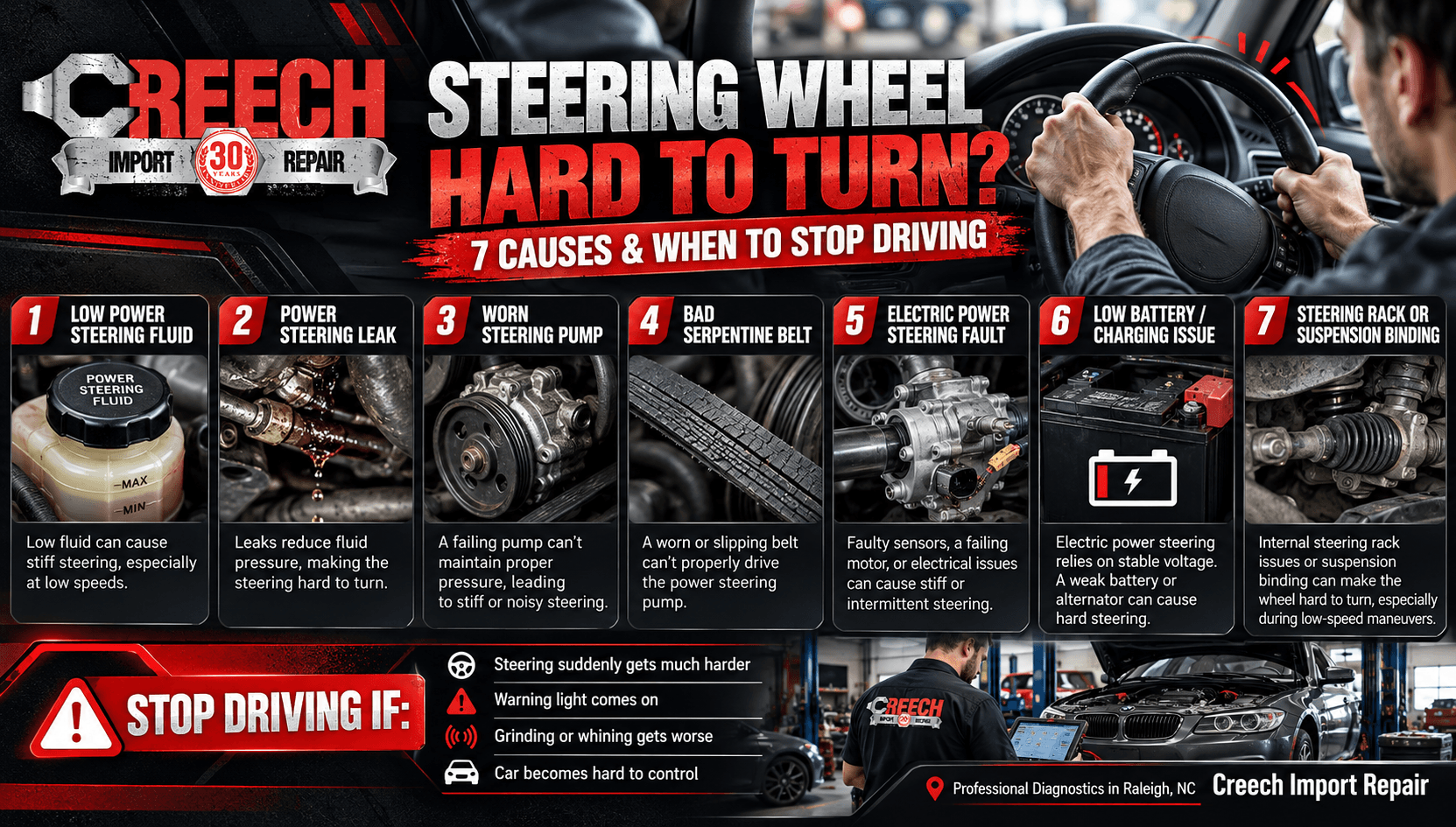
7 Possible Causes of a Steering Wheel Being Hard to Turn
The following seven categories explain common mechanisms that can increase steering effort. They are not ranked by frequency. Different vehicle designs use different components, and several faults can produce similar symptoms.
Low Power Steering Fluid in a Hydraulic System
Hydraulic power steering uses pressurized fluid to help the driver turn the wheels. A pump generates hydraulic pressure, which is directed through the appropriate steering components to provide assistance.
If the fluid level becomes too low, the pump may draw air or fail to maintain the intended hydraulic operation. Steering may become unusually heavy, and the driver may notice whining or groaning noises during ordinary turns.
The exact symptoms depend on the amount of fluid remaining, pump design, and severity of the problem. A small fluid deficit does not always create immediate complete assistance loss, but it can indicate a developing leak or another condition needing attention.
Low fluid is usually a symptom of another problem, not a complete diagnosis. A sealed hydraulic system should not require frequent unexplained fluid additions.
Some reservoirs have hot and cold level markings, while other vehicles use different inspection procedures. The owner's manual determines the correct fluid and checking method.
Electric power steering systems do not use a hydraulic reservoir unless the vehicle has a separate electro-hydraulic steering design. Never search for or add power steering fluid to a system that does not require it.
Power Steering Fluid Leaks or Damaged Hydraulic Lines
A hydraulic steering system contains seals, connections, hoses, and other passages that must maintain the correct fluid pressure and flow.
Leaks may develop at hydraulic hoses, fittings, pump seals, or the steering gear itself. Fluid loss can reduce steering assistance and eventually damage components if the system continues operating without adequate lubrication.
Depending on the fluid and vehicle, a leak may leave reddish, amber, brown, or other colored residue. Fluid appearance alone does not reliably distinguish power steering fluid from automatic transmission fluid, engine oil, or other automotive fluids.
A wet component also does not necessarily identify where a leak began. Fluid can run along hoses, brackets, or underbody panels before dripping onto the ground.
Professional inspection may involve cleaning the affected area, tracing the source, and examining the hydraulic circuit under appropriate operating conditions.
Simply topping off the reservoir repeatedly can conceal an active leak without correcting it. Using an incorrect fluid can also create compatibility problems with seals or other hydraulic components.
Worn or Malfunctioning Power Steering Pump
On a conventional hydraulic system, the power steering pump produces the pressure and flow needed for assistance. If the pump becomes worn, internally damaged, or unable to operate properly, steering effort can increase.
Some drivers notice whining, groaning, or a change in assistance during low-speed maneuvers. Other symptoms may appear primarily when parking or turning the wheel under greater load.
However, a noisy pump is not automatically defective. Low fluid, air entering the system, incorrect fluid, belt-drive problems, and restrictions elsewhere in the hydraulic circuit may produce related symptoms.
A technician may evaluate fluid condition, belt operation, hydraulic pressure, flow, and manufacturer-specified tests before recommending replacement.
On certain vehicles, the hydraulic pump is electrically driven rather than belt-driven. Those electro-hydraulic systems require a different diagnostic approach and should not be confused with a fully electric steering rack.
Replacing a pump without investigating the original failure can cause recurring problems if contamination, fluid loss, or another system condition remains uncorrected.
Damaged, Slipping, or Broken Serpentine Belt
Many conventional hydraulic power steering pumps are driven by an engine accessory belt. If that belt slips, becomes damaged, loses tension, or breaks, the pump may not receive sufficient mechanical power.
Some vehicles develop squealing noises or intermittent assistance before a complete belt failure. A sudden belt failure can also cause abrupt changes in steering effort.
The consequences depend on the engine accessory layout. A belt may drive the alternator, water pump, or other equipment in addition to the steering pump. On certain engines, belt failure can therefore create charging or cooling problems that require immediate attention.
Do not assume every vehicle with hard steering has a belt-driven steering pump. Many electric power steering vehicles have no hydraulic pump belt at all.
Technicians should inspect belt condition, tensioner operation, pulleys, alignment, and the driven accessories rather than replacing the belt without determining why it failed.
If you suspect a broken belt, avoid further driving until the vehicle's accessory configuration and safety can be assessed.
Electric Power Steering Motor, Sensor, or Control Fault
Electric power steering uses an electric motor and electronic controls to provide steering assistance. The system generally evaluates driver input and vehicle operating conditions to determine how much help to provide.
Depending on the design, important components may include a steering torque sensor, motor, control module, wiring, and related vehicle-network signals.
A malfunction can reduce assistance, cause intermittent heavy steering, or activate a steering-related warning message. Some vehicles enter a reduced-assistance strategy when certain faults are detected.
EPS faults should not be diagnosed simply by replacing the steering rack. Some vehicles have separate serviceable electrical components, while others integrate components into a larger assembly.
Professional diagnosis may involve manufacturer-specific trouble codes, electrical measurements, module communication checks, control-system data, and applicable calibration procedures.
There may be no hydraulic fluid to inspect. Adding fluid or replacing a hydraulic pump is not a solution for a conventional fully electric steering system.
Battery, Charging System, or Electrical Supply Problems
Electric power steering requires an adequate electrical supply. Depending on the vehicle, assistance can be affected by low system voltage, charging faults, damaged connections, wiring problems, or other electrical issues.
A weak battery or malfunctioning charging system does not automatically explain every steering complaint, but voltage stability is an important part of some EPS diagnostic procedures.
Symptoms may appear with battery or charging warnings, unusual electrical behavior, intermittent assistance, or problems after an engine restart.
Vehicle electrical architecture varies. Some modern cars also use battery-management systems, power distribution modules, and control strategies that can change how accessories operate during low-voltage conditions.
Diagnosis may include testing battery condition, charging output, grounds, connections, and power supply at the relevant steering module.
Do not automatically install a new battery because a steering warning light appears. A failing alternator, damaged wiring, module problem, or other electrical fault may be responsible.
Steering Rack, Column, Joint, or Suspension Binding
Not every hard-steering condition results from lost power assistance. Mechanical components can also become damaged, corroded, bent, or restricted, making the steering system physically difficult to move.
Potential areas include the steering rack or gear, intermediate steering shaft joints, column components, tie-rod connections, and certain suspension joints or strut bearings.
Mechanical binding may produce unusual resistance at particular steering positions, catching or sticking, or inconsistent return of the steering wheel after a turn.
The steering may feel heavy in both directions or more resistant in one direction. However, the direction of resistance does not reliably identify the defective component without inspection.
Some defects may develop gradually. Others can occur after an impact, improper repair, or mechanical damage.
A technician may isolate steering components and inspect relevant joints and connections using the manufacturer's safety procedures. Improvised steering tests can be dangerous because suspension components may be under load and certain systems require specialized handling.
If steering catches, binds, or feels mechanically locked, do not continue driving. That symptom is particularly concerning because normal directional control may be compromised.
For broader ride and handling information, Creech has a separate article on regular suspension maintenance. That page addresses overall suspension care, while this guide focuses on excessive steering resistance.
Why Is My Steering Wheel Hard to Turn Only at Certain Times?
The conditions under which steering becomes difficult can help a technician decide where to investigate. Sudden loss of assistance, gradually increasing resistance, and steering that binds at one specific wheel position do not necessarily share the same cause.
The following comparison is intended to organize observations, not identify a repair without inspection.
| When Steering Is Hard | Possible Diagnostic Direction | What to Report |
|---|---|---|
| Only while parking or at very low speed | Reduced steering assistance, hydraulic performance, EPS operation, tire-related effort | Whether it happens in both turning directions |
| Suddenly while driving | Loss of assist, electrical fault, belt-drive failure, mechanical defect | Warning lights, noises, and whether control changed |
| Mostly when cold | Temperature-sensitive hydraulic or mechanical conditions | How long the symptom lasts |
| After driving for a while | Heat-related control faults or changes in hydraulic operation | Approximate operating time and temperature |
| With a whining sound | Hydraulic fluid level, pump operation, air in the system | Whether the vehicle has hydraulic steering |
| With EPS warning message | Electric steering system, sensor, module, or power supply | Exact warning message and other electrical alerts |
| Only through part of the steering travel | Possible mechanical binding or restricted steering movement | Whether resistance occurs to the left, right, or both |
Why Is My Steering Wheel Hard to Turn at Low Speeds?
Low-speed steering requires greater effort than many higher-speed corrections because the tires must change direction under substantial contact pressure with the road.
Power assistance reduces that effort. If the hydraulic pump delivers inadequate assistance or an electric steering system reduces its output, the difference can become especially noticeable while parking.
Low tire pressure can also increase effort on some vehicles. However, a tire issue should not be assumed to explain a sudden substantial change in steering assistance.
A useful observation is whether the steering becomes easier once the vehicle is rolling slowly. Report that pattern, but avoid deliberately performing repeated turns to test the system.
Why Is My Steering Wheel Suddenly Hard to Turn?
A sudden increase in steering effort may indicate a rapid loss of power assistance, a drive-belt issue on an applicable hydraulic system, an electric steering fault, or mechanical damage.
The driver may still be able to rotate the wheel after assist is lost, but the additional force needed can make emergency maneuvering difficult.
Move to a safe location as conditions permit. Do not assume that because the steering wheel still moves, the car is safe to operate normally.
Why Does Steering Become Stiff When the Engine Is Cold?
Cold conditions can change the behavior of some fluids and mechanical components. Certain hydraulic systems may show more resistance or noise before reaching normal operating temperature.
However, severe stiffness is not something to dismiss as an ordinary cold-start characteristic. Incorrect fluid, contamination, damaged components, or other faults may be involved.
Use manufacturer information to distinguish expected behavior from a developing problem. A change from the vehicle's established normal steering feel remains relevant.
Why Does Steering Get Harder After Driving?
Some faults become apparent as components warm up or electrical and hydraulic systems operate for longer periods.
Heat-sensitive electronics, developing hydraulic problems, and certain mechanical restrictions may be relevant, depending on the steering design.
Report whether the symptom begins after a specific driving duration, during parking after a longer trip, or only when the vehicle is restarted.
What If Steering Is Harder Turning Left Than Right?
Unequal resistance can suggest the need to investigate mechanical movement or asymmetrical steering-system operation.
It does not reliably identify a failed rack, tie rod, or other component by itself. The technician should inspect and test the system rather than replace components based only on turning direction.
Hydraulic vs. Electric Power Steering: Why the Difference Matters
Before checking fluid, evaluating a pump, or investigating an electric steering motor, you need to know which steering design your vehicle uses.
The wrong assumption can lead to irrelevant repairs. For example, a conventional electric power steering system has no hydraulic reservoir to refill, while a conventional belt-driven hydraulic system relies on pressure produced by a pump.
| Feature | Hydraulic Power Steering | Electric Power Steering |
|---|---|---|
| Assistance source | Hydraulic pressure | Electric motor |
| Typical components | Pump, fluid, lines, steering gear | Motor, torque sensor, module, wiring |
| Fluid reservoir | Generally present | Generally absent on fully electric systems |
| Common diagnostic priorities | Fluid, leaks, pump performance, hydraulic circuit, drive system | Module faults, motor operation, sensor signals, voltage, connections |
| Possible driver symptoms | Heavy steering, hydraulic noise, changing assistance | Heavy or intermittent steering, warning messages, reduced assistance |
| Relevant tests | System-specific hydraulic and mechanical procedures | Manufacturer-specific electronic and mechanical procedures |
Some vehicles use electro-hydraulic steering, which combines an electrically powered pump with hydraulic assistance. That hybrid design does not fit neatly into the two-column comparison and requires its own system-specific procedures.
How Do You Know Which Power Steering System Your Car Has?
Start with the owner's manual or manufacturer specifications for the exact year, model, and engine configuration.
Do not rely solely on what another model from the same brand uses. Manufacturers have transitioned between steering designs across vehicle generations and trim configurations.
The presence of an engine accessory belt does not prove the steering pump is belt-driven. The belt may operate entirely different equipment.
Does Electric Power Steering Have Fluid?
A conventional fully electric power steering system does not require hydraulic power steering fluid. It uses an electric motor for assistance.
Electro-hydraulic systems do use fluid, even though an electric motor may power their hydraulic pump. Confirm the system type before purchasing or adding any fluid.
Can You Still Steer After Power Steering Fails?
Many vehicles retain a mechanical steering connection after the power assist is lost. However, the effort required may be dramatically higher, particularly at low speed.
That does not mean continued driving is automatically safe. Some mechanical steering faults can also interfere with the steering connection or movement itself.
Follow manufacturer guidance and arrange assistance if steering becomes unusually difficult or unpredictable.
Is It Safe to Drive With a Steering Wheel That's Hard to Turn?
Unexpected steering resistance can make vehicle control more difficult. Safety depends on the cause, severity, driving conditions, and whether the driver can maintain predictable directional control.
A steering system that feels slightly different is not necessarily experiencing complete failure, but sudden or severe changes require a cautious response.
Stop Driving Safely and Arrange Assistance If:
- The steering wheel suddenly becomes substantially harder to turn.
- The steering catches, locks, or does not move smoothly.
- Steering effort changes unpredictably during normal driving.
- A steering warning appears alongside significantly reduced control.
- You hear severe grinding or experience abnormal mechanical resistance.
- A belt failure is suspected and other charging or cooling warnings appear.
- After an impact, the vehicle is difficult to steer or the wheels appear damaged.
Reduce speed in a controlled manner and move to a safe location if possible. Use hazard lights where appropriate. If safe control cannot be maintained, prioritize avoiding further danger and seek emergency assistance as circumstances require.
Once stopped, arrange professional advice or towing instead of continuing an ordinary journey with significantly impaired steering.
What Should You Do if Power Steering Fails While Driving?
Maintain the best available control of the steering wheel, avoid abrupt maneuvers, reduce speed carefully, and move toward a safe stopping location when conditions allow.
Do not deliberately switch off a moving vehicle to test steering behavior. Depending on the car, shutting down the engine or electrical system may affect additional vehicle functions.
After stopping, consult your owner's manual and contact roadside assistance or a qualified repair facility.
Does a Steering Warning Light Mean Immediate Failure?
A steering warning light means the vehicle has detected a condition requiring attention, but the exact meaning depends on the manufacturer and warning message.
Some warnings indicate reduced assistance, while others may relate to steering calibration or an electrical problem. The presence or absence of a warning light alone cannot establish whether the vehicle is safe.
If the vehicle already feels difficult to control, treat that actual steering behavior as the priority.
Can Stiff Steering Damage Other Parts?
Potentially. On hydraulic systems, operating with insufficient fluid can harm pumps or related components. Certain mechanical binding conditions may place abnormal loads on steering parts.
However, no remote description can determine how much damage has occurred. Early diagnosis can help identify the problem and reduce the chance of unnecessary continued operation.
What Can You Safely Check Before Calling a Mechanic?
When steering becomes abnormal, the primary goal is safety rather than attempting to repair the system at the roadside.
Only make preliminary observations when the vehicle is safely parked and the engine and surrounding components can be approached without risk.
Check Warning Messages
Record any power steering, EPS, battery, charging, or temperature warnings shown on the dashboard.
Notice Visible Fluid
From a safe position, look for fresh fluid beneath the vehicle without reaching into hot or moving components.
Review the Manual
Confirm your steering-system type and check the manufacturer's instructions for warnings and fluid specifications.
Can You Check the Power Steering Fluid Yourself?
If your vehicle has a hydraulic reservoir and the owner's manual provides an accessible, safe checking procedure, you may be able to inspect the level when the vehicle is parked.
Follow the correct temperature and level instructions. Never open an unfamiliar reservoir or add fluid based on its color alone.
A low level should prompt investigation into where fluid is going. If the steering has suddenly become very heavy, checking or topping off fluid is not a substitute for professional evaluation.
Should You Add Power Steering Fluid to Fix Stiff Steering?
Only after confirming that the vehicle uses hydraulic fluid, verifying the proper specification, and following manufacturer instructions.
Different systems have different fluid requirements, and some vehicles use electric steering without fluid.
Adding fluid may not correct a worn pump, a damaged belt, an electrical fault, or mechanical binding. It also does not repair an active leak.
Should You Disconnect the Battery to Reset Electric Steering?
Do not treat battery disconnection as a general EPS repair. Some systems require calibration, learned settings, or diagnostic procedures after electrical work.
A reset may temporarily remove a warning without correcting the underlying fault. Follow manufacturer guidance and have the actual problem diagnosed.
Can You Keep Driving Until the Steering Gets Worse?
Delaying inspection is not a safe diagnostic strategy. A problem that begins as occasional heavy steering can become more dangerous if assistance or mechanical movement changes unexpectedly.
If steering performance is substantially abnormal or unpredictable, arrange professional assistance rather than waiting for a complete failure.
How Do Professional Technicians Diagnose Hard Steering?
A qualified steering diagnosis identifies whether the complaint originates in the hydraulic assistance system, electric controls, steering linkage, suspension components, or another related area.
The correct sequence depends on vehicle design, fault history, and immediate safety concerns.
Confirm the Complaint and Vehicle Configuration
The technician records when steering becomes heavy, whether the problem appeared suddenly, what warnings are displayed, and whether the vehicle uses hydraulic, electric, or electro-hydraulic assistance.
Evaluate Immediate Mechanical Safety
Before attempting a road test, the steering linkage, visible components, and relevant suspension connections may be checked for damage, interference, or conditions that make driving unsafe.
Inspect Hydraulic or Electrical Systems as Appropriate
Hydraulic diagnosis may involve fluid condition, leaks, drive components, pump tests, and system pressure. EPS diagnosis may involve electrical supply, stored codes, communication, sensor data, and motor operation.
Follow Vehicle-Specific Testing Procedures
Manufacturer service information can identify required measurements, safe test methods, steering calibration procedures, and component-specific diagnostic steps.
Confirm the Defective System or Component
A repair recommendation should be supported by relevant measurements, observed mechanical faults, or manufacturer-directed tests rather than symptoms alone.
Complete Repairs and Verify Steering Operation
After an authorized repair, the shop should verify steering movement, relevant warning information, and any required calibration or alignment procedures as appropriate for the vehicle.
Can a Scan Tool Diagnose Electric Power Steering?
A capable diagnostic scan tool may retrieve steering control-module fault codes, operating data, and other information unavailable to a basic emissions-only scanner.
However, a code does not always identify the failed component. A steering motor or sensor-related fault may require wiring, power supply, mechanical, or module testing before replacement is justified.
Some vehicles require manufacturer-specific software or calibration procedures.
Does Hard Steering Always Require a New Steering Rack?
No. Hard steering can originate from hydraulic fluid loss, a pump or belt problem, an electrical supply issue, or a separate mechanical component.
Even when the steering rack is suspected, its condition should be established through appropriate inspection or testing.
A steering rack can be an expensive assembly. Replacing one before confirming the fault may not solve the complaint.
Will Wheel Alignment Fix a Hard-to-Turn Steering Wheel?
Wheel alignment corrects specified wheel-geometry angles. It does not generally repair failed power assistance or mechanical steering binding.
An alignment may be recommended after certain steering or suspension repairs, or when measurements show an alignment issue. However, it should not replace diagnosis of excessive steering resistance.
Read Creech's Raleigh wheel alignment guide for its separate discussion of tracking, tire wear, and alignment adjustments.
How Much Does It Cost to Fix a Steering Wheel That's Hard to Turn?
There is no single reliable price for hard steering because the symptom can come from several different systems.
A simple correction to a verified hydraulic leak differs substantially from repairing a steering rack, replacing an electric steering assembly, or fixing a vehicle electrical problem.
Parts availability, labor accessibility, diagnostic time, and manufacturer procedures can all affect the total.
| Possible Problem | Potential Repair | Major Cost Factors |
|---|---|---|
| Hydraulic fluid loss | Repair leak and service hydraulic system as required | Leak location, system design, accessibility |
| Power steering pump | Repair or replace confirmed faulty pump | Pump type, labor access, system condition |
| Accessory belt problem | Belt, tensioner, pulley, or related repair | Failure cause, belt routing, accessory damage |
| Electric steering fault | Electrical, sensor, motor, module, or assembly repair | Integrated components, diagnostics, programming |
| Battery or charging fault | Repair verified electrical supply issue | Battery condition, alternator, wiring, controls |
| Steering rack or mechanical binding | Repair or replace affected steering components | Drivetrain layout, parts, labor, calibration, alignment |
Why Can Steering Repairs Vary So Much in Price?
Two vehicles with the same symptom may use completely different steering designs. One may require a hydraulic hose repair, while another may have an integrated electric steering assembly requiring replacement and calibration.
Even within one manufacturer, the required labor may differ across model years.
A professional estimate should identify the confirmed cause and explain the recommended parts, labor, and additional procedures.
Should You Replace the Pump Before Checking for Leaks?
No. A pump can become noisy or ineffective because the hydraulic system is low on fluid or taking in air.
Replacing the pump without fixing an active leak may leave the original problem unresolved or contribute to damage to the replacement component.
Ask the technician to explain whether pressure and flow testing, fluid inspection, or another finding supports the recommendation.
Is It Worth Fixing Power Steering on an Older Car?
The decision depends on the vehicle's overall condition, the confirmed steering fault, repair estimate, and expected remaining service life.
A major steering repair on an older vehicle may still be worthwhile if the rest of the car is in good condition. Conversely, multiple expensive defects may change the financial decision.
Steering safety should not be compromised to save money. If the vehicle cannot be repaired immediately, avoid operating it in an unsafe condition.
What Should a Written Steering Repair Estimate Explain?
Ask for the specific diagnosis, evidence supporting it, recommended repair, included parts and labor, and any required alignment, programming, or calibration.
Clarify diagnostic charges and whether any additional testing or repairs may require separate approval.
The goal is not simply to find the lowest quoted price, but to understand what work is needed to restore safe steering operation.
Do Honda, Toyota, Subaru, Nissan, and Other Makes Have Different Steering Systems?
Yes. Steering technology varies across brands, models, trim levels, and production years.
Some vehicles use conventional hydraulic systems, others use electric power steering, and a smaller number use electro-hydraulic assistance or other specialized arrangements.
For that reason, advice that applies to one model should not automatically be applied to another.
Honda and Acura
Honda and Acura vehicles use different steering configurations across generations. Some older models use hydraulic assistance, while many newer designs use EPS.
Heavy steering diagnosis may involve checking hydraulic operation on an applicable older vehicle or examining electrical and control-module information on an EPS-equipped model.
Confirm the exact model and year before considering pump or steering-rack replacement.
Toyota and Lexus
Toyota and Lexus vehicles also use multiple steering designs, including electric assistance on many modern models.
When a steering warning appears, electrical power supply, relevant control information, and mechanical condition may all be important.
A warning message should be interpreted using the correct manufacturer documentation rather than a generic description from another model.
Subaru
Subaru steering designs have changed over time. Depending on the vehicle, diagnosis may involve hydraulic assistance, electric steering control, or mechanical steering components.
A symptom that appears primarily during parking may help establish operating conditions, but it does not prove the rack or electric motor is defective.
Nissan
Nissan vehicles use various steering arrangements, and the correct diagnostic approach depends on the exact model and production year.
Electrical faults, hydraulic issues where applicable, and mechanical restrictions should be separated rather than grouped under a single assumed power steering failure.
Why Manufacturer Procedures Matter
Some modern steering repairs may require special calibration or programming. Vehicle-specific instructions also determine safe testing, component compatibility, and post-repair verification.
Creech provides general automotive repair services for Asian import vehicles and selected domestic vehicles. Confirm that your specific vehicle and steering repair needs can be accommodated when scheduling.
Steering Wheel Hard to Turn in Raleigh, NC? Get Professional Help.
If your steering wheel suddenly becomes heavy, develops unusual resistance, or triggers a steering-related warning, the next step is to identify the actual cause before normal driving resumes.
Creech Import Repair is a Raleigh automotive repair shop established in 1993. The company provides general auto repair, electrical system diagnosis, alignment-related services, and other automotive maintenance for Asian import vehicles and selected domestic models.
Whether you notice heavy steering during a parking maneuver, turning onto Capital Boulevard, or driving near I-440, describe exactly what the steering wheel does and whether the problem appeared suddenly.
Ask the service team about an appropriate inspection. If steering operation is unsafe, arrange towing or other suitable transport instead of driving the vehicle to the shop.
Creech Import Repair
1818 St. Albans Dr #106
Raleigh, NC 27609
Phone: 919-872-1999
Business Hours: Monday-Friday, 7:30 AM-5:30 PM
Online appointment requests are subject to confirmation by Creech Import Repair's service team. Unsafe steering conditions may require professional roadside assistance or towing.
Frequently Asked Questions About a Steering Wheel That's Hard to Turn
1. Why is my steering wheel suddenly hard to turn?
A steering wheel can suddenly become difficult to turn because hydraulic or electric power assistance is lost, an accessory belt fails on an applicable system, or a mechanical steering component develops a serious problem. The cause depends on the vehicle's steering design. If steering becomes unexpectedly heavy or difficult to control, move to a safe location and arrange professional assistance. Do not assume that continued driving is safe merely because the wheel can still rotate.
2. Why is my steering wheel hard to turn at low speeds?
Low-speed steering requires substantial effort because the tires must change direction while supporting the vehicle's weight. Power assistance normally reduces that effort. If assistance is weak or unavailable, the problem may be especially noticeable while parking. Hydraulic pump performance, electric steering operation, system voltage, and mechanical resistance are possible diagnostic considerations. Low tire pressure can also increase steering effort on some vehicles. A significant change from your vehicle's normal steering feel should be inspected.
3. Can low power steering fluid make steering stiff?
Yes, on vehicles with hydraulic power steering. Low fluid can interfere with hydraulic pressure and allow air into the system, potentially causing heavy steering and pump noise. However, low fluid usually raises the question of where the fluid has gone. A leak or another underlying problem may need repair. Fully electric power steering systems generally do not have hydraulic fluid reservoirs, so the owner's manual should be checked before adding anything.
4. Can a bad battery cause the steering wheel to become hard to turn?
On some electric power steering vehicles, inadequate electrical supply can affect steering assistance. Battery condition, charging output, wiring, grounds, and power distribution may be relevant. However, heavy steering does not automatically prove that the battery is defective. An electric steering motor, sensor, control module, or mechanical component could also be involved. Proper testing should confirm the electrical condition before a battery or other part is replaced.
5. What does an electric power steering warning light mean?
An electric power steering warning indicates that the vehicle has detected a condition affecting or requiring attention to its steering system. The exact meaning varies by manufacturer. Some faults reduce assistance, while others involve sensors, electrical supply, control modules, or calibration. If the steering feels unusually heavy or unpredictable, stop safely and seek assistance. A scan of the appropriate control module and manufacturer-specific tests can help identify the fault.
6. Can I drive if my power steering stops working?
Some vehicles remain mechanically steerable after power assistance is lost, but steering effort can become dramatically higher, particularly at low speeds. This can make turning or emergency maneuvers difficult. Other faults may involve mechanical binding rather than assistance loss. If steering becomes substantially heavier, catches, or behaves unpredictably, stop safely and arrange professional evaluation. There is no universal safe driving distance for an unidentified steering problem.
7. Why is my steering wheel hard to turn but there is no warning light?
Mechanical faults, hydraulic problems, and some developing steering issues may not activate a dashboard warning. Not all vehicles monitor every steering component electronically, and not every fault immediately meets the conditions required to display an alert. Check the vehicle's steering design and describe the conditions under which resistance occurs. The absence of a warning light does not mean the steering system is functioning correctly or that continued driving is safe.
8. Will a wheel alignment fix a stiff steering wheel?
A wheel alignment adjusts specified wheel-geometry angles and may improve tracking or tire-wear concerns, but it does not generally repair failed power steering assistance or mechanical binding. Hard steering can involve hydraulic pressure, electric controls, steering joints, or other defects. A technician should establish why the steering is difficult before recommending alignment. Alignment may still be required after certain repairs or if separate measurements show that the wheel angles are outside specification.
9. How much does it cost to repair power steering problems?
Repair cost depends on the confirmed problem and vehicle design. Correcting a hydraulic leak, repairing a belt system, replacing a steering pump, resolving an EPS electrical fault, or replacing a steering assembly involves different parts and labor. Some repairs also require alignment, programming, or calibration. An accurate estimate should follow vehicle-specific testing. Generic online price ranges cannot establish what your particular vehicle needs without inspection.
10. How does a mechanic diagnose a steering wheel that is hard to turn?
A technician first determines whether the vehicle uses hydraulic, electric, or electro-hydraulic steering and confirms when resistance occurs. The inspection may include steering linkage and suspension checks, hydraulic fluid and pressure testing, electrical supply measurements, or manufacturer-specific EPS fault-code analysis. If safe, steering operation can be evaluated under controlled conditions. Repair recommendations should be based on observed defects or test results rather than replacing parts based solely on the symptom.

Automotive Technical Review
Reviewed by Creech Import Staff
Creech Import Staff represents the automotive service team at Creech Import Repair, a Raleigh, North Carolina auto repair business established in 1993.
The company employs ASE-certified technicians and provides vehicle diagnostics, automotive electrical services, alignment-related inspections, general repairs, and maintenance for Asian import vehicles and selected domestic models.
Learn more about the company's history, professional team, service philosophy, and commitment to customer care.
Meet Creech Import Repair →Technical Sources and Evidence Limits
This guide explains general steering-system principles and possible faults. It does not provide model-specific repair instructions or diagnose an individual vehicle. Professional inspections and the vehicle manufacturer's service procedures determine the appropriate tests and repairs.
- National Highway Traffic Safety Administration. Functional Safety Assessment of a Generic Electric Power Steering System. Technical discussion of electric steering functions, system behavior, and safety considerations.
- Vehicle Manufacturer Troubleshooting Information. Hard Steering Troubleshooting Guide. Manufacturer diagnostic guidance covering hydraulic operation, steering shaft binding, and pump-related testing.
- Vehicle Owner's Manual Reference. Vehicle Power Steering Owner Guidance. Explains increased steering effort after loss of assistance and the importance of proper operation.
- Creech Import Repair. Clicking Noise When Turning: Is It a CV Joint or Something Else? Related guidance for steering-related noises rather than steering resistance.
- Creech Import Repair. Wheel Alignment Raleigh NC: Signs, Cost, Process, and Service. Related guidance for vehicle tracking and wheel geometry.
- Creech Import Repair. About Creech Import Repair. Company background and service qualifications.
Find Creech Import Service articles useful?
Add this site to your Preferred Sources in Google Search.