


WINDSHIELD VISIBILITY & VEHICLE CARE • RALEIGH, NC
Washer Fluid Not Spraying? Causes and 5 Safe Checks
You pull the washer control, the wipers sweep, and the windshield stays dirty. Washer fluid not spraying can involve an empty reservoir, unsuitable fluid in freezing conditions, a leak or restriction, or a pump or electrical problem. The missing spray does not tell you which part needs replacement.
Start with visibility. If road film, mud, or glare prevents you from seeing clearly, stop in a safe place. A working wiper blade cannot substitute for a washer system that supplies no cleaning fluid.
This guide explains five safe checks, what different spray patterns can tell the repair shop, and how diagnosis should narrow the cause. Follow the owner’s manual for your exact vehicle, especially for reservoir identification, fluid selection, and washer operation.
Quick Answer: Why Is Washer Fluid Not Spraying?
Check the washer-fluid level using the correct reservoir, consider recent freezing weather, and report visible fluid loss and which outlets stopped working. Use the specified fluid. Do not keep holding the washer control when no fluid comes out, and do not run an empty reservoir. Persistent failure needs vehicle-specific checks of fluid delivery and, where relevant, the electrical circuit. Pump noise, silence, or moving wipers alone cannot confirm a failed pump.
Washer Fluid Not Spraying: 5 Safe Checks to Start With
Park safely before checking anything. These observations do not require lifting the vehicle, removing wheel liners, disconnecting hoses, or opening electrical connectors. Stop if visibility is unsafe or you cannot identify the correct reservoir confidently.
1. Check the level in the correct reservoir
Use the owner’s manual to locate the windshield-washer reservoir and understand how its level is checked. Cap color alone is not a reliable identifier. If the level is low, add the specified washer fluid according to the manual and product directions. If the reservoir quickly becomes low again, report that change instead of repeatedly topping it up.
2. Consider the temperature and fluid used
Did the problem begin after freezing weather, a change of fluid, or dilution with water? Record those details. Choose a product that meets the vehicle’s requirements and protects against the temperatures you expect. A fluid’s color does not establish its freeze protection.
3. Note visible leakage without touching it
Report rapid fluid loss, a new wet patch, or liquid appearing after an earlier washer request. A puddle’s position or color does not reliably identify the fluid. Do not crawl underneath the car or taste, smell closely, or touch an unidentified liquid. A photograph taken from a safe position may help the shop understand the complaint.
4. Record which outlets stopped working
Was the problem on one front outlet, both front outlets, or the rear washer if fitted? Was there weak spray, a dribble, or no output? Tell the shop about any pump sound you already noticed. Do not keep operating a dry or non-spraying system to collect more observations.
5. Follow the manual and arrange diagnosis if needed
If washer fluid is not spraying after the level and operating instructions are addressed, contact the service team. Explain the pattern and recent work rather than requesting a new pump immediately. If the system appears frozen, ask for guidance on safe thawing and assessment; adding more fluid does not establish that the whole system is usable.
Common Causes of Washer Fluid Not Spraying
The washer system needs available liquid, an unobstructed delivery path, and a functioning means of moving that liquid to the outlets. Its layout varies by vehicle. Nozzles may be mounted on the hood, near the windshield, or incorporated into the wiper arrangement.
- Low fluid: the reservoir may have been used up or may be losing fluid.
- Freezing: unsuitable fluid or dilution can become a concern in cold conditions.
- A delivery-path problem: a hose, connector, seal, or nozzle may leak, become damaged, or restrict flow.
- A pump or electrical concern: pump operation, its supply circuit, connections, or the control system may require testing.
These are possible explanations, not a ranking of what is most likely on your car. A full reservoir rules out a simple empty-container explanation at that moment; it does not prove that fluid reaches the nozzles.
What Do Different Washer Symptoms Suggest?
With washer fluid not spraying, the pattern helps the technician decide where to begin. Use observations from normal operation; do not repeatedly trigger the system to complete this table.
| What you noticed | What needs distinguishing | What to report |
|---|---|---|
| Wipers move, but no washer spray appears. | Wiper operation versus washer-fluid delivery. | Fluid level, affected outlets, and when it began. |
| A pump-like sound occurs without spray. | Motor noise versus actual fluid delivery. | The sound and any previous leakage or weak output. |
| No pump sound was apparent. | Pump operation, electrical supply, command, and sound audibility. | Silence and whether the wipers also behaved differently. |
| Only one outlet stopped spraying. | A local outlet or branch concern versus shared supply. | Which side failed and whether the other output changed. |
| The rear washer works but the front does not. | The vehicle’s front and rear delivery and control arrangements. | Which functions still work; avoid assuming separate pumps. |
| Fluid level falls rapidly or a wet patch appears. | Fluid loss from the washer system versus another source. | Timing, level changes, and safe photographs. |
| The failure followed freezing temperatures or recent repairs. | Fluid suitability or disturbed components versus an unrelated fault. | Weather, fluid used, and the previous repair invoice. |
No single row confirms a replacement part. Several conditions can produce the same missing-spray complaint.
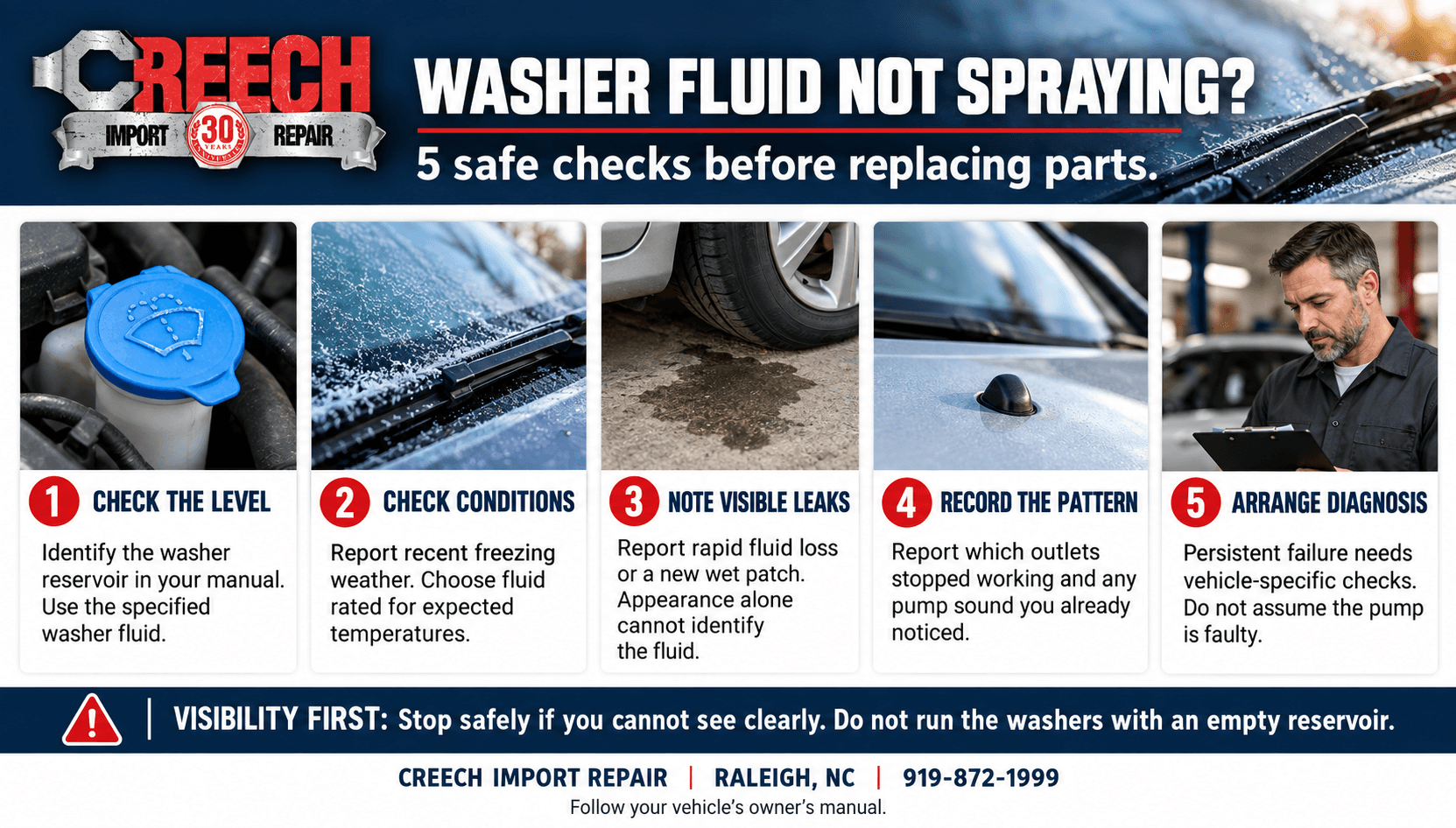
Washer Fluid Not Spraying: Five-Check Infographic
Use this visual summary to organize your observations before contacting the shop. The five checks cover fluid level, weather, visible loss, the spray pattern, and the need for diagnosis when the problem persists.
Why Do the Wipers Work but No Washer Fluid Appears?
Wiper movement confirms that the blades moved during that request. It does not confirm the fluid level, pump delivery, or condition of the hoses and outlets. The wiping action and the delivery of cleaning fluid perform different jobs, even when one control requests both.
If your wipers work but no washer fluid comes out, report both facts. Include whether the blades move normally or behave differently from before. Do not assume the washer pump must be receiving the correct electrical supply simply because the wipers operate.
Blade wear is also a separate question. Creech’s guide to different windshield wiper designs explains blade choices. Replacing blades does not repair missing washer-fluid delivery, although both issues can affect visibility.
Washer Fluid Not Spraying: Does Pump Noise Identify the Fault?
No. A sound that seems to come from the washer pump does not prove that it is delivering the required fluid. Conversely, a driver who hears nothing has not established that the pump itself is defective. Location, background noise, electrical supply, and the commanded function all matter.
For windshield washer pump diagnosis, a shop should distinguish the operating command, electrical conditions, and liquid output as applicable to the installed system. An audible motor is one observation; it is not a complete performance test.
A useful description is: “The front washers stopped spraying yesterday; I heard a brief buzz during normal use.” That gives the technician context without turning an impression into a diagnosis.
Washer Fluid Not Spraying From One Outlet: What Does It Mean?
A one-sided problem can lead the inspection toward an individual outlet, branch hose, or connector. However, washer layouts differ, and remaining spray does not establish that every shared component is operating correctly. The shop should trace the actual delivery arrangement.
A manufacturer example illustrates the distinction: Tesla recall 25V-359 identifies a hose-connector defect that can block one or both washer nozzles on certain 2026 Model Y vehicles. That example is not a diagnosis for another vehicle; it shows why missing spray should not automatically lead to a pump replacement.
If the rear washer still works, record it. Do not assume that every vehicle uses the same reservoir, separate pumps, or identical front and rear controls. Those details must come from the vehicle’s service information.
Can Cold Weather Stop Washer Fluid From Spraying?
Yes. Freeze protection matters when temperatures fall, including during trips outside Raleigh. The fluid needs to meet the vehicle’s requirements and suit the expected conditions. Follow the label’s directions for ready-to-use products or concentrates; do not assume that dilution leaves protection unchanged.
Ford owner-manual guidance addresses washer-fluid freeze protection and warns against operating an empty reservoir. Your own manual takes priority for the product specification and operation of your vehicle.
If you first noticed washer fluid not spraying after a freeze, stop repeated activation and discuss safe thawing with the shop. Avoid flames, improvised heaters, or pouring hot water onto the windshield or system. If spray later returns, report the incident; improvement does not establish that a leak or other damage is absent.
Which Fluid Should You Add to the Washer Reservoir?
Use windshield-washer fluid that meets the owner’s manual and the expected temperature conditions. Identify the correct filler first, follow the stated filling method, and keep the product away from children, pets, heat, and flames. Washer-fluid color alone does not establish compatibility.
Engine coolant and cooling-system antifreeze belong to a different system. Hyundai’s washer-fluid guidance warns against putting engine coolant or antifreeze into the washer reservoir and explains that washer fluid may be flammable and should not be ingested.
Do not add dish soap, household cleaner, or an unapproved mixture as a troubleshooting step. If the wrong product has already been added, stop using the washers and tell the service team what it was and approximately how much entered. Ask how the system should be assessed before adding another product.
Could a Fuse or Electrical Problem Be Responsible?
An electrical fault can interrupt washer operation, but there is no universal washer-fuse number, location, or test procedure. Some systems involve shared circuits or electronic control. Consult the exact owner’s manual and service information rather than using a diagram from a different model.
Do not bridge a fuse, install a higher rating, or keep replacing one that fails again. A fuse protects a circuit; replacing it does not explain why it opened. If owner-accessible checks are described in your manual, follow that procedure. Otherwise, leave circuit investigation to the technician.
When washer fluid is not spraying, report electrical symptoms such as unusual wiper behavior as well. Creech provides electrical system repair in Raleigh, including diagnosis of wiring and electrical concerns.
How Should a Shop Diagnose Washer Fluid Not Spraying?
A useful diagnostic process separates the supply of fluid, its delivery path, and pump or control operation. The sequence depends on the vehicle and complaint. Ask the shop to explain what it verified before recommending parts.
- Confirm the vehicle and symptom. Identify the installed washer arrangement, affected outlets, fluid used, weather, and recent work.
- Check fluid availability and condition. Confirm the level and address suspected freezing or an unsuitable product before interpreting output.
- Inspect the delivery path. Investigate relevant hoses, connectors, seals, outlets, and the reservoir for leakage, damage, or restrictions.
- Evaluate pump and circuit operation where indicated. Use the vehicle’s service procedures to distinguish a command or supply problem from a pump fault.
- Verify the repair. Confirm the affected washer function, appropriate output, and absence of relevant leakage under the prescribed test conditions.
The manufacturer’s Mercedes-Benz washer-leak diagnostic bulletin lists several potential leak locations and calls for replacing defective components rather than intact adjacent parts. Its application is specific, but it illustrates why locating the fault matters more than replacing a guessed assembly.
If washer fluid is not spraying after a previous repair, bring the invoice. Explain what improved, for how long, and which symptom returned. A repeated complaint deserves reassessment rather than an automatic repeat of the same repair.
How Much Does It Cost to Fix Washer Fluid Not Spraying?
There is no reliable single price for the symptom. Adding the correct fluid, repairing a delivery-path leak, replacing an outlet, and diagnosing an electrical fault involve different work. Access behind trim or around the reservoir can also affect labor.
Request an estimate based on the verified condition. Ask about diagnostic charges, parts, access-related labor, and the planned confirmation that spray has been restored. If a recent repair may have coverage, provide the invoice and ask the shop to review it.
A bulletin is not automatically a recall or a promise of free service. For applicable U.S. safety recalls, use the NHTSA recall lookup and confirm eligibility with the manufacturer. Another owner’s recall or repair does not establish coverage for your vehicle.
What Should You Avoid When the Washer Nozzle Is Not Spraying?
Avoid turning a visibility problem into additional damage. Do not hold the control continuously when no spray appears, keep running an empty reservoir, or dismantle hidden components without the applicable procedure.
There is also no universal pin-cleaning method. Toyota owner-manual guidance warns against clearing a blocked nozzle with a pin or another object. Follow the instructions for your exact nozzle design instead of assuming that every outlet can be poked or adjusted.
Do not blast compressed air into the system, force a hose connection, jump power to a pump, or use household chemicals as a generic fix. If a procedure is not described for owner use in your manual, ask the shop how it should be handled.
How Can You Reduce Future Washer Problems?
Check washer-fluid level as the owner’s manual recommends and before a trip where road spray or changing weather may matter. Select suitable fluid before cold conditions arrive, keep the cap properly secured, and use clean filling equipment when the manual calls for it.
Report recurring fluid loss, weak output, or changes after body or windshield work. Ask whether the affected washer functions can be checked during service. Maintenance reduces avoidable problems, but it does not guarantee that a pump, hose, or nozzle will never fail.
Keep the glass and blades in suitable condition as well. Missing spray, worn blades, exterior dirt, and interior fogging affect visibility in different ways and may require separate attention.
Where Can You Get Help With Washer Fluid Not Spraying in Raleigh?
Creech Import Repair provides automotive repair in Raleigh and electrical diagnostic services. Contact the team with your vehicle information and describe whether the front, rear, or one outlet stopped working.
Before booking, gather the year, make, model, approximate onset, fluid used, recent freezing conditions, any rapid level change, and relevant repair invoices. You do not need to identify the failed part. Explain any visibility concern before discussing travel to the shop.
Need Help Restoring Washer Spray?
Call Creech Import Repair to discuss a windshield washer that is not working and arrange an appropriate assessment.
Phone: 919-872-1999
Address: 1818 St. Albans Dr #106, Raleigh, NC 27609
Hours: Monday–Friday, 7:30 a.m.–5:30 p.m.
Online requests require confirmation from the service team. Do not drive when you cannot maintain clear visibility.
Frequently Asked Questions
Why is washer fluid not spraying even though the reservoir is full?
A full reservoir does not confirm fluid delivery. Freezing, a hose or nozzle problem, leakage, or pump and electrical concerns may still need investigation. Report the affected outlets and recent conditions. Do not repeatedly hold the washer control to force a result.
Why do my wipers work but no washer fluid comes out?
Wiper movement does not establish that cleaning fluid reaches the windshield. The fluid level, delivery path, and relevant pump or circuit operation still need checking. Report both the normal wiping action and missing spray so the shop can investigate the correct complaint.
Does hearing the washer pump mean it is working properly?
No. A pump-like sound does not prove adequate fluid output or an intact delivery path. Tell the shop what you heard during normal use, but avoid repeated activation to collect more evidence. Diagnosis should distinguish electrical operation from actual delivery.
Does no pump sound mean I need a new washer pump?
Not necessarily. Silence can require investigation of the operating command, circuit, connections, or pump, and the sound may be difficult to hear. A replacement recommendation should follow vehicle-specific checks rather than an assumption based only on noise.
What if only one windshield washer nozzle is not spraying?
Report which outlet failed and whether the other spray changed. The nozzle, its branch connection, or another part of the delivery arrangement may need inspection. One working outlet does not identify the failed component or justify using a pin to clear the other.
Can frozen washer fluid cause a no-spray problem?
Yes, unsuitable fluid in freezing conditions can interrupt normal operation. Stop repeated activation and ask for guidance on safe thawing. Follow the vehicle’s fluid requirements and the product’s temperature rating. Spray returning later does not establish that the system has no leak or damage.
Can I put engine antifreeze in the washer reservoir?
No. Engine coolant and cooling-system antifreeze are not windshield-washer fluid. Use the specified washer product in the correctly identified reservoir. If the wrong fluid has already been added, stop using the washers and contact the service team with the product details.
Should I use a needle to unclog the washer nozzle?
Do not assume that a needle or pin is suitable. Nozzle designs differ, and Toyota owner-manual guidance specifically warns against inserting a pin or other object into a blocked nozzle. Follow your own manual and seek assessment when the outlet remains blocked.
Can I drive with washer fluid not spraying?
The symptom alone cannot establish whether a particular trip is safe. Do not drive when dirt, road spray, glare, or weather prevents clear visibility. Discuss the problem with the service team and arrange help if necessary rather than relying on dry wiper movement.
What should I ask before approving a washer repair?
Ask what condition was verified, which checks support the proposed repair, and how the shop will confirm restored output and relevant leak-free operation. Request the diagnostic, parts, and labor charges. Bring earlier invoices if the complaint returned after recent work.
Sources and Vehicle-Specific Guidance
Manufacturer examples support the explanations above; they are not repair instructions for every vehicle. Consult your own owner’s manual and the applicable service information.
- Hyundai: washer-fluid level and product precautions
- Ford owner’s manual: washer use and freeze protection
- Toyota owner’s manual: blocked-nozzle precautions
- Mercedes-Benz: washer-fluid leak diagnosis, LI82.35-P-078467
- Tesla: recall 25V-359 owner notification
- NHTSA: U.S. vehicle recall lookup
References and business details checked October 1, 2026.
About Creech Import Repair
Creech Import Repair has served Raleigh drivers since 1993. Its listed services include automotive repair and electrical system diagnosis for import and domestic vehicles. Learn about Creech Import Repair or contact the service team to discuss a recurring washer complaint.
Find Creech Import Service articles useful?
Add this site to your Preferred Sources in Google Search.