


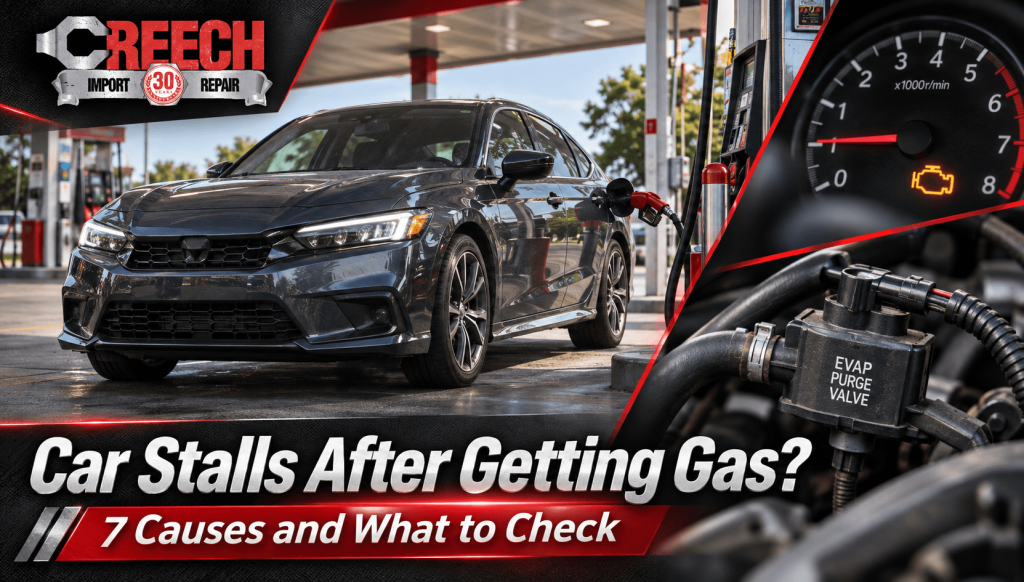
Car Stalls After Getting Gas? 7 Causes and What to Check
You finish filling the tank, get back into your car, turn the key or press Start, and something feels wrong. The engine cranks longer than usual, starts roughly, or fires up only to die seconds later. Sometimes it settles down after another attempt. Other times, the same problem returns after the next fill-up.
When a car stalls after getting gas, the timing provides a useful diagnostic clue. One particularly relevant possibility is a faulty evaporative-emissions purge valve that allows fuel vapor into the engine intake when the control system has not requested it. The additional vapor can disrupt starting or idle under certain conditions.
However, not every stall after refueling is caused by the purge valve. Overfilling, fuel contamination, fuel pressure problems, abnormal air-fuel control, or an unrelated engine fault may also require investigation. A filling-system vent problem may be relevant to the overall complaint without directly causing the engine to stall.
The important question is whether refueling actually triggers the engine problem or merely happens shortly before another intermittent fault becomes noticeable.
This guide explains seven possible diagnostic categories, the difference between purge and vent valves, the trouble codes that may help technicians, safe observations drivers can make, and when a recurring stall requires towing rather than another drive.
Quick Answer
Why Does a Car Stall After Getting Gas?
A car may stall after getting gas because an EVAP purge valve is stuck open, allowing unwanted fuel vapors into the intake during startup or idle. Other possibilities include overfilling-related charcoal canister problems, contaminated fuel, incorrect fuel delivery, air-fuel sensor or control faults, and engine problems that happen to appear after refueling.
If the engine is difficult to start only after filling the tank, a purge-flow problem deserves attention, but the timing alone cannot confirm a failed part. A technician may compare trouble codes, purge commands, actual valve sealing, fuel-trim data, fuel pressure, and the vehicle's refueling history.
Avoid topping off the tank after the pump automatically stops. If the car repeatedly stalls, dies in traffic, displays a flashing check engine light, or develops a strong gasoline odor, stop safely and seek appropriate roadside assistance.
What Happens Inside Your Car's EVAP System During Refueling?
Modern gasoline vehicles use an evaporative-emission control system, commonly called the EVAP system, to manage gasoline vapors. Rather than allowing ordinary fuel vapors to escape freely into the atmosphere, the system captures and stores them for controlled use by the engine.
The EVAP system generally includes a fuel tank and vapor lines, a charcoal canister, a purge valve, a vent valve or related venting arrangement, and monitoring components. Some vehicles also use a fuel-tank pressure sensor and a leak-detection pump or module.
During refueling, adding liquid gasoline displaces vapor within the tank. The system needs a suitable path for that vapor to be managed, often through an onboard refueling vapor recovery arrangement.
The charcoal canister contains activated carbon that absorbs fuel vapor. Under appropriate engine operating conditions, the control module commands the purge valve to open so the stored vapors can be drawn into the intake and burned.
The purge valve should not allow uncontrolled flow merely because the engine or fuel tank contains vapor. That distinction matters particularly near startup, when the engine is managing a changing air-fuel mixture.
Why Can Filling the Tank Expose a Purge-Valve Problem?
A purge valve stuck partially or fully open can create a pathway that allows fuel vapors to enter the intake when they are not supposed to. Refueling changes the vapor conditions in the tank and can make this unwanted flow more noticeable.
The engine may then crank longer than expected, run unevenly, hesitate, or stall shortly after starting. The precise behavior depends on the vehicle's design, vapor concentration, operating conditions, and how the engine controls respond.
Snap-on's EVAP technical guidance identifies a stuck-open purge valve as a potential cause of hard starting after adding fuel. This supports investigating purge flow when the symptom consistently follows refueling, but it does not eliminate other possibilities.
Does Every EVAP Fault Cause Stalling?
No. An EVAP system can produce a check engine light without causing noticeable driving problems. A loose fuel cap, small vapor leak, or certain vent-circuit faults may affect emissions monitoring without explaining a recurring stall.
Different components perform different tasks. A vent valve that does not open properly may interfere with tank ventilation and fuel filling. A purge valve leaking toward the intake can more directly affect the engine's air-fuel mixture.
Controls Vapor Into the Engine
A valve that leaks when commanded closed can permit unwanted vapor flow into the intake.
Supports Tank Ventilation
Problems commonly affect filling, venting or emissions testing; stalling requires additional evidence.
Stores Fuel Vapors
It can be affected by liquid gasoline intrusion, contamination or damage to related plumbing.
The Fuel-Vapor Path — Simplified
If vapor reaches the intake at the wrong time, the engine may struggle to maintain the intended mixture. Actual system routing and control strategies vary by manufacturer.
7 Possible Causes of a Car Stalling After Getting Gas
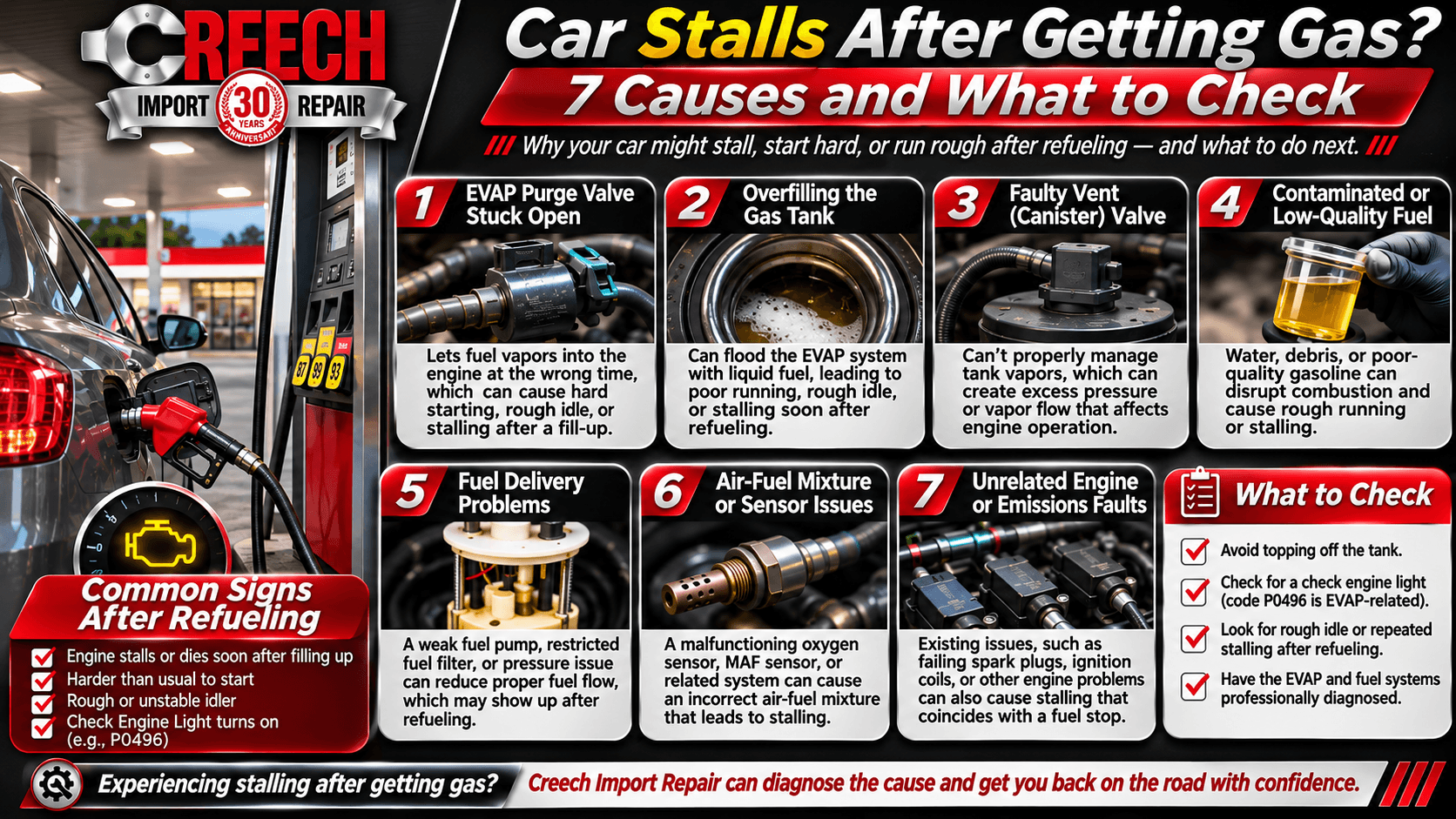
These seven categories are organized by what a technician may investigate, not by proven failure frequency. The first cause has a particularly direct relationship with post-refueling hard starting; some others are indirect or coincidental and should not be treated as equally likely.
EVAP Purge Valve Stuck Open
The EVAP purge valve regulates the pathway between the vapor-storage system and the engine intake. The engine computer controls when the valve should open so that stored fuel vapor can be burned without disrupting normal combustion.
If the valve sticks open or fails to seal, fuel vapor may enter the intake when the computer has commanded the valve closed. This unwanted flow can be especially noticeable immediately after refueling, when vapor conditions have changed.
The result may be prolonged cranking, an unstable start, rough idle, hesitation, or an engine that starts and then stalls. Some vehicles may restart successfully after the initial difficulty and run normally until the next fill-up.
A purge valve can fail mechanically, or an electrical-control problem may affect its commanded operation. A trouble code may support investigation, but codes alone are not proof of a faulty valve.
For instance, P0496 commonly describes unwanted EVAP flow during non-purge conditions in applicable systems. GM documentation explains how some vehicles monitor fuel-tank vacuum to detect purge flow when it should not be present.
A technician may verify whether the valve actually seals when commanded closed, inspect the related vapor hose, review fuel-trim or pressure data, and confirm that the problem matches the vehicle's diagnostic procedure.
Overfilling the Gas Tank or Liquid Fuel Entering the Vapor System
The fuel dispenser's automatic shutoff is designed to end the filling process under the appropriate conditions. Continuing to force additional gasoline into the tank after it stops can increase the risk of fuel entering areas intended primarily for vapor management.
A charcoal canister is designed to retain vapor, not to function as an ordinary liquid-fuel reservoir. Repeated overfilling may contribute to canister saturation, damage, or related EVAP problems.
If liquid fuel or unusually rich vapor conditions affect the purge pathway, the engine may run poorly when those vapors are drawn into the intake. However, the causal connection must be established on the specific vehicle.
A one-time top-off does not prove that a canister has failed. Likewise, ordinary filling to the dispenser's first automatic shutoff is not evidence of damage.
Other symptoms of an EVAP concern may include warning lights, fuel-filling difficulties, vapor-related odors, or stored emissions-system fault codes. These symptoms do not automatically mean the charcoal canister needs replacement.
Consumer Reports' September 2026 guidance and Snap-on's EVAP technical material both advise against topping off after automatic shutoff because it can damage vapor-control components.
Faulty Vent Valve, Restricted Vapor Line, or Canister Vent Problem
The EVAP vent valve and its connected plumbing help manage the movement of air and fuel vapor through the storage system. Some vehicle designs also use vent filters or separate leak-detection components.
When a vent valve is stuck closed or a vent path is restricted, the fuel tank may not vent properly during filling. This can contribute to a pump nozzle that repeatedly shuts off before the tank is full, depending on the vehicle and filling conditions.
A vent valve problem can also set EVAP diagnostic codes. But it is important not to confuse a fuel-filling symptom with an engine-stalling symptom.
A faulty vent valve does not inherently send excess vapor into the engine intake the way a leaking purge valve can. If stalling accompanies a vent-related code, technicians should investigate both the venting complaint and actual engine operation.
Depending on the system, related issues such as canister contamination, blocked vapor plumbing, excessive tank pressure or another component fault may need inspection.
A vehicle can have more than one EVAP fault, and an apparent vent fault may coexist with an unrelated idle problem.
Contaminated, Incorrect, or Poor-Quality Gasoline
Fuel contamination may cause engine operation problems that become noticeable soon after a fill-up. Possible contaminants include water or other material introduced into the fuel supply.
The vehicle may hesitate, misfire, idle roughly, stall, or fail to restart reliably. The exact symptoms depend on the type and amount of contamination, the engine and fuel system, and how much fuel was already in the tank.
A strong timing relationship—normal operation before filling followed by immediate trouble—can make a fuel-quality concern worth considering. But the timing alone does not establish contaminated gasoline.
For example, a purge-valve problem can create a very similar pattern while the gasoline itself is normal.
If multiple vehicles develop symptoms following fuel purchases from the same location, that information may be useful, but it must be verified independently. One driver's experience is not proof of a station-wide contamination event.
Professional diagnosis may include reviewing fuel-delivery data, inspecting applicable components, and using an approved method to evaluate fuel quality if indicated.
Do not siphon, drain, sample, or handle gasoline yourself to investigate a suspected contamination issue. Improper fuel handling can create fire and exposure hazards.
Fuel Pump, Fuel Pressure, or Fuel Delivery Problems
An engine needs an appropriate fuel supply at startup and during idle. A weak pump, faulty pressure-control component, restricted filter where fitted, or another delivery issue can affect that supply.
A fuel-pressure problem may cause extended cranking, stalling, hesitation, poor acceleration, or unstable idle. These symptoms are not exclusive to fuel delivery, and many vehicles will show them outside refueling events as well.
The timing of a fuel stop may simply be coincidental. The engine was shut off at the pump and then required another restart, which can expose a fault that was already developing.
A problem that occurs after any hot-engine shutdown, not only after gasoline is added, may point toward a broader hot-restart concern instead of a vapor-control issue.
Different vehicles use different fuel-pressure regulation strategies, including return-style and returnless arrangements. Direct-injection engines may also have low-pressure and high-pressure fuel systems with separate diagnostic requirements.
A technician should use the vehicle's specifications to evaluate actual pressure, pump operation, electrical supply, and related data. Replacing the fuel pump because a car stalled after filling up is not a reliable diagnostic strategy.
Air-Fuel Mixture, Intake, or Sensor Problems
An engine control system adjusts fuel delivery based on operating conditions and available sensor information. Depending on the design, relevant inputs may include mass airflow, intake pressure, engine temperature, oxygen or air-fuel ratio sensing, and throttle position.
Incorrect airflow measurement, an unmetered-air leak, faulty control input, or other mixture problem may cause unstable idle or engine stalling.
These faults may become more noticeable during a restart because the engine transitions through different control strategies and operating conditions.
Still, a sensor fault is not automatically connected to refueling. A contaminated or damaged sensor can affect engine operation even when the fuel tank has not recently been filled.
Likewise, an oxygen-sensor-related code does not always mean the sensor itself is defective. It can reflect a mixture condition created elsewhere in the intake, fuel-delivery, or emissions system.
Technicians may compare fuel trims, airflow measurements, engine temperature, pending codes, and other live data to identify an abnormal condition.
The diagnostic question is whether the engine is reacting to unwanted fuel vapor, an airflow or sensor problem, or another condition that has similar symptoms.
Why the Seven Causes Are Not Equally Likely
A stuck-open purge valve is particularly relevant to a repeatable hard-start complaint immediately after refueling. Vent restrictions more commonly explain filling difficulties, while sensor, ignition, and fuel-delivery faults can create similar engine symptoms without being caused by the fuel stop. A technician should select tests based on the actual pattern, not replace all seven categories of parts.
What Does the Timing of Stalling After Refueling Tell You?
A useful diagnosis starts with the sequence of events. Did the engine crank without starting? Did it start and stall immediately? Did it idle roughly before recovering? Or did it run normally until the next intersection?
Those patterns can point toward different areas to investigate. They also help distinguish an EVAP issue from a fuel-delivery or general engine problem.
| What Happens | Possible Areas to Investigate | Important Limitation |
|---|---|---|
| Hard starting immediately after nearly every fill-up | Unwanted purge flow; related EVAP vapor conditions | Strong timing clue, not proof of a defective purge valve |
| Engine starts, idles roughly, then stabilizes | Purge flow, mixture control, fuel-delivery response | Improvement does not mean the underlying issue is gone |
| Car starts and stalls repeatedly after refueling | EVAP purge, fuel quality, fuel pressure, engine controls | Repeated stalling is a safety concern |
| Gas pump keeps clicking off before the tank is full | Filler procedure, nozzle interaction, tank venting and plumbing | Filling difficulty does not independently explain a stall |
| Strong gasoline smell or visible fuel | Spill, fuel leak, filler or vapor-system problem | Fire and exposure risks take priority over diagnosis |
| Engine stalls at red lights between fill-ups | Idle control, fuel and air management, ignition or other engine faults | May not be refueling-specific |
| Engine struggles after any hot restart | Broader fuel, ignition, electrical or engine-control problems | May coincide with stopping for fuel |
| P0496 appears with post-refueling hard starts | Unwanted EVAP purge flow on applicable vehicles | Test the system; code alone does not prove the valve is defective |
Why Does My Car Start Roughly After Refueling but Drive Fine Later?
A short-lived mixture disturbance can be more noticeable during startup or low-speed idle than during other engine operating conditions. On some vehicles, an unwanted purge path may introduce vapor at a time when the engine is less able to compensate smoothly.
Once the engine stabilizes, the driver may no longer notice the disturbance. However, the absence of symptoms while cruising does not establish that the EVAP system is working correctly.
If this pattern repeats after several ordinary fill-ups, document it and have the purge system and related engine data evaluated.
Why Does My Car Stall Only When the Tank Is Filled Completely?
The difference between a nearly empty tank and a full tank may change vapor-management conditions, but several systems can contribute. A repeatable full-tank pattern should prompt a technician to inspect refueling and vapor-control behavior.
Do not deliberately overfill the tank to reproduce the complaint. Follow the manufacturer's fueling instructions and record what happens during normal use.
Why Does It Stall After Refueling but Not During Other Stops?
A problem specifically tied to filling may favor an EVAP-related investigation over a general idle problem. Yet an intermittent fuel-pump, ignition, or restart-related fault can still appear only during certain stops.
The technician should compare the symptom history with stored codes and data rather than assume the refueling event proves causation.
Purge Valve vs. Vent Valve: Which One Can Make a Car Stall After Getting Gas?
The purge valve has the more direct mechanical relationship with unwanted vapor entering the engine intake. The vent valve mainly controls the system's ability to admit or restrict airflow in support of vapor management and testing.
Both can create EVAP fault codes, but their symptoms and tests are not interchangeable.
| Question | Purge Valve | Vent Valve |
|---|---|---|
| Primary function | Controls fuel-vapor flow toward the engine intake | Controls part of the vapor system's venting and sealing |
| Can unwanted operation affect air-fuel mixture? | Yes, a leaking open path may cause mixture disturbances | Not typically by the same direct mechanism |
| Relevant to hard start after refueling? | Yes, particularly when leaking open | Sometimes related to wider EVAP faults, but less directly |
| Relevant to premature nozzle shutoff? | Not the usual primary explanation | Yes, if venting is blocked or restricted |
| Can set EVAP trouble codes? | Yes | Yes |
| Should it be replaced from the symptom alone? | No, confirm valve function and system conditions | No, verify the venting problem and applicable tests |
Snap-on's technical documentation differentiates purge control, tank ventilation, charcoal storage, and leak testing. The appropriate component tests depend on the vehicle's specific EVAP arrangement.
For a fuel pump that shuts off repeatedly during filling, see Creech's separate Gas Pump Keeps Clicking Off guide. That article addresses filling difficulties rather than engine stalling.
What Do P0496 and Other EVAP Trouble Codes Mean After Refueling?
Diagnostic trouble codes can help identify which system detected an abnormal condition. They do not automatically identify the defective part.
A code may describe a circuit fault, insufficient flow, unexpected flow, or inability to hold system pressure. Those conditions require different tests.
| Code | Common Description | What It Does Not Prove |
|---|---|---|
| P0496 | EVAP flow during non-purge conditions on applicable systems | Does not by itself prove a particular purge valve must be replaced |
| P0443 | Purge-control circuit fault | Does not necessarily mean the valve is stuck open mechanically |
| P0446 | Vent-control or related EVAP system performance fault | Does not automatically establish that a vent valve caused stalling |
| P0442 | Small EVAP system leak detected | Does not identify the leak location or explain every drivability symptom |
| P0455 | Large EVAP system leak detected | Does not automatically mean the charcoal canister is defective |
| P0456 | Very small EVAP leak detected | Does not establish that the engine will stall |
| P0171/P0174 | Fuel-system mixture too lean on applicable banks | May involve numerous intake, fuel or sensor causes |
Does P0496 Always Mean a Bad EVAP Purge Valve?
No. P0496 describes an unwanted-flow condition on applicable diagnostic strategies. The control system has detected evidence that vapor-system flow may be occurring when it should not.
A leaking purge valve is an important possibility, but circuit behavior, vapor plumbing, sensor data, control-system operation, and vehicle-specific software conditions may also require attention.
A Jaguar Land Rover technical bulletin, for example, documented a P0496 software-related issue on specified vehicles. That bulletin is not a general explanation for other models, but it reinforces why a code should be interpreted within the correct manufacturer procedure.
Can a Bad Gas Cap Make the Engine Stall After Refueling?
A loose or damaged fuel cap may allow vapor to escape and trigger a leak-related EVAP warning. By itself, it is generally a less direct explanation for severe hard starting and stalling than unwanted purge flow.
If the vehicle has a removable cap, confirm it is installed according to the owner's manual. Do not assume that tightening the cap fixes the underlying stalling complaint.
Should You Clear the Check Engine Light Before Diagnosis?
No. Clearing trouble codes before a technician examines the vehicle can remove information that helps reconstruct the conditions under which the fault appeared.
Stored, pending, and freeze-frame information may be useful when diagnosing intermittent symptoms. A code reader is a starting point, not a complete diagnosis.
What Can You Safely Check if Your Car Stalls After Getting Gas?
Drivers can record useful information without handling pressurized fuel, opening vapor lines, or attempting to test the purge valve at home.
These checks are observations rather than repair instructions. If the engine is stalling repeatedly, fuel is leaking, or there is a strong gasoline odor, skip further testing and seek assistance.
Stop Filling When the Nozzle Automatically Shuts Off
Follow the vehicle's owner's manual and posted station instructions. Do not force additional gasoline into the tank after a normal automatic shutoff. Topping off can damage vapor-management components and may cause spills.
Record Whether the Problem Happens After Every Fill-Up
Note whether it occurred once or several times. A repeatable post-refueling pattern is useful, but do not deliberately recreate unsafe conditions to confirm it.
Describe Exactly How the Engine Behaves
Tell the shop whether the engine cranks without starting, starts and dies, idles roughly, hesitates, or runs normally after a second attempt. These are different diagnostic clues.
Look for Dashboard Warnings From a Safe Position
Record whether the check engine light is illuminated or flashing. Do not clear codes before an inspection. Warning lights that appear only after the engine has stalled may have a different meaning from lights that appeared beforehand.
Note Fuel Details Without Handling Gasoline
Keep the receipt and record the approximate amount added, fuel grade, and whether the dispenser shut off normally. Do not siphon fuel, disconnect fuel lines, or remove EVAP components.
Check the Fuel Cap Only if It Is Safe and Applicable
On a vehicle with a removable cap, make sure it is properly secured according to the owner's manual. Capless systems require different procedures. A cap check does not explain every post-refueling stall.
Arrange a Vehicle-Specific Diagnostic Appointment
Provide the year, make, model, approximate mileage, refueling pattern, warning lights, and symptom timeline. If the car is unsafe to drive, ask for roadside assistance rather than attempting another trip.
Should You Replace the Purge Valve Yourself?
Even when the purge valve is accessible, replacing it without proving the fault may waste money and leave a stalling problem unresolved.
On some vehicles, a separate valve is comparatively accessible. On others, the assembly, plumbing, electrical connections, or calibration procedures differ. There may also be diagnostic steps required to distinguish a leaking valve from a control-circuit or other EVAP fault.
Because fuel vapors are flammable and fuel systems vary, professional testing is a prudent choice, especially where a gasoline smell or repeated stall is involved.
When Should You Stop Driving if Your Car Stalls After Getting Gas?
Stop driving safely and arrange assistance if the engine repeatedly stalls, dies while moving, fails to restart reliably, displays a flashing check engine light, or develops a strong gasoline odor or visible fuel leak.
An engine that stalls can make vehicle operation less predictable. Depending on the vehicle, power steering or brake assistance may change after the engine stops, increasing the difficulty of controlling the car.
Warning Signs That Need Immediate Attention
- Repeated or unpredictable stalling: The engine shuts off again after restarting or dies in traffic.
- Strong persistent gasoline odor: Fuel vapor or liquid fuel may present a fire or exposure hazard.
- Visible gasoline leak: Do not restart or continue fueling. Stay clear of the spill and notify appropriate personnel.
- Flashing check engine light: On many vehicles this indicates a potentially damaging misfire or other urgent condition.
- Unusual smoke or overheating: Address the separate urgent mechanical or safety concern.
- Loss of normal steering or braking assistance: Keep control and stop in a safe location; seek roadside assistance.
- Failure to restart in a safe location: Avoid repeated attempts that could worsen the situation or leave you exposed to traffic.
What If the Engine Stalls at the Gas Station?
Keep the vehicle stationary and follow the station's safety instructions. If you notice smoke, a fuel leak, or a strong gasoline odor, do not continue starting attempts or investigate the fuel system yourself. Notify station personnel and seek appropriate assistance.
If there is no urgent fuel or fire hazard but the vehicle does not restart reliably, request roadside help instead of repeatedly attempting to move through busy areas.
What If the Engine Stalls After Leaving the Station?
Keep control of the vehicle, activate hazard lights when appropriate, and move to a safe stopping location if possible. Steering and braking may feel different when the engine is not operating, depending on the vehicle.
Once stopped, secure the vehicle and seek assistance if it cannot be driven safely. Do not repeatedly drive it around to reproduce the complaint.
A successful restart is not proof of repair. Repeated stalling is especially concerning because the next occurrence could happen at an intersection or while merging.
How Does a Mechanic Diagnose Stalling Immediately After Refueling?
A proper diagnostic process starts with the exact symptom sequence, rather than assuming the engine needs a purge valve or fuel pump.
The vehicle's make, model, year, engine design, and stored information determine which tests are appropriate.
Confirm the Complaint and Refueling Pattern
The technician asks whether the issue follows every fill-up, whether it requires a full tank, whether the nozzle shut off normally, and whether the engine also stalls at unrelated times.
Read Diagnostic Codes and Available Freeze-Frame Data
Stored or pending codes may direct attention toward EVAP flow, fuel trims, ignition, fuel pressure, or another system. The diagnostic record is interpreted alongside the actual symptoms.
Inspect Purge Valve Sealing and Commanded Operation
Where indicated, the technician verifies whether the purge valve closes when commanded and whether unwanted flow occurs. A scan tool, appropriate vacuum testing, or another manufacturer-approved procedure may be used.
Review EVAP Venting and Charcoal Canister Conditions
If the history includes overfilling, repeated nozzle shutoff, or related EVAP codes, the shop evaluates the appropriate vapor lines, vent valve, canister, and associated components.
Assess Engine Fuel and Air Management
If purge operation does not explain the complaint, the technician may review fuel trims, relevant sensor readings, fuel pressure, intake leaks, ignition performance, and related engine controls.
Check Manufacturer-Specific Technical Information
Applicable service bulletins, software guidance, and known diagnostic procedures may help distinguish mechanical faults from vehicle-specific control issues. A bulletin must match the actual vehicle and operating conditions.
Confirm the Repair and Explain the Findings
After correcting the verified defect, the shop evaluates normal engine operation and relevant system tests. Some intermittent problems may require additional observation or a normal future refueling cycle to confirm the symptom no longer occurs.
Can a Scan Tool Diagnose a Bad Purge Valve by Itself?
A capable scan tool may command the purge valve and monitor related data, but the scan tool alone does not physically prove that a valve seals correctly.
A mechanical leak through the valve can exist even when an electrical command appears normal. Conversely, an electrical code can result from a circuit issue without a mechanically stuck valve.
The technician may need to combine electronic observations with physical tests or pressure measurements.
Does a Smoke Test Always Find a Stuck-Open Purge Valve?
Smoke testing can be useful for locating leaks in an EVAP system when performed using the correct equipment and procedure. However, an unwanted purge-flow complaint is not identical to every type of external vapor leak.
A valve that leaks toward the intake may require specific commanded-state or sealing tests. Technicians should use the correct procedure for the trouble code and vehicle.
Why Might a Car Need More Than One Test?
A vehicle can have an EVAP fault and a separate engine-performance issue at the same time. A stored code might identify one fault without explaining every symptom.
A responsible diagnosis connects the findings to the reported hard start or stall. The presence of a fault code is not a sufficient reason to replace multiple unrelated components.
How Much Does It Cost to Fix a Car That Stalls After Getting Gas?
The cost depends on the confirmed cause, vehicle design, parts availability, labor access, and required diagnostic work.
A separately serviceable purge valve may require a different repair from a damaged charcoal canister, restricted vapor plumbing, contaminated fuel, fuel-pump failure, or complex engine-control problem.
There is no defensible single price for a post-refueling stall because it describes a symptom rather than a particular failed component.
| Confirmed Fault | Possible Repair | Important Cost Factors |
|---|---|---|
| Purge valve leaking when closed | Replace or repair the verified defective purge component | Location, integrated hoses, part availability, diagnostics |
| Canister or vapor-system damage | Repair verified damaged components or affected plumbing | Fuel-tank access, system design, related contamination |
| Blocked or malfunctioning vent arrangement | Correct confirmed valve, filter, line, or related defect | Accessibility, corrosion, replacement assembly design |
| Fuel contamination | Assess contamination and perform approved fuel-system service | Extent of contamination, tank access, related damage |
| Fuel pressure or pump issue | Repair confirmed fuel-delivery defect | Low- versus high-pressure design, access, testing |
| Sensor or mixture control issue | Repair proven sensor, circuit, intake, or related fault | Specific component, electrical access, calibration |
| Ignition or other engine fault | Correct the engine fault supported by test findings | Cause, model-specific parts, severity and access |
Should You Replace the Purge Valve First?
Not without evidence. The purge valve is a plausible starting point for diagnosis when the engine reliably struggles immediately after refueling, especially if relevant trouble codes are present.
However, buying and installing a valve based solely on online symptoms can miss contaminated fuel, insufficient fuel pressure, wiring problems, or another engine fault.
Ask the shop what test establishes the failed valve and how the recommended repair addresses the specific complaint.
Can a Faulty Charcoal Canister Be Cleaned Instead of Replaced?
The proper repair depends on the actual defect and manufacturer instructions. Some vent-line restrictions may be resolved without replacing the full canister, while damaged or fuel-saturated components may require replacement.
A canister should not be replaced solely because the tank was topped off once or the pump clicked off early.
Will a Gas Cap Replacement Fix Stalling?
A defective fuel cap may explain certain EVAP leak codes or vapor odors, but it is generally not the direct explanation for unwanted purge flow into the engine.
A simple cap correction may be appropriate when the actual fault is an inadequate seal, but stalling that continues afterward needs separate investigation.
How Can You Reduce the Risk of Problems After Refueling?
Not every purge valve, fuel pump, sensor, or electronic-control fault is preventable. Still, correct refueling habits and prompt attention to changing engine behavior can reduce avoidable EVAP damage and improve diagnosis when problems appear.
Stop at the First Normal Automatic Pump Shutoff
Avoid adding extra fuel merely to round up the purchase amount. The EVAP system is intended to manage vapors, and liquid fuel intrusion can damage vapor-storage components.
Use the Fuel Recommended by the Manufacturer
Follow the owner's manual for fuel type and octane requirements. Using the correct fuel helps avoid introducing an unrelated fuel-quality problem into an existing drivability concern.
Take Repeated Hard Starts Seriously
If the engine routinely requires extra cranking or starts roughly after filling up, record the pattern and have it assessed. Do not repeatedly dismiss it simply because the car eventually runs smoothly.
Do Not Ignore Engine or EVAP Warning Lights
An illuminated check engine light can reflect a monitored emissions or engine fault. The meaning depends on the stored code and circumstances. A flashing light may indicate a more urgent operating condition.
Keep Fueling Receipts When Symptoms Appear
The fuel grade, quantity, date, and station can be useful if fuel quality becomes a legitimate diagnostic concern. Do not assume the station supplied defective gasoline without appropriate evidence.
Follow Vehicle-Specific Service Procedures
EVAP valves, charcoal canisters, filler systems, and diagnostic routines vary between manufacturers. A repair procedure written for one model should not automatically be applied to another.
Car Stalls After Getting Gas in Raleigh, NC? Get the Cause Diagnosed.
If your vehicle struggles to start, idles roughly, or stalls after filling up, Creech Import Repair can help investigate the condition and determine whether the problem involves the EVAP purge system, fuel supply, intake controls, or another engine fault.
Creech Import Repair has served Raleigh-area drivers since 1993 and provides maintenance and diagnostic services for supported import and domestic vehicles.
The most helpful information to provide is the vehicle's year, make, model, engine symptoms, refueling history, any check engine light, and whether the problem has occurred more than once.
What to Tell the Service Team
“The car starts normally most of the time, but immediately after I fill the tank it cranks longer, runs rough, and sometimes stalls. It has happened after several refueling stops.”
Visit Creech Import Repair
1818 St. Albans Dr #106
Raleigh, NC 27609
Monday-Friday
7:30 AM-5:30 PM
919-872-1999
For broader warning-light concerns, explore Creech's check engine light diagnostic service.
Online requests are not confirmed appointments until a Creech Import Repair service team member verifies them. If the vehicle is actively stalling, leaking fuel, or unsafe to drive, arrange appropriate roadside assistance instead of driving to the shop.
Frequently Asked Questions About Cars Stalling After Getting Gas
Why does my car stall immediately after getting gas?
A car may stall immediately after getting gas because an EVAP purge valve is stuck open and allows fuel vapor into the engine intake at the wrong time. The unwanted vapor can disrupt starting or idle, particularly following refueling. Other possibilities include overfilling-related vapor-system problems, contaminated fuel, fuel-delivery faults, or an unrelated engine condition. The timing is useful but cannot confirm a diagnosis. A technician should review the symptom pattern, trouble codes, purge-valve sealing, fuel-system data, and applicable vehicle procedures before recommending repairs.
Can a bad EVAP purge valve cause hard starting after refueling?
Yes. A purge valve that fails to seal when commanded closed can permit unwanted fuel vapor flow into the engine intake. Following refueling, that flow may upset the air-fuel mixture and cause extended cranking, rough idle, or stalling on certain vehicles. The valve may also set an EVAP-related diagnostic code, although not every failure produces the same code. Professional testing should confirm whether the valve seals correctly and whether the reported symptoms match the fault. A hard start alone does not prove the purge valve needs replacement.
Why does my car start and then die after I fill the gas tank?
An engine that starts and then dies after refueling may be struggling to maintain a stable mixture or adequate fuel supply. A stuck-open EVAP purge valve is one relevant possibility because vapor can enter the intake when it is not expected. Fuel contamination, pressure problems, idle-control issues, and other engine faults may produce similar behavior. Note whether this happens after every fill-up and whether the car runs normally between visits to the station. Repeated or unpredictable stalling requires professional diagnosis and may justify towing.
Can overfilling the gas tank cause a car to stall?
Overfilling can allow liquid gasoline to enter vapor-management components designed primarily to handle fuel vapor. This may damage or saturate a charcoal canister and contribute to EVAP problems. Depending on the vehicle and actual fault, abnormal vapor flow can affect engine operation. However, topping off once does not establish that a canister is damaged or directly explain a stall. Stop fueling at the first normal automatic shutoff and follow the owner's manual. A technician should confirm the cause before recommending canister or valve replacement.
What does code P0496 mean when my car stalls after refueling?
P0496 commonly describes EVAP system flow detected during non-purge conditions on applicable vehicle systems. It may point toward a purge valve allowing unwanted flow when the engine control module expects the valve to be closed. The code can be especially relevant when hard starting follows refueling. However, it does not independently prove a particular valve is defective. A technician should follow the manufacturer-specific diagnostic procedure, evaluate valve sealing and control behavior, and consider relevant sensor, circuit, or software information before replacing components.
Can a bad gas cap make my car stall after getting gas?
A loose, damaged, or missing gas cap can allow fuel vapors to escape and may trigger an EVAP leak-related check engine light. It is generally a less direct explanation for engine stalling than unwanted purge flow, contaminated fuel, or another engine-management fault. If the vehicle has a removable cap, check that it is installed according to the owner's manual. Capless vehicles have different sealing arrangements. If the engine continues to stall after refueling, do not assume a cap adjustment has corrected the problem.
Can a faulty EVAP vent valve cause my car to stall?
A faulty EVAP vent valve can cause emissions-system faults or filling difficulties, particularly if the tank cannot vent normally. However, a vent-valve fault is not the same as a purge valve leaking toward the engine intake, which has a more direct relationship with post-refueling hard starting. If a car stalls while a vent-related code is present, the technician should assess whether the symptoms share a cause or represent separate faults. Replacing the vent valve without confirming abnormal operation may leave the stalling complaint unresolved.
Is it safe to drive a car that stalls after filling up?
Repeated or unpredictable stalling can create a traffic hazard even if the engine restarts. When the engine stops, braking or steering assistance may change depending on the vehicle. Stop safely and arrange professional assistance if the car stalls while moving, does not restart reliably, or displays a flashing check engine light. A strong gasoline odor, visible fuel leak, smoke, or severe overheating also requires immediate attention. Do not continue driving merely to reproduce the symptom. Towing may be the safer choice when normal operation cannot be trusted.
How much does it cost to repair a car that stalls after refueling?
Repair cost depends on the confirmed cause, vehicle model, component accessibility, parts availability, and necessary diagnostic work. A purge-valve replacement can involve different labor from charcoal canister repair, contaminated-fuel service, fuel-pump replacement, or an engine-control problem. Some faults may also require electrical or vapor-system testing. There is no dependable single price because stalling after refueling is a symptom rather than a specific failed part. Ask the repair shop what evidence supports its diagnosis and request a written estimate before approving replacement.
Where can I get post-refueling stalling diagnosed in Raleigh, NC?
Creech Import Repair provides automotive diagnostics and repair at 1818 St. Albans Dr #106 in Raleigh, North Carolina. Call 919-872-1999 to describe your vehicle's year, make, model, whether the stall occurs after every fill-up, and any warning lights or unusual fuel odors. The service team can help arrange an appropriate diagnostic appointment. If the vehicle is actively stalling, cannot restart reliably, or appears unsafe to drive, stop safely and arrange roadside assistance or towing rather than driving to the shop.

Automotive Technical Review
Reviewed by Creech Import Staff
Creech Import Staff represents the automotive service team at Creech Import Repair, an independent Raleigh auto repair shop serving local drivers since 1993.
The shop provides maintenance, engine diagnostics, check engine light evaluation, and repair for supported import and domestic vehicles.
Learn more about the shop's service philosophy, team, and automotive expertise on its About Us page.
Sources and Technical Evidence Limits
This article explains general possibilities for gasoline-powered vehicles; it is not a diagnosis of a specific car. The seven causes are not statistically ranked failure rates. Their relevance depends on the engine, EVAP design, refueling history, and diagnostic evidence. A fault code, warning light, or refueling pattern is not sufficient by itself to justify replacing a part.
- Snap-on Diagnostics. Evaporative Emission Control System (EVAP): Friend or Foe? Technical guidance explaining purge-valve operation, hard starting after refueling, canister saturation, and common EVAP components.
- Snap-on Diagnostics. EVAP System Operation and Testing. Guidance distinguishing purge and vent valves, vapor storage, EVAP fault codes, and diagnostic testing.
- Consumer Reports. Should You Top Off Your Car's Gas Tank? Updated September 19, 2026. Explains why overfilling after automatic shutoff can damage fuel-vapor control components.
- General Motors. 2025 Engine Control Module Diagnostic Summary Tables. Manufacturer documentation identifying P0496 as an unwanted EVAP purge-flow diagnostic condition on applicable systems.
- General Motors / NHTSA. Evaporative Emissions Purge Valve Special Coverage Adjustment. An example of model-specific purge-valve-related repair guidance. Coverage and procedures apply only to the vehicles identified in the original document.
- Creech Import Repair. Check Engine Light Diagnostic Service. Information about warning lights, diagnostic codes, and the Raleigh repair process.
- Creech Import Repair. Gas Pump Keeps Clicking Off Before the Tank Is Full? A separate guide for fuel-filling difficulties and safe observations.
- Creech Import Repair. Car Smells Like Gas After Filling Up. A separate guide for gasoline odors and potential leakage safety.
- Creech Import Repair. Car Stalls When Stopping at Red Lights. Related guidance for stalling associated with idle and stopping rather than refueling alone.
- Creech Import Repair. Contact and Appointment Information. Verified Raleigh business address, telephone number, hours, and appointment confirmation information.
Find Creech Import Service articles useful?
Add this site to your Preferred Sources in Google Search.