


REFUELING & VEHICLE DIAGNOSIS • RALEIGH, NC
Gas Pump Keeps Clicking Off Before the Tank Is Full? 5 Safe Checks
If the gas pump keeps clicking off after only a small amount of fuel enters your car, a routine stop can become frustrating. The nozzle shuts off, the gauge still appears low, and you are left wondering whether the station’s equipment or your vehicle needs attention.
Early shutoff can involve the nozzle’s interaction with the filler opening, the vehicle’s prescribed refueling procedure, or a problem with the filling and venting system. The click alone cannot identify a failed valve, charcoal canister, filler neck, or fuel tank.
The useful next step is to record what happened and stop trying to force fuel into the tank. This guide explains five safe observations, the differences between common symptom patterns, and what professional diagnosis should establish. It concerns gasoline vehicles; your vehicle’s owner’s manual and posted station instructions take priority.
Quick Answer: What If the Gas Pump Keeps Clicking Off?
Stop forcing the fill. Note the starting fuel level, amount dispensed, and whether the problem has occurred at other pumps. Follow the refueling procedure for your exact vehicle and notify the attendant about suspected station-equipment problems. Recurring premature shutoff deserves vehicle-specific filler and vent-system diagnosis. Do not top off, defeat the nozzle’s shutoff, or insert tools into the filler. Fuel splashing, visible leakage, or a strong persistent odor means stop fueling and seek help.
What Are the 5 Safe Checks When the Gas Pump Keeps Clicking Off?
These checks are observations you can make without dismantling the fuel system or repeatedly attempting to fill it. Keep the engine off, follow station rules, and remain attentive to the dispenser. If there is visible fuel or another warning sign, skip the remaining checks and notify the attendant.
1. Note how much fuel actually entered
Record the dispenser’s quantity and the approximate starting fuel level. “It stopped after half a gallon with the gauge near one-quarter” is more useful than “it would not fill.” Keep the receipt when practical. Do not try to add a predetermined number of gallons based on an online tank-capacity specification.
2. Compare the pattern with previous fill-ups
Think back to whether the gas pump keeps clicking off at one particular dispenser, several pumps at one station, or different stations. Use your existing observations; this is not a reason to drive around deliberately reproducing the fault. A station-specific pattern and a repeatable vehicle-specific pattern lead to different diagnostic questions.
3. Check the vehicle’s refueling instructions
Consult the owner’s manual for nozzle insertion, fuel-door operation, and any required preparation. Some vehicles have procedures that differ from a conventional removable-cap design. Follow the complete instructions rather than transferring a nozzle angle or release-button sequence from another model. Do not force a capless flap open.
4. Watch for warning signs from a safe position
Fuel splashing back, liquid dripping from the vehicle, or a strong odor that persists requires stopping the fill. Notify station staff. Do not touch suspicious liquid, crawl underneath the car, or restart the engine to investigate. If there is an active fire or immediate danger, move away and seek emergency help.
5. Record related symptoms and recent work
Tell the shop about a warning light, difficult starting after refueling, recent filler or tank work, or a change following body repair. These details provide context without proving a cause. Do not clear diagnostic codes or disconnect the battery simply to see whether the filling problem disappears.
The Petroleum Equipment Institute’s refueling guidance emphasizes shutting off the engine, avoiding smoking, and staying outside the vehicle during fueling. Safe habits remain essential even when the pump’s behavior is frustrating.
Why Can the Nozzle Shut Off Before the Tank Is Full?
The nozzle’s automatic shutoff responds to conditions at the nozzle; it does not read your dashboard fuel gauge. Fuel reaching the sensing opening near its tip can trigger shutoff. That is why a click needs interpretation alongside the amount dispensed and the circumstances.
The EPA’s archived guidance against topping off describes this sensing function. An early shutoff can occur without establishing that the tank has reached its expected usable fill level. Equally, a gauge that appears below full is not permission to override the nozzle.
When the gas pump keeps clicking off, separate two questions: why did the nozzle stop, and why do you believe the tank was not full? The dispenser quantity, previous filling history, gauge behavior, and vehicle-specific instructions help the technician assess both.
What Can Cause a Gas Pump to Keep Shutting Off Early?
The possibilities include station equipment, nozzle positioning, a filler-path concern, or restricted venting. A particular symptom may fit more than one explanation. Inspection should distinguish them before the shop recommends replacing components.
Nozzle and filler interaction
A nozzle that is not positioned as required may interrupt filling on certain vehicles. General Motors’ bulletin PI0390A describes premature shutoff involving vapor-recovery nozzles on specified Chevrolet Volt and Cadillac ELR models. Its example shows why a vehicle-specific operating issue should not automatically become a parts replacement.
A filler tube or inlet concern
A damaged or obstructed filling path can require inspection. Stellantis’ bulletin 14-003-20 describes a filler-tube investigation for certain 2020 Ram 1500 vehicles with premature shutoff or filling difficulty. That is an application-specific example, not evidence that every car needs a filler neck.
A vent-path or tank-related problem
Some recurring hard-to-fill complaints involve venting. A later Ram bulletin, 14-013-25, identifies a vent-line issue for its specified applications and calls for diagnosis before the applicable repair. The correct response depends on the installed design and where testing locates the fault.
An inaccurate expectation of remaining capacity
The fuel gauge and an advertised tank size do not give you a precise measurement of how many gallons should be accepted at that moment. A consistent change in gauge or filling behavior should be reported, but it does not justify continuing past automatic shutoff.
If the gas pump keeps clicking off, ask which explanation is supported on your vehicle. A diagnostic code, a symptom chart, or a similar car’s repair does not settle that question.
What Do Different Early-Shutoff Patterns Suggest?
Patterns guide the inspection; they do not select a part. Record what already happened rather than deliberately creating more refueling attempts. Prioritize spills, leakage, or persistent odor over collecting a complete history.
| What you notice | What it helps distinguish | Useful next step |
|---|---|---|
| It happened at one dispenser but not on previous fill-ups. | Station equipment or nozzle interaction versus a recurring vehicle fault. | Record the station and dispenser; notify the attendant. |
| It has happened at different stations. | A vehicle-specific filling or venting concern. | Arrange diagnosis and provide the previous observations. |
| Very little fuel enters before shutoff. | Early interruption versus a normal end-of-fill event. | Record the starting level and dispensed quantity. |
| Fuel splashes back from the opening. | An immediate safety concern as well as filling difficulty. | Stop fueling and notify station staff. |
| The gauge remains below full after normal shutoff. | Fuel-level indication versus actual fill behavior. | Follow the manual; report a recurring discrepancy. |
| A warning light or starting problem accompanies refueling difficulty. | Related symptoms that may require additional tests. | Preserve the symptom history and seek assessment. |
A problem occurring at several stations increases the usefulness of a vehicle inspection, but it still does not prove that a vent valve or charcoal canister has failed. Likewise, one successful fill does not establish that an intermittent problem is repaired.
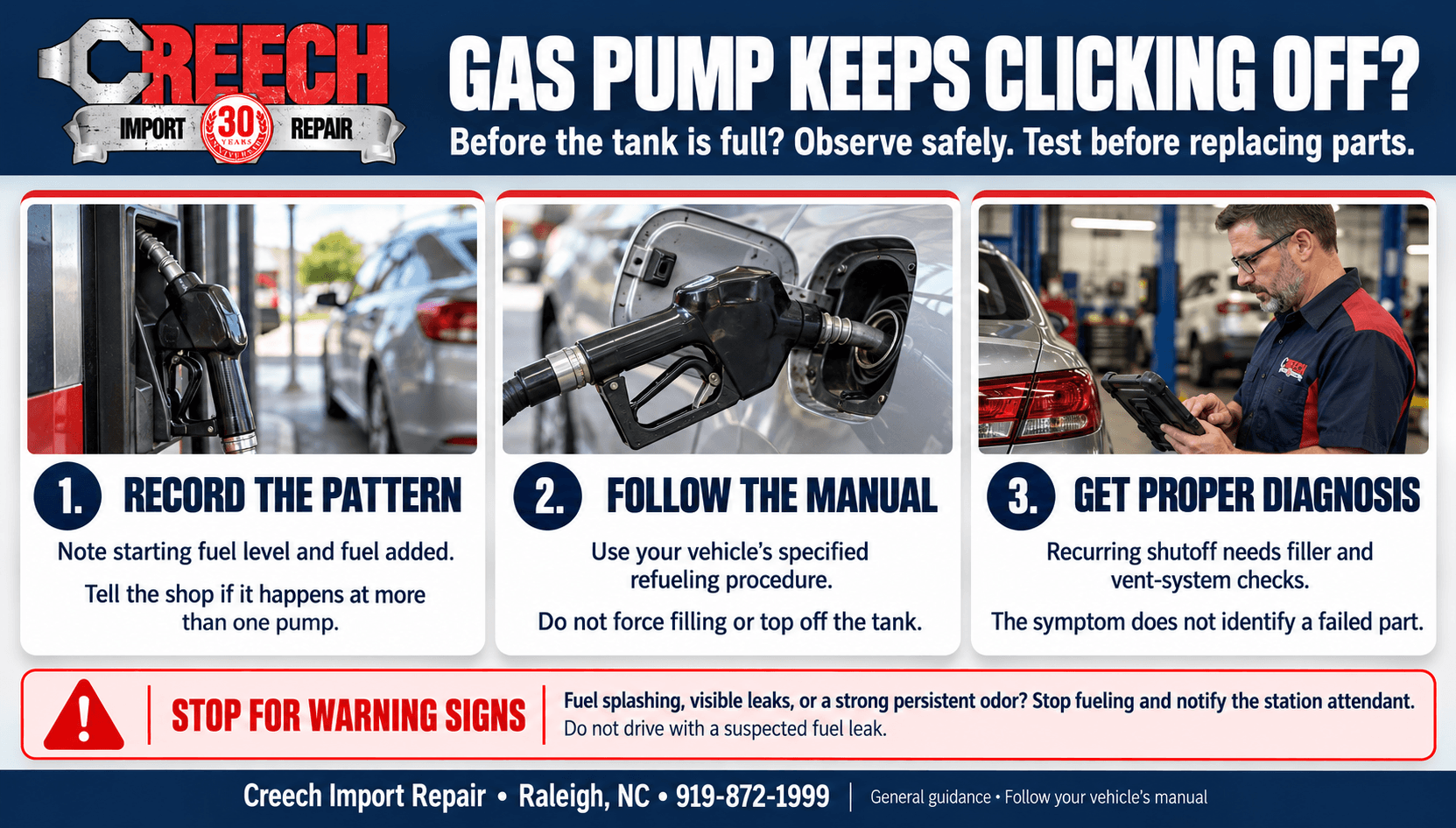
Gas Pump Keeps Clicking Off: Safe-Observation Infographic
This infographic summarizes the practical approach: record the pattern, follow the vehicle’s manual, and arrange proper diagnosis when premature shutoff recurs. It also identifies warning signs that mean you should stop fueling.
Should You Change the Nozzle Angle or Pump More Slowly?
Use the prescribed refueling procedure for your exact vehicle. There is no universal nozzle angle, insertion depth, or slower-flow remedy that should override the manual. A method appropriate for one filler design may be unsuitable for another.
The GM bulletin cited above gives specific positioning guidance for its listed models and nozzle arrangement. Its applicability matters. An instruction copied from that document should not be treated as a general procedure for every gasoline car.
If the gas pump keeps clicking off despite following your manual, do not pull the nozzle partly out to keep fuel flowing, hold the trigger against repeated shutoff, or prop it open with an object. Ask the station attendant about a suspected dispenser issue and contact the shop about a recurring vehicle complaint.
A change in flow behavior can be useful diagnostic information if it already happened during normal use. Report it without assuming that it proves a restriction or establishes a safe workaround. The aim is reliable filling using the intended procedure, not discovering an improvised position that defeats the symptom.
Does a Fuel Gauge Below Full Mean You Should Keep Filling?
No. A gauge below its full mark does not establish that additional fuel can safely be forced into the tank. Treat automatic shutoff according to the vehicle’s instructions, and report a consistent discrepancy between normal filling and the displayed level.
Separate “the nozzle repeatedly stops after a small quantity” from “the gauge does not show full after an otherwise normal fill.” Those complaints can require different investigations. If the gas pump keeps clicking off, note whether the gauge was already behaving unusually before the refueling problem began.
Tank-capacity figures are not an instruction to add that amount at every fill. Fuel remaining in the vehicle and its intended filling behavior affect what it accepts. Do not continue until a receipt matches an advertised capacity or until the sale reaches a round dollar amount.
Keep several existing receipts if the problem is recurring, together with approximate starting gauge readings. Avoid presenting the gauge as a calibrated measurement. A technician can determine whether the complaint concerns filling, level indication, or both.
How Can the EVAP System Affect Refueling?
The evaporative emissions system manages fuel vapor. Depending on the vehicle, the refueling and venting arrangement can involve hoses, valves, a charcoal canister, and tank or filler components. A restriction may affect filling, but the exact path and test procedure vary.
Mitsubishi’s Tech Talk 283, pages 5–6, explains hard-to-fill concerns on its covered models, excluding the Outlander Plug-in Hybrid. It describes how displaced air moves through the refueling vent arrangement and how restricted flow can contribute to fuel backing up or splashing near the nozzle sensor.
That technical example explains why a venting complaint deserves design-specific investigation. It does not make the charcoal canister the default replacement. Different restrictions and control problems can require different repairs, and some vehicle configurations use additional refueling controls.
When the gas pump keeps clicking off, give the shop the symptom rather than requesting an EVAP part by name. Ask which section of the system was tested and what evidence identifies the failure. Do not introduce compressed air or improvised smoke into the fuel system to investigate it yourself.
How Should a Shop Diagnose Recurring Premature Pump Shutoff?
A useful diagnosis should connect the reported filling behavior to findings on the actual vehicle. The technician should establish whether the complaint concerns nozzle operation, the filler path, tank venting, fuel-level indication, or an associated symptom. The test sequence depends on the design and initial findings.
Verify the history and applicable instructions
Vehicle identification, fuel-system configuration, and the owner’s description help establish which service information applies. A technician may investigate station or nozzle variables as part of a controlled assessment. You should not be asked to reproduce spills or repeatedly force fuel into the tank.
Inspect the relevant filling and venting components
Inspection may include accessible filler hardware, connections, hoses, and evidence of damage or obstruction. Recent body or fuel-system work should be disclosed. The presence of a similar-looking component does not establish that a procedure for another model applies.
Use diagnostic data where relevant
If a warning light or stored code is present, the shop can review it alongside the filling complaint. Appropriate component or system tests should support the repair decision. A scanner reading alone does not establish that a particular valve, canister, or tank needs replacement.
Explain the finding and confirm the repair
Ask how the identified fault accounts for the gas pump clicking off early and what normal operation will be checked afterward. A repair should address the verified condition rather than replace a list of possible causes. Where a bulletin applies, the shop should confirm the vehicle and equipment details before relying on it.
Creech’s check engine light diagnostic service describes inspection, code analysis, and further testing. Mention filling difficulty even if your appointment begins with a warning-light complaint.
Can There Be a Refueling Problem Without a Check Engine Light?
Yes. The absence of an illuminated warning light does not rule out a reported filling problem. Station equipment, nozzle interaction, or a mechanical concern may need assessment even when the dashboard shows no warning. Report the symptom itself rather than waiting for a light.
If the gas pump keeps clicking off and a light is present, record when it appeared. A code can provide a starting point, but it does not establish whether the light and the filling behavior have the same cause. Avoid clearing codes before the shop has reviewed them.
Difficult starting, rough running, or stalling after refueling is additional information. Tell the technician whether those symptoms happen immediately after filling or at other times too. Do not repeatedly run or restart a vehicle with a suspected fuel leak to collect more evidence.
Gasoline odor is a separate safety concern. Creech’s guide to a car that smells like gas after filling up addresses that symptom. A strong persistent smell or visible fuel should take priority over a routine emissions-code discussion.
How Much Does It Cost to Fix a Gas Pump That Keeps Clicking Off?
The cost depends on whether the issue involves station equipment, the vehicle’s operating procedure, or a verified component fault. Filler access, vent-system design, related damage, and the required repair all affect the estimate. The symptom alone cannot support a reliable price.
When the gas pump keeps clicking off, request an assessment before choosing a repair. Ask whether the diagnostic charge is separate and what the estimate includes. An inexpensive valve price is not the same as the full cost of identifying and correcting a filling problem.
- Verified cause: Which test or inspection supports the recommendation?
- Repair scope: Is the fault in a hose, connection, filler component, valve, or another assembly?
- Related work: Is additional damage documented?
- Verification: How will the original complaint be checked afterward?
- Coverage: Does a prior repair, manufacturer program, or warranty apply?
A technical bulletin does not automatically establish free coverage for your vehicle. Eligibility depends on the program and vehicle details. Bring previous invoices if the same problem returned after repair, and ask why any additional replacement is necessary.
What Should You Avoid When the Tank Is Difficult to Fill?
Do not turn a filling complaint into an improvised fuel-system modification. If the gas pump keeps clicking off, repeated trigger pulls or bypasses can increase the opportunity for spills without identifying the cause. Normal refueling should use the intended equipment and procedure.
- Do not defeat the nozzle’s automatic shutoff or wedge the trigger open.
- Do not insert wire, tools, or an unapproved funnel into the filler.
- Do not disconnect vapor hoses or remove valves to make filling easier.
- Do not attempt compressed-air, smoke, or chemical testing at home.
- Do not keep topping off to reach a full gauge or a round sale amount.
The EPA advises against topping off because extra fuel can spill and interfere with vapor recovery. Its archived explanation includes station equipment used in that period; those details should not be assumed to describe every current pump.
A shop can determine whether a repair is needed and which procedure applies. An improvised workaround that temporarily changes filling behavior does not prove that the vehicle is safe or that the underlying fault has been corrected.
What Should You Tell the Shop Before Your Appointment?
Provide enough detail to make the first inspection productive. You do not need to identify a failed component. If the gas pump keeps clicking off, explain the quantity accepted, the approximate starting level, and where the problem has happened.
- Year, make, model, and whether the vehicle uses a capless filler or a special refueling procedure.
- How much fuel entered before the nozzle stopped.
- Whether the pattern occurred at one dispenser or on previous visits to other stations.
- Any splashback, persistent odor, visible fuel, or unusual gauge behavior.
- Warning lights, starting problems, and recent tank, filler, or body work.
Keep the fuel level at a normal usable level if possible, without forcing a fill. Ask the service team whether it needs any particular preparation for testing. Do not arrive with a suspected active leak or attempt to drain the tank yourself. Discuss assistance first when safety is uncertain.
Where Can You Get Help With Refueling Problems in Raleigh?
Creech Import Repair provides automotive repair in Raleigh and diagnostic services for vehicle concerns. Contact the team with your vehicle information and filling history to discuss an appropriate assessment. Include any warning light, fuel odor, or recent repair when booking.
If the gas pump keeps clicking off, describe it as recurring premature nozzle shutoff rather than requesting a charcoal canister or fuel tank in advance. Ask the shop to explain its findings and proposed repair. If liquid fuel is leaking or the odor is strong and persistent, arrange help before considering travel.
Need Help With a Tank That Is Difficult to Fill?
Call Creech Import Repair to discuss recurring pump shutoff, refueling difficulty, or an accompanying warning light.
Phone: 919-872-1999
Address: 1818 St. Albans Dr #106, Raleigh, NC 27609
Hours: Monday–Friday, 7:30 a.m.–5:30 p.m.
Online requests require confirmation from the service team. Tell the team about suspected leakage or persistent fuel odor before driving to the shop.
Frequently Asked Questions
Why does the gas pump keep clicking off when my tank is not full?
Early shutoff can involve the nozzle’s interaction with the filler, an operating-procedure issue, or a vehicle filling or venting problem. The gauge and amount dispensed help describe the complaint, but they do not identify a failed component. Follow your vehicle’s manual, avoid forcing the fill, and arrange assessment if the problem recurs. Stop immediately for splashback, leakage, or a strong persistent odor.
Does repeated pump shutoff mean the charcoal canister is bad?
No. The symptom does not confirm a defective canister. Station equipment, nozzle positioning, filler-path concerns, and other venting components may need investigation. The correct test sequence depends on the vehicle. Ask which inspection or test supports a replacement recommendation rather than buying a canister based on an online symptom chart. A similar repair on another car does not establish your diagnosis.
Should I try a different gas pump?
Tell the station attendant about a suspected dispenser issue and follow the station’s instructions. Report whether the problem has happened at other pumps during previous normal fill-ups. Do not deliberately reproduce spills or move between stations to force more fuel into the tank. A recurring pattern across different stations is useful information for a vehicle inspection, but it still does not identify a particular part.
Is pumping more slowly a reliable fix?
Not universally. Appropriate nozzle positioning and refueling operation depend on the vehicle and equipment. Follow the exact owner’s manual rather than assuming that the lowest flow setting solves every complaint. If filling behavior changed during normal use, report that observation. Temporary improvement does not establish the cause or prove that a restricted or damaged component has been repaired.
Should I keep filling until the fuel gauge reads full?
No. Do not use the gauge as permission to continue past automatic shutoff or force an expected number of gallons into the tank. Follow the vehicle’s refueling instructions. If the gauge repeatedly remains below full after an otherwise normal fill, tell the shop about that separate pattern. Keep receipts and approximate starting readings without treating the gauge as an exact measurement.
Can a loose gas cap make the pump click off early?
A cap-sealing concern and a filling interruption should not be assumed to have the same cause. The cap is removed during conventional refueling, while capless vehicles use different hardware. Report cap damage or a related warning light, but do not assume a new cap will restore normal filling. The shop should investigate the actual refueling complaint and any associated sealing issue.
Can there be a filling problem without a warning light?
Yes. A reported nozzle or filling concern can need investigation even when no check engine light is illuminated. Describe the fuel quantity, starting gauge level, and previous occurrences. If a light is present, preserve the codes for assessment. The absence of a light does not confirm that the filler and venting system are sound or that a suspected fuel leak is safe.
What should I do if fuel splashes back?
Stop fueling and notify the station attendant. Keep clear of spilled fuel and follow the station’s safety instructions. Do not repeatedly squeeze the trigger, touch suspicious liquid, or restart the engine to investigate. Visible leakage or a strong persistent odor also requires help. Move away and seek emergency assistance if there is an active fire or immediate danger.
Can I drive if the gas pump keeps clicking off?
The filling symptom alone cannot establish whether driving is safe. Do not drive with a suspected fuel leak, visible fuel, a strong persistent odor, or another serious symptom. Contact the shop or roadside provider for advice about your situation. If there are no immediate warning signs, discuss recurring filling difficulty with the service team before assuming that the vehicle simply needs a new EVAP part.
What should I ask before approving a refueling-system repair?
Ask what condition was verified, which tests support it, and how it explains the original filling complaint. Confirm the correct part or assembly, diagnostic and labor charges, any documented related damage, and the planned verification. Bring earlier invoices if the problem returned after repair. If a manufacturer bulletin or program is mentioned, ask whether your vehicle and coverage actually qualify.
Sources and Vehicle-Specific Guidance
These references support the operating and diagnostic distinctions in this guide. Manufacturer bulletins apply to their specified vehicles and equipment; they are not universal diagnoses or DIY repair instructions.
- Petroleum Equipment Institute: Stop Static Campaign — safe refueling practices.
- EPA: Don’t Top Off Your Gas Tank, archived 2004 guidance — automatic nozzle sensing and overfilling concerns.
- General Motors: PI0390A — a specific nozzle-positioning concern on listed Volt and ELR models.
- Stellantis: 14-003-20 — a filler-tube investigation on specified Ram 1500 vehicles.
- Stellantis: 14-013-25 — a model-specific hard-to-fill and vent-line concern.
- Mitsubishi: Tech Talk 283, pages 5–6 — refueling vent paths and hard-to-fill diagnosis.
- Creech Import Repair: contact and appointment information.
References and business details checked October 1, 2026.
About Creech Import Repair
Creech Import Repair is a family-owned automotive repair business serving Raleigh drivers since 1993. Its listed services include automotive repair and diagnostic testing for import and domestic vehicles. Contact the service team for assessment of a recurring refueling complaint.
Find Creech Import Service articles useful?
Add this site to your Preferred Sources in Google Search.