


Creech Import Repair | Raleigh, North Carolina
Brake Pedal Hard to Push? 7 Causes and When to Stop Driving
You press your car's brake pedal and it suddenly feels much harder than normal. Instead of responding with familiar resistance, the pedal seems stiff or nearly solid, and slowing the vehicle may require far more effort. Is the brake booster failing, or could something else be wrong?
A brake pedal hard to push complaint often involves inadequate power-brake assistance. On vehicles with vacuum-assisted brakes, this can happen when the brake booster, vacuum supply hose, check valve, engine vacuum source, or vacuum pump is not working correctly.
Other systems use hydraulic or electronically controlled brake assistance, and a mechanical or hydraulic restriction can create different forms of abnormal pedal resistance. The exact diagnosis depends on the braking system installed in the vehicle.
A hard brake pedal is not the same as a pedal that sinks toward the floor. With a hard pedal, the driver must apply unusually high force. A sinking pedal usually raises different questions about hydraulic pressure retention, system operation, or pedal travel.
This distinction is important because replacing a master cylinder will not necessarily restore missing vacuum assistance, and replacing a brake booster will not correct a damaged brake pedal linkage or an electrical assist fault.
In this guide, we'll explain seven possible causes, normal pedal behavior when the engine is off, the warning signs that require you to stop driving, and how technicians distinguish booster problems from vacuum, hydraulic, and electronic faults.
We'll also cover vehicle-specific considerations, repair options, and what Raleigh drivers should know before scheduling professional brake diagnosis.
Quick Answer
Brake Pedal Hard to Push: What Causes It?
A brake pedal that is suddenly hard to push may indicate lost power-brake assistance, especially from a faulty brake booster, leaking or collapsed vacuum hose, defective check valve, low engine vacuum, or failing vacuum pump. Hydraulic, electronic-assist, or mechanical problems can also affect pedal effort. The exact possibilities depend on the vehicle's braking system.
A firm pedal after repeated presses with the engine off can be normal on a conventional vacuum-assisted system because stored vacuum assistance becomes depleted. However, a pedal that becomes unusually hard while driving, requires much greater stopping effort, or is accompanied by reduced braking performance is a safety concern. Stop safely and arrange professional assistance rather than continuing to drive normally.
How Does Power-Brake Assistance Make the Pedal Easier to Push?
A vehicle's service brakes create friction at the wheels to slow the vehicle. In a conventional hydraulic system, pressing the brake pedal operates the master cylinder, which generates hydraulic pressure delivered to the wheel brakes.
Power-brake assistance helps the driver create the force needed to operate that system without applying excessive leg pressure.
Many gasoline-powered vehicles use a vacuum brake booster mounted between the brake pedal linkage and the master cylinder. The booster uses a pressure difference across an internal diaphragm or related mechanism to increase the force transmitted from the pedal.
That assistance makes ordinary braking feel much easier than operating the same basic hydraulic brakes without power assistance.
The vacuum supply may come from the engine intake manifold, an engine-driven pump, or an electrically driven vacuum pump. Other vehicles use hydraulic pressure or electronically controlled assist systems instead.
When the assist system is unable to provide its intended force, the driver may need to press the pedal much harder to obtain the same braking effect.
What Happens When Power-Brake Assistance Is Lost?
On some conventional systems, the foundation brakes may still operate when booster assistance is lost, but the pedal force required for effective braking increases substantially.
That change can result in longer stopping distances because the driver may not be able to generate the same braking force quickly or consistently.
The available fallback braking capability is vehicle-specific. Electronically controlled or brake-by-wire systems may behave differently and can display warnings or enter a reduced-assistance mode.
A driver should never assume that the brakes remain fully functional simply because the pedal is firm.
Why Does a Brake Pedal Feel Hard When the Engine Is Turned Off?
A conventional vacuum booster usually retains a limited amount of vacuum after the engine stops.
Each brake application may use some of that stored assistance. After repeated applications, the remaining vacuum can become insufficient to provide normal boost, causing the pedal to feel noticeably firmer.
That can be normal for the system's design, particularly when the vehicle is stationary and the engine is off.
However, the pattern varies by model. Some vehicles have electric pumps or electronic assist systems that can provide braking assistance without a running gasoline engine.
The owner's manual is the correct reference for expected behavior.
Hard Pedal
The driver needs unusually high force. Investigate power assistance, vacuum supply, electronic assist, and mechanical resistance.
Soft or Spongy Pedal
The pedal may feel springy or travel farther than normal. Hydraulic system concerns require a different assessment.
Sinking Pedal
The pedal continues moving down under sustained pressure. Investigate pressure retention and the vehicle's normal assist behavior.
For a separate explanation of continuous downward pedal movement, see Creech's Brake Pedal Sinks at a Stop guide.
7 Possible Causes of a Brake Pedal That's Hard to Push
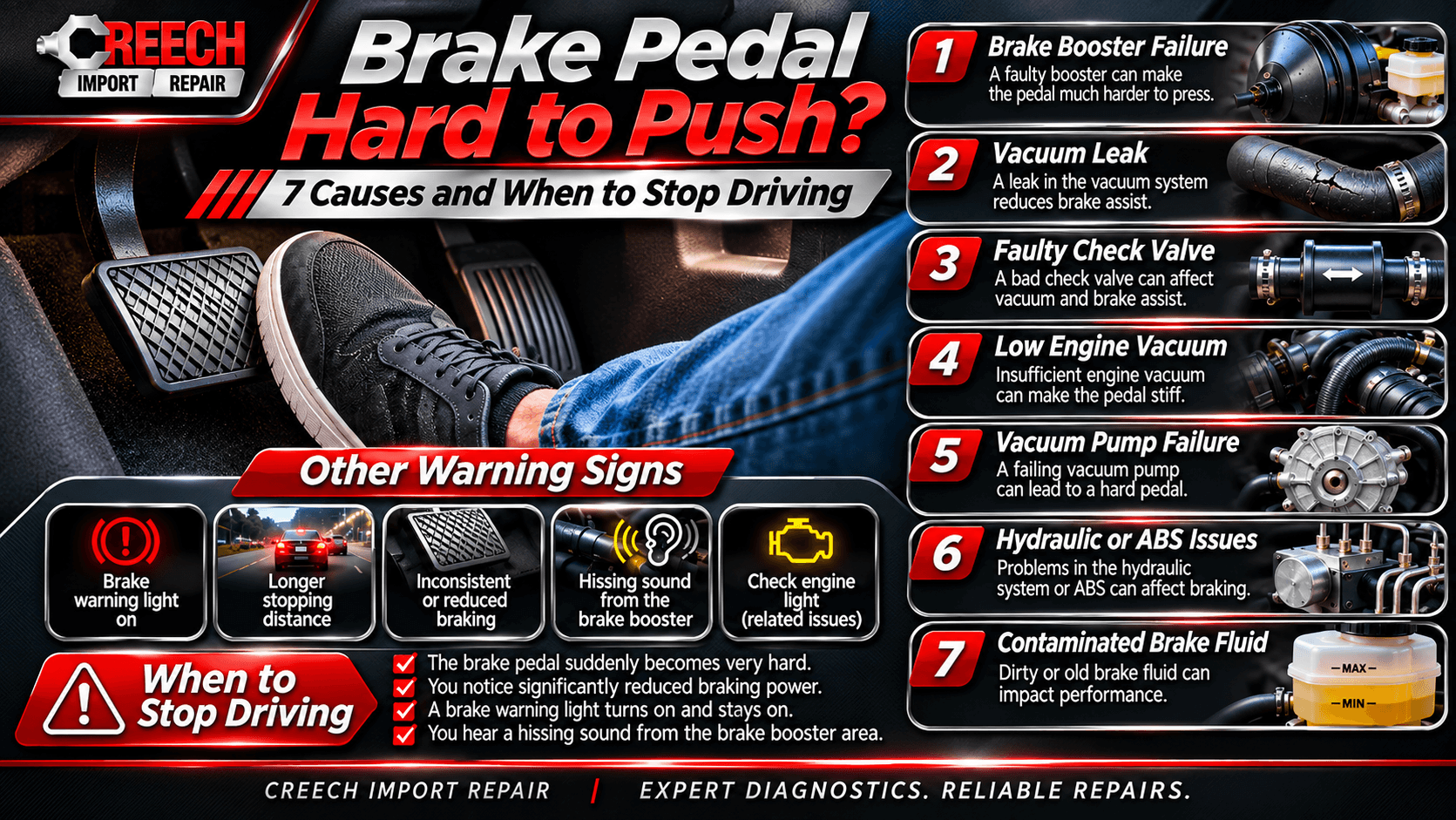
The following categories match the accompanying infographic. They are diagnostic possibilities rather than a ranking of failure frequency.
The first five primarily relate to conventional vacuum-assisted brakes. The sixth addresses other braking-system architectures and hydraulic or mechanical concerns. The seventh explains why fluid condition matters but should not be treated as the leading explanation for sudden high pedal effort.
Faulty Brake Booster
The brake booster helps multiply the force applied through the brake pedal. In a typical vacuum-assisted design, internal diaphragms and valves use a pressure difference to assist the driver.
If the booster cannot create or maintain the required pressure difference, its assisting force can decrease significantly.
Possible internal faults include diaphragm damage, air-valve problems, seal failure, or other mechanical defects depending on the booster design.
The result can be a pedal that requires considerably greater effort even though the driver has not changed how the vehicle is operated.
Some booster leaks produce a hissing sound near the pedal or firewall. Others may not create an obvious noise.
A booster-related vacuum leak can also affect engine idle in some vehicles, but rough idle alone does not prove the booster is defective.
Before recommending a replacement, a technician should verify that the booster is receiving adequate vacuum and that its check valve and supply circuit are functioning.
Otherwise, a good booster might be replaced when the actual problem is an external vacuum leak or insufficient vacuum production.
Possible clues: High pedal effort while the engine is running, reduced assistance, or hissing near the booster.
Professional diagnosis: Evaluate vacuum supply, booster response, internal sealing, and related mechanical operation using the vehicle manufacturer's procedure.
Important distinction: A hard pedal suggests missing assistance, but it does not prove the booster itself has failed. The vacuum source and one-way check valve must also be considered.
Vacuum Leak or Damaged Booster Hose
A vacuum brake booster requires a suitable vacuum source. On conventional systems, a reinforced hose connects the booster or check valve to the engine or a dedicated vacuum source.
Over time, the hose may become brittle, cracked, loose, incorrectly routed, or deteriorated.
Some hoses may also soften and collapse under vacuum, restricting the supply even when no obvious exterior leak is visible.
A damaged hose can prevent sufficient vacuum from reaching the booster or interfere with maintaining the required pressure difference.
The pedal may then become unusually firm. Depending on the arrangement, an air leak can also contribute to engine idle irregularities or an engine-related warning.
The presence of a hose does not establish that the system uses engine manifold vacuum in every vehicle. Turbocharged, diesel, hybrid, and other engines may use an auxiliary pump or a different arrangement.
A technician can inspect the hose and connections, then measure the supply using an appropriate gauge or diagnostic procedure.
Possible clues: Hissing near a vacuum connection, a visible cracked hose, abnormal idle on some engines, or a hard pedal accompanied by inadequate measured vacuum.
Professional diagnosis: Inspect hose condition, routing, fittings, possible collapse, and vacuum delivery.
Important distinction: Replacing the booster cannot fix an upstream vacuum hose that leaks or collapses. Both should be assessed before purchasing expensive parts.
Faulty Brake Booster Check Valve
Many vacuum-assisted brake systems include a one-way check valve. Its function is to help maintain vacuum in the booster when conditions at the vacuum source change.
This reserve can provide a limited amount of assistance during brief changes in engine operation or after the engine is switched off, depending on the system.
If the check valve leaks, sticks, becomes blocked, or fails to operate in its intended direction, the booster may lose vacuum or fail to receive it properly.
The brake pedal can become harder than normal or lose its expected reserve of power assistance.
A faulty check valve may produce symptoms that closely resemble internal brake booster failure.
Some vehicles incorporate the check valve into a hose or booster fitting, while others use a separate serviceable component.
The technician should verify correct valve direction, retention of vacuum, and associated hose condition using the model-specific procedure.
Possible clues: Unusually rapid loss of stored brake assistance, high pedal effort, or abnormal vacuum behavior.
Professional diagnosis: Test valve sealing and flow direction, inspect connections, and determine whether the booster itself retains vacuum.
Important distinction: A check-valve fault can imitate a failed booster. These components may have very different parts and labor requirements.
Insufficient Engine Vacuum or Engine-Operation Problems
Some brake boosters rely on vacuum generated by the engine. If that source is inadequate, an otherwise functional booster may not provide enough assistance.
Low vacuum may relate to engine operating conditions, leaks, restrictions, or mechanical problems.
The precise causes depend on engine design, load, and the presence of additional vacuum-generating equipment.
For example, a stalled engine may stop producing manifold vacuum, and the remaining reserve of assistance may be depleted after subsequent braking.
An engine that runs poorly may also fail to provide the expected vacuum at certain operating conditions.
In a technical bulletin, CARDONE describes measuring vacuum at the booster supply circuit rather than assuming the booster is defective from pedal feel alone.
Its published vacuum specifications apply to the type of system discussed in that bulletin; they should not be applied universally to every vehicle.
A technician should check the manufacturer's expected vacuum level and determine whether the source, hose, valve, or booster is responsible for inadequate assistance.
Possible clues: Hard pedal following an engine stall, rough running, engine-related faults, or measured vacuum below the specified range.
Professional diagnosis: Verify actual vacuum supply and engine performance using vehicle-specific specifications.
Important distinction: Low vacuum is a condition, not a diagnosis by itself. The technician must determine why the vacuum source is insufficient.
Vacuum Pump Failure
Some vehicles use a dedicated vacuum pump to support brake assistance. The pump may be mechanically driven or electrically operated, depending on the vehicle.
Dedicated pumps can be especially important where engine manifold vacuum is unavailable or insufficient under expected driving conditions.
If the pump fails, produces inadequate vacuum, or is not controlled properly, power-brake assistance may decrease.
The driver can experience increased pedal effort, a brake-system warning, or reduced confidence in stopping performance.
A pump-related problem might involve the pump itself, power supply, control circuit, related hose, or another part of the vacuum system.
Toyota's documented safety recall involving certain 2018-2019 Camry vehicles provides an example of a vehicle-specific brake-assistance risk associated with premature vacuum-pump component wear.
The recall does not mean all Camrys or all vehicles with a hard pedal have the same defect. Recall applicability must be checked by VIN.
Possible clues: Suddenly increased braking effort, relevant dashboard warnings, or insufficient measured vacuum from a pump-supported system.
Professional diagnosis: Check pump operation, vacuum delivery, electrical controls where fitted, and relevant manufacturer service information.
Safety consideration: Loss of power-brake assistance can increase the force needed to slow the vehicle. A driver should not assume normal stopping capability remains available.
Hydraulic, Electronic Brake-Assist, or Mechanical Problems
Not every vehicle uses a conventional vacuum booster. Some use hydraulic assistance, electrically controlled boosters, integrated brake-actuation systems, or regenerative-braking coordination.
A problem with these systems can change brake-pedal effort, assistance, response, or pedal feedback.
Depending on the design, relevant faults might involve assist pressure, pumps, electrical supply, sensors, actuators, control modules, or mechanical components.
A mechanically binding pedal linkage or brake assembly can also produce abnormal resistance.
Brake hydraulic restrictions or related component faults can sometimes affect pedal behavior, although these faults often produce symptoms different from a classic vacuum-booster failure.
Importantly, an ordinary ABS warning light does not automatically mean the vehicle has lost power-brake assistance.
On many conventional systems, ABS prevents wheel lockup during certain braking conditions, while the booster provides a separate assisting function.
On integrated brake systems, the relationship between electronic stability functions, hydraulic pressure generation, and brake assistance may be more complex.
The technician needs to identify the vehicle's actual braking architecture before interpreting fault codes or recommending components.
Possible clues: Brake assist warnings, multiple braking-system messages, abnormal pedal resistance, changes in braking response, or unusual mechanical resistance.
Professional diagnosis: Inspect the pedal and mechanical connections, retrieve applicable codes, and test hydraulic or electronic assist operation according to manufacturer procedures.
Important distinction: A conventional ABS sensor fault is not the same as a failed brake booster. Read Creech's ABS Light On but Brakes Work guide for that separate problem.
Contaminated Brake Fluid or Related Hydraulic Restrictions
Brake fluid transfers hydraulic pressure through the braking system. The correct fluid specification and its condition matter for reliable operation.
Over time, some brake fluids absorb moisture, and contamination can affect boiling characteristics, corrosion protection, seals, and hydraulic components.
Severe contamination or internal deterioration may contribute to component sticking, restrictions, or abnormal braking behavior.
However, dirty or aged brake fluid is not a typical direct cause of a suddenly rock-hard brake pedal.
Moisture-related boiling and vapor formation more commonly raise concerns about a soft, long, or inconsistent pedal, particularly after substantial brake heating.
Likewise, low brake fluid often raises concern for leaks or brake wear rather than a classic loss-of-vacuum-assistance symptom.
This category is included because hydraulic faults can affect the braking system, not because every hard pedal should be treated with a fluid flush.
A professional should inspect the system before deciding whether contaminated fluid, internal hydraulic restrictions, or another mechanical fault contributes to the complaint.
Possible clues: Incorrect or visibly contaminated fluid, hydraulic service history, inconsistent brake operation, or evidence of internal restrictions.
Professional diagnosis: Assess fluid specification and condition, inspect hydraulic components, and follow the manufacturer's procedures for the actual fault.
Evidence limit: Brake fluid service is important maintenance, but a flush should not be presented as the default repair for sudden high pedal effort. Loss of assistance and mechanical binding require their own tests.
Hard Brake Pedal Symptoms: What Do Different Patterns Suggest?
Describing the exact pedal behavior helps a technician investigate the correct system.
Pedal symptoms can overlap, so the table below is a diagnostic comparison rather than a way to identify a failed part without inspection.
| What You Notice | Possible Investigation Area | Important Distinction |
|---|---|---|
| Brake pedal hard while the engine is running | Vacuum supply, booster, check valve, pump, assist system, pedal linkage | Unusual operating effort is not normal and requires prompt safety assessment. |
| Pedal becomes firm after repeated presses with engine off | Stored booster vacuum depletion | May be expected on a conventional vacuum-assisted system. |
| Pedal suddenly hard after engine stalls | Loss of vacuum generation or assist reserve | Engine stoppage and brake assistance must both be addressed. |
| Hard pedal with hissing near dashboard or firewall | Booster sealing, vacuum hose, connections | A hiss supports investigation but does not independently prove the booster has failed. |
| Hard pedal plus rough idle | Possible engine vacuum issue or related leak | Engine symptoms and brake symptoms need coordinated diagnosis. |
| Hard pedal with brake-assist warning | Vehicle-specific electronic, hydraulic, or vacuum assist system | Warning meaning varies by make, model, and brake architecture. |
| Pedal soft, spongy, or traveling too far | Hydraulic pressure, air, leaks, or other mechanical condition | Different complaint from the classic high-effort pedal. |
| Pedal sinks continuously while held | Hydraulic pressure retention or system-specific behavior | See the dedicated sinking-pedal troubleshooting guide. |
| Hard pedal with markedly longer stopping distance | Reduced assistance or other major braking defect | Stop safely and arrange towing rather than driving to a repair shop. |
Can the Brake Pedal Be Hard Even if the Car Still Stops?
Yes. On some conventional systems, the underlying mechanical and hydraulic brakes may remain capable of producing braking force after power assistance is lost.
However, the driver may need substantially more force and may not achieve the same stopping performance, especially during an unexpected event.
This should not be considered proof that the vehicle is safe to operate. The braking system must be inspected before normal driving resumes.
Does a Hard Pedal Always Trigger a Dashboard Warning?
No. Some vacuum hose, check-valve, or booster faults may not produce a dedicated electronic warning.
Other vehicles use monitoring systems that can display brake assistance, electronic braking, or power-system warnings when certain faults occur.
The absence of a warning light does not establish that normal brake assistance is present.
Is a Hissing Noise a Sign of Brake Booster Failure?
A hiss may indicate air movement or a leak in the booster or vacuum circuit.
The sound can sometimes become more noticeable when the brake pedal is pressed.
However, noises from other systems can resemble booster hissing. A technician should locate the sound and verify whether vacuum is being lost.
Why Is My Brake Pedal Hard When the Car Is Off but Softer After Starting?
On a conventional vacuum-assisted braking system, this may reflect normal booster operation.
While the engine is running, the vacuum source helps the booster create assisting force.
After shutdown, a limited reserve may remain. Repeated brake applications can reduce that reserve until the pedal requires greater effort.
When the engine is started again and normal vacuum becomes available, assistance can return and the pedal may feel easier to push.
Some diagnostic procedures assess this change while the vehicle is stationary, but the exact method should follow the manufacturer's service information.
Do not perform improvised brake tests while moving, intentionally stall the engine, or attempt to reproduce a loss of braking assistance on a public road.
What If the Pedal Stays Rock Hard After the Engine Starts?
A pedal that remains unusually hard during normal engine operation may indicate that expected assistance is unavailable.
Possible areas include the vacuum supply, one-way check valve, internal booster operation, dedicated pump, or another form of brake-assist control.
A mechanical binding problem can also create resistance.
The vehicle should be assessed before continued driving, especially if stopping effort has increased.
What If the Pedal Becomes Hard Only After Several Stops?
This can suggest that the system is not maintaining or replenishing assistance under repeated braking conditions.
A technician may investigate vacuum supply, check-valve retention, pump capacity, booster sealing, or electronic assist operation depending on the vehicle.
However, changes in pedal feel after repeated braking can also reflect other mechanical or hydraulic conditions.
The timing of the symptom should be documented rather than used to guess a single failed component.
When Should You Stop Driving With a Hard Brake Pedal?
If the brake pedal suddenly becomes much harder to press while driving, or the vehicle requires substantially more effort or distance to stop, treat it as a potentially serious brake-system problem.
Your immediate priority is to maintain control and stop in a safe location. Once stopped, do not continue normal driving until the cause has been assessed.
Warning Signs That Need Immediate Attention
- Sudden high pedal effort: The brake pedal becomes dramatically harder than its normal operating feel.
- Reduced stopping power: The car does not slow as expected with a familiar pedal application.
- Markedly longer stopping distance: More distance or force is required to stop safely.
- Brake assistance warning: A red brake warning, low-braking-power message, or vehicle-specific assist warning appears with abnormal operation.
- New hissing with poor assistance: The pedal becomes hard and an unusual air-leak sound is present.
- Engine stall followed by hard brakes: Engine operation and braking assistance change together.
- Multiple serious brake symptoms: A hard pedal occurs with unusual steering, fluid leaks, dragging brakes, smoke, or unstable stopping behavior.
If the problem occurs in motion, keep your attention on controlling the vehicle, reduce speed when possible, maintain firm and controlled braking input, and move to a safe stopping location. Avoid repeatedly pumping the pedal as a substitute for proper control, because doing so may further use the remaining vacuum reserve on some systems.
Follow the owner's manual for vehicle-specific emergency procedures. Once safely stopped, arrange appropriate roadside or towing assistance if the braking system is not operating normally.
Can You Drive to the Shop With a Bad Brake Booster?
A suspected booster problem is not a reason to assume it is safe to drive a short distance.
Even where non-assisted braking remains possible, the force needed to stop may be considerably greater, and the vehicle's complete braking condition has not been verified.
If the pedal suddenly becomes unusually hard or stopping performance is reduced, towing is the safer option.
What If the Brake Warning Light Is On but Pedal Feel Seems Normal?
A brake-system warning can have several meanings. These may include the parking brake, fluid level, or a monitored brake fault depending on the vehicle.
Do not assume the light is unrelated to braking simply because the pedal still feels familiar.
Follow the owner's manual and obtain a diagnosis appropriate to the warning. A red brake warning deserves particular attention.
What Can Drivers Safely Check Before a Brake Inspection?
If your brake pedal has suddenly become hard while driving, the priority is to stop safely. The following observations are for a stationary vehicle that is already in a safe location.
Describe When the Pedal Became Hard
Did it happen while driving, just after an engine stall, during startup, or only after the engine had been off? These are different diagnostic situations. If braking was impaired, do not drive again to reproduce it.
Record the Warning Lights or Messages
Note any red brake warning, ABS warning, brake-assist message, check-engine light, or other displayed fault. A photograph taken while safely parked may help the technician.
Note Changes in Stopping Effort
Explain whether the vehicle needed more force, more distance, or both to slow down. Do not perform a road test to estimate the stopping distance.
Describe Any Hissing or Engine Symptoms
Report unusual air sounds near the firewall or dashboard, rough idle, recent engine stalling, or changes after mechanical work. Do not disconnect vacuum hoses to investigate.
Check Relevant Service History
Mention recent brake booster, master cylinder, engine vacuum, brake fluid, battery, or electronic-braking repairs. Also share any applicable recall notice or recent brake-system warning.
Review the Owner's Manual
Identify the vehicle's braking-system warnings and expected pedal behavior. Some hybrid or electronic systems behave differently from conventional vacuum boosters.
Arrange Professional Diagnosis
Tell the shop the model, year, exact symptoms, and whether the vehicle is safe to move. If the brakes are not operating normally, arrange towing instead of driving to an appointment.
Should You Pump the Brake Pedal to Test the Booster?
Some published diagnostic procedures involve repeated pedal applications while the vehicle is stationary to evaluate stored vacuum and booster response.
Those procedures are intended for the applicable type of system and must be performed under the correct conditions.
They should not be used as improvised roadside driving tests, especially when the system may already have lost assistance.
For an unfamiliar or electronically controlled braking system, professional testing is the better approach.
Should You Add Brake Fluid to Fix a Hard Pedal?
Do not add brake fluid simply because the pedal feels hard.
The brake-fluid reservoir may be relevant to a braking inspection, but fluid level alone does not establish the cause of unusually high pedal effort.
If fluid is unexpectedly low, the system may need inspection for leaks, component wear, or another cause.
Using the wrong fluid or contaminating the system can introduce additional hazards.
How Does a Mechanic Diagnose a Brake Pedal That's Hard to Push?
A proper diagnosis should establish whether the problem originates in the driver-assistance system, the mechanical pedal and hydraulic connections, or another brake-system component.
The technician must first identify the vehicle's actual braking architecture because a conventional vacuum booster and an electronically controlled integrated brake system require different testing procedures.
Verify the Complaint and Safety Status
The technician reviews the onset of the problem, warning messages, stopping effort, engine behavior, and service history. A road test may be inappropriate if the vehicle has lost normal braking capability.
Identify the Type of Brake Assistance
The vehicle may use an engine-vacuum booster, vacuum pump, hydraulic assist, electrohydraulic system, or electrically controlled booster. This determines which components and specifications matter.
Inspect the Pedal and Mechanical Connections
Where appropriate, the pedal linkage, mounting points, mechanical operation, and surrounding components are checked for abnormal resistance or damage.
Evaluate Vacuum Supply Where Applicable
On conventional vacuum systems, the technician checks the source, hoses, check valve, and related vacuum retention using the manufacturer's specified tests and measurements.
Test Booster or Assist-System Operation
The technician assesses whether the system provides its intended assistance. A failed test should lead to identifying the actual defect rather than immediately replacing the most expensive component.
Review Electronic and Hydraulic Information
When appropriate, diagnostic equipment may retrieve brake-system codes, live data, pressure information, power-supply measurements, or relevant component commands.
Inspect Related Hydraulic Components
If symptoms indicate restrictions, binding, leakage, contamination, or abnormal pressure operation, the relevant components and fluid are inspected using approved procedures.
Explain and Verify the Repair
After confirming the failed component or condition, the shop provides the recommended repair. Normal pedal effort and braking operation should be verified under appropriate safe conditions before the vehicle is returned to service.
Does a Diagnostic Scan Tool Always Identify a Failed Brake Booster?
No. A conventional vacuum booster can develop mechanical or sealing problems without storing an electronic fault code.
Electronic or hydraulic assist systems may provide more diagnostic information, but a code often identifies a system or circuit rather than proving a specific part has failed.
Mechanical testing, pressure measurements, vacuum assessment, and service information may still be necessary.
Why Should Vacuum Be Measured Before Replacing a Booster?
A booster cannot function as intended if its required vacuum source is unavailable.
Testing the supply helps distinguish a failed booster from a leaking hose, defective check valve, inadequate engine vacuum, or pump problem.
CARDONE's technical guidance specifically emphasizes vacuum supply, hose condition, check-valve operation, and booster response as separate diagnostic considerations.
How Much Does It Cost to Fix a Hard Brake Pedal?
The repair cost depends on the confirmed fault, vehicle design, parts availability, labor access, required electronic procedures, and whether related damage is present.
A vacuum hose or separate check valve may require a different repair from replacing a booster, vacuum pump, hydraulic unit, or integrated electronic brake actuator.
Because the symptom alone does not identify the failed component, there is no single reliable repair price for a hard brake pedal.
| Confirmed Problem | Possible Repair | Important Cost Factors |
|---|---|---|
| Internal brake booster failure | Replace the confirmed defective booster or related assembly | Vehicle design, booster access, required hydraulic work |
| Leaking or collapsed vacuum hose | Replace or repair affected hose and connections | Hose routing, fittings, integrated components |
| Faulty booster check valve | Replace the valve or appropriate integrated assembly | Separate versus integrated design, accessibility |
| Insufficient engine vacuum | Correct verified engine or vacuum-generation problem | Underlying engine fault and required diagnosis |
| Vacuum pump failure | Repair verified pump, drive, electrical or control condition | Mechanical or electric pump design, programming |
| Electronic or hydraulic assist fault | Repair confirmed actuator, pump, circuit, control, or mechanical issue | System architecture, equipment, calibration, parts |
| Hydraulic restriction or severe contamination | Repair affected hydraulic components and service fluid as indicated | Damage extent, approved bleeding procedures, component access |
Is Replacing a Brake Booster Always Necessary?
No. A hard pedal can result from inadequate vacuum reaching a functioning booster.
If the problem is an external hose, one-way check valve, vacuum pump, or engine condition, correcting that fault may restore normal assistance without replacing the booster.
The shop should explain which test established the failure before recommending replacement.
Does Brake Fluid Flushing Fix a Hard Pedal?
Not ordinarily when the cause is loss of vacuum or electronic assistance.
Brake fluid replacement may be appropriate for scheduled maintenance or when testing confirms a fluid-related condition.
But a fluid flush should not be substituted for booster, vacuum supply, pedal linkage, hydraulic restriction, or electronic-assist diagnosis.
Can a Hard Pedal Be Fixed Without Replacing the Master Cylinder?
Yes. Many hard-pedal complaints originate outside the master cylinder, particularly in the power-assistance system.
Master-cylinder faults can affect brake operation, but the correct diagnosis depends on the actual symptoms and test findings.
Do not replace the master cylinder merely because the pedal resistance is abnormal.
Do Hard Brake Pedal Problems Differ by Vehicle Brand and Technology?
Yes. Different vehicles use different braking-assistance technologies, even within the same manufacturer's lineup.
The exact model, year, engine, and braking-system configuration are more useful for diagnosis than the brand name alone.
Toyota and Lexus
Some Toyota and Lexus vehicles use conventional vacuum assistance, while certain hybrid and other models use different electronic or hydraulic braking arrangements.
Toyota has also issued vehicle-specific safety recalls related to power-brake assistance. Recall eligibility must be checked by the vehicle identification number rather than inferred from a symptom.
A hard pedal on one model should not be diagnosed using an unrelated model's booster or vacuum-pump procedure.
Honda and Acura
Honda and Acura models vary by engine generation, trim, and braking architecture.
A technician should identify the expected assist system and determine whether the complaint relates to vacuum delivery, electronic assistance, hydraulic operation, or mechanical pedal resistance.
Subaru
Subaru vehicles also vary by model and year. Some use conventional brake boosters, but related systems and vacuum sources may differ.
A diagnosis should confirm the actual assist type and manufacturer-specified operating requirements before evaluating or replacing a booster.
Nissan and Infiniti
Nissan and Infiniti braking systems may include conventional, electronically assisted, or hybrid-related arrangements depending on the vehicle.
A brake warning, hard pedal, or unusual assist response should be interpreted using the correct model-specific service information.
Hyundai, Kia, and Mazda
These manufacturers use different engine and brake configurations across their vehicle ranges.
The technician should investigate the actual assistance source and relevant electronic systems rather than assume a vacuum booster is fitted to every model.
Domestic Vehicles
Chevrolet, Ford, GMC, Jeep, and other domestic vehicles can have vacuum, hydraulic, or electronically controlled brake-assist systems.
Heavy-duty models and some trucks may use arrangements different from those found in ordinary passenger cars.
The correct diagnosis may require specialized pressure testing or vehicle-specific equipment.
Hybrid and Electric Vehicles
Hybrid and electric vehicles may use electrically powered pumps, electrohydraulic units, integrated brake actuators, or brake-by-wire arrangements.
The brake pedal's behavior can differ from that of a conventional gasoline vehicle, especially when regenerative braking and friction braking are coordinated.
Do not assume a hybrid or EV has an engine-driven vacuum source or that a simple vacuum-booster test applies.
These systems may also include high-voltage components, requiring trained personnel and the correct safety procedures.
Can You Prevent a Brake Pedal From Becoming Hard to Push?
Not every booster, vacuum pump, hose, or electronic fault can be prevented through routine maintenance.
However, timely inspections and attention to changing brake behavior can help identify developing concerns before they create more serious operational problems.
Follow the Manufacturer's Brake Maintenance Schedule
Use the owner's manual for brake inspection intervals, fluid specifications, and relevant service recommendations.
Maintenance schedules vary by vehicle and driving conditions. Universal fluid-change intervals should not replace the manufacturer's instructions.
Have Unusual Pedal Changes Evaluated
A pedal that becomes harder, softer, lower, or less consistent than normal deserves investigation.
Even when the vehicle still seems able to stop, a new pedal symptom may reflect a fault requiring professional attention.
Address Vacuum and Engine Problems
On vehicles relying on engine vacuum for brake assistance, engine and vacuum-system problems may affect pedal effort.
Unexplained rough idle, repeated stalling, or air leaks should be investigated rather than ignored.
Do Not Ignore Brake-System Warning Messages
Electronic systems may monitor certain assist functions and display warnings when an abnormal condition occurs.
Follow the owner's manual, and do not keep driving with brake warnings accompanied by altered stopping behavior.
Check for Vehicle-Specific Safety Recalls
The National Highway Traffic Safety Administration maintains a VIN-based recall lookup.
A recall may apply to a particular model, production period, or component. Its existence does not establish the cause of your vehicle's problem without confirming applicability.
You can review open recalls through the official NHTSA vehicle recall lookup.
Brake Pedal Hard to Push in Raleigh, NC? Get Professional Diagnosis.
If your vehicle has an unusually hard brake pedal, Creech Import Repair can help investigate the condition and identify whether it involves brake assistance, vacuum delivery, hydraulic operation, or another component.
Based in Raleigh, North Carolina, Creech Import Repair has served local drivers since 1993 and provides brake maintenance, diagnosis, and repair for supported import and domestic vehicles.
When you contact the shop, explain whether the pedal became hard while driving, after engine shutdown, during startup, or following repeated braking.
Also mention any brake warning messages, hissing, engine problems, or changes in stopping performance.
These details help the service team understand the complaint before recommending a diagnostic appointment.
Creech Import Repair
1818 St. Albans Dr #106
Raleigh, NC 27609
Phone: 919-872-1999
Hours: Monday-Friday, 7:30 AM-5:30 PM
Learn more about brake repair in Raleigh, NC or visit Creech's complete brake repair guide for broader brake maintenance and repair information.
Online appointment requests are not confirmed until verified by Creech Import Repair's service team. If the brake pedal has suddenly become unusually hard, stopping power has changed, or the vehicle is unsafe to drive, arrange roadside assistance or towing instead of driving to the shop.
Frequently Asked Questions About a Brake Pedal That's Hard to Push
1. Why is my brake pedal suddenly hard to push?
A brake pedal that suddenly becomes hard to push may indicate lost power-brake assistance. Possible causes include a faulty brake booster, leaking or collapsed vacuum hose, defective one-way check valve, inadequate engine vacuum, or vacuum pump failure. Some vehicles use hydraulic or electronic assistance, so their fault possibilities differ. Mechanical resistance can also affect pedal feel. Because unexpectedly high pedal effort may reduce your ability to stop, pull over safely and arrange professional assessment rather than continuing normal driving. The cause cannot be confirmed from pedal feel alone.
2. Can a bad brake booster make the pedal feel hard as a rock?
Yes. A defective brake booster can reduce the assisting force available when you press the pedal, making braking require much more leg effort. On conventional vacuum systems, the booster may have an internal seal, diaphragm, valve, or mechanical problem. However, similar symptoms can occur when the booster receives insufficient vacuum because of a damaged hose, check valve, engine condition, or pump fault. A technician should test the vacuum source and booster operation before deciding which part needs repair or replacement.
3. Why is my brake pedal hard when the engine is off?
On a conventional vacuum-assisted brake system, a firm pedal after repeated applications with the engine off can be normal. The booster retains a limited amount of vacuum assistance after shutdown, and pressing the pedal can gradually use that reserve. When the engine starts and vacuum is restored, the pedal may feel easier to press. However, not all vehicles use the same system. Hybrids, electric vehicles, and electronically assisted brakes can behave differently. Follow the owner's manual and have unexpected behavior professionally evaluated.
4. Why does my brake pedal stay hard when the engine is running?
A brake pedal that remains unusually hard during normal engine operation may indicate insufficient power assistance or abnormal mechanical resistance. On vacuum-assisted systems, possible areas include the booster, vacuum hose, check valve, engine vacuum source, or dedicated pump. On electronically controlled systems, hydraulic, electrical, or actuator-related faults may be relevant. The technician must identify the vehicle's brake architecture and test the components that provide assistance. If stopping requires much greater force than usual, stop safely and do not continue normal driving until the system has been assessed.
5. Can a vacuum leak cause a stiff brake pedal?
Yes. A leak in a conventional brake-booster vacuum circuit can reduce the pressure difference the booster needs to assist braking. A damaged hose, loose fitting, faulty check valve, or internal booster leak may contribute. Some leaks produce hissing near the firewall or dashboard, and certain engine-related leaks can affect idle quality. However, a hiss or rough idle alone does not prove the source. Professional testing should measure vacuum supply, inspect connections, and verify booster operation before parts are replaced.
6. Is it safe to drive with a stiff or hard brake pedal?
Not when the pedal has become unusually hard during normal operation or the vehicle requires significantly more force or distance to stop. Some conventional brakes may retain non-assisted hydraulic braking after loss of booster assistance, but the effort required can increase substantially. A hard pedal can also accompany other mechanical or electronic faults. Stop safely, follow the vehicle's emergency guidance, and arrange professional assistance or towing. A pedal that is firm after repeated engine-off applications may be expected on some systems, but that is a different situation.
7. Can low or dirty brake fluid cause a hard brake pedal?
Brake fluid problems can affect braking performance, but they are not the typical direct cause of a suddenly rock-hard pedal. Low fluid often raises concern about leaks or brake wear, while moisture-related vapor formation more commonly contributes to a soft or inconsistent pedal. Severe contamination or internal hydraulic restrictions can sometimes affect brake operation differently. The technician should evaluate fluid condition and system function without assuming a fluid flush will restore missing booster assistance. Always use the fluid specification and service procedure required by the manufacturer.
8. Can a bad vacuum pump cause a hard brake pedal?
Yes. Vehicles that use a dedicated mechanical or electric vacuum pump may lose braking assistance if the pump fails or cannot provide adequate vacuum. Related wiring, control, drive, or hose problems may produce similar symptoms. Some manufacturer recalls document risks involving specific vacuum-pump components, but applicability depends on the vehicle identification number. A technician should identify the type of brake-assist system and measure or assess the pump's operation before replacement. Sudden loss of assistance or reduced stopping power requires immediate safety attention.
9. How much does it cost to fix a brake pedal that's hard to push?
The cost depends on the confirmed cause, vehicle model, parts, labor, and brake-system design. A damaged vacuum hose or separate check valve can involve a different repair from replacing a booster, vacuum pump, hydraulic unit, or integrated electronic brake actuator. Some systems also require specialized testing, bleeding, or calibration. There is no reliable single price because a hard pedal is a symptom rather than a diagnosis. Ask for the test findings and a written estimate before approving replacement of major braking components.
10. Where can I get a hard brake pedal diagnosed in Raleigh, NC?
Creech Import Repair provides automotive brake diagnosis and repair at 1818 St. Albans Dr #106 in Raleigh, North Carolina. Call 919-872-1999 to describe your vehicle's make, model, year, when the pedal became hard, and whether stopping effort or dashboard warnings changed. The service team can help arrange an appropriate diagnostic appointment. If the pedal suddenly becomes unusually stiff while driving, braking performance deteriorates, or the vehicle is unsafe to operate, stop safely and arrange towing rather than driving to the shop.

Automotive Technical Review
Reviewed by Creech Import Staff
Creech Import Staff represents the automotive service team at Creech Import Repair in Raleigh, North Carolina.
Serving local drivers since 1993, Creech Import Repair provides maintenance, diagnostics, and repair for supported import and domestic vehicles, including brake-system concerns.
Learn more about the shop's history, certified automotive technicians, and commitment to clear, professional service.
About Creech Import RepairTechnical Sources and Evidence Limits
This article provides general automotive information rather than a confirmed diagnosis of an individual vehicle. The seven categories represent possible causes and related system concerns, not statistically ranked failure rates. The correct tests, expected pedal response, vacuum requirements, and braking architecture vary by manufacturer, model, and year.
Brake assistance recalls cited here involve specific vehicles or components. They should not be interpreted as evidence that all vehicles with a hard pedal have the same defect. For current recall applicability, check the vehicle's VIN using the official NHTSA lookup.
- CARDONE Industries. Diagnosing a Vacuum Brake Booster. Technical guidance on booster function, vacuum supply, hoses, check valves, and diagnostic testing.
- Bendix. Changes in Brake Pedal Feel and Brake-System Symptoms. Manufacturer guidance on abnormal brake effort, booster function, and different pedal symptoms.
- Toyota / National Highway Traffic Safety Administration. Safety Recall 21TA09: Sudden Loss of Power Braking Assist May Occur. An example involving specified 2018-2019 Toyota Camry vehicles and vacuum-pump-related braking assistance concerns. Not a general diagnosis for other models.
- National Highway Traffic Safety Administration. Vehicle Safety Recall Lookup. Official vehicle identification number search for applicable open safety recalls.
- Creech Import Repair. Brake Repair in Raleigh, NC. Primary service page for the shop's braking diagnostics and repairs.
- Creech Import Repair. Brake Pedal Sinks at a Stop: Causes and Safe Next Steps. Related guide distinguishing continuous downward pedal movement from unusually high pedal effort.
- Creech Import Repair. ABS Light On but Brakes Work? Causes and What to Do. Related article explaining conventional ABS warnings and their distinction from other brake-system faults.
- Creech Import Repair. Contact and Appointment Information. Raleigh location, telephone number, shop hours, and appointment policies.
Find Creech Import Service articles useful?
Add this site to your Preferred Sources in Google Search.