


If your car won’t start but the lights work, the battery may still be weak. Other possible causes include corroded battery connections, a faulty starter, a failed relay or fuse, a park/neutral safety switch, a key-recognition problem, or a fuel or ignition fault if the engine cranks without starting.
Quick Answer: Why Won’t My Car Start If the Lights Work?
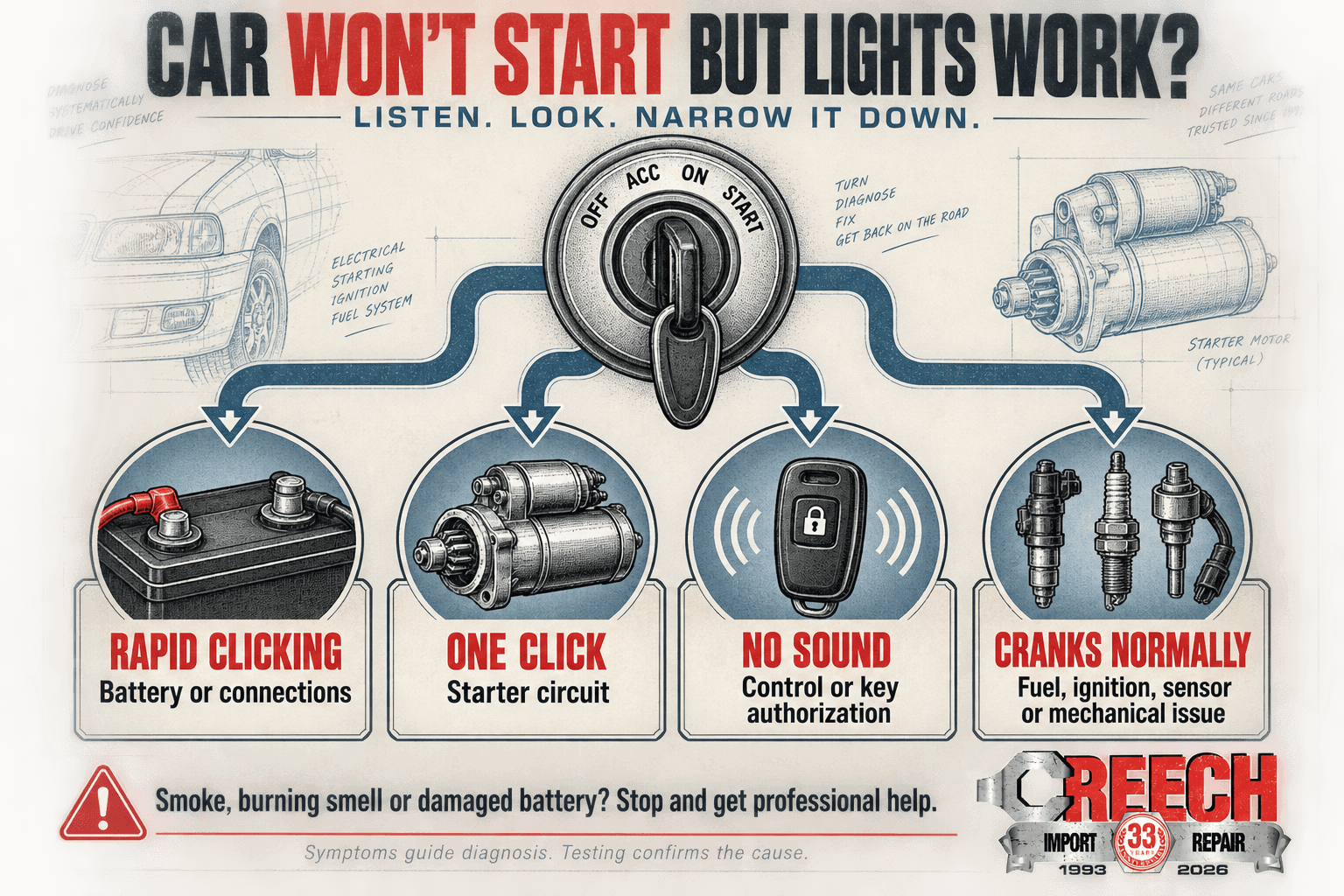
A car that won’t start but the lights work may have enough battery power for its lights and dashboard but not enough current to operate the starter. Rapid clicking often points toward a weak battery or poor connection. One click may involve the starter circuit. No sound may indicate a control, safety-switch, or key-authorization problem. Normal cranking without startup usually shifts the diagnosis toward fuel, ignition, sensor, immobilizer, or mechanical issues.
Need help now? If your vehicle will not start in Raleigh, call Creech Import Repair and describe whether you hear rapid clicking, one click, normal cranking, or no sound.
The first diagnostic distinction is whether the vehicle has a no-crank condition or a crank-but-no-start condition. These symptoms can sound similar when described as “the car won’t start,” but they direct technicians toward different systems.
- No crank: The engine does not turn when you press the start button or turn the key.
- Slow crank: The engine turns more slowly than normal and does not start.
- Cranks but does not start: The starter turns the engine, but the engine never begins running.
- Starts and then dies: The engine briefly runs but cannot remain running.
Stop If You Notice an Electrical or Battery Hazard
Stop attempting to start the vehicle if you notice smoke, sparks, a burning smell, leaking battery fluid, melted wiring, unusual heat, or a swollen or damaged battery. Move away from the vehicle if necessary and arrange professional assistance. Always follow the jump-starting instructions and warnings in the vehicle owner’s manual.
Why a Car Won’t Start but the Lights Work
Your headlights, radio, interior lights, and instrument panel do not prove that the battery can start the engine. These accessories require much less electrical current than the starter motor.
A weak battery may contain enough energy to illuminate the dashboard but experience a significant voltage drop when the starter is engaged. This can cause the lights to dim, flicker, or switch off during the start attempt.
The battery’s appearance is not a reliable measure of its condition. A battery can look clean but have insufficient capacity. Resistance can also develop inside a terminal, cable, connection, or ground path. Professional testing evaluates battery performance under load and checks whether voltage is being lost elsewhere in the starting circuit.
The Most Important Diagnostic Question
Does the engine crank? If it does not turn at all, diagnosis generally begins with the battery, connections, starter, starter-control circuit, safety interlocks, and immobilizer. If the engine turns at normal speed but does not run, diagnosis shifts toward fuel delivery, ignition, sensor inputs, security authorization, engine timing, and mechanical condition.
What Does the Sound Mean When Your Car Will Not Start?
The sound and behavior you observe can provide useful clues. However, similar symptoms can have different causes, so sound alone should not be used to select a replacement part.
| What Happens | Likely Diagnostic Area | What It May Mean |
|---|---|---|
| Rapid clicking | Battery, terminals, cables, or grounds | The starter circuit may not be receiving enough stable current. |
| One solid click | Starter, solenoid, battery, or high-resistance connection | The starter may be commanded on but unable to turn the engine. |
| No sound | Start-control circuit, relay, fuse, safety switch, ignition switch, or immobilizer | The starter command may not be reaching or activating the starter. |
| Slow cranking | Battery, cables, grounds, or starter | The engine is turning but not at its normal cranking speed. |
| Normal cranking but no start | Fuel, ignition, sensors, immobilizer, or mechanical condition | The starting circuit works, but the engine is missing something required to run. |
| Starts with a jump but later dies | Battery or charging system | The battery may not retain a charge, or the charging system may not replenish it. |
| Starts in Neutral but not Park | Transmission range or park/neutral safety circuit | The vehicle may not consistently recognize a safe starting position. |
8 Reasons Your Car Won’t Start but the Lights Work
1. The Battery Is Weak or Discharged
A weak battery is one of the most common reasons a car does not start even though its lights and radio still operate. Starting an engine requires a large burst of electrical current. A battery that can power low-demand accessories may still be unable to supply that burst.
Possible clues include rapid clicking, slow cranking, dashboard lights that dim during a start attempt, or a vehicle that starts with an appropriately performed jump. Battery age, temperature, internal deterioration, an accessory left on, or a parasitic electrical draw may contribute to the problem.
A successful jump start does not prove that the battery is the only fault. The battery may have been drained by a charging-system problem, electrical draw, poor connection, or repeated short-trip operation. The battery and related systems must be tested to determine why it lost power.
2. A Battery Terminal, Cable, or Ground Is Faulty
The battery may contain usable power, but resistance in a connection can prevent enough current from reaching the starter. Loose terminals, corrosion, damaged cables, or poor engine and chassis grounds can create a no-start condition.
Because lighting circuits require less current, the dashboard may continue to work while the high-current starter circuit fails under load. The lights may also dim sharply or switch off when the driver attempts to start the engine.
A visual inspection can reveal obvious corrosion or damage, but not every connection problem is visible. Voltage-drop testing while the circuit is loaded can identify excessive resistance that a visual inspection may miss.
3. The Starter Motor or Starter Solenoid Is Failing
The starter motor turns the engine during startup. The starter solenoid helps engage the starter and connect it to battery power. A fault may cause a single click, intermittent no-crank condition, slow or irregular starter operation, or no response.
One click does not automatically prove that the starter has failed. A weak battery, poor ground, or high-resistance cable can produce a similar symptom. Battery condition, starter power, ground integrity, and starter-control signals should be tested before replacing the starter.
4. A Starter Relay, Fuse, or Control Circuit Has Failed
Modern starting systems use relays, fuses, modules, switches, and wiring to carry the driver’s start request to the starter. A fault in this control circuit can prevent starter operation even when the battery and starter motor are functional.
Depending on the vehicle, the start request may pass through the ignition switch, body control module, engine control module, transmission range input, immobilizer, and starter relay. Diagnosis may require wiring information, module data, and circuit testing rather than simply replacing a relay.
5. The Park/Neutral Safety Switch or Clutch Interlock Is Not Working
Automatic-transmission vehicles are designed to start only when the transmission is recognized as being in Park or Neutral. Manual-transmission vehicles commonly require the clutch pedal to be depressed.
If an automatic vehicle starts in Neutral but not Park, the problem may involve the transmission range switch, park/neutral safety circuit, shifter alignment, wiring, or control-module data. A manual vehicle may have a clutch-interlock switch or circuit problem.
Trying Neutral once can provide a useful diagnostic clue, but it is not a repair. Intermittent safety-switch problems should be diagnosed because the starting failure may become more frequent.
6. The Key Fob, Immobilizer, Ignition Switch, or Start Button Is the Problem
Many vehicles require electronic authorization before the starter, fuel system, or ignition system will operate. A weak key-fob battery, damaged key, immobilizer fault, ignition-switch problem, or start-button circuit issue may prevent startup.
Possible clues include a security warning light, “key not detected” message, intermittent starting, or successful starting with a spare key. Some vehicles provide a backup procedure for recognizing a key fob with a weak battery. Follow the instructions for the specific vehicle because procedures differ by manufacturer and model.
7. The Alternator or Charging System Is Not Recharging the Battery
The alternator normally does not crank the engine; the battery supplies starting power. However, a failing alternator or charging circuit can leave the battery too discharged to start the vehicle later.
This possibility becomes more likely if the vehicle starts after a jump but later dies, if a charging warning appeared before the no-start, or if the problem returns shortly after the battery is charged.
The charging system includes more than the alternator. Belt condition, tensioner operation, electrical connections, fuses, battery condition, wiring, and computer-controlled charging strategies can affect performance. Testing the complete system helps prevent replacing a battery when another fault caused it to discharge.
8. The Engine Cranks but Has a Fuel, Ignition, Sensor, or Mechanical Problem
If the engine turns at normal speed but never begins running, the battery and starter may be performing their primary functions. The problem may instead involve fuel delivery, ignition, engine timing, air measurement, compression, an immobilizer, or a critical sensor signal.
For example, a crankshaft-position sensor fault may prevent the engine computer from correctly controlling ignition and fuel injection. A fuel-pump or fuel-pressure problem can prevent the engine from receiving enough fuel. Other possibilities include ignition-system power, wiring faults, contaminated fuel, or mechanical damage.
A diagnostic trouble code can provide direction, but it does not necessarily identify a defective part. Accurate diagnosis combines code information with live data, circuit testing, fuel or ignition checks, and the conditions under which the problem occurred.
Need No-Start Diagnostics in Raleigh?
Creech Import Repair can evaluate the battery, starting circuit, charging system, electrical connections, security authorization, and related vehicle systems to identify why your vehicle will not start.
Battery vs. Starter vs. Alternator
The battery, starter, and alternator work together, but each has a different role. Because their failure symptoms can overlap, each component should be tested before replacement.
| Component | Primary Job | Possible Failure Symptoms |
|---|---|---|
| Battery | Stores electrical energy and supplies power for starting. | Rapid clicking, slow cranking, dimming lights, or repeated need for a jump. |
| Starter | Uses battery power to turn the engine during startup. | One click, intermittent no-crank, or no starter operation despite proper power and control. |
| Alternator | Powers electrical systems and replenishes the battery while the engine runs. | Charging warning, recurring discharged battery, unstable lights, or an engine that dies after starting. |
A failing alternator can discharge an otherwise usable battery, creating what appears to be a battery-related no-start. Excessive resistance in a battery cable can also imitate a failed battery or starter. Testing separates the failed component from the underlying cause.
What Can You Safely Check Before Calling a Mechanic?
These observations can help a technician understand the problem. They are not substitutes for professional testing.
- Confirm the transmission position. Make sure an automatic vehicle is fully in Park. With your foot on the brake, try starting it in Neutral once. For a manual transmission, fully depress the clutch.
- Listen to the start attempt. Note whether you hear rapid clicks, one click, slow cranking, normal cranking, or no sound.
- Watch the lights. Observe whether the dashboard and headlights remain steady, dim significantly, flicker, or turn off.
- Read dashboard messages. Look for security, key, battery, transmission, or other warning messages.
- Try the spare key. If one is available, it may help identify a key-recognition problem.
- Check the owner’s manual. Follow the manufacturer’s backup key-recognition and jump-start procedures.
- Look for visible damage. From a safe position, note obvious corrosion, damaged wiring, or loose-looking connections. Do not touch damaged components.
- Avoid repeated cranking. Excessive attempts can further discharge the battery and overheat the starter.
Should You Jump-Start the Vehicle?
Attempt a jump start only when it is safe, the battery is not swollen, cracked, leaking, frozen, or otherwise damaged, and you can follow the procedure in the vehicle owner’s manual. Connection points and procedures can differ, particularly on hybrid vehicles and vehicles with remotely located batteries.
If you are uncertain about the correct procedure or notice damaged electrical components, arrange professional assistance instead.
When Should You Stop Trying to Start the Car?
Repeated start attempts rarely correct an electrical or mechanical fault and may further discharge the battery. Stop and arrange assistance if:
- You smell burning plastic, fuel, or overheated electrical components.
- You see smoke, sparks, leaking battery fluid, or melted wiring.
- The battery appears cracked, swollen, frozen, or damaged.
- The starter grinds or remains engaged after the start attempt.
- The engine makes an unusual mechanical noise while cranking.
- The vehicle repeatedly starts and stalls.
- A jump start does not work or the problem immediately returns.
- The vehicle is stopped in an unsafe location.
How Professional No-Start Diagnosis Works
A systematic diagnosis is more reliable than replacing a battery, starter, or alternator based only on a symptom. The exact procedure depends on whether the engine does not crank, cranks slowly, cranks normally, or starts and stalls.
1. Verify the Exact Starting Symptom
The technician observes what happens during the start request and checks for warning messages, abnormal sounds, intermittent behavior, and relevant repair history.
2. Test Battery Condition and State of Charge
Battery voltage alone may not reveal whether the battery can produce sufficient current. Appropriate testing evaluates state of charge, capacity, and performance under load.
3. Inspect Connections and Test for Voltage Loss
The battery terminals, power cables, grounds, and related connections are checked. Voltage-drop testing can reveal excessive resistance while current is flowing through the circuit.
4. Test the Starter Power and Control Circuits
The technician determines whether the starter has adequate power and ground, receives the correct control signal, and operates with an appropriate current draw.
5. Scan Relevant Vehicle Modules
Modern vehicles may store useful information in the engine, transmission, body, immobilizer, or gateway modules. Scan data can show whether the vehicle recognizes Park or Neutral, detects the key, authorizes startup, and receives the driver’s start request.
6. Check Fuel, Ignition, Sensors, and Mechanical Condition
If the engine cranks normally, diagnosis shifts toward the systems required for combustion. Testing may involve fuel pressure, injector control, ignition output, sensor signals, engine timing, compression, or other model-specific systems.
7. Test the Charging System After the Engine Runs
If the vehicle can be started, charging-system testing helps determine whether the battery is being replenished correctly and whether a charging fault caused the original discharge.
Creech Import Repair’s automotive electrical-system service addresses battery, starting, charging, wiring, fuse, sensor, and related electrical concerns. Other mechanical problems can be evaluated through the shop’s Raleigh auto repair services.
Can a Check Engine Light Help Diagnose a No-Start?
Sometimes. A diagnostic trouble code may reveal that a module detected an abnormal sensor signal, communication fault, immobilizer condition, or electrical problem. However, the check engine light normally illuminates temporarily when the ignition is switched on. Seeing the light before the engine starts does not prove that it caused the no-start.
Codes must be interpreted in the context of the vehicle’s symptoms and test results. Learn more about professional check engine light diagnostics in Raleigh.
About This Automotive Guide
This educational guide was prepared for Creech Import Repair using a symptom-first diagnostic structure. Creech Import Repair has served Raleigh-area drivers since 1993. Vehicle design and diagnostic procedures vary by year, make, model, powertrain, and equipment, so testing is required before any component is replaced.
Frequently Asked Questions
Can a car battery be dead if the lights still work?
Yes. Lights and dashboard electronics require less current than the starter. A weak or discharged battery may operate those accessories but lose too much voltage when asked to crank the engine.
What does rapid clicking mean when a car will not start?
Rapid clicking commonly points toward insufficient current reaching the starter. Possible causes include a weak battery, loose or corroded terminals, a damaged cable, or a poor ground. Testing is required to identify the cause.
What does one click mean when I try to start my car?
One click may involve the starter or solenoid, but a weak battery, high-resistance cable, poor ground, or mechanical problem can create a similar symptom. Test the complete starting circuit before replacing parts.
Why does my car start in Neutral but not Park?
The vehicle may not consistently recognize that the transmission is in Park. Possible causes include a transmission range switch, park/neutral safety circuit, shifter alignment, wiring, or module-data problem.
Can a bad alternator cause a car not to start?
Yes, indirectly. The battery powers the starter, but a failing alternator or charging circuit can leave the battery discharged. A vehicle that starts with a jump but later dies should have its battery and charging system tested.
Can a bad key fob prevent a car from starting?
Yes. If the vehicle cannot recognize or authorize the key, it may prevent cranking or disable fuel or ignition. Follow the owner’s manual backup procedure or try a verified spare key, if available.
Should I keep trying if the engine will not start?
No. Repeated attempts can further discharge the battery and overheat the starter. Stop immediately if you notice smoke, sparks, a burning smell, leaking battery fluid, damaged wiring, grinding, or unusual mechanical noises.
Who diagnoses car no-start problems in Raleigh, NC?
Creech Import Repair diagnoses battery, starter, charging-system, wiring, sensor, immobilizer, fuel, ignition, and related no-start concerns in Raleigh. Call 919-872-1999 to discuss the vehicle’s symptoms.
The Bottom Line
If your car won’t start but the lights work, do not assume the battery is healthy—or that the starter automatically needs replacement. The problem may involve insufficient battery capacity, cable resistance, a starter fault, safety interlock, key authorization, charging-system fault, or a separate fuel, ignition, sensor, or mechanical problem.
Pay attention to whether the engine cranks, what sounds you hear, how the lights behave, and whether the vehicle starts in Neutral or with a spare key. These observations can guide the diagnostic process, but electrical and mechanical testing is still required to confirm the cause.
Schedule No-Start Diagnostics in Raleigh
Creech Import Repair has served Raleigh-area drivers since 1993. If your car, truck, or SUV will not start, contact the shop for professional testing and an accurate diagnosis.
Call 919-872-1999
Contact the Shop
Creech Import Repair
1818 St. Albans Drive, Suite 106
Raleigh, NC 27609
About the Author: The ASE-certified team at Creech Import Repair has been serving Raleigh drivers since 1993. We specialize in engine diagnosis, repair, and replacement..
Automotive Safety and Reference Resources
- AAA: Common Reasons a Vehicle Will Not Start
- AAA: Battery and Alternator Differences
- Your vehicle owner’s manual: Follow the manufacturer’s instructions for jump-starting, designated connection points, key recognition, hybrid-system precautions, and vehicle-specific warnings.
This article provides general educational information and does not diagnose a specific vehicle. Starting-system design, warning messages, jump-start procedures, and safety precautions vary by vehicle. Consult the owner’s manual and a qualified automotive technician for vehicle-specific guidance.