



Creech Import Repair | Raleigh, North Carolina
Car Shakes at Highway Speeds? 7 Causes and When to Stop Driving
Your car feels smooth on neighborhood streets, but once you reach highway speed, the steering wheel starts trembling or the entire cabin begins vibrating. Maybe the shaking appears around 60 mph, becomes noticeable at 70 mph, or disappears when you slow down.
A car that shakes at highway speeds may have an issue with a tire, wheel, wheel-and-tire assembly, steering or suspension component, wheel hub, or drivetrain. Some causes are relatively straightforward to correct. Others, particularly tire structural damage or loose steering and wheel components, can make continued driving unsafe.
A common mistake is assuming every highway vibration requires an alignment. Another is assuming a tire must be safe because it looks normal from a distance. The actual repair depends on whether the vibration follows vehicle speed, engine load, braking, road conditions, or recent tire or wheel service.
This guide explains seven possible causes, the differences between shaking through the steering wheel and the seat, how balancing differs from alignment, and when you should stop driving instead of attempting another highway trip.
We'll also explain how qualified technicians investigate a speed-related vibration without automatically replacing tires, bearings, or suspension parts.
Quick Answer
Why Does My Car Shake at Highway Speeds?
Highway-speed shaking is often related to a rotating wheel or tire assembly, but it can also involve tire damage, bent wheels, steering or suspension wear, wheel bearings, or drivetrain components. Vibration that is strongest in a particular speed range may justify checking wheel balance and tire uniformity. Steering-wheel vibration can suggest a front-end concern, while seat or floor vibration may involve rear wheels or the driveline; neither pattern is conclusive. Severe shaking, wobbling, visible tire bulges, unusual handling, or loose steering warrants stopping safely and arranging professional assistance. Do not continue high-speed driving simply to reproduce the symptom.
What Does It Mean When a Car Only Shakes at Highway Speeds?
A vibration that appears mainly at highway speeds is an important diagnostic pattern because the frequency and forces acting on tires, wheels, axles, and other rotating components increase as the vehicle travels faster.
A tire-and-wheel assembly with uneven mass distribution, for example, can generate repeated forces as it spins. Those forces may be especially noticeable within a particular speed range due to the way the vehicle's suspension, steering, body, and cabin respond.
Other defects can create similar sensations. A tire with internal damage may become noticeably irregular when rotating. A wheel may be bent. A steering component may have excessive movement. A driveline component may vibrate under certain combinations of speed and load.
The important distinction is between road-speed-related vibration and other symptoms that happen to occur while driving on a highway.
Road-Speed Vibration vs. Engine-Speed Vibration
Road-speed vibration generally changes with vehicle speed because it involves something rotating at a rate tied to wheel speed, such as tires, wheels, axles, or other driveline components.
Engine-speed vibration can change with engine RPM and load, even when vehicle speed stays relatively constant. Misfires, engine mounts, powertrain behavior, and other operating conditions may contribute.
Modern automatic transmissions can change engine RPM without a proportionate change in road speed, so describing which measurement or driving condition affects the vibration helps narrow the diagnostic path.
Drivers do not need to conduct special tests on public roads. Simply report what happened during normal, legal driving and allow the technician to determine whether further testing is safe.
Why Does My Car Shake Around 60 to 70 MPH?
Tire or wheel imbalance may become particularly noticeable within a specific speed range, and Creech's existing road-force tire balancing service discusses vibration commonly experienced around 60 to 70 mph.
However, no single speed identifies the cause. A bent wheel, tire uniformity problem, hub issue, or driveline vibration may also be noticed at highway speed.
The speed at which shaking begins is helpful information, not a diagnosis. There is no universal rule that a vibration at 65 mph always means an unbalanced front tire.
Is Highway Shaking the Same as a Car Shaking at Idle?
No. A car that shakes while stationary with the engine running calls for an investigation that may involve idle quality, engine performance, mounts, or contact between components.
When shaking appears mainly while the wheels rotate at higher road speeds, tire, wheel, hub, and drivetrain concerns often become more relevant.
Creech has a separate guide to shaking at idle. This article stays focused on the moving, highway-speed pattern to avoid mixing two different search intents.
Only at Highway Speed
Document the speed range, road surface, and whether the vibration remains during steady cruising.
Only While Accelerating
Describe whether power delivery, engine load, or a particular gear changes the sensation.
Only When Braking
A braking-specific shake calls for a different assessment involving braking components and related systems.
Does the Location of the Vibration Matter?
Yes, but only as a clue. A steering wheel that shakes may direct attention toward front wheel assemblies or steering-related components. A vibration felt mainly through the seat or floor may direct attention toward rear wheels or the driveline.
Vehicles transmit vibration through their chassis, suspension, steering, and body. That means the part you feel shaking is not necessarily located next to the failed component.
A technician must confirm the source with appropriate inspection and testing rather than using cabin location as proof.
7 Possible Causes of a Car Shaking at Highway Speeds
The following categories are possible causes, not a statistical ranking. Some involve overlapping symptoms, and several can exist on the same vehicle. The correct repair depends on confirming the underlying condition.
Wheel and Tire Imbalance
When a tire and wheel assembly has uneven mass distribution, it can produce repeated forces as it rotates. Those forces may be transmitted through the suspension into the steering wheel, floor, or cabin.
A driver may notice a steady vibration that grows within a particular speed range, becomes less apparent at lower speeds, or changes after a tire rotation.
Imbalance can occur after a wheel weight is lost or moves, a tire is installed or repaired, or the distribution of mass changes with tire wear. Tire and wheel condition can also affect how effectively a balancing procedure resolves the concern.
A tire may be balanced using a machine that measures dynamic imbalance and indicates where corrective weights should be installed. That procedure can correct certain mass-related problems, but it does not repair internal tire damage, a severely bent wheel, or worn mechanical components.
One common misunderstanding is that an assembly that shows zero imbalance must be free from all vibration-related defects. Even when mass balance is acceptable, tire uniformity, mounting, wheel runout, or another vehicle component can produce a vibration.
That's one reason professional diagnosis may require more than repeating an ordinary balancing procedure.
Tire Damage, Bulges, or Internal Separation
Tires are engineered to maintain their shape and structure under load, but punctures, impacts, improper inflation, age-related deterioration, and other conditions can damage them.
A damaged tire may develop abnormal movement, a visible bulge, vibration, or changes in handling. In some cases, internal structural damage is not immediately obvious from a quick external glance.
This category carries a significant safety concern. Tire bulges, evidence of tread separation, exposed reinforcement materials, major cuts, or rapid deterioration should not be treated as ordinary balancing problems.
A vibrating tire with suspected structural damage requires evaluation by a qualified tire professional. Adding wheel weights cannot restore a tire's damaged structure.
If the vehicle begins shaking severely after striking a pothole or road debris, a damaged tire or wheel should be considered before further high-speed travel.
Never drive faster simply to determine whether the vibration disappears. Some tire defects can worsen with continued use and create a risk of sudden failure.
The National Highway Traffic Safety Administration advises drivers to pay attention to tire damage, irregular wear, inflation, and changes in vehicle performance.
Bent Wheels or Excessive Wheel Runout
A wheel can bend after striking a pothole, curb, or other road obstacle. The damage may involve the inner barrel, outer rim, or another portion of the wheel.
Even a wheel that looks acceptable while installed on the car can have runout, meaning part of the assembly moves away from its intended circular or lateral path as it rotates.
Runout may contribute to repetitive vibration, abnormal tire movement, or a wheel-and-tire assembly that does not roll smoothly.
A technician may inspect the rim visually and measure wheel or assembly runout using appropriate equipment. Tire mounting, hub seating, and other conditions also matter.
Some wheels can be professionally assessed for repair, but not every bent or cracked wheel is safe or suitable to repair. Manufacturer instructions and the nature of the damage should determine the next step.
A wheel with a structural crack, significant deformation, or other safety-critical problem should not be returned to highway use simply because a balancing machine can compensate for some mass differences.
Uneven Tire Wear or Tire Uniformity Problems
A tire can develop irregular tread wear that changes how smoothly it rolls. Examples include cupping, scalloping, feathering, and localized flat spots.
Wear patterns may develop because of improper inflation, alignment conditions, suspension problems, imbalance, previous braking events, or a combination of factors.
Once a tire has developed a substantial irregular pattern, correcting the condition that caused the wear does not automatically restore the missing tread or make the tire perfectly round again.
This is why a vehicle can still vibrate after an alignment. The alignment may correct certain wheel-angle problems that contributed to wear, but an already deformed or uneven tire may continue creating vibration until it is addressed separately.
Tire manufacturing uniformity and the interaction between tire stiffness and road forces can also matter. A wheel-and-tire assembly may have acceptable mass balance but still produce a noticeable force variation as it rolls under load.
Specialized road-force equipment can help identify certain issues of this kind. The appropriate next step may involve further inspection, tire repositioning relative to the wheel when suitable, or replacement of a defective tire or wheel.
Not every irregular wear pattern is a balancing issue. A technician should evaluate the underlying cause rather than simply correcting the visible symptom.
Worn Steering or Suspension Components
Steering and suspension components help position the wheels, control movement, and keep the tires in appropriate contact with the road.
Parts such as tie rods, ball joints, control-arm bushings, struts, and other joints can wear over time. Excessive movement or damaged components may contribute to vibration, steering instability, uneven tire wear, or changes in handling.
Worn components are not always the primary source of a speed-related shake. In some cases, they allow an existing wheel or tire disturbance to become more noticeable. In other cases, the component itself may be a direct safety concern.
Do not assume every vibration means the shocks or control arms need replacement. A qualified inspection should determine whether a component is worn beyond acceptable limits and whether its condition is connected with the complaint.
Some steering and suspension problems also create clunks, pulling, inconsistent steering response, or unusual tire wear. Those details help establish which systems deserve attention.
If steering feels loose or the vehicle begins wandering unpredictably, do not continue highway driving to gather more symptoms.
Creech's Raleigh wheel alignment guide discusses alignment measurements and the importance of inspecting components that affect the vehicle's ability to hold proper geometry. The present article focuses instead on vibration diagnosis.
Wheel Bearing, Hub, or Wheel-Mounting Problems
Wheel bearings support rotating wheel assemblies and allow them to turn with controlled friction and alignment. Certain bearing or hub defects can produce vibration, noise, looseness, or changes in vehicle behavior.
A failing bearing may generate a humming, growling, or rumbling noise that increases with road speed, although not every failing bearing is noisy in the same way.
Excessive wheel-end movement can be a safety issue. However, vibration alone does not establish a defective bearing, and some bearings can make noise without showing obvious movement during a simple check.
Wheel-mounting concerns also deserve consideration. Improper wheel seating, incorrect hardware, damaged mounting surfaces, or loose wheel fasteners can create dangerous conditions.
These are especially important considerations when vibration begins immediately after tire replacement, wheel removal, or other wheel-related service.
Wheel fasteners must be installed and tightened according to the manufacturer's specifications and procedures. A driver should not assume that repeatedly tightening or improvising with hardware is an appropriate diagnosis.
Creech's separate guide to humming noises that grow with speed covers the sound-based diagnostic intent in more depth. Here, the concern is a physical highway-speed vibration.
Drivetrain, Axle, or Driveshaft Vibration
Not all speed-related vibrations originate at the tires. The drivetrain contains rotating shafts, joints, and other components that transfer power from the engine and transmission to the wheels.
Depending on the vehicle's layout, relevant components may include constant-velocity joints, axle shafts, driveshafts, universal joints, support bearings, or other related hardware.
A vibration that becomes noticeably stronger under acceleration may direct attention toward drivetrain load. Some issues can also be felt during steady cruising or transitions between acceleration and deceleration.
Front-wheel-drive sedans, rear-wheel-drive trucks, and all-wheel-drive crossovers use different arrangements, so their diagnostic procedures are not interchangeable.
A technician may inspect shafts and joints for damage, unusual movement, incorrect assembly, leaks from protective boots, or related concerns. Road-speed and engine-load information can help determine which systems need further testing.
Engine misfire or transmission shudder can sometimes be perceived as vibration, but those concerns require additional diagnostic distinctions. If your car repeatedly bucks or hesitates under throttle, Creech's car jerking during acceleration guide addresses that separate symptom.
Severe driveline shaking or unusual mechanical noises should not be ignored, especially when the vehicle becomes difficult to control.
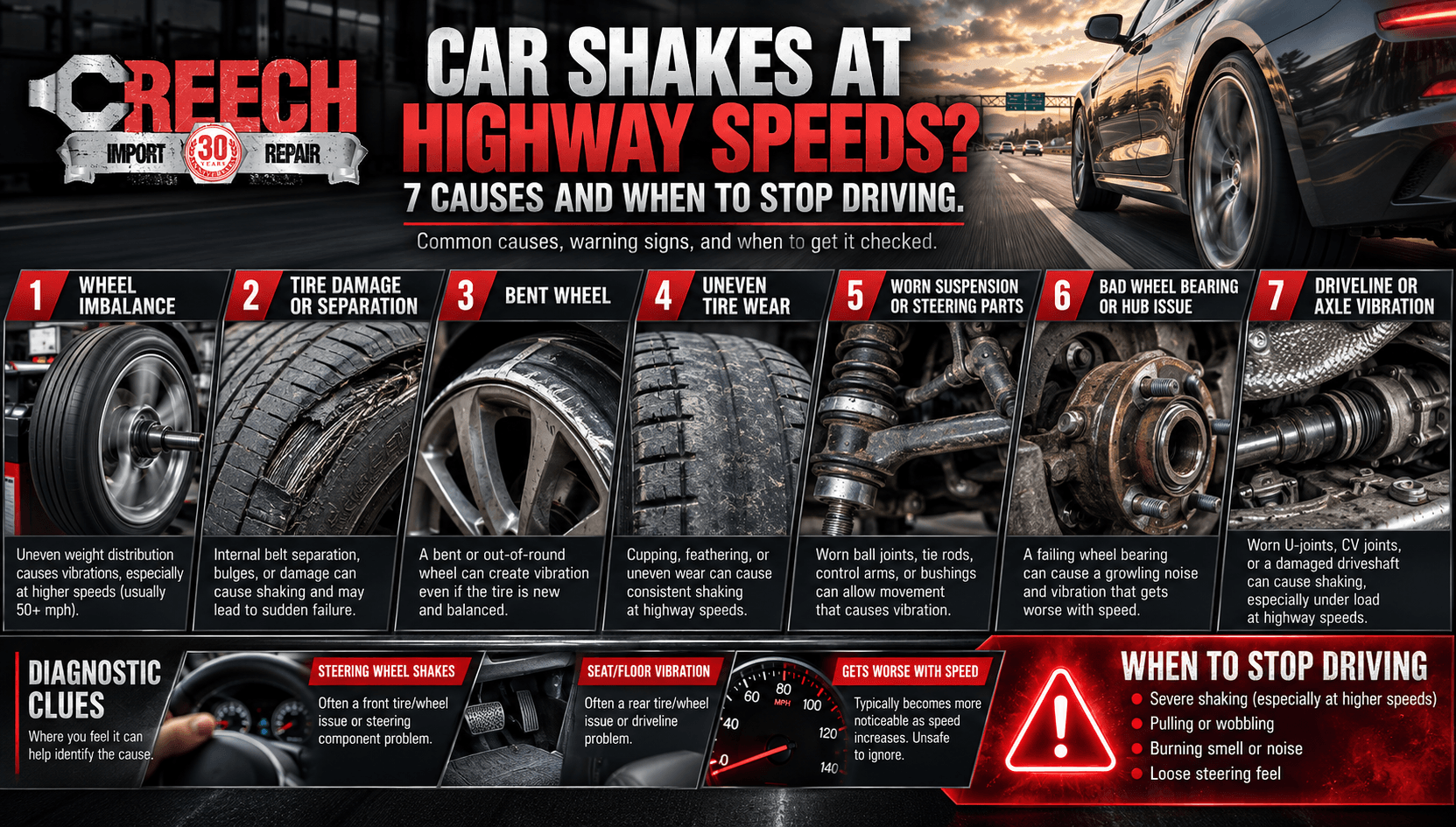
What Does the Type of Highway Vibration Tell You?
The most useful clues come from the circumstances under which shaking occurs. A service advisor may ask where you feel it, when it starts, whether acceleration changes it, and whether the problem began after tire service or a road impact.
Do not deliberately reproduce severe vibration at high speed for diagnosis. Report what you observed during ordinary driving and allow a technician to determine whether a controlled road test is appropriate.
| Vibration Pattern | Possible Systems | Important Diagnostic Distinction |
|---|---|---|
| Steering wheel shakes at a certain speed | Front tires/wheels, steering components, hubs or related chassis systems | The felt location suggests where to investigate, but does not prove the source. |
| Seat or floor vibrates during cruising | Rear wheel assemblies, drivetrain, mounts or other transmitted vibration | The source may be elsewhere in the vehicle because vibration travels through the body. |
| Shaking increases mainly during acceleration | Driveline, engine under load, transmission-related or rotating wheel concerns | Determine whether vibration follows throttle/load or road speed. |
| Shaking begins after new tires | Balance, tire uniformity, wheel seating, damage or installation concerns | Recent work is an important clue, not proof of an installation error. |
| Shaking begins after striking a pothole | Tire damage, bent wheel, steering or suspension damage | Inspect for structural defects before balancing or highway testing. |
| Vibration primarily while braking | Brake system and related wheel-end or suspension concerns | Brake-specific vibration requires a different diagnostic path. |
| Humming accompanies the shaking | Tire wear, hub or bearing, wheel-and-tire or drivetrain concerns | Noise plus vibration does not establish a specific failed bearing. |
| Sudden violent wobble or loose steering | Potential tire, wheel-mounting, steering or suspension safety defect | Stop driving safely and arrange assistance. |
Why Does My Steering Wheel Shake at 70 MPH?
A steering wheel that vibrates around a particular highway speed can result from a front wheel-and-tire assembly, tire uniformity, hub condition, or steering-related concern.
One common possibility is imbalance, but the observation is not enough to authorize balancing or replacing parts without inspection.
If the vibration began suddenly or the steering feels loose, tire and wheel safety should be assessed before the vehicle is driven at highway speed again.
Why Does My Car Shake at 60 MPH but Not at 50 MPH?
Some rotating disturbances become more noticeable within certain vehicle-speed ranges due to suspension and body response. This is one reason a driver may report a shake around 60 mph but little vibration at 40 or 50 mph.
The pattern can be consistent with a wheel-and-tire concern, although it is not exclusive to imbalance. Tire uniformity, wheel runout, and other rotating components may also contribute.
There is no exact speed that identifies one failed component across all vehicles.
Why Does the Car Shake Less When I Slow Down?
Reducing speed changes the rotational frequency and forces acting on the vehicle. That can reduce some vibrations even though the underlying fault remains.
A symptom that becomes less noticeable at a lower speed is not necessarily harmless. A damaged tire or loose component may still pose a safety risk.
Do not use an apparent improvement at lower speed as the sole basis for deciding to continue a trip.
Can a Car Shake Only on One Type of Road?
Yes. Road texture and surface irregularities can change how tire and suspension disturbances are transmitted to the cabin. Some tire wear patterns create different noise or vibration on coarse pavement than on smooth asphalt.
However, a problem that appears more noticeable on a particular road does not prove that the road is the only cause. Tire damage, suspension wear, or other defects may still require attention.
A technician can consider road-surface history as one part of a controlled diagnostic process.
What If the Car Shakes Only Under Acceleration at Highway Speed?
If shaking changes significantly with accelerator input, technicians may investigate powertrain and driveline conditions in addition to wheel-and-tire concerns.
For example, an axle joint or driveline component may behave differently under load. Engine misfire or transmission shudder can produce a separate sensation that a driver describes as shaking.
The distinction depends on engine speed, gear, road speed, throttle conditions, and vehicle configuration. It should not be decided from one symptom alone.
Do You Need Tire Balancing, Road-Force Balancing, or Wheel Alignment?
These services are related to how a vehicle rides and handles, but they address different conditions. Choosing the wrong service can leave the vibration unchanged and add unnecessary cost.
What Does Regular Wheel Balancing Fix?
Conventional dynamic wheel balancing measures mass imbalance in a rotating wheel-and-tire assembly. The equipment identifies the location and amount of corrective weight required.
It can be appropriate when an otherwise serviceable assembly has an imbalance causing vibration. Balancing is also part of standard procedures when tires are mounted or remounted.
However, corrective weights cannot fix a tire with internal separation, serious rim damage, excessive wheel-bearing movement, or worn steering components.
What Is Road-Force Tire Balancing?
Road-force balancing uses specialized equipment that evaluates tire and wheel behavior under a simulated load in addition to conventional balance-related measurements.
It can help identify certain variations in the assembly that may contribute to a ride complaint even when ordinary dynamic balance appears acceptable.
Depending on the findings, a technician may evaluate tire-to-wheel positioning, assembly uniformity, wheel runout, or whether a defective component requires replacement.
Creech Import Repair has a dedicated Road Force Tire Balancing page describing the service and its application to highway vibrations. That service page is the appropriate destination for readers specifically seeking road-force balancing in Raleigh.
What Does Wheel Alignment Correct?
Wheel alignment involves measuring and, where possible, adjusting the angles of the wheels and suspension relative to the vehicle and road.
Incorrect alignment can contribute to uneven tire wear, pulling, and certain handling concerns. But alignment is not a substitute for wheel balancing or repair of a defective tire.
If alignment problems have already created significant irregular tire wear, adjusting the alignment cannot restore worn tread. The existing tire condition must also be evaluated.
Creech's wheel alignment service explains that process. This highway-vibration article should remain a diagnostic guide rather than duplicate the service page.
| Service | What It Evaluates | What It Does Not Automatically Fix |
|---|---|---|
| Conventional wheel balancing | Uneven mass distribution in a wheel-and-tire assembly | Internal tire separation, bent or cracked wheels, worn bearings or loose steering parts |
| Road-force balancing or measurement | Assembly behavior under simulated load, including certain tire/wheel uniformity issues | All suspension or drivetrain faults, unsafe structural tire damage |
| Wheel alignment | Wheel and suspension geometry relative to manufacturer specifications | Mass imbalance, irreversibly worn tread, internal tire damage |
| Steering and suspension inspection | Component condition, excessive movement and related handling concerns | Every possible vibration without further diagnosis |
Why Does My Car Still Shake After Balancing?
A vibration that continues after balancing may indicate that the original cause was not simple mass imbalance, that the balancing procedure or wheel installation needs further evaluation, or that another vehicle component is contributing.
Possibilities include tire uniformity, wheel runout, internal tire damage, uneven tread wear, hubs, or driveline components. The specific findings determine the next step.
Repeatedly adding wheel weights without investigating other causes can waste money and delay a necessary safety repair.
Should You Get an Alignment First?
Not automatically. The first step should be an assessment of tire safety, wheel condition, steering and suspension integrity, and the exact symptom.
If the vehicle pulls or shows tire wear consistent with geometry problems, alignment evaluation may be appropriate. If the complaint is a speed-specific vibration with otherwise normal handling, wheel-and-tire testing may be considered first.
A qualified shop should explain the order of testing rather than using a universal rule.
When Should You Stop Driving a Car That Shakes at Highway Speeds?
Stop as safely as possible and seek assistance if the vibration is severe, rapidly worsening, or accompanied by any of the following:
- A tire bulge, visible tread separation, or suspected structural damage.
- Violent steering-wheel shaking or wheel wobble.
- Loose, vague, or unpredictable steering response.
- Noticeable pulling or difficulty maintaining control.
- Grinding, severe banging, or other unusual mechanical noises.
- Shaking that begins after a significant pothole or curb impact.
- Suspected loose wheel fasteners or improper wheel attachment.
- Sudden air loss, a flat tire, or a tire-pressure warning with abnormal handling.
Ease off the accelerator, maintain steering control, avoid sudden maneuvers when possible, and move to a safe location. If a tire fails, do not abruptly brake or jerk the steering wheel; slow progressively and stop once you can do so safely.
Do not attempt to return to highway speed to test whether the shake disappears. Arrange towing or professional roadside assistance when the vehicle's condition is uncertain or unsafe.
Is It Safe to Drive When Your Car Vibrates at Highway Speed?
Safety depends on the severity and cause. A mild, stable vibration can result from a wheel-balance issue, but the same general description can also conceal tire damage or looseness in a critical component.
Without an inspection, it is difficult to determine which situation applies. A new or growing vibration deserves prompt attention, and significant shaking or abnormal handling should stop highway driving.
Do not judge safety solely by whether the vehicle still reaches the speed limit. Tire and wheel-end failures can develop while the car remains capable of moving.
Can Unbalanced Tires Be Dangerous?
Wheel imbalance may increase vibration and contribute to driver fatigue or wear of tires and suspension components. It should be corrected when confirmed.
However, the larger immediate concern is mistaking a damaged tire for an ordinary imbalance. A tire with structural damage cannot be made safe merely by balancing it.
Inspection is important whenever a vibration is new, severe, or associated with visible tire defects.
Can Highway Vibration Cause Additional Damage?
Persistent vibration can place repeated loads on affected components and may contribute to undesirable wear or reduced driving comfort. More importantly, some underlying conditions can worsen with continued operation.
For example, a tire with structural damage, a damaged wheel, or a loose steering component may pose a hazard unrelated to the discomfort of the vibration itself.
The right response is to determine the source rather than continue driving and assume the issue will remain unchanged.
Should You Drive Home If the Shaking Is Mild?
There is no universal safe distance. Consider whether the vehicle's handling is normal, whether the vibration is new or growing, whether any tire damage is visible, and what the owner's manual says about warning conditions.
If the cause is uncertain, particularly after a pothole impact or wheel-related service, contact a professional for guidance. If there is significant instability, visible damage, or suspected looseness, do not drive the vehicle home on the highway.
What Should You Do When Your Car Starts Shaking on the Highway?
Keep Control and Avoid Sudden Steering Inputs
Maintain a steady grip on the steering wheel, avoid abrupt movements, and assess whether the vehicle is still controllable. If the vibration is severe or there are signs of a tire failure, slow down gradually rather than making sudden maneuvers.
Move Out of Traffic When Safe
Signal and find an appropriate place to stop. If traffic or shoulder conditions make stopping immediately unsafe, prioritize controlled movement to a safer location. Do not stop in an active travel lane simply to inspect a tire.
Note the Circumstances Without Repeating the Problem
Remember the approximate speed, whether the vibration was through the steering wheel or seat, whether you were accelerating or cruising, and whether the issue began after recent service. You do not need to drive again to confirm it.
Check for Obvious Damage Only When Safely Parked
From a safe location, look for visibly flat tires, major bulges, detached tread, or obvious wheel damage. Do not crawl beneath an unsupported vehicle, touch hot components, or attempt roadside wheel repairs in unsafe conditions.
Arrange Inspection or Towing
Contact a qualified repair facility. Severe shaking, suspected tire damage, wheel looseness, or steering problems justify towing rather than attempting another highway trip.
Can You Check Tire Pressure Yourself?
Checking pressure with an appropriate gauge while the vehicle is safely parked can be useful, provided the tire is not visibly damaged or unsafe to approach.
Use the vehicle manufacturer's recommended pressure information, generally found on the vehicle placard or in the owner's manual. The maximum pressure printed on a tire's sidewall is not automatically the recommended inflation pressure for that vehicle.
Pressure should be assessed under the applicable conditions specified by the vehicle or tire manufacturer.
Correct pressure matters for safety, but inflation alone does not repair internal tire damage, a bent wheel, or another confirmed defect.
Should You Rotate Tires to See If the Vibration Moves?
Tire position changes can sometimes help qualified technicians isolate a tire or wheel issue, but rotation is not a safe substitute for first checking for structural damage and proper fitment.
Some vehicles have different front and rear tire sizes or directional tire requirements that restrict rotation patterns. Certain tire defects require replacement rather than repositioning.
Leave diagnostic tire movement and installation to a professional when the cause of vibration is uncertain.
How Does a Mechanic Diagnose Highway-Speed Vibration?
A good diagnostic process starts with the driving complaint, confirms whether the vehicle is safe to operate, and tests the components most consistent with the observed pattern.
Record the Driver's Description
The technician asks when the vibration started, the speed range, where it is felt, whether engine load changes it, and whether recent wheel service, pothole impacts, or tire replacement occurred.
Inspect Tire and Wheel Safety
Visible structural damage, tire bulges, abnormal tread wear, inflation problems, cracked rims, wheel-mounting concerns, and other obvious hazards should be assessed before considering a high-speed road test.
Evaluate Steering, Suspension, and Hubs
Appropriate component-specific inspection can assess excessive movement, worn joints, bearing condition, mounting hardware, and other factors that may affect wheel stability.
Measure Wheel and Tire Behavior
If the initial inspection indicates a safe wheel-and-tire assembly and the symptom supports it, testing may include dynamic balance, tire uniformity, wheel runout, or road-force measurements.
Assess Drivetrain or Powertrain Conditions When Relevant
When shaking changes with throttle input, gear, or engine operation, the technician may expand the investigation to axles, joints, shafts, mounts, or engine/transmission operating data.
Verify the Repair Safely
After the confirmed defect is addressed, the technician performs appropriate checks and, only when safe and justified, verifies that the original complaint is resolved. Repair verification should not require unsafe public-road maneuvers.
Can a Mechanic Diagnose Highway Vibration Without Driving 70 MPH?
Often, significant information can be gathered through a stationary inspection, wheel-and-tire measurement, mounting checks, or component testing.
A controlled road test may be useful in some situations, but it should only be performed when the vehicle is safe. Visible tire damage, suspected loose wheels, or major steering instability must be addressed before road testing.
Diagnostic equipment and shop procedures should be selected according to the suspected fault and manufacturer service information.
What If the Tires Have Already Been Balanced Twice?
Repeated balancing does not rule out every wheel-and-tire problem, but it is a reason to review the diagnosis rather than simply repeat the same procedure.
A technician may need to confirm that the assembly was mounted correctly on the balancing machine, inspect for wheel runout, evaluate tire uniformity, check wheel-to-hub fitment, or investigate another rotating component.
A defective tire or mechanical wheel-end problem will not necessarily disappear after balancing.
What If the Vibration Started Immediately After Tire Installation?
Tell the service provider when the symptom began and what work was performed. Possible causes include balance, tire uniformity, mounting or seating conditions, or damage that coincidentally became evident.
The recent service history is relevant, but it does not prove the installer caused the problem. The safest approach is to inspect the assembly and confirm its condition before highway use.
Can a Wheel Bearing Be Bad Without Making Noise?
Yes. Bearing faults do not always produce a clear, recognizable sound in every situation, and different faults can manifest differently.
Conversely, a vehicle may make a humming sound that comes from tire wear rather than a bearing. Inspection and the manufacturer's recommended procedures are needed to distinguish the possibilities.
How Much Does It Cost to Fix a Car That Shakes at Highway Speeds?
The price depends on what is actually causing the vibration. Wheel balancing, replacement of a damaged tire, repair of steering components, replacement of a wheel bearing, and drivetrain work are different jobs with different labor and parts requirements.
Vehicle make, model, wheel size, tire specification, suspension design, parts availability, and the extent of damage also affect costs.
There is no responsible universal price estimate that applies to every highway-vibration complaint. The right first expense may be diagnosis rather than an assumed replacement part.
| Confirmed Finding | Potential Service | Important Limitation |
|---|---|---|
| Mass imbalance | Wheel and tire balancing | Does not repair internal tire damage or worn mechanical parts. |
| Excessive tire force variation | Road-force evaluation and appropriate corrective action | Some tires or wheels may require replacement. |
| Tire structural defect | Replace affected tire according to safety guidance | Do not rely on balancing or cosmetic repair to restore structural integrity. |
| Bent or cracked wheel | Evaluate wheel condition and appropriate replacement or permitted repair | Not all wheel damage is safe or suitable for repair. |
| Worn steering or suspension part | Repair verified defective components and check geometry when relevant | Alignment alone cannot repair excessive component looseness. |
| Hub or bearing defect | Repair or replace verified defective wheel-end component | Part and procedure vary by vehicle. |
| Driveline fault | Repair verified joint, axle, shaft, or associated component | Requires drivetrain-specific diagnosis. |
Is Balancing Cheaper Than Replacing Suspension Parts?
Often, a balancing service is less involved than replacing major steering or suspension components, but the least expensive service is only useful if it addresses the actual fault.
Performing unnecessary balancing before finding a broken joint or damaged tire can delay the correct repair and potentially create additional risk.
A qualified shop should explain why its recommended service matches the diagnostic findings.
Can a Bent Wheel Be Repaired?
Some wheel damage may be assessed for professional repair, but suitability depends on wheel material, design, damage location, extent, and applicable manufacturer restrictions.
A cracked or severely deformed wheel can present a serious safety issue. Replacement may be the appropriate solution.
Never assume a wheel is safe simply because it can be made to spin with less visible wobble on a machine.
Will New Tires Fix Highway Vibration?
New tires may help when existing tires are confirmed defective, excessively worn, or otherwise unsuitable for continued use. But they are not a universal fix for bent wheels, hub faults, suspension looseness, or drivetrain vibration.
If new tires are recommended, confirm the correct size, load rating, fitment, and manufacturer specifications. The shop should also consider whether the condition that damaged the old tires needs correction.
Does Highway-Speed Vibration Differ Between Sedans, SUVs, and AWD Vehicles?
The general causes of road-speed vibration are similar across vehicle types, but drivetrain layout, suspension design, tire specifications, and manufacturer procedures can change the diagnostic process.
Honda, Acura, Toyota, and Lexus
On applicable sedans and crossovers, tire condition, wheel balance, wheel runout, hub condition, and steering or suspension systems may all deserve consideration when a vibration follows road speed.
Different generations use different suspension and drivetrain arrangements. A symptom on a Toyota Camry does not automatically have the same cause as a Lexus RX or Honda CR-V.
Vehicle-specific specifications and inspection findings determine the repair.
Subaru and Other All-Wheel-Drive Vehicles
All-wheel-drive designs introduce drivetrain components and, on some vehicles, tire-matching requirements that make correct tire size and condition especially important.
A tire replacement decision should account for the manufacturer's requirements for circumference, tread depth matching, and tire specifications, where applicable.
However, AWD does not mean every highway vibration originates in the drivetrain. Tires, wheels, steering, and suspension still need appropriate evaluation.
Nissan, Infiniti, Hyundai, and Kia
These vehicles include a range of drivetrain designs, wheel sizes, steering systems, and suspension layouts. The same complaint of shaking at 65 mph can have different mechanical causes.
Do not assume a transmission defect merely because the vibration is noticeable during highway driving. Determine whether the symptom follows vehicle speed, engine load, or gear changes.
Trucks and Larger SUVs
Larger vehicles may use different wheel sizes, driveline configurations, suspension systems, and tire load requirements. Driveshaft-related conditions may be particularly relevant on some configurations.
Any diagnostic approach should account for the actual drivetrain and vehicle design rather than applying a passenger-sedan assumption to every truck or SUV.
Creech specializes in Asian imports and offers limited domestic vehicle services. Contact the team to confirm the appropriate service for your exact vehicle.
How Can You Help Prevent Highway-Speed Vibration?
Not every failure can be prevented, but regular tire care and attention to new symptoms can reduce certain risks and identify problems before they become severe.
Maintain Manufacturer-Recommended Tire Inflation
Check tire pressure according to your vehicle's guidance and inspect it regularly. Incorrect inflation can affect tire wear, handling, and durability.
A tire-pressure monitoring system is useful, but it does not replace routine tire inspection or guarantee that a tire has no structural damage.
Inspect Tires for Wear and Damage
Look for unusual wear, bulges, major cuts, exposed reinforcement, or visible deformation. Do not continue using a tire with apparent structural defects merely because it still holds air.
For internal damage concerns, professional inspection may be necessary even when the outside surface looks normal.
Follow Appropriate Tire Rotation and Balancing Procedures
Regular rotation and balancing, when recommended for the vehicle and tire configuration, can help maintain consistent performance and identify developing problems.
Use the applicable rotation pattern and manufacturer guidance, particularly with directional, staggered, or AWD tire setups.
Address Pothole and Curb Impacts Promptly
A strong impact can damage a tire, bend a wheel, or affect steering and suspension components. New vibration after an impact deserves inspection rather than waiting for it to worsen.
Do Not Ignore Uneven Tire Wear
Cupping, feathering, or one-sided wear may indicate conditions worth investigating. A shop can assess whether alignment, inflation, suspension, tire condition, or other factors contributed.
Correcting the cause of wear is important, but a severely worn tire may still require replacement.
Report New Vibration After Service
If shaking begins after tire installation, wheel removal, suspension repair, or another service, tell the shop what work was performed and when the symptom began.
Clear information can help a technician target the inspection without implying that any particular person or procedure caused the issue.
Car Shaking at Highway Speeds in Raleigh, NC? Get It Diagnosed.
If your steering wheel trembles on I-440, your seat vibrates at cruising speed, or your car begins shaking after new tires or a pothole impact, professional inspection can help determine whether the issue involves wheel balance, tire condition, steering and suspension components, or another system.
Creech Import Repair provides automotive repair and diagnostic services in Raleigh, North Carolina. The shop's services include road-force tire balancing, wheel alignment, tire-related work, and general automotive repairs for supported vehicles.
Creech specializes in Asian import vehicles and also provides limited domestic vehicle services. Explain your vehicle's year, make, model, speed range, where the vibration is felt, and whether any recent tire or wheel service occurred.
If the vehicle shakes severely, feels unstable, or may have tire or wheel damage, do not attempt to drive it to the shop at highway speed. Arrange appropriate roadside assistance or towing.
Creech Import Repair
1818 St. Albans Dr #106
Raleigh, NC 27609
Phone: 919-872-1999
Hours: Monday-Friday, 7:30 AM-5:30 PM
Online appointment requests are not considered confirmed until Creech Import Repair's service team verifies them. Ask the team which inspection or diagnostic service is suitable for your vehicle.
Frequently Asked Questions About Cars Shaking at Highway Speeds
1. Why does my car shake at highway speeds?
A car may shake at highway speeds because of wheel imbalance, tire structural damage, a bent wheel, uneven tread wear, worn steering or suspension components, a wheel bearing or hub problem, or drivetrain vibration. The speed at which shaking begins, where it is felt, and whether acceleration changes it can help guide diagnosis. None of these clues identifies the cause by itself. Severe shaking, tire damage, wobbling, or unpredictable steering requires stopping safely and obtaining professional assistance.
2. Why does my car shake at 60 or 70 mph but not at lower speeds?
Some wheel, tire, and other rotating-component disturbances become more noticeable within particular speed ranges because the vehicle responds differently as rotational frequency increases. Wheel imbalance is one possibility, but tire uniformity, wheel runout, suspension, hub, and drivetrain conditions can create similar symptoms. There is no universal speed that proves a tire needs balancing. A technician should inspect the vehicle and use appropriate measurements instead of diagnosing the problem from the speed alone.
3. Is it dangerous to drive when my steering wheel shakes on the highway?
It can be dangerous, depending on the cause. Mild steering-wheel vibration may result from wheel imbalance, but tire damage, loose wheel hardware, worn steering components, or other faults can also create shaking. If the vibration is severe, suddenly worsening, accompanied by wobbling or pulling, or the steering feels loose, stop safely and seek professional assistance. Do not intentionally increase speed to reproduce the problem. Inspection is needed before the vehicle can be considered safe for normal highway use.
4. Can unbalanced tires make my car shake at high speeds?
Yes. Uneven mass distribution in a wheel-and-tire assembly can produce repeated forces as it rotates, sometimes becoming noticeable through the steering wheel, seat, or vehicle body at highway speeds. Conventional dynamic balancing may correct a confirmed mass imbalance. However, balancing does not repair structural tire damage, a bent wheel, excessive wheel-end movement, or every tire uniformity problem. A professional should inspect tire and wheel condition before assuming balancing is the appropriate solution.
5. Why does my car still shake after the tires were balanced?
Vibration can remain after balancing when the original problem is not ordinary mass imbalance or when another concern affects the assembly. Possible explanations include tire force variation, internal tire damage, excessive wheel runout, uneven tread wear, mounting issues, suspension wear, or drivetrain problems. The shop may need to verify the balancing procedure and perform additional inspection or road-force measurements when appropriate. Repeating the same balancing service without investigating other causes may not resolve the complaint.
6. Does my car need an alignment if it shakes at highway speeds?
Not necessarily. Wheel alignment adjusts suspension and wheel angles; wheel balancing addresses uneven mass distribution in rotating wheel-and-tire assemblies. Alignment problems can contribute to uneven tire wear and handling concerns, but alignment does not directly correct a tire imbalance or damaged wheel. If shaking occurs alongside pulling or irregular wear, alignment evaluation may be appropriate after tire and suspension safety checks. A qualified technician should identify the actual cause before recommending either service.
7. Why does my steering wheel shake but the rest of the car feels normal?
Steering-wheel vibration may direct attention toward front wheel-and-tire assemblies, hubs, steering components, or other related systems, but its location is not a definitive diagnosis. Vibrations travel through the vehicle's structure, so a different component may still be responsible. The technician should consider the speed range, recent tire work, wheel condition, and any steering or suspension looseness. Severe steering-wheel shaking or unpredictable handling requires stopping safely rather than continuing highway driving.
8. Can a bad wheel bearing cause highway-speed vibration?
Yes. A defective wheel bearing or hub can sometimes contribute to vibration, noise, looseness, or changes in handling. Some bearing problems create humming or growling that increases with road speed, but similar sounds can also result from tires. A bearing fault may not produce obvious looseness during a simple check. Diagnosis requires appropriate inspection and manufacturer-specific procedures. A wheel bearing should not be replaced solely because a vehicle vibrates or hums on the highway.
9. How does a mechanic diagnose vibration at highway speeds?
A mechanic begins by documenting the speed range, vibration location, recent service, road impacts, and whether acceleration or braking changes the symptom. The technician checks tires, wheels, mounting hardware, steering, suspension, and hubs for damage or unsafe conditions. Depending on findings, testing may include dynamic balancing, road-force measurements, wheel runout evaluation, or drivetrain inspection. A road test is performed only when the vehicle is safe. The repair should address the confirmed fault rather than an assumed cause.
10. Where can I get highway-speed vibration diagnosed in Raleigh, NC?
Creech Import Repair provides automotive diagnostic and repair services at 1818 St. Albans Dr #106 in Raleigh, North Carolina. Its services include road-force tire balancing, wheel alignment, and related automotive inspections for supported vehicles. Call 919-872-1999 to describe your vehicle's year, make, model, vibration speed range, and any recent tire or wheel service. If the car has severe shaking, suspected tire damage, or unsafe handling, arrange towing or appropriate roadside assistance rather than driving at highway speed.

Automotive Technical Review
Reviewed by Creech Import Staff
Creech Import Staff represents the automotive service team at Creech Import Repair, a Raleigh automotive repair business operating since 1993.
The shop provides automotive diagnostics, tire and wheel-related services, road-force balancing, alignment, and general repair for supported import and domestic vehicles.
Learn more about Creech Import Repair's technicians, business history, service philosophy, and customer-care approach.
Meet Creech Import Repair →Technical Sources and Evidence Limits
This guide explains possible causes of highway-speed vibration, not a guaranteed diagnostic sequence for every car. The seven categories are not a ranking by measured frequency. Tire safety, manufacturer instructions, actual inspection findings, and vehicle-specific service procedures take priority over general symptom descriptions.
- National Highway Traffic Safety Administration. Tire Safety and Maintenance. Official information on tire inflation, condition, damage, and preventive inspection.
- Michelin. Handling Problems: Symptom Vibration. Tire balance, suspension, and professional inspection guidance.
- Michelin. Tire Wear Problems. Explanations of irregular tread wear and possible contributing conditions.
- Michelin. Routine Tire Care. Tire balancing, inspections, and maintenance recommendations.
- Creech Import Repair. Road Force Tire Balancing in Raleigh, NC. The shop's specialized tire and wheel evaluation service.
- Creech Import Repair. Wheel Alignment Service. Differences between alignment, tire wear, and handling concerns.
- Creech Import Repair. Humming Noise Gets Louder With Speed. A separate diagnostic guide for speed-related noise rather than vibration alone.
- Creech Import Repair. Car Shakes at Idle. Separate diagnostic intent focused on vibration while stationary.
- Creech Import Repair. Contact Creech Import Repair. Confirmed Raleigh location, phone number, and business hours.
Find Creech Import Service articles useful?
Add this site to your Preferred Sources in Google Search.